eBook - ePub
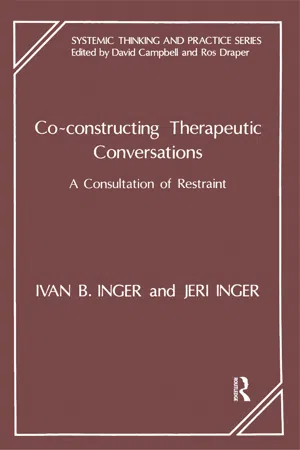
Co-Constructing Therapeutic Conversations
A Consultation of Restraint
- 112 pages
- English
- ePUB (mobile friendly)
- Available on iOS & Android
eBook - ePub
Co-Constructing Therapeutic Conversations
A Consultation of Restraint
About this book
This book illustrates the unique systemic approach of the Ingers who are well-known teachers and co-founders of the Family Studies Institute in Portland, Oregon. Their work combines elements of the reflective team approach with a model of co-therapy. It is a fresh and innovative application of systemic thinking to the field of family therapy. The book consists of a full-length description of one family consultation with detailed commentary on the process of the interview provided by the Ingers. The theoretical basis of their model is a carefully explained and the interview itself is discussed by a range of American and British therapists taking part in a family therapy exchange.
Information
Transcript of a consultation with a therapist and a family
During the morning session of the Exchange Seminar, Silvia Nobori, the family's therapist, presented her impressions of the family and her work with them to the Exchange participants. Shortly after her presentation, participants simulated the family, and we conducted the interview with them. The actual family was interviewed the same afternoon. Below is the information that Silvia shared with the simulators.
The Therapist's Presentation of the Family
Jeri: Silvia, tell us about the family.
Silvia: This is a family of four; Mother and Father are in their mid-thirties, Barbara is 13 years old, and Steven is seven years old. Mother called requesting family therapy. Mother is mostly concerned about Barbara's stealing. Barbara was picked up for shoplifting two days after her religious confirmation while her paternal grandparents were visiting from New York. That was the precipitating problem that pushed Mother into calling for family therapy. Barbara believes she and her brother should get the same number of gifts for their birthdays. However, she feels she should be special and get more time alone with her paternal grandparents. This poses a dilemma for the family because Mother says she shouldn't get more. At the same time, Barbara is stealing her possessions and invading other people's territories.
Mother works and Father is unemployed and a student. Father usually tries to remove himself from the family's dilemmas. He is gone a lot. When he is home, he is often outside playing ball with Steven. He does not seem surprised that his daughter misses him. He admitted he used to play with her a lot. Barbara's perception of the problem was that she lost her Father to Steven. Father validated this and said he doesn't know what to do with her now. They don't have anything in common.
I have seen the family three times, so I am just beginning to know them. Mother seems to feel she has lost her daughter to her husband's parents who are quite wealthy. In the last session, Barbara blurted out that she was having problems so her Mother and Father would not get divorced. She wrote her grandmother and asked if she could live with her if her parents divorced. Grandmother wrote back and said yes. Mother was quite upset and said she felt she lost Barbara as a result of this. She is afraid her mother-in-law may be able to "buy" the children. Mother recently had a hysterectomy and had to stay in bed a while. Barbara may have crossed Mother's boundary, by seeing herself as the Mother of the house.
Mother believes in therapy, so it wasn't unusual for her to agree to come today. Father is coming mostly to please his wife. Barbara doesn't want to come today, and Steven will be more of an observer. I've watched him play quietly and observe whatever they are doing and saying. Every once in a while he will comment. I framed their coming today as being helpful to our Exchange participants. I did not promise the family that they would get anything out of it, although I did say they might find it interesting. I told them that we would want feedback from them about what the experience was for them.
Ivan: Is there anything more you want to share with us?
Silvia: Mother has known her husband since she was 15 years old. She comes from a single-parent, working-class family and Father comes from a two-parent, wealthy family. He has two brothers and is the middle child. Mother's father died when she was seven years old, and she was raised alone by her mother. She is the youngest of four children and has three older brothers. She met her husband through her older brother who went to college with him and brought him home for a visit.
Interviewing the Family
The family, Mother, Father, Barbara and Steven, along with the therapist, Silvia, enter the room and sit on chairs facing the consultants, with their backs to the audience. We sit next to each other facing the family. Previous to entering the room, we had gone out to meet the family and briefly talked about the upcoming interview. The family have their backs to the audience. Steven does not sit in a chair, but immediately sits on the floor under a table out right. He proceeds to play with two little dolls that one of the participants had brought with her. Mother and Father sit next to each other, Mother on the left of Father, and Barbara on Father's right. To the left of Barbara is the therapist, Silvia.
Father is dressed neatly in a dark gray suit, and Mother is wearing a light gray dress. Barbara is dressed in a white cotton cardigan sweater, white T-shirt, white Bermuda shorts, and black shoes. Steven has on a T-s...
Table of contents
- Cover
- Title
- Copyright
- Contents
- Editors' foreword
- Acknowledgements
- Introduction: theoretical considerations
- Transcript of a consultation with a therapist and a family
- Intersession discussion with the team
- Message to the family
- Debriefing/reflecting
- The update
- Further theoretical considerations
- Conclusion
- Bibliography
Trusted by 375,005 students
Access to over 1.5 million titles for a fair monthly price.
Study more efficiently using our study tools.
Frequently asked questions
Yes, you can cancel anytime from the Subscription tab in your account settings on the Perlego website. Your subscription will stay active until the end of your current billing period. Learn how to cancel your subscription
No, books cannot be downloaded as external files, such as PDFs, for use outside of Perlego. However, you can download books within the Perlego app for offline reading on mobile or tablet. Learn how to download books offline
Perlego offers two plans: Essential and Complete
- Essential is ideal for learners and professionals who enjoy exploring a wide range of subjects. Access the Essential Library with 800,000+ trusted titles and best-sellers across business, personal growth, and the humanities. Includes unlimited reading time and Standard Read Aloud voice.
- Complete: Perfect for advanced learners and researchers needing full, unrestricted access. Unlock 1.5M+ books across hundreds of subjects, including academic and specialized titles. The Complete Plan also includes advanced features like Premium Read Aloud and Research Assistant.
We are an online textbook subscription service, where you can get access to an entire online library for less than the price of a single book per month. With over 1.5 million books across 990+ topics, we’ve got you covered! Learn about our mission
Look out for the read-aloud symbol on your next book to see if you can listen to it. The read-aloud tool reads text aloud for you, highlighting the text as it is being read. You can pause it, speed it up and slow it down. Learn more about Read Aloud
Yes! You can use the Perlego app on both iOS and Android devices to read anytime, anywhere — even offline. Perfect for commutes or when you’re on the go.
Please note we cannot support devices running on iOS 13 and Android 7 or earlier. Learn more about using the app
Please note we cannot support devices running on iOS 13 and Android 7 or earlier. Learn more about using the app
Yes, you can access Co-Constructing Therapeutic Conversations by Ivan B. Inger,Jeri Inger, David Campbell,Rosalind Draper, David Campbell, Rosalind Draper in PDF and/or ePUB format, as well as other popular books in Psychology & History & Theory in Psychology. We have over 1.5 million books available in our catalogue for you to explore.