
eBook - ePub
Where Authentic Leaders DARE
From Professional Competence to Inspiring Leadership
- 116 pages
- English
- ePUB (mobile friendly)
- Available on iOS & Android
eBook - ePub
About this book
This book demonstrates, complete with practical exercises, how to be successful in both your work and your personal life by becoming a truly authentic leader and empathic influencer. Above all, it shows you how to do this with the positive intention of successful, connected communication and through honouring the other person's perspective. The book is of particular value to managers and leaders who are very proficient in their areas of expertise and are looking for ways to improve team and personal performance further by developing their leadership and authentic influencing skills.
The book provides you with:
- Clear reasons why authentic leadership and empathic influencing will help in work and personal relationships.
- How to develop these influencing skills and remain authentic.
- The evidence, including the relevant neuroscience, as to why this is important.
- A 'how to' guide. If you are looking for some practical exercises to help develop authentic leadership, then you can go straight here.
Trusted by 375,005 students
Access to over 1 million titles for a fair monthly price.
Study more efficiently using our study tools.
Information
Part I
Why empathic influencing is important if you want to succeed as an authentic leader
1 Empathic influencing if used properly can be a powerful tool
Meet James. He is head of IT in a large organisation. James is exhausted and frustrated. He is working a 70-hour week and has been told he wouldn’t be considered for promotion even if he put in 100 hours a week. His boss has informed him that technically he is brilliant – it’s just that his peers don’t warm to him or want to engage him with their IT issues. His team is effective and yet, when there is a crisis, they don’t pull together or have the passion to resolve it.
James does not know what to do. He has no more to give. To further add to his frustration, his wife and children don’t seem to understand. And when he thinks about it, he doesn’t really know what they are all doing anyway. He is so tired that he just doesn’t have the energy to enjoy life and spend time with those he loves. He can’t even find the time and enthusiasm to go to school events or family gatherings. Is this what life is all about?
This is an all-too familiar scenario. Yet it can easily be changed by empathic influencing skills, which can put even people like James on a journey to authentic leadership. Empathic influencing is the most powerful way of getting on in organisations and in the world. Some might say it is the holy grail!
Imagine being able to read others’ minds. The film What Women Want illustrates the power of telepathy in a comedy format. In the movie, Mel Gibson is able to read women’s minds by hearing exactly what they are thinking (Goldsmith, 2001). Scary, I know, but just picture a world like that. If we knew what everyone was thinking, we would know exactly how to respond. What would that mean for us in our workplace, home and beyond? There would be no misinterpretation of information based on what we hope or (more likely) fear someone is thinking. No escalating anxiety with unhelpful hares running amok in your head. If this was a film, it would be a fantasy, yet it is a near possibility if we develop empathic influencing skills.
Four steps to becoming an empathic influencer
From working with hundreds of leaders, I have discovered that there are four levels to developing empathic influencing skills. All you have to do is DARE (Figure 1.1).
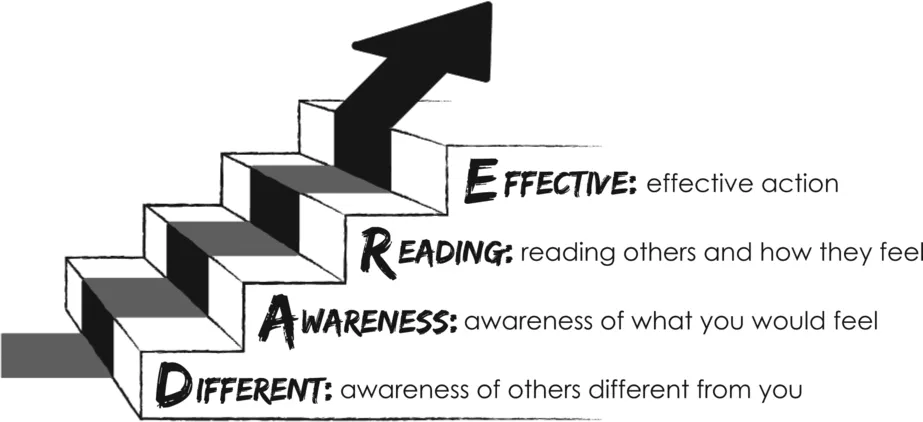
Figure 1.1 Four steps to empathic influencing.
- Difference: realising that not everybody thinks/feels the same way as you do.
- Awareness: of your own emotions and understanding of how you would feel in a given situation.
- Reading others: recognising how the other person is not like you (e.g. they may be less confident) and really seeing the world through their eyes.
- Effective action: communicating and connecting with the other person from an understanding of where they are coming from.
The majority of people operate from position 1. They are aware that other people are different, but simply accept that’s the way it is and think no further about it.
People at stage 2 see the world mainly through their own eyes and experiences. What is positive is that they are working by the adage ‘do unto others as you would have them do unto you’. However, this assumes that most others are like you. Quite often people operating at level 2 cannot understand why someone has reacted so badly to something they have said or done. They say, ‘It wouldn’t have upset me,’ and are frequently surprised or even shocked by the reactions of others. We can also sometimes assume that others will be upset with some feedback, because we might be. In fact, they may be happy to receive it.
One of my clients, let’s call him Rob, told me a story of innocently saying to a colleague that everyone knew she was in a relationship with one of the directors. The colleague didn’t like to hear this and responded that she had worked very hard to achieve her current position. Rob wasn’t questioning how she got there, but unfortunately that’s what she heard and felt. The conversation escalated into a formal grievance and then mediation. Once again, when both read out their narrative of events and listened with the help of the mediator, the colleague misheard and even attributed comments to Rob that weren’t actually made. The process didn’t end well. My client couldn’t see anything wrong with his remark from his own perspective. He would have been fine if it had been said to him. However, by looking at the colleague from her perspective he might have realised that his remarks could have been inflammatory to her. And he might not have lost his job (Figure 1.2).

Figure 1.2 Not everybody feels the same as you do.
Another good example came from Jane, an entrepreneur. She had developed a network of people who had supported her with developing her business. There was one man in particular who had been very helpful. She was a great advocate of this man and very appreciative of his advice and particularly his challenges. She would regularly refer to him as her business guru. One day she happened to bump into him whilst she was with a customer.
On this occasion, by her own admission, Jane was feeling somewhat ‘giddy’. She has also confessed to having a very humorous, bantering relationship with the client in question. What followed was a huge error in judgement and she later described it as a ‘massive failure of emotional intelligence’.
She introduced her respected guru with the words: “This is John, he is a complete tyrant”. She then followed up with: “What he lacks in looks, he makes up for in brains”. Ouch!
As you can imagine, he was less than impressed and responded the next day with an email. In his email he expressed his extreme upset with her, he couldn’t believe that anyone could say such a thing and who did she think she was to say it. He felt that the comment was not only akin to sexual innuendo but even worse, a form of bullying. He went on to say that he had interpreted it that he was only worthy of conversation because he had the brainpower to help her so long as she didn’t have to look at him. He finished by saying that he had never been so unimpressed with anyone in his life for being so shallow and that from here on he would no longer talk to her, respond to her emails and offer her any further support.
As you can imagine, in Jane’s words, her momentary emotional intelligence failure resulted in irreversibly losing a relationship she truly valued.
People reach level 3 by really understanding how someone else sees the world. This is hard to achieve particularly in light of another old adage about ‘walking a mile in someone else’s moccasins’. Who really has time to do that? Furthermore, humans are inherently biased. We try not to be and yet research study after research study proves that we are. If we are really honest with ourselves, we know it. We hear some information and then make assumptions.
Doctor and writer, Danielle Ofri wrote in The New York Times in 2012 about a letter she had received from a professor whose first-year class had been assigned one of her essays, a story about a young woman in intensive care with a mysterious diagnosis. ‘More than half the students,’ the professor wrote, ‘assumed that you were a man – despite your name. When asked why, many said that your writerly voice was unmistakably masculine: logical, confident, secure, sometimes sarcastic…and, above all, that you are an M.D.’ (Ofri, 2012).
Yes, it can be difficult not to make erroneous assumptions about other people. But the good news is that it’s not impossible, as we will see throughout this book.
Ultimately, it’s all very well understanding how exactly someone differs from you; it’s what you do with that awareness that counts – which is how you get to position 4. For example, if you’re giving a presentation, does your audience like a logical, evidence-based argument or would it prefer an intuitive, emotionally engaging story? If you know what will make people happy or, conversely, trigger a negative emotional reaction, you will know how to connect and communicate with them.
Kevin, a managing director I once coached, was just about to start a new role. He wanted to show his boss, the group chief executive, that he was keen to get started. He sent an email requesting information as follows:
My exit from my current operation is on track. In view of preparing for my new role can you arrange and submit the following details for my review?
In itself, the request for information is positive. However, the tone in which it is expressed is negative. Words like ‘submit’ and ‘review’ could be construed as commands. In fact, it almost sounds as if the chief exec is working for Kevin, rather than vice versa. Add into the mix that this particular chief exec disliked anyone telling him what to do, and you can imagine that Kevin’s new job didn’t start well. By understanding his own tone and the person he was dealing with, Kevin could easily have ensured a positive reaction to his fundamentally positive action. If only he had written something like this instead:
My exit from my current operation is on track. To help me accelerate into my new role and deliver results, would it be possible for someone to send me the following information?
By developing empathic influencing, you can achieve a common understanding and connection. You will build a fantastic rapport with others and move along an accelerated path of mutual trust.
Empathic influencers demonstrate that they are listening and pay exquisite attention to other people. They hear not only what is being said in words but also, more importantly, what the person is saying with their body language and tone of voice. They can read other people and can sense their joy, frustration, uncertainty and (un)happiness. They know how to position ideas, issues and feedback so that they land with people.
I recall working with one team whose leader just couldn’t understand why no one seemed to do what he asked. He complained that he would email them documents with all the information and instructions, explaining everything in full detail, yet nothing ever happened. The team members, on the other hand, complained that their manager wrote reams of information and instructions in his own lengthy and unique style. They all found it laborious and difficult to understand. Consequently, his emails remained unread and his instructions undone. As one team member articulated, the boss was throwing a ball of information but not in a way that he could catch it.
How empathic influencing fits with other aspects of emotional intelligence
There has been significant research demonstrating the crucial role of emotional intelligence (EI or, sometimes, emotional quotient [EQ]) in leadership. Take, for example, Daniel Goleman’s classic Harvard Business Review article from 1998, ‘What Makes a Leader?’ (Goleman, 1998), or Andrea Ovans’ overview published in the same journal in 2015, ‘How Emotional Intelligence Became a Key Leadership Skill...
Table of contents
- Cover
- Half Title
- Title Page
- Copyright Page
- Dedication Page
- Table of Contents
- Preface
- Acknowledgements
- Part I Why empathic influencing is important if you want to succeed as an authentic leader
- Part II Authenticity
- Part III The science bit
- Part IV You DARE!
- Part V Final thoughts
- Index
Frequently asked questions
Yes, you can cancel anytime from the Subscription tab in your account settings on the Perlego website. Your subscription will stay active until the end of your current billing period. Learn how to cancel your subscription
No, books cannot be downloaded as external files, such as PDFs, for use outside of Perlego. However, you can download books within the Perlego app for offline reading on mobile or tablet. Learn how to download books offline
Perlego offers two plans: Essential and Complete
- Essential is ideal for learners and professionals who enjoy exploring a wide range of subjects. Access the Essential Library with 800,000+ trusted titles and best-sellers across business, personal growth, and the humanities. Includes unlimited reading time and Standard Read Aloud voice.
- Complete: Perfect for advanced learners and researchers needing full, unrestricted access. Unlock 1.4M+ books across hundreds of subjects, including academic and specialized titles. The Complete Plan also includes advanced features like Premium Read Aloud and Research Assistant.
We are an online textbook subscription service, where you can get access to an entire online library for less than the price of a single book per month. With over 1 million books across 990+ topics, we’ve got you covered! Learn about our mission
Look out for the read-aloud symbol on your next book to see if you can listen to it. The read-aloud tool reads text aloud for you, highlighting the text as it is being read. You can pause it, speed it up and slow it down. Learn more about Read Aloud
Yes! You can use the Perlego app on both iOS and Android devices to read anytime, anywhere — even offline. Perfect for commutes or when you’re on the go.
Please note we cannot support devices running on iOS 13 and Android 7 or earlier. Learn more about using the app
Please note we cannot support devices running on iOS 13 and Android 7 or earlier. Learn more about using the app
Yes, you can access Where Authentic Leaders DARE by Ruth Smith in PDF and/or ePUB format, as well as other popular books in Business & Business General. We have over one million books available in our catalogue for you to explore.