Chapter 1
The English Arcadia
- 144 pages
- English
- ePUB (mobile friendly)
- Available on iOS & Android
eBook - ePub
About this book
Book Award Finalist for Urban Design Group Awards 2020
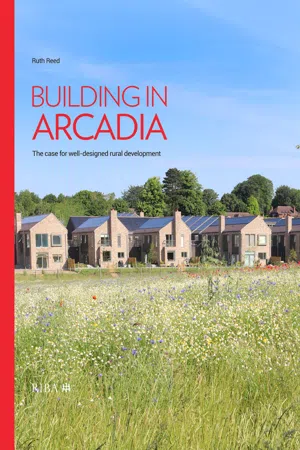
Building in Arcadia: The case for well-designed rural development is a reasoned, impassioned and ultimately practical book identifying key barriers to rural development, and how planning applicants (whether householders, developers and landowners), and most particularly their agents who make the applications – architects, landscape architects or planners – can address, and overcome, them.
Focusing on the positive aesthetic role buildings can play in the landscape, and proposing sensitive development, Building in Arcadia also explores the essential economic, social and Environmental case for more building in the countryside to make the countryside more viable. In so doing, it will actively engage, challenge and provoke debate – as well as offering practical ways forward.
Tools to learn more effectively

Saving Books

Keyword Search

Annotating Text

Listen to it instead
Information
Part 1
Planning Constrains on Countryside Development
Chapter 2
Policy
Policy
Chapter 3
Decision-taking
Decision-taking
Chapter 4
Planning for a new development
Planning for a new development
Chapter 1
The English Arcadia
Oh, to be in England Now that April’s there, And whoever wakes in England Sees, some morning, unaware, That the lowest boughs and the brushwood sheaf Round the elm-tree bole are in tiny leaf, While the chaffinch sings on the orchard bough In England—now!1
1 Robert Browning, ‘Home-Thoughts, from Abroad’, 1845
To understand why development in the countryside is so constrained by planning decision-makers, it is necessary to appreciate how the prevailing perception of a rural idyll evolved as England industrialised and urbanised. This gave rise to the culture of protectionism that sought to restrict new development in the countryside, which in turn informed the development of rural planning policy. This chapter also examines how the concept of acceptable rural architecture evolved and why it differs from urban architecture. This is set out under the following headings:
- From agriculture to industry in the 18th–19th century
- Country living in the 19th–20th century
- Modern pressures on the rural landscape + The rise of protectionism
- A history of rural planning
- Changing perceptions of an appropriate rural architecture
From agriculture to industry in the 18th–19th century
England in the 18th century was predominantly agricultural, supporting a market economy centred on the market towns and London. Appreciation of the aesthetic qualities of the landscape was the preserve of the landed gentry who were laying out country estates, providing both prestige and income, as well as a base for rural pursuits such as hunting, shooting and fishing. The country seat was the focus of aristocratic life, and was occupied as a primary residence. The town house just provided a base from which to supervise business interests and enjoy the short social season.
The country estate was designed to impress and has furnished the English landscape with many beautiful houses set in idealised parkland settings. The English Landscape Movement of the 18th century is, for many, the pinnacle of landscape design, epitomised by the work of Lancelot ‘Capability’ Brown. It is significant to modern planning because, for the first time, with the economic and political control of the ruling class, the natural landscape was manipulated and enhanced on a wide scale.
One of the aspects of these grand visions was the development of model estate villages. Existing worker housing, inconveniently sited in the idealised vistas, could be swept away to be reconstructed out of sight, in an exaggerated vernacular of cottage-loaf thatched roofs, ornate rustication and heavily timbered porches. This is the first indication that reproducing vernacular architecture was considered the appropriate form for new rural buildings. Although arranged in formal estates, and frequently with repetitive use of house types, the rural village was not to be the same as the mass housing being built in towns, where the terraced house was replicated at all scales and for all social classes. Rural new-build housing was done in a faux vernacular style, reworking the components of vernacular construction as ornamental elements for the working classes, while the country seat of the 18th century was classical. So successful and enduring was the outcome, that villages such as Milton Abbas, within the estate of Milton Abbey in Dorset, are still held to be exemplars of rural design.

Fig 1.1: Milton Abbas, estate village to Milton Abbey, Dorset, Sir William Chambers (1723–1796)
The estate workers in their new houses were the lucky few. For the majority, homes in the countryside were still medieval constructions. An increasingly mobile rural population, freed from feudalism in Tudor times, had already begun to move towards alternative sources of employment in the towns. This was fuelled by a rise in population that could not be supported by agricultural employment alone.

Fig 1.2: A Village Street by Helen Allingham
This trend accelerated remarkably in the second half of the 18th century, with the arrival of the Industrial Revolution. It had a profound effect on the balance between the rural and urban populations. Between 1750 and 1851 the percentage of the population supported by the rural economy dropped from 75% to 21%.2 Throughout the 19th century, the countryside depopulated and the rapidly growing population of England became overwhelmingly urban.
2 Michael Bunce, The Countryside Ideal: Anglo-American Images of Landscape, Routledge, London and New York, 1994, p9
With the growth of the cities came the idealisation of the countryside by the urban population. The new middle classes, anxious to escape the polluted and overcrowded cities, looked to the countryside as a cleaner, more spacious place to live. The growth of a nostalgic and romantic view of nature and rural life idealised a landscape that had evolved from more pragmatic influences. The country estate and its strict social hierarchy, field enclosures, developing agricultural technologies and rural depopulation had actually formed the countryside, but what the 19th century urbanite saw was a simpler and more picturesque existence, with a strong and enduring social order.
This dream of Arcadia was fuelled by the growth of new literature and art, promulgated by the mechanisation of printing. Writers such as George Eliot, the Brontë sisters, Jane Austen and Thomas Hardy described the class structure of rural society in romantic terms. Poets such as Robert Browning and Gerard Manley Hopkins explore the place that the rural idyll holds in the English psyche. Artists such as John Constable, JMW Turner and Thomas Girtin celebrated the English landscape, capturing scenes of rural life, and buildings against a wider backdrop of land and sky. Agricultural workers were given greater dignity and became the focus of the French realists such as Millet.
On a smaller and more focussed scale, Helen Allingham, the first woman to be admitted as a full member of the Royal Watercolour Society, captured and, at times, re-imagined the country cottages she found in Surrey, Dorset, the Isle of Wight and Kent, in her paintings and watercolours. The middle classes, whose parlour walls these vignettes adorned, either did not know or did not care that these were romanticised images of rural poverty and decay, as rural depopulation caused buildings to fall into disuse and disrepair. The bucolic image of the small cottage and the tumble-down village street became central to the romantic image of rural life, and the dwellings that remained became swept up in the tide of gentrification that accompanied the movement of the middle classes out of the cities.3
3 Ina Taylor, Helen Allingham’s England: An idyllic view of rural life, Webb and Bower, Exeter, 1990
Country living in the 19th–20th century
In the 19th century, the notion of a country seat was taken up by the growing numbers of wealthy industrialists who built a house in the country not as a place of income, but one of leisure. The town house was, for them, the primary seat, and the country house was for the summer season and for the weekends. This notion of owning a second home filtered down to the middle classes, and by the 1880s there was a fashion for weekend cottages, supported by the ever-growing railway network. The desire to own some land in the countryside reached the working classes of the South East in the early 20th century, resulting in the plotlands: small parcels of land bought by Londoners to site a cabin or cultivate a smallholding.
The railways brought even greater change to the countryside, as they facilitated the spread of suburbia, and beyond it, exurbia – a term first coined by Spectorsky – to describe a great wedge of country residential development extending for 100 kilometres to the north and west of New York City.4 It is used by Bunce5 to describe the exclusive estates of villas now in the outer suburbs of London: Chislehurst, Esher and Ascot, and the Metrolands – the commuter villages that grew up along the Metropolitan Railway – such as Gerrards Cross, Radlett, Haywards Heath and Harpenden.
4 Augusta C Spectorsky, The Exurbanites, Lippincott, Philadelphia, 1955
5 Michael Bunce, The Countryside Ideal: Anglo-American Images of Landscape, Routledge: London and New York, 1994, p93
The England that was the focus for patriotism in the First World War was perceived to be an unchanging rural idyll. In reality, the war brought irreversible change to the countryside, stripping the great houses of their workforces and seeing the construction of army camps. After the war, change accelerated with the spread of low density suburbia, and the breakup of many large country estates due to death duties and a lack of an available workforce to maintain them. The rural population who were engaged in agriculture declined as a change from arable land to pasture was brought about by economic pressures.6 The proportion of commuters, retirees and small business owners grew – people who chose the countryside for its lifestyle rather than through economic necessity, and with the new population grew pressures to resist further change.
6 Gordon E Cherry and Alan Rogers, Rural Change and Planning: England and Wales in the Twentieth Century, E and FN Spon, London, 1996, p47–49
These new rural dwellers brought with them the urbanite view of country life and a desire to preserve a rural idyll that was more a construct of art than of reality. The focus of this ideal was the village, and the more picturesque the village, the more desirable it was. Although the growth of exurbia is most prevalent in the home counties, it has driven an attitude to rural life that exists across England to this day.
The residents of exurbia developed a high level of protectionism that endures and shapes modern planning decisions. Ironically, many of the homes built in the early years of the development of exurbia have now become the rural assets to be protected. Bunce articulates the drive for protection of the English village by those who have invested in it and in the countryside, as a residential ideal.
The pressure for housing is now greater than it has ever been before, and the desire to move to the country is as great as it ever was. It is the pressure for housing land that has highlighted the perceptions of what role the countryside should play in society and what is appropriate new development within it.
Modern pressures on the rural landscape
The pressure for new housing and the desire to convert redundant rural buildings into desirable residences were not the only pressures for change that started to grow in the mid-19th century and throughout the 20th century. To what was once a predominantly agricultural landscape, have come new infrastructures of canals, railways, metalled roads, road signs, street lighting, advertising, telephone cables and overhead powerlines. These have all had a profound effect on the countryside. One has only to look at the present setting of a Helen Allingham cottage in a village street to understand how ingrained and irreversible these changes now are.7
7 Annabel Watts, Helen Allingham’s Cottage Homes Revisited, Annabel Watts, 1994
Demand for industrial and building resources has grown with the economy, resulting in extensive quarrying, reservoirs and forestry. These now occupy significant tracts of what was once agricu...
Table of contents
- Cover
- Title
- Copyright
- Contents
- Foreword
- Preface
- Acknowledgements
- Introduction
- PART 1 PLANNING CONSTRAINTS ON COUNTRYSIDE DEVELOPMENT
- PART 2 MAKING THE CASE FOR DEVELOPMENT
- PART 3 A NEW APPROACH
- Bibliography
- Appendix Survey of local authority councillors into attitudes towards development in the English countryside
- Index
- Image Credits
Frequently asked questions
Yes, you can cancel anytime from the Subscription tab in your account settings on the Perlego website. Your subscription will stay active until the end of your current billing period. Learn how to cancel your subscription
No, books cannot be downloaded as external files, such as PDFs, for use outside of Perlego. However, you can download books within the Perlego app for offline reading on mobile or tablet. Learn how to download books offline
Perlego offers two plans: Essential and Complete
- Essential is ideal for learners and professionals who enjoy exploring a wide range of subjects. Access the Essential Library with 800,000+ trusted titles and best-sellers across business, personal growth, and the humanities. Includes unlimited reading time and Standard Read Aloud voice.
- Complete: Perfect for advanced learners and researchers needing full, unrestricted access. Unlock 1.4M+ books across hundreds of subjects, including academic and specialized titles. The Complete Plan also includes advanced features like Premium Read Aloud and Research Assistant.
We are an online textbook subscription service, where you can get access to an entire online library for less than the price of a single book per month. With over 1 million books across 990+ topics, we’ve got you covered! Learn about our mission
Look out for the read-aloud symbol on your next book to see if you can listen to it. The read-aloud tool reads text aloud for you, highlighting the text as it is being read. You can pause it, speed it up and slow it down. Learn more about Read Aloud
Yes! You can use the Perlego app on both iOS and Android devices to read anytime, anywhere — even offline. Perfect for commutes or when you’re on the go.
Please note we cannot support devices running on iOS 13 and Android 7 or earlier. Learn more about using the app
Please note we cannot support devices running on iOS 13 and Android 7 or earlier. Learn more about using the app
Yes, you can access Building in Arcadia by Ruth Reed in PDF and/or ePUB format, as well as other popular books in Architecture & Architecture General. We have over one million books available in our catalogue for you to explore.