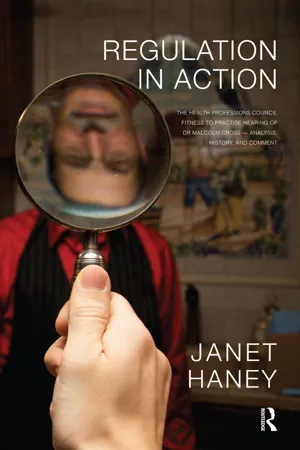
eBook - ePub
Regulation in Action
The Health Professions Council Fitness to Practise Hearing of Dr Malcolm Cross - Analysis, History, and Comment
- 200 pages
- English
- ePUB (mobile friendly)
- Available on iOS & Android
eBook - ePub
Regulation in Action
The Health Professions Council Fitness to Practise Hearing of Dr Malcolm Cross - Analysis, History, and Comment
About this book
This incisive study shows that "regulation", against which many have warned but which some psychotherapists still imagine to be a solution to all their ills, is actually already here. The author traces her way through this apparatus, and makes a compelling case for taking the HPC seriously as a machine that incarnates the very kind of unhealthy practice it pretends to set itself against.'- Professor Ian Parker, Manchester Metropolitan University'. If you want to know about the reality of state regulation, how it works in practice - as opposed to what people say about it - you should read this book. A shocking and unsettling account.'- Paul Gordon, author of The Hope of Therapy and former chair of the Philadelphia Association'. Do not let the simplicity of this lucid account of a difficult problem deceive you. 'This book investigates the claim that regulation by agencies of State is one of the prerequisites for improving professional practice. It displays how the underlying administrative interests of such bureaucracies are detrimental to the structure of professional communities.
Trusted by 375,005 students
Access to over 1.5 million titles for a fair monthly price.
Study more efficiently using our study tools.
Information
Chapter One
Some steps that led to this book
This book is quite particular and rather unusual. Most of it is a transcript of the fitness to practise case of a psychologist and HPC Council Member, Dr Malcolm Cross. I have chosen to present this transcription (made available under the law that created the Health Professions Council, henceforth the HPC) in order to allow people to grasp the reality of the new regulatory framework that now exists in this country. Very few people, even amongst those directly affected, seem to know what the framework is based on, nor how it arose. Much of the problem is that the new regulation is based on quite different assumptions from those we are accustomed to, and it is the arbitrary change in these underlying assumptions that make it difficult to grasp what’s going on. During the course of my research into this problem, Dr Cross’s fitness to practise case came forward. It occurred to me that the transcription of this case would provide the perfect material to reveal the nature of what is actually going on. The case itself reads rather like a soap opera, and has a curiously compelling character. It is quite fun to read. However, this is not the level at which the real information exists. The case is presented in order to show the mechanisms and procedures that are put into play in the name of “public protection”. Dr Cross himself is not the primary concern of this book, but a useful and unavoidable vehicle for it. I have topped and tailed the transcript with an introduction and conclusion. In Chapter One, I have brought together some threads that make up the backdrop to the case, and which help to make sense of what has happened. The concluding chapter also includes other information arising from my wider research into the HPC, which helps to show how the single case presented here is part of a wider pattern of chaos. I hope that it helps to frame the material and to prompt more people to act.
1959: CPSM—one register for eight professions
On 20 November 1959, The Times newspaper announced the impending creation of the Council for Professions Supplementary to Medicine (CPSM). The paper’s political correspondent reported:
Eight new professional bodies with the general function of promoting high standards of education and professional conduct, and each with its investigating and disciplinary committees, will be set up under the terms of the Professions Supplementary to Medicine Bill which was published yesterday … Each profession will have a board to regulate professional conduct. Their first duty will be to maintain a register of all persons qualified for the profession and to approve training courses, qualifications and training institutions and will have power to cancel registration in cases of misconduct. [emphasis added]
Ten days later, on 30 November 1959, the bill was due for its second reading in the House of Commons, and The Times responded to the occasion by publishing a leader comment and a letter of dissent from the speech therapists (Morley, Court & Tuck, 1959). The leader article looked forward to a law to rid the country of charlatans, while the letter argued the need to avoid registration in order to protect and pursue its academic credentials: two rather different points of view on the function and effects of statutory power. The Conservative Minister of Health (Mr Derek Walker-Smith) opened the reading in the House of Commons. In his introduction he explained that the bill was an attempt to bring together eight different professions without common organization and that this would be tricky and time-consuming. There were also, he said, many interests to consider, including those of the medical profession under whom these eight callings were to perform their “supplementary” functions (chiropody, radiography, remedial gymnastics, etc.).
We intend that the Bill should make it possible to distinguish people eligible for employment in the public service—health, welfare, school health and education—but I should like to make it clear that the Bill does not seek to ban the employment of other than registered people … Similarly, the Bill does not prohibit private practice by unregistered people but merely protects the title “State Registered”. [emphasis added]
The government was grappling with how to employ people in the NHS and clearly thought that a register, which people could opt into, was a practical, if not entirely logical, solution. It was down to the speech and language therapists to spell out the implications this had for the field of knowledge that supported a practice.
Reading through the Hansard transcript, it is possible to hear the astonishment of the politicians at the reluctance of the speech therapists to take this “gift”. But one can also read how they eventually conceded to the demands and did not insist that the speech therapists enter the CPSM. The following excerpt from Hansard from a speech by Dr Barnett Stross, Labour MP for Stoke on Trent, reveals something of the relation between politics to the professions at the time:
There again, the article in The Times—not the letter but the leader—is quite right. The speech therapists can do all this and still have state registration and do nothing but gain by it. If, however, as a last resort, they refuse, we cannot help it. They will be free if they insist upon it. I can only say that I hope they will listen to what some of us in this House are saying and to what we shall say in Committee and realise that they can do nothing but gain. We cannot see how they could possibly lose. [emphasis added]
Depending on where they were sitting, everyone had a different point of view (Scott, 1998), but the arguments from the speech therapists prevailed, and they were eventually to enter a statutory register forty years later when the HPC took over from the CPSM in 2001.
The pressure to create a new organization arose out of the problems experienced in the management of the CPSM. The UK Health Departments (of which by now there were four due to devolution) commissioned a report in 1996 by JM Consultants—“Report of a Review of the Professions Supplementary to Medicine Act (1960)”. This report does not so much explain what had changed but manifests some of the signs of the change as well.
1996: The JM Consultants report
The JM report notes that much had changed in British society since the 1960s (education policy reform, NHS reform, the increased numbers of professions and members) but it did not remark on any of the main currents of health problems faced by British society at the time or indeed on anything else. Instead, JM kept it local and consulted with interested parties to discover that almost everyone was unhappy with the CPSM: “Most support our view that the problems are now so severe that new legislation is required. However, there are differing views on the direction which this should take” (p. 3, emphasis added). Although the problems outlined in the report all point to tensions arising from the idea of regulating multiple professions with a single regulatory organization—a possible cause of the problems—the solution JM came up with was, astonishingly, more of the same.
The report dismisses the dissenting voice by insinuating that it is a self-interested voice, or one too bogged down in details to see the “bigger picture”. Thankfully, The Times Higher Education Supplement (in 2000) was not so partial, so we can learn that:
Many chiropodists, radiographers and others in the remaining ten professions supplementary to medicine say the new arrangements will undermine their attempts to maintain standards and protect the public.
“They will be able to put on my tombstone that I fought to the bitter end,” says Raymon Ariori, chair of the chiropodist board of the CPSM.
“Only a madman or a fool could possibly believe that the new arrangements will help patients,” he says.
He argues that the new council—which will establish common procedures for the different professions—will undermine the status of individual professions and will make it easier for universities to get approval for poor-quality courses. (Sanders, 4 February 2000)
Nevertheless, JM stuck to the political vision and strategy, which pressed on regardless. When considering the increasing number of people who opted out of registration, a number that was supposed to dwindle away to nothing as a result of a natural choice from the public, JM acknowledged that it had in fact increased. But rather than read this as a sign of dissatisfaction with the CPSM regime, JM assumed it was a call for stricter control by the state.
In 1959 the politicians had recognized that bringing eight different practices together in one organization would be both unnatural and difficult and required caution and care. In 1996 this consideration had disappeared. Instead of seeing that a specialized approach might maintain independent, creative, responsive, and responsible conduct across the practices then covered by the CPSM, JM recommended weakening the powers of the professions by removing the powers of the boards. It also recommended increasing the power of the central council by decreasing the number of professionals and increasing lay membership. And in a final move against experience and knowledge they opted for “efficiency of scale” by opening the possibility for unlimited numbers of new professions to be brought into the structure.
All this weakens the mechanisms of self-regulation. The new proposals attack the basis upon which a process of rational and enlightened regulation takes place. That is, the proposals favour a system based on the power of politics and economics, rather than the power of reason in relation to particular practical reality. This, of course, is a giant step backwards, and cannot be considered a sign of progress.
Enlightened regulation belongs to the community that is implicated in the practice and the creation and transmission of knowledge that supports the practice. By grounding the regulation amidst the knowledge and experience of a practice it is possible to temper the rise of political power within the system. That is, political power must take its chances with the actual contexts and problems faced by the practitioner within a system of laws and a consideration of ethics. When regulation is split off and handed to people who are asked to know nothing of the practice, a lacuna is created. In such a case no reason, no body of knowledge, no evidence, no discrete idea or philosophy underpins the system of “regulation”—these are the conditions in which political and economic power can grow unchecked.
In an adjacent field, that known as the study of audit culture, a similar lacuna has been noted where we see the bizarre consequence of people spending valuable time proving to their managers and auditors that they are running a quality service, rather than actually running a quality service (see for example, Cooper, 2001; Power, 1994, 1997, 2009; Strathern, 2000; Travers, 2007). The structure of this problem serves a “double whammy”. First, valuable time is taken away from doing the job while practitioners attend to tick-box form filling, and second, valuable headspace is taken up with a form of thinking that has nothing to do with the actual job in question. It is possible to see how this in itself will undermine the structures of reason and control that are necessary for the proper regulation of a practice—the careful attention to what is going on by people who are experienced and responsible for the practice. The collapse in this attention is likely to lead to problems in the practice. Ironically these problems, whose causes are structural and out of sight, then get taken up by the new regulators who propose it as “evidence” for the need for increased state control.
John Major’s government had no obvious plans for actioning this report. But the year after the publication of the JM report, New Labour was swept to power with a majority of 418 seats (sixty-six percent) over 165 (twenty-six percent) for the Conservatives and forty-six (seven percent) for the Liberal Democrats.
1997: The impact of New Labour
One of the first items on the agenda of any new government is usually the setting out of its plans to reform the NHS, and the 1999 Health Act did just that. Section 60 of the act includes words that empower “Her Majesty” by “Order in Council” “… to make provision to modify the regulation of any profession so far as appears to be necessary or expedient for the purpose of securing or improving the regulation of the profession or the services which they provide”.
So while the act might have gone through all the usual steps afforded by the democratic tradition, this section of the act was left deliberately vague and provided an opportunity for the government to take executive action at some future date. Executive action was duly taken a couple of years later, with the introduction of the secondary legislation—a statutory instrument, the Health Professions Order 2001 (henceforth HPO 2001). It has been noted that in an attempt to pass record levels of legislation this Labour Government introduced cut-off times on debates, and made use of increasing levels of secondary instruments which required no general debate.
The arrival of HPO 2001 also marked the exit of a private member’s bill seeking to establish a General Psychotherapy Council, which had been introduced by Liberal Democrat peer Lord John Alderdice. This rather quiet coup marked the change from traditional statutory regulation (where power is passed to an organization responsible for the practice), to the new regulation, which requires the creation of a new regulator that does not know about the practice.
In the meantime the public inquiries into Dr Harold Shipman, tried and found guilty of murdering many of his patients (Smith, 2001), and the Bristol Royal Infirmary, concerning mortality rates among infants who underwent cardiac surgery there (Kennedy, Howard, Jarman & Mclean, 2001), were giving a particular and pernicious backdrop of support to the government’s programme of change in the NHS. Although these two inquiries were quite different from each other, the political atmosphere fused them together and they both became fuel for the idea, much amplified by politicians and the press, that “doctors” as a set of people could not be trusted and needed to be brought under state control. We will come back to this shortly.
This gave John Hutton’s speech the sensational backdrop he needed to get away with a surprisingly aggressive attitude against the integrity of the professions. He introduced HPO 2001 as a means of dealing with charlatans, adding:
The greater the access to independent practitioners, the stronger the case for regulation because those in managed services such as the National Health Service are more likely to be subject to a higher degree of quality control.
He had made the assumption that it is NHS control mechanisms that guarantee practitioner quality. Not only does this make huge and probably imaginary assumptions about the cohesion and stability of the NHS, it is also little more than a parody of Taylorist factory management, which supposes that skilled labour has already been eradicated (see Braverman’s seminal Labor and Monopoly Capitalism: The Degradation of Work in the Twentieth Century, 1976). When Hutton spoke of the chiropodists—decent, law-abiding citizens, with a history of good practice despite the lack of a university degree—he said:
I have received representations from practitioners in the unregulated sector saying that the order unfairly discriminates against them, but it does not. [emphasis added]
Not only does this view of regulation misrepresent them as being unregulated (that particular misrepresentation will be repeated regularly from now on) but Hutton also appears to assume that he knows best. Although this is similar to the position held by Dr Barnett Stross in 1959, it is also utterly different. Being right has turned into something less pleasant. He went on:
I assure the Committee that we are not bashing the unregulated sector.
Repeating the point that those with a different view are an unruly lot (“unregulated”) and flatly denying that he is doing something that his previous words clearly indicate to be his main purpose, he then concludes:
We want to be open and fair. We are not approaching the task in a spirit of hostility or discriminating against those with unregistered qualifications.
In fact, the order as written implied that anyone without a degree, no matter what their track record to date, would, in the event of enactment, find themselves criminalized if they continued to see their patients. The next speaker, Dr Evan Harris (Liberal Democrat MP for Oxford West and Abingdon), frames his opposition to Hutton diplomatically:
I do not necessarily disagree with the Minister, but he has now said twice that he is not trying to discriminate against the unregistered sector. He might have seen the same representations that I have, arguing that state-registered chiropodists who never took a degree—even those who trained many years ago and have since retired—should not have to go down the pathway of further qualifications or tests. In a sense, that is discriminatory. Will he comment on that?
Hutton replies:
We have tried to find a compromise and consensus, but they have eluded us.
Without elaborating on the nature of the effort, or on the reason for the failure, Hutton simply hammers home the idea that the public is in danger from unregulated practitioners who put themselves, in his view, beyond the reach of discussion.
The vote in the House of Commons was undertaken separately from the debate in committee and on another day: 28 November 2001. The results can only reflect the dimensions of the political consensus of the day, and not the result of reasoned debate: 292 supporting (seventy-two percent), 113 opposing (twenty-eight percent).
A fortnig...
Table of contents
- Cover
- Half Title
- Title
- Copyright
- Dedication
- CONTENTS
- ACKNOWLEDGEMENTS
- ABOUT THE AUTHOR
- FOREWORD
- CHAPTER ONE Some steps that led to this book
- CHAPTER TWO The FTP case begins
- CHAPTER THREE FTP detail
- CHAPTER FOUR The evidence of the quality assurance officer
- CHAPTER FIVE The evidence of Dr Cross
- CHAPTER SIX The final scene
- CHAPTER SEVEN Regulation in action, inaction, or distraction?
- REFERENCES
- INDEX
Frequently asked questions
Yes, you can cancel anytime from the Subscription tab in your account settings on the Perlego website. Your subscription will stay active until the end of your current billing period. Learn how to cancel your subscription
No, books cannot be downloaded as external files, such as PDFs, for use outside of Perlego. However, you can download books within the Perlego app for offline reading on mobile or tablet. Learn how to download books offline
Perlego offers two plans: Essential and Complete
- Essential is ideal for learners and professionals who enjoy exploring a wide range of subjects. Access the Essential Library with 800,000+ trusted titles and best-sellers across business, personal growth, and the humanities. Includes unlimited reading time and Standard Read Aloud voice.
- Complete: Perfect for advanced learners and researchers needing full, unrestricted access. Unlock 1.5M+ books across hundreds of subjects, including academic and specialized titles. The Complete Plan also includes advanced features like Premium Read Aloud and Research Assistant.
We are an online textbook subscription service, where you can get access to an entire online library for less than the price of a single book per month. With over 1.5 million books across 990+ topics, we’ve got you covered! Learn about our mission
Look out for the read-aloud symbol on your next book to see if you can listen to it. The read-aloud tool reads text aloud for you, highlighting the text as it is being read. You can pause it, speed it up and slow it down. Learn more about Read Aloud
Yes! You can use the Perlego app on both iOS and Android devices to read anytime, anywhere — even offline. Perfect for commutes or when you’re on the go.
Please note we cannot support devices running on iOS 13 and Android 7 or earlier. Learn more about using the app
Please note we cannot support devices running on iOS 13 and Android 7 or earlier. Learn more about using the app
Yes, you can access Regulation in Action by Janet Haney in PDF and/or ePUB format, as well as other popular books in Law & Ethics & Professional Responsibility in Law. We have over 1.5 million books available in our catalogue for you to explore.