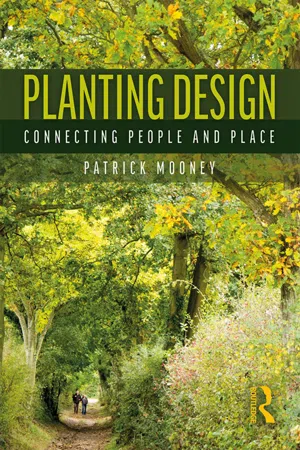
Landscape designers have long understood the use of plants to provide beauty, aesthetic pleasure and visual stimulation while supporting a broad range of functional goals. However, the potential for plants in the landscape to elicit human involvement and provide mental stimulation and restoration is much less well understood.
This book meshes the art of planting design with an understanding of how humans respond to natural environments. Beginning with an understanding of human needs, preferences and responses to landscape, the author interprets the ways in which an understanding of the human-environment interaction can inform planting design. Many of the principles and techniques that may be used in planting design are beautifully illustrated in full colour with examples by leading landscape architects and designers from the United Kingdom, Europe, North America and Asia, including:
Andrea Cochran, Andrea Cochran Landscape Architecture, San Francisco, CA
Design Workshop Inc.
Richard Hartlage, Land Morphology, Seattle, WA
Shunmyo Masuno, Japan Landscape Consultants Ltd., Yokohama
Piet Oudolf, Hummelo, The Netherlands
Melody Redekop, Vancouver
Christine Ten Eyck, Ten Eyck Landscape Architects Inc., Austin, TX
Kongjian Yu, Turenscape Ltd., Beijing.
The book stimulates thought, provides new direction and assists the reader to find their own unique design voice. Because there are many valid processes and intentions for landscape design, the book is not intended to be overly prescriptive. Rather than presenting a strict design method and accompanying set of rules, Planting Design provides information, insight and inspiration as a basis for developing the individual designer's own expression in this most challenging of art forms.
Trusted by 375,005 students
Access to over 1.5 million titles for a fair monthly price.
This chapter discusses, first from a historical perspective and then on the basis of environmental psychology and neurobiology, the preferences that people have for landscapes. The history of garden development, the ways in which evolution has formed our preferences for landscapes, why we prefer certain landscape types and configurations and the way we mentally process natural landscapes are discussed. This and the next chapter provide the basis of much of the discussion of planting design in the rest of the book.
Part 1: The paradise garden
The Egyptian garden
The oldest existing garden images, found in Egypt (c.3000 BC), depict fruit trees, vines and vegetables flourishing within walled enclosures (Goode and Lancaster, 1986). These early gardens resulted from the application of life-bringing water to an otherwise barren landscape and often contained a pool for irrigation (G. Jellicoe, S. Jellicoe and Waymark, 1975). Over time, Egyptian gardens combined the utilitarian and the pleasure garden. In this form, the gardens retained their original productive purposes but also became places of shady respite from the desert, complete with decorative water features and abundant flowers. This type of multi-purpose garden was not unique to Egypt. In ancient Egypt, Samaria, Persia and throughout the Roman Empire, the farms, vineyards and hunting parks of the wealthy incorporated ornamental gardens that supported social purposes and provided views over the surrounding countryside.
Such gardens arose, in part, from a conception of an afterlife spent in celestial gardens that was common to many ancient cultures. The ancient Egyptians believed that their gods inhabited a world of gardens and groves, and their tomb paintings portray an afterlife in which the deceased share in this divine landscape. The pharaohs, not content to wait for the hereafter, surrounded their palaces with extensive gardens designed in imitation of the home of their father, the sun god Ra, and Egyptian nobility built themselves gardens intended as earthly reflections of the celestial paradise (Wilkinson, 1998).
The Greeks and Romans
The ancient Greeks, like the Egyptians before them, believed in an eternity spent in a celestial garden that they shared with their gods. The Grecian afterlife, or Elysium, is described in the Aeneid as a paradise of fragrant groves and delightful meadows inhabited by the gods and fallen warriors (Carroll, 2003; Ward Thompson, 2011).
Because the ancient Greeks considered the beauties of nature in their native landscape so highly, they felt little need to embellish nature but were careful to consider “landscape beauty within the site and visible from it” when choosing important sites (Crouch, 1993, p. 59, quoted in Ward Thompson, 2011). For example, Greek temples were commonly set on promontories or in sacred groves found in natural woodlands.
Later, groves were planted around important sites (Barnett, 2007) and the academies of philosophers like Plato (c.428–347 BC) and Epicurus (341–270 BC) were located in both natural groves and designed spaces. The Roman historian Plutarch (c.46–120 AD) described the Greek academies as having beautiful gardens where the philosophers and their students walked in the open while discussing nature and the gods or viewed the landscape from covered colonnades (Penfield, 1961; Thielen and Diller, 2012).
The Roman villa
The third century Greek practice of locating academies in beautiful natural and designed settings and of walking in nature while engaging in discussion was later emulated by the Romans in their villa gardens. The letters of Roman statesman Pliny the Younger (c.61 AD–c.112 AD) make it clear that while his estates were productive enterprises, he treasured the respite from the city, mental restoration and thoughts inspired by the beauty of nature that he experienced there. He wrote:
You desire to know in what manner I dispose of my day in summer time at my Tuscan villa … About ten or eleven of the clock … according as the weather recommends, I betake myself either to the terrace, or the covered portico, and there I meditate and dictate … From thence I get into my chariot … and find this changing of the scene preserves and enlivens my attention. (Book nine, Letter 36)
… the sylvan solitude with which one is surrounded, and the very silence which is observed on these occasions, strongly incline the mind to meditation. (Book one, Letter 6)
True and genuine life! Pleasing and honourable repose! More, perhaps, to be desired than the noblest employments! Oh solemn sea and solitary shore, best and most retired scene for contemplation, with how many noble thoughts have you inspired me! (Book one, Letter 9)
(Gaius Plinius Caecilius Secundus—Pliny II)
The Persian garden
The sacred texts of Judaism, Christianity and Islam depict the Garden of Eden as an earthly paradise created by divine power as the intended home of humanity.
And out of the ground made the LORD God to grow every tree that is pleasant to the sight and good for food, the tree of life also in the midst of the garden, and the tree of knowledge of good and evil. And a river went out of Eden to water the garden, and from thence it was parted and became four heads.
(King James Bible, Genesis 2:9–10)
In addition to this description of Eden, found in the Torah, Bible and Quran, the Quran refers to paradise as a garden of flowing waters that is the reward of the faithful.
And give good tidings to those who believe and do righteous deeds that they will have gardens [in Paradise] beneath which rivers flow.
(Quran 2:25)
These sacred texts inspired the Islamic garden and later Christian gardens in Europe.
The Persian garden dates to c.4000 BC and was, like other gardens of the ancient world, a walled garden. Persian hunting parks were known as pairidaeza, derived from pairia, meaning around, and daeza or wall, and are the source of the English word paradise (Carroll, 2003). Very early in its development the Persian garden contained extensive water channels, pools and fountains and many trees (Wilber, 1962).
The classic Persian garden is divided into quadrants by water channels that intersect at the centre of the garden in what is known as the chahar bagh or four gardens form. It was this garden tradition that Alexander the Great (356–323 BC) encountered when he conquered the Persian Empire in 331 BC and by the time of his death in 323 BC had transmitted throughout his empire, which stretched from the Nile to the Caspian Sea and from the Balkans to the Himalayas (Carroll, 2003).
The Islamic garden
In 651 AD, the Persian Empire was re-conquered by Muslim Arabs. Under Islamic influence the classic Persian garden became synonymous with paradise. The flowing water channels came to symbolise the four rivers of Eden as described in the Quran, and the chahar bagh form became the template for Islamic gardens for the next millennium (Hobhouse, 2004). Muslim Arabs carried this enclosed paradise garden north from Africa to Sicily and Spain and eastward to the Middle East and India, where it was introduced in the form of the Mughal garden in the sixteenth century. In its various incarnations, the Islamic garden incorporated two seemingly contradictory philosophies: Like the earlier Egyptian gardens, it was simultaneously an earthly imitation of an afterlife paradise and a lush oasis intended to delight the senses and facilitate worldly pleasures (Carroll, 2003).
Figure 1.0The thirteenth-century Court of the Lions at the Alhambra Palace in Grenada, Spain, exhibits the classic chahar bagh form of the Islamic garden. The gravel paved areas between the water channels would have been filled with flowers under the care of its Moorish builders.
In later times, the walled Persian gardens became the basis for the medieval cloister garden and the Italian villa (Jellicoe et al., 1975). Enclosed gardens similar to the Persian gardens were first built in Europe during in the Middle Ages (c.500–1500 AD). Many of these were monastic cloisters in which the garden enclosure was formed by the walls of the monastery and by covered arcades that provided views into the garden from a protected space (Gerlach-Spriggs, Kaufman and Warner, 1998). Very little is known of the planting of these gardens, and in England many cloisters probably contained little more than grass and trees (Goode and Lancaster, 1986).
Like the Persian garden, the cloister garden symbolised the paradise of holy writ. The garden was divided into quadrants by two paths, symbolising the four rivers of Eden, that intersected at a well or fountain at the centre of the garden (Figure 1.1). Early Christians believed that by virtue of being baptised they could return to Eden, and this garden form symbolised their return to grace (Carroll, 2003).
Many of these cloister gardens were adjacent to the monastery infirmary and were also used as places of healing. Saint Bernard (1090–1153) described the purpose of the courtyard garden of his monastery at Clairvaux, France, and the benefits it gave the convalescent.
Figure 1.1The courtyard of Jerónimos Monastery in Lisbon, showing the cruciform paths with a fountain in the centre and cloister walls behind.
Source: Véronique Debord-Lazaro | Flickr (used under the Creative Commons licence).
Within this enclosure, many and various trees, prolific with every sort of fruit, make a veritable grove, which lying next to the cells of those who are ill, lightens with no little solace the infirmities of the brethren, while it offers to those who are strolling about a spacious walk, and to those overcome with heat, a sweet place for repose … The lovely green of the herb and tree nourishes his eyes … their immense delights hanging and growing before him … while the air smiles with bright serenity, the earth breathes with fruitfulness and the invalid himself with eyes, ears and nostrils, drinks in the delights of colours, songs and perfumes.
(Saint Bernard, quoted in Gerlach-Spriggs et al., 1998, p. 9)
The Romantic landscape ideal
In the eighteenth century, the wealthy classes of northern Europe built country estates, similar in purpose to first-century Roman villas. These working farms had extensive designed landscapes and were used by their owners as retreats from city life and for contemplation of the beauties of nature.
In England, Europe and the United States the Romantic philosophic movement played a major role in the development of a new style of landscape design (Rogers, 2007). Major contributors to Romantic thought, like Jean-Jacque Rousseau (1712–1778) and Alexander Pope (1688–1744), believed that culture and society corrupted human nature and that contact with nature revealed the essential goodness of human beings by inducing moral thoughts that led to tranquility and wellbeing (Clark, 1943; Neumeyer, 1947). The natural garden that Rousseau described in his novel Julie or La Nouvelle Héloïse (1761) was widely admired and stimulated a move to a new style of landscape design that imitated nature (Neumeyer, 1947).
Th...
Table of contents
Cover
Half Title
Title Page
Copyright Page
Dedication
Contents
Preface
Acknowledgements
Chapter 1 The preferred landscape
Chapter 2 The restorative landscape
Chapter 3 Horticultural considerations in planting design
Chapter 4 Functional and aesthetic criteria in planting design
Chapter 5 Space and place
Chapter 6 The elements of design
Chapter 7 Colour
Index
Frequently asked questions
Yes, you can cancel anytime from the Subscription tab in your account settings on the Perlego website. Your subscription will stay active until the end of your current billing period. Learn how to cancel your subscription
No, books cannot be downloaded as external files, such as PDFs, for use outside of Perlego. However, you can download books within the Perlego app for offline reading on mobile or tablet. Learn how to download books offline
Perlego offers two plans: Essential and Complete
Essential is ideal for learners and professionals who enjoy exploring a wide range of subjects. Access the Essential Library with 800,000+ trusted titles and best-sellers across business, personal growth, and the humanities. Includes unlimited reading time and Standard Read Aloud voice.
Complete: Perfect for advanced learners and researchers needing full, unrestricted access. Unlock 1.5M+ books across hundreds of subjects, including academic and specialized titles. The Complete Plan also includes advanced features like Premium Read Aloud and Research Assistant.
Both plans are available with monthly, semester, or annual billing cycles.
We are an online textbook subscription service, where you can get access to an entire online library for less than the price of a single book per month. With over 1.5 million books across 990+ topics, we’ve got you covered! Learn about our mission
Look out for the read-aloud symbol on your next book to see if you can listen to it. The read-aloud tool reads text aloud for you, highlighting the text as it is being read. You can pause it, speed it up and slow it down. Learn more about Read Aloud
Yes! You can use the Perlego app on both iOS and Android devices to read anytime, anywhere — even offline. Perfect for commutes or when you’re on the go. Please note we cannot support devices running on iOS 13 and Android 7 or earlier. Learn more about using the app
Yes, you can access Planting Design by Patrick Mooney in PDF and/or ePUB format, as well as other popular books in Architecture & Urban Planning & Landscaping. We have over 1.5 million books available in our catalogue for you to explore.