This volume illustrates Melford Spiro's explorations of key relationships among culture, society, and human nature. He addresses such fundamental issues as the limitations of cultural relativism, the problem of explanation in the social sciences, and the importance of a comparative approach to the study of social and cultural system.
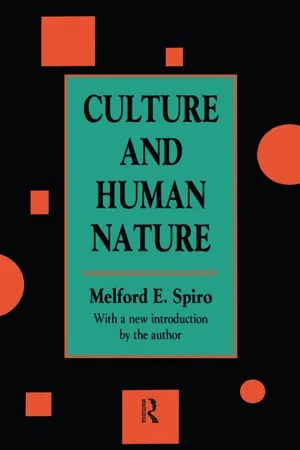
- 310 pages
- English
- ePUB (mobile friendly)
- Available on iOS & Android
eBook - ePub
Culture and Human Nature
About this book
Information
III
RELIGION AND MYTH
8
Religion: Problems of Definition and Explanation
Introduction 1
1. Work on this paper is part of a cross-cultural study of religion supported by research grant M-2255 from the National Institutes of Health, U.S. Public Health Service.
BEFORE EXAMINING various approaches to the explanation of religion, we must first agree about what it is that we hope to be able to explain. In short, we must agree on what we mean by ‘religion’. Anthropology, like other immature sciences—and especially those whose basic vocabulary is derived from natural languages—continues to be plagued by problems of definition. Key terms in our lexicon—culture’, ‘social system’, ‘needs’, ‘marriage’, ‘function’, and the like—continue to evoke wide differences in meaning and to instigate heated controversy among scholars. Frequently the differences and controversies stem from differences in the types of definition employed.
Logicians distinguish between two broad types of definition: nominal and real definitions (Hempel 1952:2–14). Nominal definitions are those in which a word, whose meaning is unknown or unclear, is defined in terms of some expression whose meaning is already known. We all engage in such an enterprise in the classroom when we attempt to define, i.e. to assign meaning to, the new terms to which we expose our untutored undergraduates. Our concern in this case is to communicate ideas efficiently and unambiguously; and, in general, we encounter few difficulties from our students, who have no ego-involvement in alternative definitions to our own. We do have difficulties with our colleages, however, because they—unlike us!—are ego-involved in their immortal prose and, intransigently, prefer their nominal definition to ours. Despite their intransigence, however, the problem of achieving consensus with respect to nominal definitions is, at least in principle, easily resolved. We could, for example, delegate to an international committee of anthropologists the authority to publish a standard dictionary of anthropological concepts, whose definitions would be mandatory for publication in anthropological journals.
The problem is more serious, and its resolution correspondingly more difficult, in the case of real definitions. Unlike nominal definitions which arbitrarily assign meaning to linguistic symbols, real definitions are conceived to be true statements about entities or things. Here, three difficulties are typically encountered in anthropology (and in the other social sciences). The first difficulty arises when a hypothetical construct—such as culture or social structure—is reified and then assigned a real definition. Since that which is to be defined is not an empirically observable entity, controversies in definition admit of no empirical resolution.
A second difficulty is encountered when real definitions are of the kind that stipulate what the definer takes to be the ‘essential nature’ of some entity. Since the notion of ‘essential nature’ is always vague and almost always nonempirical, such definitions are scientifically useless. Kinship studies represent a good case in point, with their—at least so it seems to a nonspecialist—interminable controversies concerning the essential nature of marriage, descent, corporality, and the like.
Sometimes, however, real definitions are concerned with analyzing a complex concept—which has an unambiguous empirical referent—by making explicit the constituent concepts which render its meaning. These are known as analytic definitions. Thus, the expression ‘X is a husband’ can be defined as ‘X is a male human, and X is married to some female human’. But the possible objections which such a definition would evoke among some anthropologists, at least, exemplifies the third definitional difficulty in anthropology: what might be called our obsession with universality. Since there are instances in parts of Africa of a phenomenon similar to what is ordinarily termed ‘marriage’, but in which both partners are female, some scholars would rule out this definition on the grounds that it is culturally parochial. This insistence on universality in the interests of a comparative social science is, in my opinion, an obstacle to the comparative method for it leads to continuous changes in definition and, ultimately, to definitions which, because of their vagueness or abstractness, are all but useless. (And of course they commit the fallacy of assuming that certain institutions must, in fact, be universal, rather than recognizing that universality is a creation of definition. I am also at a loss to understand why certain institutions—marriage, for example—must be universal, while others—such as the state—need not be.)
The Problem of Definition in Religion
An examination of the endemic definitional controversies concerning religion leads to the conclusion that they are not so much controversies over the meaning either of the term ‘religion’ or of the concept which it expresses, as they are jurisdictional disputes over the phenomenon or range of phenomena which are considered to constitute legitimately the empirical referent of the term. In short, definitional controversies in religion have generally involved differences in what are technically termed ostensive definitions. To define a word ostensively is to point to the object which that word designates. In any language community, the fiery ball in the sky, for example, evokes a univocal verbal response from all perceivers; and a stranger arriving in an English-speaking community can easily learn the ostensive definition of the word ‘sun’ by asking any native to point to the object for which ‘sun’ is the name. Similarly the empirical referent of ‘table’ can be designated unequivocally, if not efficiently, by pointing to examples of each subset of the set of objects to which the word applies.
The community of anthropologists, however, is not a natural language community—more important, perhaps, it does not share a common culture—and although there is little disagreement among anthropologists concerning the class of objects to which such words as ‘sister’, ‘chief, ‘string figure’—and many others—properly do apply, there is considerable disagreement concerning the phenomena to which the word ‘religion’ ought to apply. Hence the interminable (and fruitless) controversies concerning the religious status of coercive ritual or an ethical code or supernatural beings, and so on. From the affect which characterizes many of these discussions one cannot help but suspect that much of this controversy stems, consciously or unconsciously, from extrascientific considerations—such as the personal attitudes to religion which scholars bring to its study. Since I am concerned with the logic of inquiry, I must resist a tempting excursion into the social psychology of science.
The scientific grounds for disagreement are almost always based on comparative considerations. Thus Durkheim rejects the belief in supernatural beings as a legitimate referent of ‘religion’ on the grounds that this would deny religion to primitive peoples who, allegedly, do not distinguish between the natural and the supernatural. Similarly, he rejects the belief in gods as a distinguishing characteristic of ‘religion’ because Buddhism, as he interprets it, contains no such belief (1954:24–36). Such objections raise two questions; one factual, the other methodological. I shall return to the factual question in a later section, and confine my present remarks to the methodological question. Even if it were the case that Theravada Buddhism contained no belief in gods or supernatural beings, from what methodological principle does it follow that religion—or, for that matter, anything else—must be universal if it is to be studied comparatively? The fact that hunting economies, uni-lateral descent groups, or string figures do not have a universal distribution has not prevented us from studying them comparatively. Does the study of religion become any the less significant or fascinating—indeed, it would be even more fascinating—if in terms of a consensual ostensive definition it were discovered that one, or seven, or sixteen societies did not possess religion? If it indeed be the case that Theravada Buddhism is atheistic and that, by a theistic definition of religion, it is not therefore a religion, why can we not face, rather than shrink, from this consequence? Having combatted the notion that ‘we’ have religion (which is good) and ‘they’ have supersitition (which is ‘bad), why should we be dismayed if it be discovered that society x does not have ‘religion’, as we have defined that term? For the premise ‘no religion’ does not entail the conclusion ‘therefore superstition’—nor, incidentally, does it entail the conclusion ‘therefore no social integration’, unless of course religion is defined as anything which makes for integration. It may rather entail the conclusion ‘therefore science’ or ‘therefore philosophy’. Or it may entail no conclusion and, instead, stimulate some research. In short, once we free the word ‘religion’ from all value judgments, there is reason neither for dismay nor for elation concerning the empirical distribution of religion attendant upon our definition. With respect to Theravada Buddhism, then, what loss to science would have ensued if Durkheim had decided that, as he interpreted it, it was atheistic, and therefore not a religion? I can see only gain. First, it would have stimulated fieldwork in these apparently anomalous Buddhist societies and, second, we would have been spared the confusion created by the consequent real and functional definitions of religion which were substituted for the earlier substantive or structural definitions.
Real definitions, which stipulate the ‘essential nature’ of some phenomenon are, as I have already argued, necessarily vague and almost always nonempirical. What, for example, does Durkheim’s ‘sacred’—which he stipulates as the essential nature of religion—really mean? How useful is it, not in religious or poetic, but in scientific discourse? It is much too vague to be taken as a primitive term in a definitional chain, and it is useless to define it by equally vague terms such as ‘holy’ or ‘set apart’. But if such real definitions are unsatisfactory when the phenomenal referent of the definiendum is universally acknowledged, they are virtually useless when, as in this case, it is the phenomenal referent which is precisely at issue. If there is no agreement about what it is that is being defined, how can we agree on its essential nature? Durkheim, to be sure, circumvented this problem by arguing that the sacred is whatever it is that a society deems to be sacred. But even if it were to be granted that one obscurity can achieve clarity by the substitution of another, real definitions of this type—like functional definitions to which I now wish to turn—escape the trap of overly narrow designata only to fall into the trap of overly broad ones.
Most functional definitions of religion are essentially a subclass of real definitions in which functional variables (the promotion of solidarity, and the like) are stipulated as the essential nature of religion. But whether the essential nature consists of a qualitative variable (such as the sacred) or a functional variable (such as social solidarity), it is virtually impossible to set any substantive boundary to religion and, thus, to distinguish it from other sociocultural phenomena. Social solidarity, anxiety reduction, confidence in unpredictable situations, and the like, are functions which may be served by any or all cultural phenomena—Communism and Catholicism, monotheism and monogamy, images and imperialism—and unless religion is defined substantively, it would be impossible to delineate its boundaries. Indeed, even when its substantive boundaries are limited, some functional definitions impute to religion some of the functions of a total sociocultural system.
It is obvious, then, that while a definition cannot take the place of inquiry, in the absence of definitions there can be no inquiry—for it is the definition, either ostensive or nominal, which designates the phenomenon to be investigated. Thus when Evans-Pritchard writes that ‘objectivity’ in studies of religion requires that “we build up general conclusions from particular ones” (1954:9), this caution is certainly desirable for discovering empirical generalizations or for testing hypotheses. But when he tells us that “one must not ask ‘what is religion?’ but what are the main features of, let us say, the religion of one Melanesian people …” which, when compared with findings among other Melanesian peoples, will lead to generalizations about Melanesian religion, he is prescribing a strategy which, beginning with the study of that one Melanesian people, cannot get started. For unless he knows, ostensively, what religion is, how can our anthropologist in his Melanesian society know which, among a possible n, observations constitute observations of religious phenomena, rather than of some other phenomenal class, kinship, for example, or politics?
Indeed, when the term ‘religion’ is given no explicit ostensive definition, the observer, perforce, employs an implicit one. Thus, Durkheim warns that in defining religion we must be careful not to proceed from our “prejudices, passions, or habits” (1954:24). Rather, “… it is from the reality itself which we are going to define” (ibid.). Since any scientist—or, for that matter, any reasonable man—prefers ‘reality’ to ‘prejudice’, we happily follow his lead and, together with him, “… set ourselves before this reality” (ibid.). But since, Durkheim tells us, “religion cannot be defined except by the characteristics which are found wherever religion itself is found,” we must “… consider the various religions in their concrete reality, and attempt to disengage that which they have in common” (ibid.). Now, the very statement of this strategy raises an obvious question. Unless we already know, by definition, what religion is, how can we know which ‘concrete reality’ we are to ‘consider’? Only if religion has already been defined can we perform either this initial operation or the subsequent one of disengaging those elements which are shared by all religions.
In sum, any comparative study of religion requires, as an operation antecedent to inquiry, an ostensive or substantive definition that stipulates unambiguously those phenomenal variables which are designated by the term. This ostensive definition will, at the same time, be a nominal definition in that some of its designata will, to other scholars, appear to be arbitrary. This, then, does not remove ‘religion’ from the arena of definitional controversy; but it does remove it from the context of fruitless controversy over what religion ‘really is’ to the context of the formulation of empirically testable hypotheses which, in anthropology, means hypotheses susceptible to cross-cultural testing.
But this criterion of cross-cultural applicability does not entail, as I have argued above, universality. Since ‘religion’ is a term with historically rooted meanings, a definition must satisfy not only the criterion of cross-cultural applicability but also the criterion of intracultural intuitivity; at the least, it should not be counter-intuitive. For me, therefore, any definition of ‘religion’ which does not include, as a key variable, the belief in superhuman—I won’t muddy the metaphysical waters with ‘supernatural’—beings who have power to help or harm man, is counter-intuitive. Indeed, if anthropological consensus were to exclude such beliefs from the set of variables which is necessarily designated by ‘religion’, an explanation for these beliefs would surely continue to elicit our research energies.
Even if it were the case that Theravada Buddhism postulates no such beings, I find it strange indeed, given their all-but-universal distribution at every level of cultural development, that Durkheim—on the basis of this one case—should have excluded such beliefs from a definition of religion, and stranger still that others should have followed his lead. But this anomaly aside, is it the case that Buddhism contains no belief in superhuman beings? (Let us, for the sake of brevity, refer to these beings as ‘gods’.) It is true, of course, that Buddhism contains no belief in a creator god; but creation is but one possible attribute of godhood, one which—I suspect—looms not too large in the minds of believers. If gods are important for their believers because—as I would insist is the case—they possess power greater than man s, including the power to assist man in, or prevent him from, attaining mundane and/or superm...
Table of contents
- Cover
- Half Title
- Title Page
- Copyright Page
- Contents
- Introduction to the Transaction Edition
- Editors’ Introduction
- I. CULTURE AND HUMAN NATURE
- II. FUNCTIONAL ANALYSIS
- III. RELIGION AND MYTH
- Index
Trusted by 375,005 students
Access to over 1.5 million titles for a fair monthly price.
Study more efficiently using our study tools.
Frequently asked questions
Yes, you can cancel anytime from the Subscription tab in your account settings on the Perlego website. Your subscription will stay active until the end of your current billing period. Learn how to cancel your subscription
No, books cannot be downloaded as external files, such as PDFs, for use outside of Perlego. However, you can download books within the Perlego app for offline reading on mobile or tablet. Learn how to download books offline
Perlego offers two plans: Essential and Complete
- Essential is ideal for learners and professionals who enjoy exploring a wide range of subjects. Access the Essential Library with 800,000+ trusted titles and best-sellers across business, personal growth, and the humanities. Includes unlimited reading time and Standard Read Aloud voice.
- Complete: Perfect for advanced learners and researchers needing full, unrestricted access. Unlock 1.5M+ books across hundreds of subjects, including academic and specialized titles. The Complete Plan also includes advanced features like Premium Read Aloud and Research Assistant.
We are an online textbook subscription service, where you can get access to an entire online library for less than the price of a single book per month. With over 1.5 million books across 990+ topics, we’ve got you covered! Learn about our mission
Look out for the read-aloud symbol on your next book to see if you can listen to it. The read-aloud tool reads text aloud for you, highlighting the text as it is being read. You can pause it, speed it up and slow it down. Learn more about Read Aloud
Yes! You can use the Perlego app on both iOS and Android devices to read anytime, anywhere — even offline. Perfect for commutes or when you’re on the go.
Please note we cannot support devices running on iOS 13 and Android 7 or earlier. Learn more about using the app
Please note we cannot support devices running on iOS 13 and Android 7 or earlier. Learn more about using the app
Yes, you can access Culture and Human Nature by Horace Kallen,Melford E. Spiro in PDF and/or ePUB format, as well as other popular books in Social Sciences & Comparative Religion. We have over 1.5 million books available in our catalogue for you to explore.