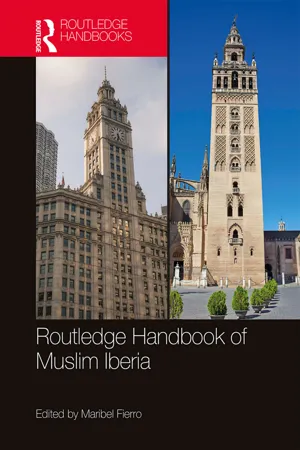
This handbook offers an overview of the main issues regarding the political, economic, social, religious, intellectual and artistic history of the Iberian Peninsula during the period of Muslim rule (eighth–fifteenth centuries). A comprehensive list of primary and secondary sources attests the vitality of the academic study of al-Andalus (= Muslim Iberia) and its place in present-day discussions about the past and the present.
The contributors are all specialists with diverse backgrounds providing different perspectives and approaches. The volume includes chapters dealing with the destiny of the Muslim population after the Christian conquest and with the posterity of al-Andalus in art, literature and different historiographical traditions. The chapters are organised in the following sections:
Political history, concentrating on rulers and armies
Social, religious and economic groups
Intellectual and cultural developments
Legacy and memory of al-Andalus
Offering a synthetic and updated academic treatment of the history and society of Muslim Iberia, this comprehensive and up-to-date collection provides an authoritative and interdisciplinary guide. It is a valuable resource for both specialists and the general public interested in the history of the Iberian Peninsula, Islamic and Medieval studies.
Trusted by 375,005 students
Access to over 1 million titles for a fair monthly price.
* This chapter was prepared as part of the research project Collapse and political regeneration in late Antiquity and Early Middle Ages: the case of Northwestern Iberia (HAR2013-47789-C3-1-P), funded by the Spanish Ministry of Economy and Competitiveness. I am indebted to Robert Portass for his comments and help with English translation.
Iñaki Martín Viso
The sudden collapse of the kingdom of Toledo in 711 after confronting the Muslim troops that had disembarked in the Iberian Peninsula has led to a negative assessment of the Visigothic monarchy. For many scholars, the collapse represents the final consequence of a gradual process of internal deterioration, a perspective influenced by credulous readings of the Asturian chronicles written in the late ninth century. Historiography has nurtured this idea for a long time. E. A. Thompson, in his influential book on the Goths in Spain, stated that “the Visigothic state machine was breaking down”, which would explain the fast destruction of the kingdom.1 Clear indications of this hypothesised breakdown would be the military laws established by the later kings and the legislation concerning fugitive servants. L. A. García Moreno provides a summary of the converging crises (economic, social, political and cultural) that afflicted the kingdom in the early eighth century, eventually leading to its destruction.2 As recently as 2011, a renowned expert on the Islamic conquest affirmed that “Nobody disputes the fact that the kingdom of Toledo showed advanced signs of decay when the Muslim invasion took place. Decomposition on this scale affected political, economic, social and moral structures”.3
Nevertheless, voices have been raised in recent years which aim to minimize the significance of the crisis as an explanatory factor, even going so far as to reject the idea of pre-711 crisis, indeed presenting the kingdom as a solid political structure in the context of the Post-Roman West.4 An analysis of royal legislation, the type of evidence most frequently used, shows that the laws should not be understood as straightforward indicators of disintegration. For example, late Visigothic military laws, far from being a consequence of centrifugal forces, must be understood as the adaptation of an army made up mainly of rural militias, which could be more effective in their nearby territories.5 Ch. Wickham summarizes this perspective as follows: “In that period [the late seventh century] the Visigothic state was the strongest in the West”.6 The so called Chronicle of 754, the Hispanic Christian source closest to the events it narrates, describes the Muslim conquest as a tragedy that struck a stable kingdom that had ruled over Hispania for 140 years.7 Thus, the story of the fall of the Visigothic kingdom is reinforced (indeed, dramatized) by its unexpected nature.
Map 1.1 Visigothic kingdom
For a proper assessment of the Visigothic kingdom, it is necessary to integrate it into the context of Post-Roman political structures, which were characterized by the existence of a strong but small polity focused upon kings. These rulers engaged in patronage, even if at a much lower level than the late Roman emperors. And yet, at the same time, local societies enjoyed greater autonomy. G. Halsall has proposed that kingdoms could only be held together if people identified with them in the localities (that is, those areas that were politically peripheral), which only happened when such identification offered advantages.8This means that early medieval kingdoms operated through a double mechanism of “penetration from above” and “investment from below”. In very local political arenas, such “investment from below” could sometimes be a way for certain families to gain long-lasting authority, although there were also families whose local prominence was well secured and did not need to “invest” in a distant power source.9 Accordingly, early medieval political structures generally appear to have manifested themselves as “thin” states, with scarce capacity to intervene at the local level. Consequently, local societies enjoyed a greater capacity for action, and their integration into higher political structures involved strong elements of negotiation.
The evolution of Hispania between the fifth and sixth centuries, with the proliferation of local powers and the late assertion of Visigothic central power, implemented under Leovigild’s rule (569–585), made the consolidation of strong local structures easier, so that those who “invested” in the regnum became members of very strong and small socio-political groups. The result was that only a reduced number of families was directly concerned with the kingdom’s affairs, while most of the population, even regional aristocracies, felt little to no effect from the “policies” that emanated from Toledo.
A noteworthy aspect is that the Visigothic monarchy remained elective, although no clear criteria on the manner of election of the king were ever established, which caused successions to become breeding grounds for factional conflicts.10 This elective and hardly formalized nature of the monarchical succession could be regarded as conducive to instability, although it was not a specific trait of the kingdom of Toledo, since the Lombard kingdom maintained the election of kings and managed to survive for two hundred years. Neither was the second half of the seventh century a phase of acute tensions: between 642 and 710, no succession to the throne involved murder or armed conflict within the Visigothic kingdom, which stands in contrast to the serious problems endured by the Merovingian dynasty.11 Indeed, factionalism and violence were part of political practice throughout the entire Post-Roman West. The kingdom of Toledo was not an exception, even though the degree of violence and instability it suffered was far less than that observed in other kingdoms. Likewise, this elective nature would have facilitated the existence of some groups that could have access to the throne and were therefore interested in the preservation of the kingdom, while it also prevented excessive concentration of power in the hands of a single family. In this way, it contributed to the perception of the kingdom as a matter that affected and involved the entirety of the gens Gothorum, the recipients of political sovereignty.
This led to what has been regarded as a dual system between king and aristocracy, whereby the former held the crown as a representative of the gens, understood as a cultural and political entity. The key to stability would be in the distribution of tax revenues and resources that belonged to the gens as a whole, and not exclusively to the king. Throughout the seventh century, certain kings (e.g. Chindaswinth, Recceswinth, Egica) sought to strengthen their position by using a confiscation mechanism aimed at obtaining new resources to share among their faction’s members.12 Far from being weak rulers, the late seventh-century kings established new bases for exercising their power, supplemented by consolidated ideological praxis, most obviously apparent in royal anointing. Revolts, such as the one headed by dux Paulus in the early days of Wamba’s reign, were not aimed at changing political relations nor at eliminating the figure of the king, but at rebalancing power in favour of groups that were distant from royal sponsorship. This would explain the support obtained in the region of Septimania, north of the Pyrenees, home to a large number of late sixth- and early seventh-century Visigothic kings, whose aristocracy had been excluded from the crown since the times of Chindaswinth (642–653). In any case, only a few families had access to the throne and played an active role in this policy.
On the other hand, the characterization of Visigothic Spain as a slave-based society does not correspond with reality. Even though there is scarce private documentation, the reality it portrays differs greatly from the parameters of this model. Vincent of Asan’s will, dated back to the mid-sixth century, conveys the description of a large property that was mostly worked by dependent peasants, some of them identified as coloni.13 Visigothic slate tablets from between the sixth and seventh centuries also contribute explicit evidence. An analysis of these documents reveals the existence of a large free peasantry that was subject to tax payment, although it also bears testimony of the presence of slaves (mancipia) and freemen. Still, the use of the term mancipia does not imply servile status, since one of the tablets mentions the need for these individuals to swear that they would conduct their work properly, a form of small-scale pact hardly likely to be offered to slaves.14 The hagiographies of the period do not reveal evidence of widespread slavery either, and even the legislation of the time emphasizes the relevance of such free peasantry, which made up the conuentus publicum uicinorum and was required to pay taxes.
The idea of a slave-based society is associated with the models corresponding to the transition from Antiquity to Feudalism conceived within a Marxist framework in the 1960s and 70s.15 Yet, this type of society never existed in the Late and Post-Roman West.16 While there were, indeed, slaves, there was never a slave-based society. How, then, should the legislation against the flight of servi toward the end of the reign be understood? A recent analysis of Egica’s 702 law interprets it as a way of securing the support of very specific aristocratic circles, namely those based in the province of Baetica (the valley of the Guadalquivir river) and, more specifically, in the city of Cordoba. It was also aimed at conveying an image of the monarch as a strong king, reiterating the provisions of the late Roman emperors.17 There was a strong ideological aspect to the legislation, and it should not be overlooked, since it need not imply the large-scale flight of servi, which was likely confined to very specific cases. At any rate, the data available do not support the idea of a slave-based society or of a widespread social crisis.
The supposed economic crisis of the late seventh-century Visigothic kingdom is related by its proponents to the alleged deterioration of the slave-based society and the problems associated with state resources. The clearest symptom would be the progressive loss of purity of the gold coinage issued by the ...
Table of contents
Cover
Half Title
Title Page
Copyright Page
Dedication
Table of Contents
List of figures
List of maps
List of dynastic tables
List of boxes
List of contributors
Notes on transliteration and dates
Introduction: Languages, academic traditions and disciplinary backgrounds in the study of al-Andalus
Part I Rulers
Part II Society
Part III Culture
Part IV The aftermath of al-Andalus
Glossary
Bibliography
Index
Frequently asked questions
Yes, you can cancel anytime from the Subscription tab in your account settings on the Perlego website. Your subscription will stay active until the end of your current billing period. Learn how to cancel your subscription
No, books cannot be downloaded as external files, such as PDFs, for use outside of Perlego. However, you can download books within the Perlego app for offline reading on mobile or tablet. Learn how to download books offline
Perlego offers two plans: Essential and Complete
Essential is ideal for learners and professionals who enjoy exploring a wide range of subjects. Access the Essential Library with 800,000+ trusted titles and best-sellers across business, personal growth, and the humanities. Includes unlimited reading time and Standard Read Aloud voice.
Complete: Perfect for advanced learners and researchers needing full, unrestricted access. Unlock 1.4M+ books across hundreds of subjects, including academic and specialized titles. The Complete Plan also includes advanced features like Premium Read Aloud and Research Assistant.
Both plans are available with monthly, semester, or annual billing cycles.
We are an online textbook subscription service, where you can get access to an entire online library for less than the price of a single book per month. With over 1 million books across 990+ topics, we’ve got you covered! Learn about our mission
Look out for the read-aloud symbol on your next book to see if you can listen to it. The read-aloud tool reads text aloud for you, highlighting the text as it is being read. You can pause it, speed it up and slow it down. Learn more about Read Aloud
Yes! You can use the Perlego app on both iOS and Android devices to read anytime, anywhere — even offline. Perfect for commutes or when you’re on the go. Please note we cannot support devices running on iOS 13 and Android 7 or earlier. Learn more about using the app
Yes, you can access The Routledge Handbook of Muslim Iberia by Maribel Fierro in PDF and/or ePUB format, as well as other popular books in History & European History. We have over one million books available in our catalogue for you to explore.