The One-Hour Shakespeare series is a collection of abridged versions of Shakespeare's plays, designed specifically to accommodate both small and large casts.
This volume, The Early Comedies and Romances,includes the following plays:
A Midsummer Night's Dream
Two Gentlemen of Verona
The Tempest
The Winter's Tale.
These accessible and versatile scripts are supported by: an introduction with emphasis on the evolution of the series and the creative process of editing; the One-Hour projects in performance, a chapter on implementing money-saving ideas and suggestions for production whether in or outside a classroom setting; specific lesson plans to incorporate these projects successfully into an academic course; and cross-gender casting suggestions. These supplementary materials make the plays valuable not only for actors, directors and professors, but for any environment, cast or purpose.
Ideal for both academics and professionals, One-Hour Shakespeare is the perfect companion to teaching and staging the most universally read and performed playwright in history.
Trusted by 375,005 students
Access to over 1 million titles for a fair monthly price.
Shakespeare was my first love. I remember growing up, my family would pile into our old Dodge station wagon and drive 12 hours up the California coast to the Oregon Shakespeare Festival. There we would pitch a tent at the KOA campground and, come rain or shine, watch seven provocative plays in five days. This annual pilgrimage hooked me on William Shakespeare by the time I was 11 years old.
For the past 25 years, I’ve been successfully working in the entertainment industry as an actor, director and independent film producer and, since 2012, as a Professor of Acting at Pace University, the School of Performing Arts in New York City. At the university, my specialty is scene study with classical texts and the highlight for my students are the accessible One-Hour Shakespeare projects I’ve successfully implemented as lesson plans.
These personal edits and abridged versions of Shakespeare’s classics are a perfect length for academic and professional productions and are designed specifically to accommodate small casts (5–8 actors), if you choose, or casts as numerous as the character count is in each play. There are suggestions of double and triple casting and, in some cases, character lines have been combined and some characters have been omitted. Acting companies and students can take these one-hour versions and perform them with or without production resources and still reap the benefits of the magnificent plays of William Shakespeare.
My creative process for editing these plays of Shakespeare down to an hour is first based on paying respect to the original text, rhythm, meter and through-line of the main characters in each play. I use multiple editions of each play to refer to throughout the editing process; The Arden Shakespeare, The Oxford Shakespeare, the Folger Shakespeare Library editions, The New Cambridge editions, The Pelican Shakespeare, The Signet classics, The Riverside Shakespeare, The Folio Society editions and The Complete Works of William Shakespeare online at http://shakespeare.mit.edu. Each editor takes a license with punctuation and the endings of words (“ed” or “’d”) as well as many other word endings and spellings. I take the same license when editing the full text down to an hour. There are inconsistencies and variations on words, punctuation and formatting throughout all editions of Shakespeare’s plays in print based on editorial choices and on whether an editor is using the First Folio or one of the Quarto versions as their source.
Each play in this collection includes line numbers and selected definitions. The line numbers will not correspond to the original line numbers in the full text of each play with the exception of the very beginning of each scene. Line numbers are included for easy reference during study and rehearsals. In regard to word definitions, I encourage actors and educators to use the Shakespeare Lexicon and Quotation Dictionary (Volumes I and II) by Alexander Schmidt, Dover Publications Inc., which does identify words by play, act, scene and original line numbers. It’s an invaluable resource and what I used for all definitions in this series.
Each one-hour play in the collection has been performance vetted by members of the 2015–2018 BFA Acting classes of The School of Performing Arts at Pace University, NYC.
Please enjoy the accessibility of these personal edits, in-performance production suggestions, lesson plans and cast list suggestions. My hope is that these projects will ultimately inspire actors, audiences and educators alike to then pick up the complete text of each play and engage in Shakespeare more fully.
2
ONE-HOUR PROJECTS IN PERFORMANCE
Money-saving suggestions to consider with a minimal budget
Shakespeare’s plays have proven successful in performance, time and time again, set in any time period and any location. This provides a great deal of artistic freedom and creativity when considering how you will structure your projects. Some fundamental production ideas to consider are what your theatre space will look like, where it will be, whether you will have access to lighting equipment, whether you will have access to scenery or basic furniture and what design choices you will make for costumes and sound.
Theatre space
Any room or area, inside or outside, can be made into a performance space. The “playing space” or stage is defined by where the audience is placed, choice of entrances and exits, and any scenery and lighting available. Some spaces to consider might include the following.
Traditional theatre space
This space is already defined, often with a raised stage and a proscenium arch, but you have the choice to use entrances and exits through the audience aisles as well as the on-stage wings.
Black Box theatre or any classroom or multi-purpose room
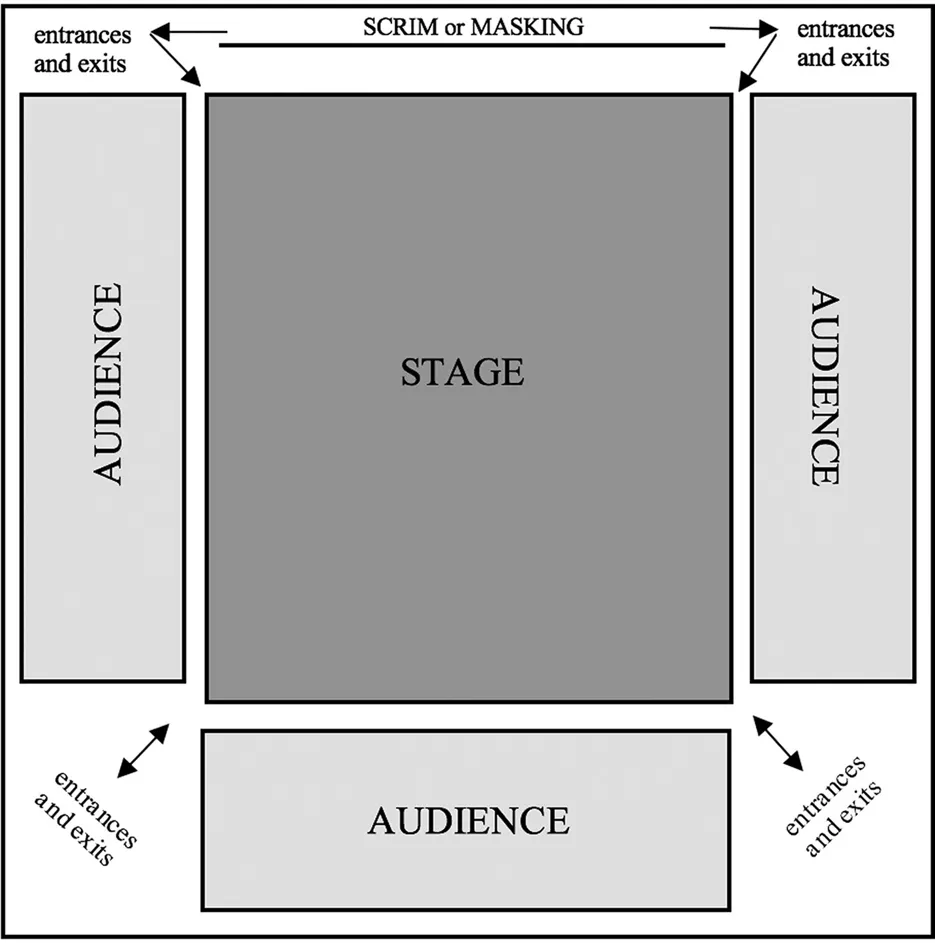
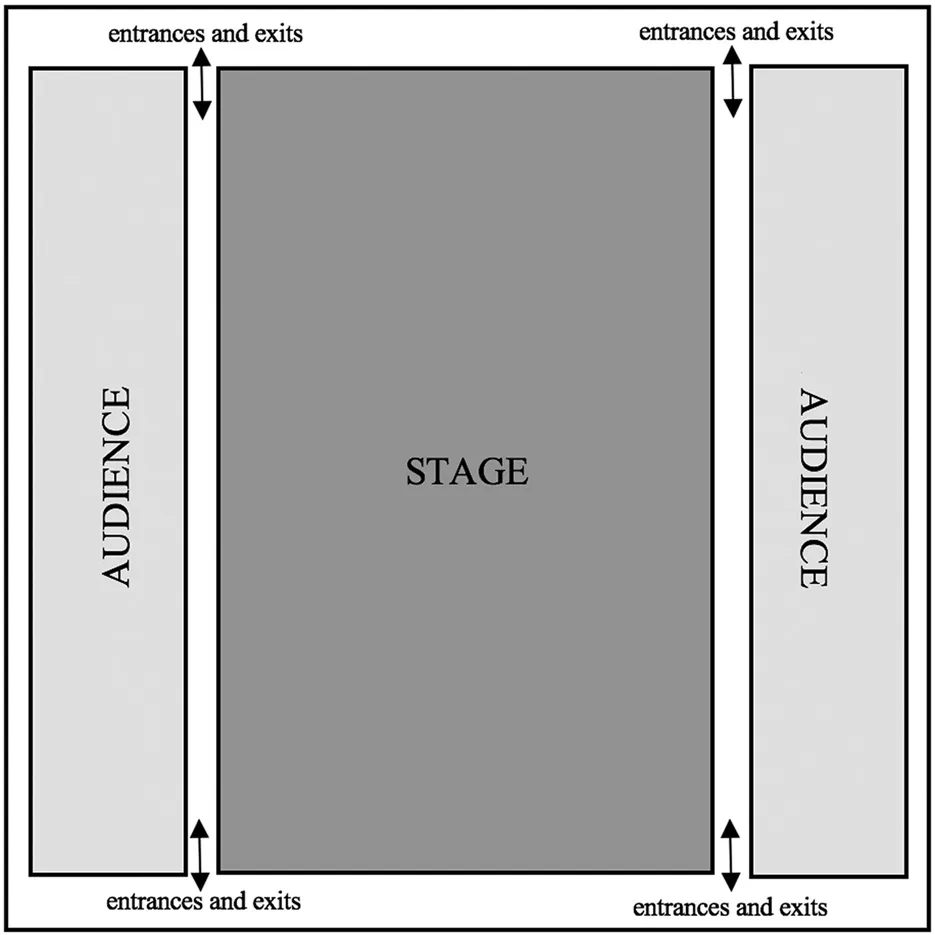
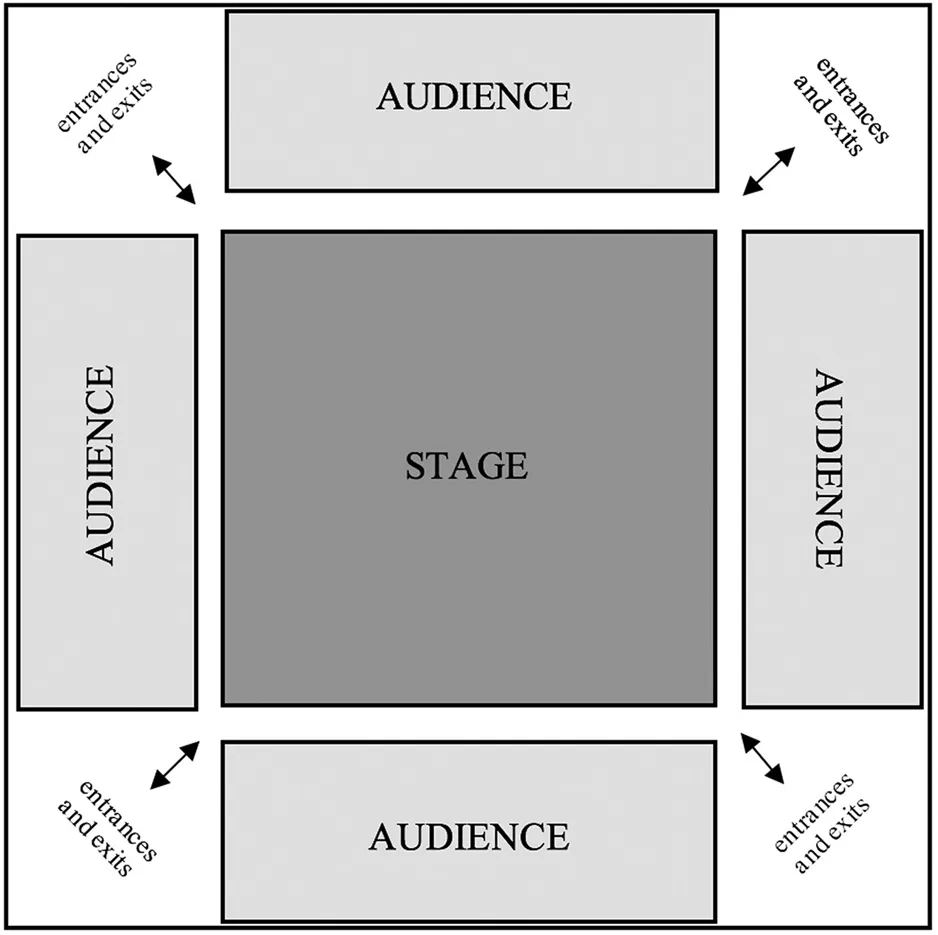
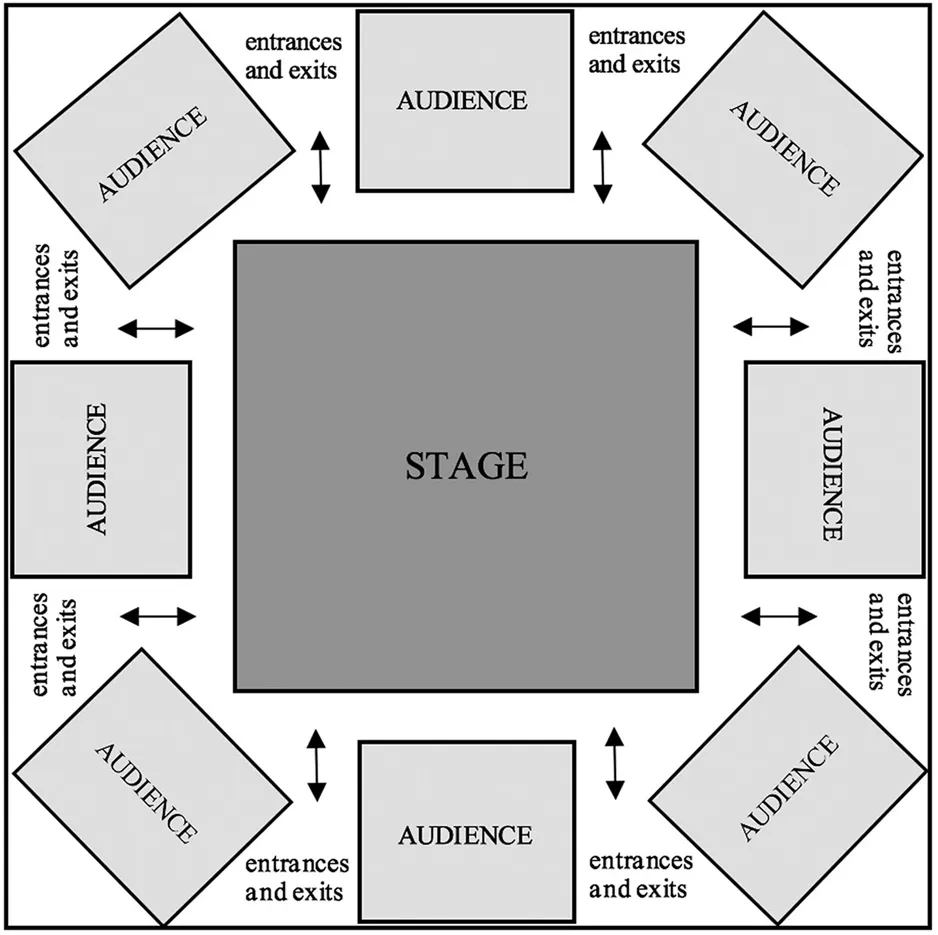
The space can be defined in multiple ways; traditional (sometimes referred to as proscenium; Figure 1), a thrust stage (Figure 2), a traverse stage which has a center alley for the playing space (Figure 3) or theatre in the round (Figures 4 and 5).
FIGURE 1 Traditional theatre space – audience out front
FIGURE 2 Thrust stage – seating on three sides
FIGURE 3 Traverse stage – audience on opposite sides
FIGURE 4 Theatre in the round – audience on all sides
FIGURE 5 Theatre in the round – audience on all sides
Outdoor area
These spaces are limitless. Some areas to consider might include a quad or green space of a campus, a park, a private garden, a rooftop, an area of a beach, etc. The same principle of defining the space for a black box theater can be used here. Where do you want your audience? Where is your “playing space”?
Outdoor environments cannot be as easily controlled as a traditional or indoor theatre space due to lights and sounds. There may be birds, insects, rabbits, honking cars, planes flying overhead, loud voices and the weather to contend with. However, all of these environmental factors can create fantastic and spontaneous in-the-moment performance opportunities, which can be thrilling for actors and audiences alike.
Site specific areas
These spaces provide excellent and, sometimes, more controlled environments for a “playing space” depending on the specific site chosen. Permission to use the space may need to be granted, if the space is private. There is no limit to what one may consider a performance space. Some specific ideas to consider are:
A small intimate library or the corner of a larger one to suggest the locations in Measure for Measure (Angelo’s office, a prison cell, Isabella’s place of worship, etc.). If you have access to a place of worship this could be a provocative and powerful location to choose.
A school cafeteria, indoor or outdoor, to suggest a busy market place, the Rialto, the public court and other locales in The Merchant of Venice.
A campground and its surroundings or a barnyard, stables and accompanying bales of hay to suggest the Forest of Arden and all locations in As You Like It.
A park with benches and walkways to suggest the environments for A Midsummer Night’s Dream.
A green area adjacent to or in sight of a graveyard for Hamlet or even Macbeth. In one of the many film versions of Hamlet, the director chose to make Denmark the name of a corporation where Claudius works and not the country where Hamlet lives. The site-specific space used for many scenes was a Wall Street office building.
The grand steps of a building to suggest the various locations of Rome in Julius Caesar (ancient Rome, the Senate, the Capital, an open Forum, etc.).
Private walking gardens for Much Ado About Nothing.
A courtyard surrounded by multi-level buildings (school buildings or apartments with a useable window), a structure with a front porch or an interior of a building with a staircase landing for the aloft scenes and all else in Romeo and Juliet.
A futbol pitch or practice fields (from the 18-yard line through to the frame of the goal) to suggest the environments for Two Gentlemen of Verona. Valentine and Proteus can be two gentlemen “V”arsity athletes.
A plot of beach for The Tempest.
Entrances and exits
Entrances and exits for the actors can be through the right and left wings both upstage and downstage in the traditional space, through any aisles in the audience, around the right or left corner areas of audience seats, upstage center of the stage space if there is masking hung which has a center separation or upstage far left and far right around masking if masking or a scrim is being used (entrance and exit options are pictured in Figures 1–5). Actors can also choose to have chairs placed on stage or in the audience and use those as their entrance and exit positions.
Defining your space
Once a space has been decided on, you have chosen how to configure the audience seating and you defined specific entrances and exits that the actors will use, here are some additional money-saving suggestions to consider:
Hang a dark or light sheet (masking/scrim) upstage center to serve as an area for slide projections and/or an offstage area for quick changes. A whiteboard on rollers is convenient to use as well. Additionally, you may choose to use more than one scrim to create walls if that is desired;
Define your offstage area. Offstage can be behind the audience seating, behind masking or a scrim or in the wings if using a traditional theatre space. You might also decide not to designate an offstage space and allow the actors to be seen at all times. If this is your choice, a suggestion would be to have chairs or acting blocks placed in a semi-circle towards the upstage area of the playing space or in two rows opposite one another on the sides of the playing space for the actors to sit in when they are “offstage” and not in a particular scene. The actors’ bodies then frame the playing space as well;
If using slides or projected images to further suggest the environment for each scene, either a rear projector or a front projector can work. The placement of the projector will dictate the blocking or staging of the scenes. Rear projectors can allow for an actor in the ensemble to operate, when behind the masking, and will not constrict the blocking of scenes on stage and in front of the masking. Projectors are often available to sign out through Media departments in schools and universities;
Basic acting cubes (standard furniture for a black-box or studio space), chairs and A-frame ladders can be used to further define the setting for each scene and serve as the “scenery” (a throne, seats, a table, a bed, rocks to hide behind, a balcony, a pulpit, a cave, the bow of a ship, the entrance to a castle, etc.);
Basic props, supplied by actors or a school prop collection, can consist of whatever you feel is essential to tell the story of the scene (stage knives, stage blood, wine glasses, flashlights, safe candles, fighting implements, flowers, letters, books, food, etc.).
Lighting
This will be determined by what is available in the space and whether the chosen space is inside or outside. Without a budget set aside for lighting, here are some suggestions:
If your theatre space is in...
Table of contents
Cover
Half Title
Series Information
Title Page
Copyright Page
Contents
Acknowledgments
1 Introduction
2 One-Hour projects in performance: Money-saving suggestions to consider with a minimal budget
3 Lesson plan and editing exercise
4 Cross-gender casting suggestions
5 A Midsummer Night’s Dream
6 A Midsummer Night’s Dream: Suggested cast list and character assignments for a small cast
7 Two Gentlemen of Verona
8 Two Gentlemen of Verona: Suggested cast list and character assignments for a small cast
9 The Tempest
10 The Tempest: Suggested cast list and character assignments for a small cast
11 The Winter’s Tale
12 The Winter’s Tale: Suggested cast list and character assignments for a small cast
Frequently asked questions
Yes, you can cancel anytime from the Subscription tab in your account settings on the Perlego website. Your subscription will stay active until the end of your current billing period. Learn how to cancel your subscription
No, books cannot be downloaded as external files, such as PDFs, for use outside of Perlego. However, you can download books within the Perlego app for offline reading on mobile or tablet. Learn how to download books offline
Perlego offers two plans: Essential and Complete
Essential is ideal for learners and professionals who enjoy exploring a wide range of subjects. Access the Essential Library with 800,000+ trusted titles and best-sellers across business, personal growth, and the humanities. Includes unlimited reading time and Standard Read Aloud voice.
Complete: Perfect for advanced learners and researchers needing full, unrestricted access. Unlock 1.4M+ books across hundreds of subjects, including academic and specialized titles. The Complete Plan also includes advanced features like Premium Read Aloud and Research Assistant.
Both plans are available with monthly, semester, or annual billing cycles.
We are an online textbook subscription service, where you can get access to an entire online library for less than the price of a single book per month. With over 1 million books across 990+ topics, we’ve got you covered! Learn about our mission
Look out for the read-aloud symbol on your next book to see if you can listen to it. The read-aloud tool reads text aloud for you, highlighting the text as it is being read. You can pause it, speed it up and slow it down. Learn more about Read Aloud
Yes! You can use the Perlego app on both iOS and Android devices to read anytime, anywhere — even offline. Perfect for commutes or when you’re on the go. Please note we cannot support devices running on iOS 13 and Android 7 or earlier. Learn more about using the app
Yes, you can access One-Hour Shakespeare by Julie Fain Lawrence-Edsell in PDF and/or ePUB format, as well as other popular books in Media & Performing Arts & Shakespeare Drama. We have over one million books available in our catalogue for you to explore.