- 160 pages
- English
- ePUB (mobile friendly)
- Available on iOS & Android
eBook - ePub
About this book
When space is tight how can a city provide the best education experience for children? Is a multi-storey school really a poor option? Can high-quality play opportunities be provided without playgrounds? This book explores the design of schools in urban settings, the increased challenges in meeting the typical expectations of school design, and what the successful new typology of a school in a city might be. A practical guide as well as a theoretical exploration of ideas, this book outlines successful international contemporary and historical case studies, providing much-needed guidance for architects and others working in education design in dense urban environments.
Tools to learn more effectively

Saving Books

Keyword Search

Annotating Text

Listen to it instead
Information
CHAPTER ONE
THE DISPERSED SCHOOL

INTRODUCTION
The streets of our cities are believed to be ever more hostile and dangerous places for children and young people to navigate, whilst images of education in the public mind continue to be restricted to school interiors. But in an era when children have taken it upon themselves to leave the classroom in order to protest and take action on climate change,1 shouldn’t we be conceiving the whole city as an educational environment?
THE CHILD IN THE CITY
In 1978, when Colin Ward embarked on his study of The Child in the City,2 the well-rehearsed Victorian maxim ‘children should be seen and not heard’ was still generally regarded to be true. Ward was also co-author, with Anthony Fyson, of the earlier Streetwork: The Exploding School (1973),3 published as Ward and Fyson took up their roles as newly appointed education officers for the Town and Country Planning Authority. Streetwork imagined the disappearance of any recognisable ‘school’, as it had become established as a specific place and idea. ‘School’ would instead by replaced by a system of urban pedagogy whereby children learned – mostly outside the walls of a school building – to question their environment, identify problems and assist in designing solutions. This was considered to be working with the grain of human nature, assisted by children’s natural curiosity and the need for them to develop awareness of their self-worth. In Streetwork, and in an extensive series of bulletins designed for teachers in schools – the Bulletin for Environmental Education (BEE) – Ward and others advanced the idea of the city as school. This was a radical approach that set out how learning might take place through engagement with pressing problems in environments that were familiar to young people and about which they cared. It belonged to a climate of opinion held by progressive practitioners – architects, planners and educationalists – who believed it inevitable that

Figure 1.01 Children playing by the lake at Thamesmead, Greenwich, London, 1970

During the late 1960s, across the Atlantic, a similar projection was voiced and visualised by architects and educators who together could not imagine that the traditional form of schooling as it had developed in the industrial nations could survive a contemporary climate which subjected all modern institutions to radical questioning. The architect Shadrach Woods, for example, argued:
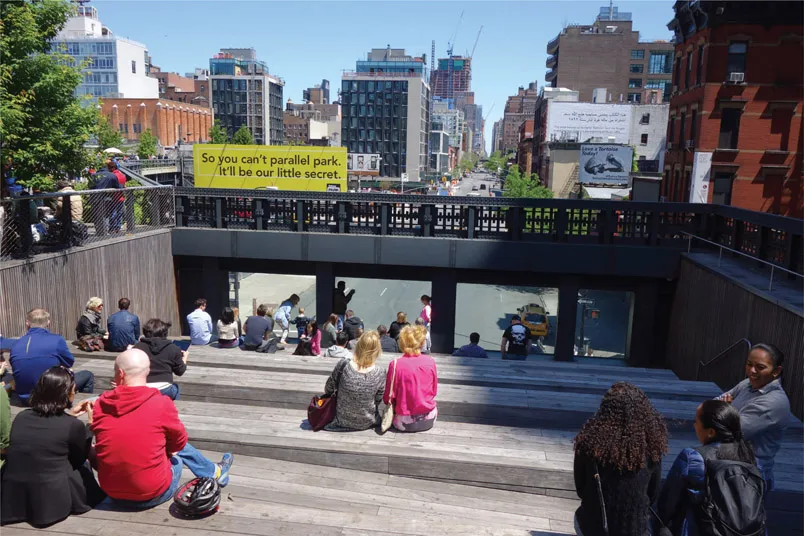
Figure 1.02 Looking at the city – The view from the High Line, New York
In 1960s America, the possibilities of the city in the school were clearly grasped by a child featured in Robert Coles’s essay ‘Those Places They Call Schools’, which appeared in a 1969 special issue of the Harvard Educational Review on the theme of architecture and education. Apart from having ‘everything’ such as a ‘movie theatre’ and home comforts,
From another point of view, the educational and social critic Ivan Illich argued in 1971 that schooling promoted a dependency which was the opposite of true education. Instead, he proposed the ‘deschooling’ of society: rather than being confined to a set curriculum and specific building, education might flourish best through the construction of networks of expertise whereby learning would happen through active engagement with those carrying out everyday tasks in the community.7
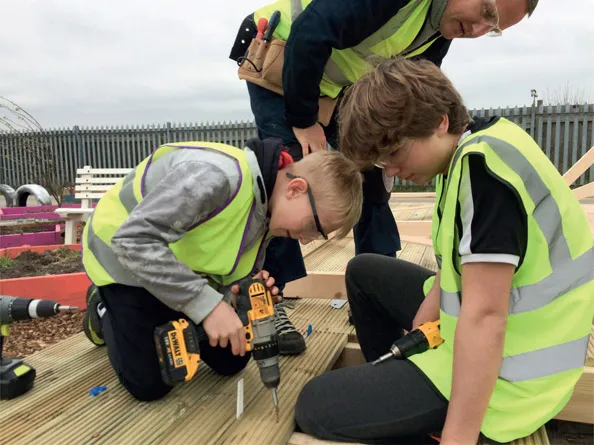
Figure 1.03 Architecture educators Matt+Fiona provide young people with opportunities to build their own learning spaces in the Made in Oakfield project, Hull
Children and young people who in 2001 contributed their ideas about how 21st-century education should be experienced agreed with Ward and Fyson that the school might move ever closer to the urban environment. From Jonathan, then aged 17
What are the barriers to implementing these reconfigured, reimagined educational environments? Were ‘school’ to ‘explode’ into the community, as Ward and Fyson envisaged, teaching and learning would happen primarily in the streets and neighbourhoods of our towns and cities, using the public facilities that were designed for community use, and perhaps some of the commercial facilities designed to support our economy. This would transform many things. The profession of teaching and the nature of training and development would by necessity be very different. The responsibility of the urban pedagogue would be to seek out opportunities to engage the whole community in projects that could enable young people to work together to help bring about positive change or to develop skills through involvement in initiatives within the local economy. Cities might become less places of consumption and more places of invention and creation. Could a ‘learning path’ be a physical experience in the city? Fifty years on, is digital technology now facilitating the scenario that Ward and Fyson imagined?
THE IMPACT OF DIGITAL
Digital technology, or ‘tech’, actually impacts physical space, despite its early perception as ‘cyberspace’. It displaces and transforms. It is having an ever more visible impact on the use and availability of space in our cities: entire job types and services – travel agents, department stores – occupy ever dwindling physical space in the heart of cities, partly due to digital transformation. Systems like Airbnb suggest a fluidity of use of physical space, via digital interfaces. The growth of app-enabled ride-sharing, car-sharing and soon autonomous vehicles all challenge the dominance of the hugely space-hungry private car in our mobility systems and, if handled strategically, could free up vast amounts of parking space and road space for other uses. Amidst all the noise, we should consider that these digital systems often replace, or ‘disintermediate’, the undifferentiated and generic, rather than the local and distinctive. Perhaps the only things that may be resilient to these global plays are the super-local and community-based: the independently owned store; the old model of the bottega as mini-factory (workshop in the back, shop in the front); or the ‘third place’ of library, or community centre, or kindergarten, or distinctive café – all of which you might find in a school.
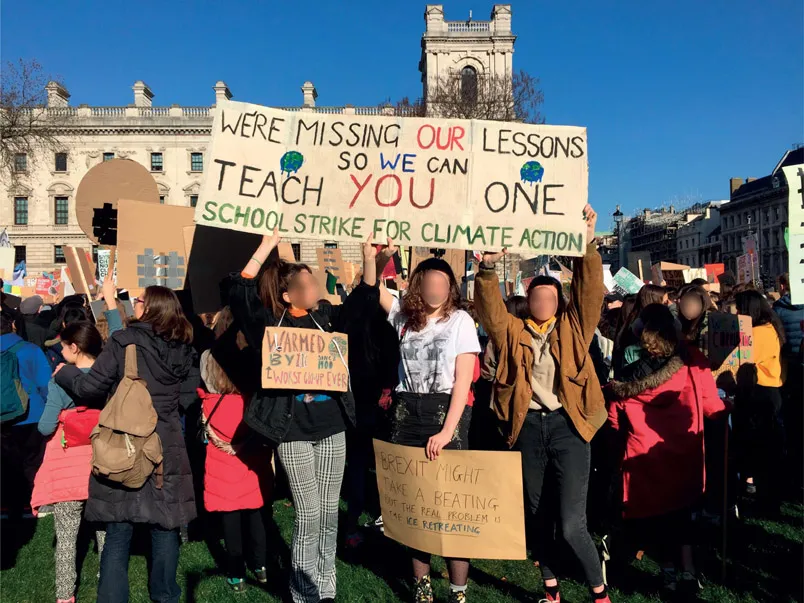
Figure 1.04 Children engaging with the city – UK Youth Strikes 2019
If one of the impacts of digital on our high streets has been to displace space and move retail out, it equally provides quicker and easier ways of filling those same streets. In the recent past, finding a vacant shop and turning it into a kindergarten would require significant time and patience, filling out apparently endless amounts of paperwork, and many administrative dead ends. Yet just as one can find and book a flight and hotel in a few clicks, without the assistance of a travel agent, it is increasingly easy to match demand to supply in terms of space. Projects like Renew Newcastle in Australia – in which otherwise vacant former retail premises were used to meet a demand for cultural spaces and workspaces – have shown how a small amount of digital assistance can support a community-led campaign and lead to a vastly increased and more diverse utilisation of space in what was previously a rapidly deteriorating town centre.9
The ‘flipped classroom’ is a model of schooling where the traditional learning environment is reversed by delivering instructional content, often online, outside the classroom and using the classroom for collaborative activities. In an underoccupied urban environment, could we create the ‘flipped school’? A school turned inside-out and dispersed into a city could be made more viable by embedding digital interactions in physical and natural ...
Table of contents
- Cover
- Title Page
- Copyright Page
- CONTENTS
- Foreword
- Acknowledgements
- Editors
- Contributors
- Introduction
- Chapter 1 The Dispersed School
- Chapter 2 Education and Global Urbanisation
- Chapter 3 Understanding the Urban School
- Chapter 4 Small People, Large Scale: The Early Learning Village, Singapore
- Chapter 5 Mixed-Use Developments
- Chapter 6 High-Rise Schools
- Chapter 7 Reuse, Repurpose, Share
- Chapter 8 The Connected Learner
- Chapter 9 The Urban Environment for Learning
- Chapter 10 Building Schools in Urban Environments
- Conclusions
- Notes
- Index
- Picture Credits
Frequently asked questions
Yes, you can cancel anytime from the Subscription tab in your account settings on the Perlego website. Your subscription will stay active until the end of your current billing period. Learn how to cancel your subscription
No, books cannot be downloaded as external files, such as PDFs, for use outside of Perlego. However, you can download books within the Perlego app for offline reading on mobile or tablet. Learn how to download books offline
Perlego offers two plans: Essential and Complete
- Essential is ideal for learners and professionals who enjoy exploring a wide range of subjects. Access the Essential Library with 800,000+ trusted titles and best-sellers across business, personal growth, and the humanities. Includes unlimited reading time and Standard Read Aloud voice.
- Complete: Perfect for advanced learners and researchers needing full, unrestricted access. Unlock 1.4M+ books across hundreds of subjects, including academic and specialized titles. The Complete Plan also includes advanced features like Premium Read Aloud and Research Assistant.
We are an online textbook subscription service, where you can get access to an entire online library for less than the price of a single book per month. With over 1 million books across 990+ topics, we’ve got you covered! Learn about our mission
Look out for the read-aloud symbol on your next book to see if you can listen to it. The read-aloud tool reads text aloud for you, highlighting the text as it is being read. You can pause it, speed it up and slow it down. Learn more about Read Aloud
Yes! You can use the Perlego app on both iOS and Android devices to read anytime, anywhere — even offline. Perfect for commutes or when you’re on the go.
Please note we cannot support devices running on iOS 13 and Android 7 or earlier. Learn more about using the app
Please note we cannot support devices running on iOS 13 and Android 7 or earlier. Learn more about using the app
Yes, you can access Urban Schools by Helen Taylor,Sharon Wright in PDF and/or ePUB format, as well as other popular books in Architettura & Architettura generale. We have over one million books available in our catalogue for you to explore.