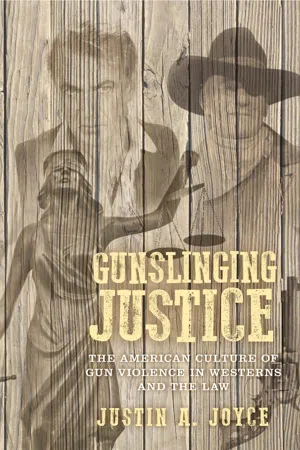
eBook - ePub
Gunslinging justice
The American culture of gun violence in Westerns and the law
- 264 pages
- English
- ePUB (mobile friendly)
- Available on iOS & Android
eBook - ePub
About this book
Gunslinging justice examines gun violence in Western films and literature alongside changes in justifiable homicide and gun rights in the United States.
Tools to learn more effectively

Saving Books

Keyword Search

Annotating Text

Listen to it instead
Information
1
‘A kind of wild justice’: revenge and constitutional commentary in the Western
John Huston’s 1972 film, The Life and Times of Judge Roy Bean, tells the story of an outlaw who sets himself up as a judge—the judge—in an ungoverned territory of western Texas. Markedly irreverent, the film is explicitly dedicated to raising myth over history, an agenda made clear by opening titles that declare, ‘Maybe this isn’t the way it was … it’s the way it should have been.’ ‘Judge’ Roy Bean (Paul Newman) administers a ruthless and unchecked style of ‘justice’ and law that consists largely of extorting fines and summarily hanging offenders for the most trivial of infractions. John Milius’s screenplay for the film is not the first dramatization of Bean’s legendary story, for Phantly Roy Bean, Jr was in fact a remarkable historical figure who presided as justice of the peace in Vale Verde County, Texas during much of the 1890s.1 Neither is the film unique in its derisive portrayal of Bean’s self-interested proclamation to be the ‘only law west of the Pecos,’ which provides the barest of justifications for his avarice and aggression. Several decades earlier, Walter Brennan portrayed a similarly scheming Bean to great comic effect in William Wyler’s 1940 film The Westerner. What stands out in Milius’s, Huston’s, and Newman’s interpretations of Bean, however, is the redemptive force of the vengeance that Bean exacts.
This vengeful version of Bean’s law is more complicated than the knowing satire or revisionist ethos that marked such contemporaneous Westerns as Blazing Saddles (1974) and Pat Garrett and Billy the Kid (1973), for Bean’s revenge is represented in several ways. On the one hand, Bean’s wrath is first depicted here as a foundational act of violence which grounds ‘the law.’2 Accosted by local toughs upon his arrival in the whimsically named town of Vinegaroon, Bean is robbed, lynched, and left for dead, only to revive and return, killing nearly a dozen people so that he may then enshrine himself as a figure cloaked in the thinnest rhetoric of law to keep order in the territory (see Figure 1). On the other hand, Bean’s rage is depicted as a necessary supplement to legal order; his extortion and intimidation tactics are shown to spur development, as the rugged and barren landscape is transformed in montage into an ostensibly ordered municipality. The railroad then brings mediated legal administration in the form of a lawyer with the Dickensian name of Gass (Roddy McDowall), who not only supplants Bean as mayor but also discovers oil, a discovery that transforms the area into a bustling metropolis replete with land and commodities financing, cars (again, the film is set in the 1890s), and gang warfare. Bean’s response to this ‘development’ is the most keenly felt, most affectively forceful, and most interesting representation of his rage in the film.

1 Paul Newman as Judge Roy Bean in The Life and Times of Judge Roy Bean, 1972
As it happens, Bean’s saloon sits atop an oil reserve and Gass’s henchmen attempt to wrest the property away from him. When they descend on the saloon Gass’s hired guns ask Bean to identify himself. He passionately declares that he is ‘Justice, you sons of bitches!,’ and proceeds to lead an attack on Gass that literally destroys Vinegaroon. An unapologetically populist and nostalgic vengeance erupts in the film’s penultimate scene: horses triumph over cars, grizzled cowboys in rugged clothes wielding pistols defeat slickly uniformed mercenaries armed with submachine guns, and a lone Bean on horseback rides over Gass before the two are engulfed in flames and the exploding oil wells come crashing down as fire overwhelms the town. As the flames fade out we are shown a few dilapidated buildings and an almost deserted settlement, the voice-over narrator informing viewers that ‘the wells dried up, the desert took back what was once its own.’ Here, perhaps, lies the real force of the film’s opening historical revisionism: Bean as the incarnation of ‘Justice,’ destroying the oil business, triumphing over technological progress, vaulting the mediations of legal procedure, consigning the corruption of the moneyed Eastern interests to the barren desert, the film suggests, is the way it ‘should have been.’
What is most interesting about Bean’s apocalyptic rage here is the empathetic structure of feeling created around his acts of revenge. Bean’s initial killings are easily justified because he was attacked and robbed. Moreover, Bean’s admittedly self-interested administration of ‘law’ in the town of Vinegaroon does indeed provide a sense of stability and order, however perverse this order may appear to the modern eye. Further still, Bean’s vision of developing the land for emergent commerce is certainly concomitant with a progressive vision of American capitalism, even if it is short-sighted about the coming transformations wrought by industry and financial speculation. Finally, by pitting Bean against the Eastern oilman, the film aligns him with a longstanding populist and parochial tradition in the genre.3 In summary, Bean’s rages that viewers witness over the course of the film are presented in the context of a series of rhetorical flourishes and emotional appeals to core civic values. Weighed against these cherished values, his circumvention, manipulation, and defiance of the technicalities of ‘the law’ are not nearly evil enough to make him completely villainous. The racist and sexist Bean still emerges as an erstwhile ‘hero’ in this otherwise quite conservative film.
It would be tempting to say that Bean’s climactic triumph, a portrayal endemic—perhaps even systematic—within the Western genre, is, due to its populist rhetoric, satisfactory despite the violence. In fact, however, the genre’s notion of heroism depends on this seemingly wild violence. Put another way, Bean and the vast majority of Western gunslingers are heroes precisely because of their vengeful tendencies. In The Culture of Vengeance and the Fate of American Justice Terry K. Aladjem has suggested that ‘when Americans say they want justice, they want something angry and punitive.’4 On his view, American society is caught between two images of justice, a legal system focused on procedural safeguards and processes that purport to remove personal biases—especially, but not limited to, vengeful feelings—and a popular culture that for over a century has insisted that a satisfactory sense of justice is best delivered via a gun. Although the Western genre is largely missing from Aladjem’s account of American popular culture, his notion of American popular culture as ‘angry’ and ‘punitive’ is perfectly encapsulated in the figure of Judge Roy Bean outlined above. What makes this gunslinger’s ‘justice’ so satisfactory is precisely that it is personal, swift, precise, and conclusive. The thrill of Western gun violence lies in its decisive resolution of seemingly irresolvable conflicts.
This focus on the depiction of Bean as a sympathetic avenger is meant to train our attention on this important aspect of the genre, namely, its status as a drama of revenge. Despite dismal box-office returns—due in no small part certainly to the film’s blatant sexism—The Life and Times of Judge Roy Bean is a typical example, for revenge is often an integral motivation for heroic violence within the Western. The film’s portrayal of Bean’s manipulation of the rhetoric of ‘the law’ is part and parcel of the genre’s imagination of justifiable violence and the idea of the Western’s gunslinging hero as a critique of the American legal system. The Western genre, I argue, represents a critical juncture between American legal and cultural ideologies. Although the codified and mediated American legal system may well, as Stanley Fish has suggested, wish to have a formal existence, it nonetheless shares many of the rhetorical strategies of our popular cultural traditions. The argument here is not mimetic but instead an attempt to unravel the complex interrelationship between ostensibly distinctive discursive fields which underwrite our social understanding of justice.
The seeming disparity between revenge and justice is an ancient one. Both revenge and justice address an initial injury and mete out subsequent punishment, but the distinction between the two lies in the method. In short, ‘revenge’ has traditionally been viewed as excessive, passionate, unrestrained, and an incitement to more and often escalating violence; ‘justice,’ in opposition to revenge, has been viewed as equitable, dispassionate, restrained, a more circumscribed exercise of punishment. Revenge has thus long had a negative connotation, perhaps the best example being the biblical injunction of an ‘eye for an eye’ found in Exodus and Leviticus.5 These infamous passages, with their extensive listing of bodily punishments, lend the pejorative connotation to the phrase ‘Old Testament vengeance,’ and have long been thought to promote a system of blood revenge crueler and less restrained than a modern legal system. Although commonly thought of as a more ruthless sort of equity than a modern system of punishment that declines to sever, dismember, and distribute bodies as recompense, it is important to note that the calculus embodied in the lex talionis actually sought to limit excessive punishment. In other words, the injured party was advised to take only an eye, only a tooth, and so on, depending on the crime.6
Despite the delimiting intent of the lex talionis, the disparity between revenge and justice is enshrined in Francis Bacon’s notion of revenge as a kind of ‘wild justice’ which ‘putteth the law out of office.’7 Bacon’s famous equation deserves further consideration here, for he does not strictly oppose revenge to justice. In his formulation the difference is one of degree and not of kind—for revenge is but a ‘wild’ sort of justice. The main threat imposed by revenge, for Bacon, is not that justice would fail to be served, but rather that revenge is unrestrained and therefore anathema to the rational calculus of ‘the law.’ This is further clarified when he notes that ‘the most tolerable sort of revenge is for those wrongs which there is no law to remedy.’8
Where there exists a legal system to remedy a wrong, however, revenge is seen as abhorrent chiefly because it is direct and personal, qualities that a mediated and disinterested legal system seeks to cull from the administration of punishment. This sense of the personal and immediate nature of revenge as threatening to a legal order is by no means isolated to Bacon. As Susan Jacoby notes in her wide-ranging study of revenge themes in literature and culture, ‘One measure of a civilization’s complexity is the distance between aggrieved individuals and the administration of revenge.’9 This distance is precisely the mediation and procedural complexity enshrined in modern, European-style legal systems that seek to remove punishment from the aggrieved party in the hope of thereby establishing a more objective and proportional system for redressing injuries.
While the distance between injury and punishment may indeed be a measure of a civilization’s complexity, this distance has also long been felt as deracinating justice, bleeding some of the satisfaction that aggrieved parties take from it. As the legal scholar William Ian Miller has pointed out, ‘justice, if it means anything, means having people feel the sense of it. The ultimate legitimacy of institutions charged with administering justice depends on this sense.’10 Miller goes on to suggest that whenever justice is not ‘felt’ in the administration of punishment, there is ‘demoralization, despair, [and] cynicism,’ but he neglects to mention a great flourishing of cultural entertainments.11
Numerous works explore this distance between legal administration and the public’s sense of what constitutes ‘justice.’ Within the American context, accounts which seek to redress the current justice system to accommodate personal retribution include Charles K. B Barton’s Getting Even: Revenge as a Form of Justice (1999) and Peter A. French’s The Virtues of Vengeance (2001).12 Aladjem’s The Culture of Vengeance represents a more measured study, as his conceptualization of the American justice system’s inability to account for what he terms ‘the rage in grief’ leads him to explore the contradictions inherent in a ‘system of justice that denies vengeance, and a culture that is utterly obsessed with it.’13 In other words, the distance between the administration of punishment and a felt system of justice is also inherently productive, a generative space within which mass entertainments negotiate the social tension constituted by this distance. If people feel that justice is not being served in their legal system this feeling has often been accommodated in their cultural entertainments. Reconciling, howsoever imaginatively or fantastically, this space, this gap between ‘the law as it is and law as it should be,’ is one of the functions of popular culture.14
One such cultural tradition that has been productively read as indicating the anxieties expressed in a contemporaneous legal system is Early Modern theatre. Numerous commentators have identified ways in which Elizabethan and Jacobean revenge drama bears witness to anxieties over the shifting power relations caused by...
Table of contents
- Cover
- Half Title
- Title Page
- Copyright
- Contents
- Figures
- Acknowledgements
- Introduction: the warp, woof, and weave of American gun violence
- 1 ‘A kind of wild justice’: revenge and constitutional commentary in the Western
- 2 No retreat: American self-defense doctrine
- 3 American gun rights: from national defense to self-defense
- 4 The guns that ‘won the Western’: firearm iconography in Western literature and film
- 5 Guns and governmentality: normative masculinity and disciplined gun violence
- 6 ‘Deserve’s got [everything] to do with it’: property, process, and justice in Unforgiven
- 7 Old dogs and new tricks: race and justifiable homicide in neoliberalism’s Western imagination
- Bibliography
- Index
Frequently asked questions
Yes, you can cancel anytime from the Subscription tab in your account settings on the Perlego website. Your subscription will stay active until the end of your current billing period. Learn how to cancel your subscription
No, books cannot be downloaded as external files, such as PDFs, for use outside of Perlego. However, you can download books within the Perlego app for offline reading on mobile or tablet. Learn how to download books offline
Perlego offers two plans: Essential and Complete
- Essential is ideal for learners and professionals who enjoy exploring a wide range of subjects. Access the Essential Library with 800,000+ trusted titles and best-sellers across business, personal growth, and the humanities. Includes unlimited reading time and Standard Read Aloud voice.
- Complete: Perfect for advanced learners and researchers needing full, unrestricted access. Unlock 1.4M+ books across hundreds of subjects, including academic and specialized titles. The Complete Plan also includes advanced features like Premium Read Aloud and Research Assistant.
We are an online textbook subscription service, where you can get access to an entire online library for less than the price of a single book per month. With over 1 million books across 990+ topics, we’ve got you covered! Learn about our mission
Look out for the read-aloud symbol on your next book to see if you can listen to it. The read-aloud tool reads text aloud for you, highlighting the text as it is being read. You can pause it, speed it up and slow it down. Learn more about Read Aloud
Yes! You can use the Perlego app on both iOS and Android devices to read anytime, anywhere — even offline. Perfect for commutes or when you’re on the go.
Please note we cannot support devices running on iOS 13 and Android 7 or earlier. Learn more about using the app
Please note we cannot support devices running on iOS 13 and Android 7 or earlier. Learn more about using the app
Yes, you can access Gunslinging justice by Justin A. Joyce in PDF and/or ePUB format, as well as other popular books in Law & Legal History. We have over one million books available in our catalogue for you to explore.