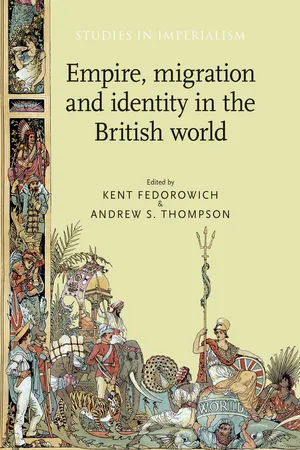
eBook - ePub
Empire, migration and identity in the British World
- 275 pages
- English
- ePUB (mobile friendly)
- Available on iOS & Android
eBook - ePub
Empire, migration and identity in the British World
About this book
The essays in this volume have been written by leading experts in their respective fields and bring together established scholars with a new generation of migration and transnational historians. Their work weaves together the 'new' imperial and the 'new' migration histories, and is essential reading for scholars and students interested in the interplay of migration within and between the local, regional, imperial, and transnational arenas. Furthermore, these essays set an important analytical benchmark for more integrated and comparative analyses of the range of migratory processes – free and coerced – which together impacted on the dynamics of power, forms of cultural circulation and making of ethnicities across a British imperial world.
Information
Publisher
Manchester University PressYear
2015Print ISBN
9781526106704
9780719089565
eBook ISBN
9781526103222
CHAPTER 1
Malthus and the uses of British emigration
The dynamics of emigration
The British World, in its most basic origins, started with people moving along country lanes from cottages in the towns and villages of rural Britain. This movement extended across several centuries and ultimately stretched across the globe. It reached its flood tide in the middle decades of the nineteenth century, when it became increasingly an urban phenomenon.1 How exactly it was activated remains largely a mystery.
In his seminal work on the Atlantic world at the end of the eighteenth century, Bernard Bailyn speculated about the grand, almost tectonic forces that impelled vast movements of people within the three connecting continents and across the ocean itself. In a series of scintillating metaphors Bailyn imagined the Atlantic basin being convulsed into intercontinental flows of human beings over a territory that stretched from Luanda to Shetland, and from the Danube to the Mississippi.2 These dynamic mechanisms are still obscure and have not yet been absorbed into the general literature.
A similar imaginative challenge is required of the even larger idea of the ‘British World’. In this case the British spread themselves territorially over a global scale. The fact is that we have relatively few clues about the underlying dynamics of that great diasporic process, that is, the articulation of the grand movements of emigrants from the British Isles who eventually numbered tens of millions, greater even than the black slave trade in the Atlantic.
What ultimately animated these out-seeking people? It was evidently a complicated and long-term shifting process that had more than a single connecting cause. It was obviously more than a simple extrusion of population from the land. But the disengagement of people from rural society was a common prior requirement in the arousal of mobility in Britain as elsewhere. We also have a rather poor grasp on the ways in which the exodus of perhaps thirty million British migrants affected Britain itself. Moreover, despite unprecedented emigration and renewed imperialism, in population terms most of the ‘British World’ remained within the British Isles.
Upon these large spheres Thomas Robert Malthus (1766–1834) continues to cast his ghostly influence. Malthus was an equivocal advocate of emigration. He was, nevertheless, immensely influential among those who urged emigration as a solution to the problems of poverty, destitution and over-population across the British Isles in the nineteenth century. Their idea was to populate the British World while simultaneously relieving the British Isles of its excess population. In the outcome Malthus’s predictions about emigration were not wellborne out and their applicability in the new industrial world is now generally discounted.
Yet there were certainly regions in each of the home countries which were caught in severely negative conditions and where labour supply outran the long-term possibilities of employment. The efficacy of migration as a means of relief, in terms of Malthusian doctrine, is the central issue in this essay. Malthus offered a surprisingly wide range of propositions on the question and these are re-examined in terms of the timing, dynamics, diversity and psychology of emigration from the British Isles in the nineteenth century. Malthus and his reputation provide a convenient peg for two connected issues which had a fundamental bearing upon the making of the British World. One is the manner in which Malthusian doctrine related to emigration; the other is the overhanging problem of rural evacuation in the nineteenth-century economy.
Malthusian predictions
Malthus’s most famous propositions on emigration related to the short run and were concerned with the utility or otherwise of emigration as a means of relieving the pressure of population on subsistence. His prescriptions were connected with his broad principle that population tended always to expand to the limits of subsistence unless other influences actively intervened. The evolution of his thinking on emigration occurred in a critical context – namely the volatile conditions in Britain during the Napoleonic Wars and especially in the years after Waterloo when constricted demand for labour caused serious mass unemployment in most sectors of the economy. In these circumstances, in 1817, Malthus was prepared to allow that ‘emigration is most useful as a temporary relief’, and could be used to reduce the adjustment required until population would ‘conform itself to the state of the demand for labour’. Nine years later he repeated his earlier proposition, that: ‘A certain degree of emigration is known to be favourable to the population of the mother country.’3
The essential point was that emigration could exert a benefit only in a strictly temporary fashion; it could not provide any permanent relief to society’s woes. Emigration alone was entirely inadequate to affect the level of population; it could not reduce the population permanently and consequently would never lead to depopulation. As he expressed it: ‘There are no fears so totally ill-grounded as the fears of depopulation from emigration.’4 It was, however, marginally useful ‘as a partial and temporary expedient’. And emigration, incidentally, would help to spread the benefits of civilisation and ‘the more general cultivation of the earth’.5
In 1827, in his famous explication before the Emigration Committee of Parliament, he argued that the ineffectiveness of emigration as a permanent remedy was a consequence of the much repeated ‘vacuum effect’6 – that the space released by the removal of emigrants was inevitably replenished by a subsequent regrowth of population, facilitated by the return to subdivision of the land holding and early marriages and followed by a further round of ‘prolificness’. As Malthus put it: ‘There is always a natural tendency towards the filling up of a vacuum’, which would render the effect of emigration ‘nugatory’.7 And again ‘there is always a very strong tendency to fill up the vacuum; and you might even encourage a greater proportion of births by an emigration, unless it were accompanied by some measures of the kind before referred to.’8 Malthus was alluding especially to Ireland and the Scottish Highlands but also the feared inundation of England by destitute Irish. He was prepared to allow that the refilling of the vacuum could be diminished if people were prevented from reoccupying the land from which the emigrants had departed. This would be accomplished by the prohibition of sub-division and the literal destruction of houses and cottages previously occupied by the departed emigrants. As he put it: ‘I think it is possible that the vacuum might not be filled up, because those miserable hovels that had been deserted might be pulled down and not be replaced.’9 This would ‘be something like an effectual remedy’ because it would deter early marriages, which were the root of the evil.10
This was the Malthusian doctrine of emigration in its limited role as a palliative.11 In the British experience of emigration in the nineteenth century it is now utterly clear that the record was highly varied, but that many parts of the country did indeed register permanent reduction in population levels and that the vacuum effect was eventually shown to be inoperative in practice. This was true of very large rural tracts of the country; it was also eventually true of the two sites to which Malthus particularly pointed. The population of the Highlands began to fall absolutely after 1851; and, most sensationally, the population of Ireland fell like a stone after the Great Famine and did not begin to recover for another hundred and fifty years. Emigration was part of the cause; emigration indeed diminished population and the vacuum simply did not work in the manner Malthus predicted.
Even more fundamentally for Malthusian predictions, the population of the British Isles as a whole rose cumulatively for 200 years, from the early part of the nineteenth century, and this period was clearly associated with rising living standards. The wrongness of Malthus seems to be complete. Indeed, when in mid-2005, the 125th anniversary issue of Science magazine rank-ordered the really ‘Big research questions’ of the day, it identified number twenty-five as: ‘Will Malthus continue to be wrong?’12
Nevertheless, the influence of Malthus caused his contemporaries and their immediate successors to dismiss emigration as a relieving mechanism on the demographic pressures of the day. According to Mark Blaug this was ‘a generation drunk on Malthusian wine’.13 Thus Herman Merivale, in this Lectures on Colonisation in 1839–41, cited the well-known case of the Isle of Skye from which 8,000 of a total population of 11,000 emigrated in the late eighteenth century. Yet within a generation Skye had recouped its original numbers, which then proceeded to grow much further. This seemed to be a perfect example of the Malthusian vacuum effect. It encouraged generalised scepticism about the possible benefits of large-scale emigration, even from Ireland. In the outcome Merivale lived to witness the impact of the Great Famine and, in the post-famine edition of his lectures in 1861, he conceded that emigration had hugely reduced the Irish population; and emigration certainly helped to sustain its gradual betterment over the following century.14 In the case of the Isle of Skye, its population history followed a similar path, rising until 1851 and then beginning at last its long, continuous decline.15
It can be argued that there is a let-out clause for Malthus particularly if we consider his doctrine in its longer-run mode. One school of thought claims that there was less rigidity and less pessimism in Malthusian doctrine than is conventionally thought. Malthus was not saying that humanity was doomed forever to retreat to bedrock subsistence and misery.16 He was just as emphatic that the supplies of subsistence could be increased. J. J. Spengler for instance, says that Malthus was a Smithian and believed that urban and industrial development would ultimately increase ‘the expandability of employment’, which would lead to a better balance of population with subsistence. How much flexibility this permitted in the Malthusian framework is not entirely clear. But it is worth consulting a lineal descendant of Malthus, the economist J. M. Keynes, who had interesting things to say about the course of growth in the nineteenth-century world. Keynes regarded the great expansion of trade, settlement and migration as the engine of development in the long Victorian era. But when the territorial expansion of the European people seemed to reach its geographical limits by 1914, Keynes was pessimistic. He sensed the end of the extended Malthusian limits. This was one of his recurrent themes in the 1920s and 1930s, causing him to be greatly dispirited about, in essence, the future supply of food. This, of course, had been a vital element in the great age of emigration, much of it in the form of the extension of the British World.17
Thus there is some doubt, which is not unusual, about the implications of Malthus’s prescriptions with regard to the emigration variable. But there is no doubt about the story of economic growth and ultimately the rising living standards during the Victorian Age – which is a recognition of the success of the supply side that he had emphasised. Indeed, emigration was certainly a vital component in the widening scale of British production around the world.
The social psychology of emigration
Malthus was a keen observer of the course of emigration from the British Isles at the end of the eighteenth century. Apart from his principal theoretical propositions on the subject he was also fascinated by the social psychology of migration, although these elements in his thinking have been somewhat neglected. He was clear-minded about the essential differential that was required to induce emigration. Thus in the 1798 exposition, he remarked that ‘a great emigration necessarily implies unhappiness of some kind or other in the country that is deserted’, some serious uneasiness to justify the loss of ‘families, connections . . . and native land’ to take up a new life ‘in untried foreign climes’. But he also acknowledged the ‘hope of some great advantage’ in the new place.18 He emphasised the risk factor in any kind of emigration, noting that ‘the emigrant, impatient of the distresses which he feels in his own country, is by no means secure of finding relief in another’.19
Here his emphasis is on the reluctance to emigrate, the inertia of rural people – of ‘how much misery and hardship men will undergo in their own country, before they can determine to desert it’ – and how even the most tempting settlements were rejected ‘by people who appeared to be starving’.20 Malthus probably had in mind the Irish and the Highland peasantries. It was a theme to which observers of even the English rural...
Table of contents
- Cover
- Half Title
- Title Page
- Copyright
- Contents
- List of tables
- Notes on contributors
- General editor’s introduction
- Acknowledgements
- Introduction: Mapping the contours of the British World: empire, migration and identity
- 1 Malthus and the uses of British emigration
- 2 ‘Sprung from ourselves’: British interpretations of mid-nineteenth-century racial demographics
- 3 Religious nationalism and clerical emigrants to Australia, 1828–1900
- 4 Resistance and accommodation in Christian mission: Welsh Presbyterianism in Sylhet, Eastern Bengal, 1860–1940
- 5 Asian migration and the British World, c. 1850–c.1914
- 6 Righting the record? British child migration: the case of the Middlemore Homes, 1872–1972
- 7 Travelling colonist: British emigration and the construction of Anglo-Canadian privilege
- 8 ‘Dear Grace . . . Love Maidie’: interpreting a migrant’s letters from Australia, 1926–67
- 9 Staying on or going ‘home’? Settlers’ decisions upon Zambian independence
- 10 ‘I’m a citizen of the world’: late twentieth-century British emigration and global identities – the end of the ‘British World’?
- 11 Multiculturalism, decolonisation and immigration: integration policy in Britain and France after the Second World War
- Index
Trusted by 375,005 students
Access to over 1.5 million titles for a fair monthly price.
Study more efficiently using our study tools.
Frequently asked questions
Yes, you can cancel anytime from the Subscription tab in your account settings on the Perlego website. Your subscription will stay active until the end of your current billing period. Learn how to cancel your subscription
No, books cannot be downloaded as external files, such as PDFs, for use outside of Perlego. However, you can download books within the Perlego app for offline reading on mobile or tablet. Learn how to download books offline
Perlego offers two plans: Essential and Complete
- Essential is ideal for learners and professionals who enjoy exploring a wide range of subjects. Access the Essential Library with 800,000+ trusted titles and best-sellers across business, personal growth, and the humanities. Includes unlimited reading time and Standard Read Aloud voice.
- Complete: Perfect for advanced learners and researchers needing full, unrestricted access. Unlock 1.5M+ books across hundreds of subjects, including academic and specialized titles. The Complete Plan also includes advanced features like Premium Read Aloud and Research Assistant.
We are an online textbook subscription service, where you can get access to an entire online library for less than the price of a single book per month. With over 1.5 million books across 990+ topics, we’ve got you covered! Learn about our mission
Look out for the read-aloud symbol on your next book to see if you can listen to it. The read-aloud tool reads text aloud for you, highlighting the text as it is being read. You can pause it, speed it up and slow it down. Learn more about Read Aloud
Yes! You can use the Perlego app on both iOS and Android devices to read anytime, anywhere — even offline. Perfect for commutes or when you’re on the go.
Please note we cannot support devices running on iOS 13 and Android 7 or earlier. Learn more about using the app
Please note we cannot support devices running on iOS 13 and Android 7 or earlier. Learn more about using the app
Yes, you can access Empire, migration and identity in the British World by Kent Fedorowich,Andrew S. Thompson,Andrew S. Thompson, Kent Fedorowich, Andrew S. Thompson in PDF and/or ePUB format, as well as other popular books in Social Sciences & Marketing. We have over 1.5 million books available in our catalogue for you to explore.