eBook - ePub
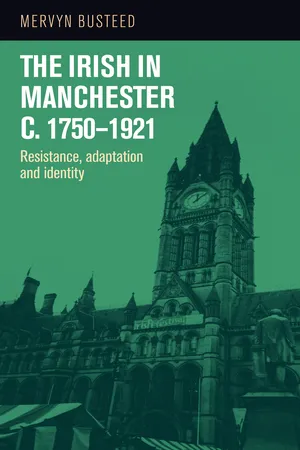
The Irish in Manchester <i>c</i>.1750–1921
Resistance, adaptation and identity
- 286 pages
- English
- ePUB (mobile friendly)
- Available on iOS & Android
eBook - ePub
About this book
This book examines the development of the Irish community in Manchester, one of the most dynamic cities of nineteenth-century Britain. Based on research into a wide variety of local sources, it examines the process by which the Irish came to be blamed for all the ills of the Industrial Revolution and the ways in which they attempted to cope with a sometimes actively hostile environment. It discusses the nature and degree of residential segregation in one notable Irish district and the role of the Catholic Church as a source of spiritual comfort and the base for a dense network of mutual aid and social and cultural organisations. It also examines how the Irish community allied itself with local campaign groups and political parties and organised celebrations and processions that simultaneously expressed its evolving sense of Irishness but fitted in with local traditions and customs.
Information
Publisher
Manchester University PressYear
2015Print ISBN
9781526134356
9780719087196
eBook ISBN
9781784996376
1

Early connections, ‘Little Ireland’ and stereotypes
This chapter will trace the development of the earliest links between Manchester and Ireland and, noting the growth of military and commercial connections, the build-up of a resident Irish-born population down to 1841. It will then discuss the development of the Irish neighbourhood of ‘Little Ireland’, the role of Dr James Phillips Kay and other writers in presenting it as the archetypical Irish quarter in Britain and the renewal of historic anti-Irish sentiment in mid-Victorian Britain.
Early connections
From at least the early sixteenth century there are indications of commercial links between Manchester and Ireland. John Leyland, visiting Liverpool in 1530, remarked, ‘Good merchandise at Lypol, and much Irish yarn that Manchester men do by there’, though the precise nature of this ‘yarn’ is not specified.1 A hundred years later cotton working was firmly established in Manchester, but there were recurring problems with yarn, which was not strong enough to be used as the warp. The solution was to mix cotton with linen yarns, thereby producing a hybrid material known as fustian. In 1641 it was noted that a two-way trade had developed, an observer describing how ‘the town of Manchester buys the linen yarn of the Irish in great quantity and weaving it returns the same again to Ireland to sell’.2 It was noted that ‘Where theses Irish merchants haggled over their linen yarn, near Smithy Door, was known as the Patrick Stone’.3
Commercial links continued to develop, but the emphasis shifted as fast-growing Manchester became an increasingly significant market for Irish agricultural produce. The eighteenth century saw the growth of an extensive Irish provisions trade, involving the export of butter, cheese, salt beef, pork, fish and ship’s biscuit. For some time legislation blocked the import of these Irish products into Britain and Irish producers turned to alternative markets in the British royal and merchant navies, France and the slave plantations in the West Indies. However, the legislative barriers were gradually removed and Manchester drew an increasing amount of its food from Ireland. The ban on Irish live cattle imports was repealed in 1759 and a trade in Irish cattle destined for final fattening and slaughter in Britain grew up. Following the close of the wars with France in 1815 this grew appreciably in volume and altered in nature, thanks to transport developments. The first regular passenger steam service across the Irish Sea began in June 1818 and a regular commercial link was inaugurated in 1824.4 By the 1840s there were over a hundred crossings per week for passengers and goods. A voyage that previously took a week or even more in adverse winds now on average took fourteen hours, and subsequent competition between steamship companies reduced costs. The cattle trade between Ireland and Liverpool grew rapidly and was soon dominated by animals fattened in Ireland and ready for slaughter on arrival. In the late 1830s Manchester’s meat market was dominated by Irish produce, and large numbers of pigs and, to a lesser extent, sheep also made the journey.5 Development of rail services meant that increasing amounts of Irish butter, bacon, ham, potatoes, cheese and salmon also began to appear in Manchester markets and shops. One commentator observed that for half of the year only Irish produce was available, and dealers in Co. Sligo butter alone had ten shippers in the city.6 By the 1840s the city’s Irish trade had become such a feature that it figured in a broadside ballad:
The Port of Manchester – A Yarn
The Union flag is flying,
By the Company’s Wharf, Old Quay,
And ‘Mary’ of Dublin lying,
Unloading her Murphies today
Should your chickens all turn out
And refuse eggs to lay;
Why, then- fresh laid ones you may have
From Dublin every day
You’ll have POTATOES, PIGS AND MEAL,
And butter in such plenty,
That none but lunatics will steal-
The New Bailey will be empty 7
Traffic in people across the Irish Sea was doubtless as long established as trade in goods. As early as 1243 there was such national concern at the numbers of Irish vagrant poor in Britain that legislation authorised their expulsion.8 Its subsequent repetition underlines the persistence of the problem. Returns from local authorities and charities indicate their presence in Manchester. The Constables’ Accounts for Manchester list a succession of payments to distressed people travelling from and to Ireland. On 2 December 1634 there was a payment of six pence ‘to 2 Irish women & a boy yt went to London per pass’.9 There was a notable increase in payments in the early 1640s, reflecting the 1641 rising and the subsequent years of instability. In late 1641 the widow Elizabeth Parsiual was paid 2s 6d for the nine Irish who had lodged with her, and on 23 February 1642 ten pence was paid out ‘for burying a child & bying a winding sheet came from Ireland’.10 Subsequently the emphasis shifted back from wartime refugees to people who were simply in want, as in the case of the shilling given on 1 March 1755 to ‘Ann Greaves to Ireland child dead’.11 There are also changes in terminology, as with the shilling paid ‘To two trampers going to Ireland’ on 25 October 1772.12 Some observers were convinced that such charity did not best serve the interests of the city. When in 1811 local magistrates suggested that indigents should receive three shillings per week, those in charge of disbursements retorted that ‘most, even of the Irish, would not expect so much’.13 Thomas Armitt, Manchester’s visiting Poor Law overseer, giving evidence to the commissioners investigating the state of the Irish poor in Great Britain, argued that local charities drew ‘a vast number of Irish and idle vagabonds from all parts’.14
Manchester’s military links with Ireland were long established. There were constant demands on the city for men and supplies, especially in the closing years of the sixteenth century in the campaigns leading up to the final conquest of Ireland.15 Court Leet records for 1579–80 note: ‘paid to the hands of Sr. Edmud Trafford and Mr. Edmud assheton ffor the making of soldiars into Ireland £16’.16 This was the first of a series of such levies, and another in July 1613, when £3 7s 11d was raised, hints at the burden they imposed: ‘The various garrisons in Ireland required constant reinforcement, and special money was collected for that purpose.’17 Inevitably, there were casualties. In 1598 a local man, Captain William Radcliffe, was killed when campaigning in Ulster, and in August the following year his brother Sir Alexander died when the Earl of Tyrone defeated an English force in the Curlieu Hills of Co. Roscommon. Manchester’s efforts were not always appreciated. In 1599 it was reported: ‘On raising men to suppress the rebellion in Ireland. The magistracy of Manchester were cautioned not to send any vagabonds or disorderly persons, but young men of good character, who were well skilled in the use of the hand-gun.’18 Veterans of the Irish wars were frequent recipients of local charity. On 29 March 1618 a shilling was given to ‘a poore Souldier who had a pass under the Lo[rd] Deputye of Ireland … to travaile to york’, and on 18 June 1745 the same was given to ‘Alex McKie and his wife from Royal Irish Dragoon’.19
By the second half of the eighteenth century it is clear that there was a constant flow of army regiments to and from Ireland. On 23 May 1772 a local newspaper noted, ‘Major General Mackay reviewed the sixth or Inniskilling Regiment of Dragoons, now quartered in this town, commanded by the Hon. General James Chomondele’; the Constables’ Accounts for June note 21s for quartering and on 28 September £5 10s ‘for rent of a music room for Inniskilling Dragoons’.20 Other Irish regiments based in the area included the Irish Fusiliers (87th Regiment), who marched to Mass at St Augustine’s Catholic church on St Patrick’s Day 1830 ‘preceded by their band playing “St. Patrick’s Day in the Morning”’.21 The 1851 census recorded several examples of Irish-born soldiers on furlough on census night, such as Corporal Edward Duggan of the 31st regiment at 22 Cable Street. The same source also records the presence of Irish-born ‘pensioners’ or ex-soldiers, such as Ernest (or James) Cleary of 12 Gould Street, formerly of the 88th regiment, the famous Connaught Rangers, reflecting the fact that discharged soldiers often settled in the garrison towns where their enlistment had expired. But the Irish also served in other regiments, and in the early nineteenth century the majority of recruits to the 47th Foot (Lancashire Regiment) were Irish-born. This reflects the fact that by the mid-Victorian period it has been estimated that 30% of the regular army were Irish-born, with an even higher proportion in the rank of regimental sergeant major and below.22 Local regiments also served in Ireland, especially during the wars against revolutionary and Napoleonic France. On 21 August 1794, when the Royal Manchester Volunteers (104th regiment) were inspected by General Musgrave, ‘Colours were presented to the regiment in St. Anne’s Square, after which it marched to Liverpool to embark for Ireland’, and in 1801 ‘the Earl of Wilton’s regiment of Lancashire Volunteers returned from Ireland, where they had been doing duty for five years’.23
Migrant harvesters were another traditional and transitory element in Manchester’s Irish population. From the late eighteenth century onwards increasing numbers of Irish made the journey to Britain to help with the harvest, most coming from the north-western counties of Roscommon, Mayo and Galway.24 By the mid-nineteenth century there was a well-established pattern of locally recruited groups travelling under acknowledged leaders to Britain, where they worked their way across the country in the summer months, living in outhouses and temporary booths, following the harvests of hay, potatoes, grain crops and hops and scathingly referred to by locals as ‘July barbers’.25 The process was reflected in several ballads:
Billy O’Rook the Boy
I greased my brogues and cut my stick
At the latter end of May, sir
And off for England I set out
To sail upon the sea, sir
To reap the hay and corn, sir … 26
As for transport, another ballad recorded Pat Molloy declaring how ‘I tramped from York to London, with my scythe upon my back’.27
The process was vividly described by a migrant Irish harvester interviewed in Manchester in June 1889, when the reporter estimated that his informant was ‘fairly typical of the thirty or forty thousand yearly visitors of this class’. The man, aged fifty, came from a village sixty miles from Galway town and close to the River Shannon, where he lived as a tenant on a twelve-acre farm and kept a cow and some pigs, two miles outside his local village. The annual rent was £13, which was paid by the sale of dairy produce, potatoes, the occasional pig and money sent home by his migrant daughter and three sons at Christmas and Easter. Thanks to this and ‘with the money from England he managed to live’. The progress of the harvest in England was closely followed in the Freeman’s Journal newspaper, and the departure of the workers was clearly one of the outstanding events of the year. On the appointed morning sixty had heard Mass at six o’clock and together had travelled the twelve miles to the local railway station, where for five shillings they journeyed to Dublin. There they had a wait of six hours, along with many others. Another five shillings paid for the pa...
Table of contents
- Cover
- Half Title
- Title Page
- Copyright
- Contents
- List of figures
- Acknowledgements
- Introduction
- 1 Early connections, ‘Little Ireland’ and stereotypes
- 2 Famine influx and residential clustering: Angel Meadow
- 3 The Catholic Church
- 4 St Patrick’s Day: evolution of a celebration
- 5 Revolution and reform: 1790s to 1850s
- 6 Elections and meetings: 1870–1921
- 7 Fenians, martyrs and memories
- 8 Decline, revival and rising
- Conclusion
- Index
Trusted by 375,005 students
Access to over 1.5 million titles for a fair monthly price.
Study more efficiently using our study tools.
Frequently asked questions
Yes, you can cancel anytime from the Subscription tab in your account settings on the Perlego website. Your subscription will stay active until the end of your current billing period. Learn how to cancel your subscription
No, books cannot be downloaded as external files, such as PDFs, for use outside of Perlego. However, you can download books within the Perlego app for offline reading on mobile or tablet. Learn how to download books offline
Perlego offers two plans: Essential and Complete
- Essential is ideal for learners and professionals who enjoy exploring a wide range of subjects. Access the Essential Library with 800,000+ trusted titles and best-sellers across business, personal growth, and the humanities. Includes unlimited reading time and Standard Read Aloud voice.
- Complete: Perfect for advanced learners and researchers needing full, unrestricted access. Unlock 1.5M+ books across hundreds of subjects, including academic and specialized titles. The Complete Plan also includes advanced features like Premium Read Aloud and Research Assistant.
We are an online textbook subscription service, where you can get access to an entire online library for less than the price of a single book per month. With over 1.5 million books across 990+ topics, we’ve got you covered! Learn about our mission
Look out for the read-aloud symbol on your next book to see if you can listen to it. The read-aloud tool reads text aloud for you, highlighting the text as it is being read. You can pause it, speed it up and slow it down. Learn more about Read Aloud
Yes! You can use the Perlego app on both iOS and Android devices to read anytime, anywhere — even offline. Perfect for commutes or when you’re on the go.
Please note we cannot support devices running on iOS 13 and Android 7 or earlier. Learn more about using the app
Please note we cannot support devices running on iOS 13 and Android 7 or earlier. Learn more about using the app
Yes, you can access The Irish in Manchester <i>c</i>.1750–1921 by Mervyn Busteed in PDF and/or ePUB format, as well as other popular books in History & British History. We have over 1.5 million books available in our catalogue for you to explore.