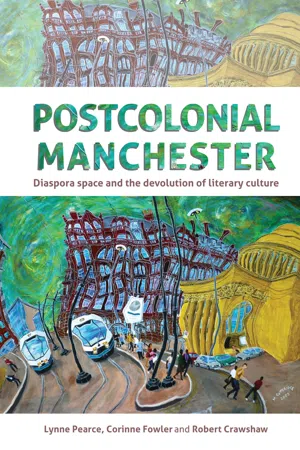
eBook - ePub
Postcolonial Manchester
Diaspora space and the devolution of literary culture
- 304 pages
- English
- ePUB (mobile friendly)
- Available on iOS & Android
eBook - ePub
Postcolonial Manchester
Diaspora space and the devolution of literary culture
About this book
Offers a radical new perspective on Britain's devolved literary cultures by focusing on Manchester's vibrant, multicultural literary scene.
Tools to learn more effectively

Saving Books

Keyword Search

Annotating Text

Listen to it instead
Information
1
Manchester: the postcolonial city
Lynne Pearce
Today – the second decade of the twenty-first century – Greater Manchester is home to approximately 2.6 million people.1 But in what sense ‘home’? Despite the postmodern discourses – both academic and popular – which have imbued the concept with provisionality, ‘home’ still bears powerful connotations of roots, rootedness and heritage (Marangoly George, 1996). ‘Home’, in this archaic sense, is not where ‘you’ come from, or even where you were born, but where previous generations of your family come from: your parents, your grandparents and, quite possibly, your great-grandparents. Leaving aside the fact that the extreme mobility of post-Second World War generations has meant that fewer and fewer people in either the Western or developing worlds are able to lay claim to specific geographical roots in this way, Manchester is still an exceptional case. Little more than a hundred and fifty years old, Manchester is frequently invoked as ‘the first industrial city of Europe’, a spectacular illustration of the way in which enterprise, investment and industry transformed the landscape and demography of northern England in the space of a generation. As Malcolm Bee, writing in 1984, observed:
Manchester was the capital of cotton, and as the industry grew so did ‘Cottonopolis’. The open ground which lay between Manchester and its surrounding towns was shrinking rapidly, and by the middle of the century, these towns were so close together and had so much in common that we can consider each of them to be part of a greater entity – a giant Manchester with a population of a million people. This was Britain’s largest urban region by far, excluding London, and it was the largest manufacturing area in the world. (Bee, 1984: 1–2)
The crucial point that follows on from this is that no one living in Manchester today can claim it as home in a definitive, transgenerational sense. Go back a generation or two and your family will almost certainly have come to Manchester from somewhere else, be that near or far. As Dave Haslam sums up:

1.1 A view of Manchester in 1841. © Manchester Museum of Science and Industr
As in other cities, Manchester communities can feel transient; it’s like we’re all somehow strangers, rubbing together, making it up as we go along. Unlike London, which was a thriving metropolis three hundred years ago, Manchester is a hybrid town, born all in a rush one hundred and fifty years ago, when those arriving for work in the fast-growing factories, workshops, warehouses and foundries included large numbers of Catholic Irish, as well as Scots, and Germans and East European Jews. These migrations have been replicated since, with incomers from the Caribbean in the 1950s and from the Asian sub-continent in the 1970s. Then there are the students, appearing every September, many not staying more than three years, but others relocating here permanently. (Haslam, 2000: xi)
This chapter thus seeks to locate Manchester not only as a northern city, and as Europe’s premier industrial city, but as a migrant and emphatically postcolonial city whose existence owes as much to the reverse-flows of Empire as to internal migration from the rest of England, as well as Scotland and Ireland. Indeed, even though the British National Party and English Defence League may still be seen to draw distinctions between the so-called indigenous and migrant populations of the north of England, a little history makes it clear that the concept of an indigenous population makes very little sense in the case of Manchester. Put simply, the city (and many of its satellite towns and suburbs) came into being because of a cotton trade that depended upon slave labour to pick the cotton and migrant labour to manufacture it. This dynamic, desperate but above all ‘migrant’ history is encapsulated in the following paragraph from Gary Messinger’s Manchester in the Victorian Age (1985):
Manchester was an extraordinarily open town which took full advantage of its position between a geographic frontier to the north and an economic frontier to the south. It became a kind of Eldorado. From the farms, towns and villages of neighbouring areas, successive waves of English labourers migrated towards it. From across the sea came the poor of Ireland. From the north came Scotsmen fleeing the harsh life of the Highlands and the slums of Edinburgh and Glasgow. And from the Continent, more settlers arrived; some fleeing religious persecutions, others fleeing civil strife, such as the Greeks during the revolution of 1821 and Italians during the wars leading up to national unification in the 1840s; others, under clandestine conditions, either offering to sell or hoping to steal new industrial techniques; still others, particularly the large numbers of Germans from Hanseatic cities, attracted by the chance of high monetary returns for their business skills. (Messinger, 1985: 8)
To these eloquent portraits by Haslam and Messinger of Manchester’s cosmopolitan past should also be added the somewhat belated acknowledgement of the significant numbers of black residents in Britain long before the twentieth century (see Fryer, 1984, and also Chapter 5). Although most social and cultural histories of Manchester and its surrounding ‘mill towns’ tell a story of ‘successive waves’ of immigration, recent commentators like Fryer have argued for a more complex demographic evolution which makes clear that the district’s ethnic composition was ‘always already’ mixed.
Further, as we shall see, the region’s colonial interests are also writ large on the geography and architecture of the city and have been marked, often in passing, by the city’s novelists and poets. As the black Detective Inspector of Peter Kalu’s Yard Dogs (2002) ironically observes, a long history of enterprise and exploitation links Manchester’s present with its past:
Evenings, I walked the moody streets. Half the city centre buildings were still named after colonial traders – India House, Africa Mill. Its citizenry owed its current prosperity to the black slaves who were the currency of the seventeenth-century’s triangular trade. And to the white wage slaves who worked the looms in the nineteenth. Marketing Manchester, Market That. (Kalu, 2002: 37)
The particular link that Kalu makes here, meanwhile, regarding the fact that the Lancashire cotton mills arose as a direct result of the nation’s colonial expansion (see also Kalra, 2000), may be read as de facto proof that, as well as its claim to be the world’s first industrial city, Manchester may very properly be thought of as Britain’s first postcolonial city. For although other British cities can be and have been restyled in these terms (most notably, the metropolis: see John McLeod’s Postcolonial London (2004) and Sukhdev Sandhu’s London Calling (2003)), there is a clear argument, following Haslam, that London existed before the era of European colonialism while Manchester was created because of it. Further, although the Mancunian authors considered in this volume are, principally, the sons and daughters of the post-1945, postcolonial moment (in particular, second- and third- and fourth- generation members of the city’s African, African-Caribbean and Asian diasporic communities whose families migrated to Britain at the end of colonial rule), it can be argued that the white, working-class writers, artists and musicians who have come out of the city and its environs are also, if less obviously, the ‘children of Empire’. Inasmuch as it was the rapid contraction of the region’s industrial base in the 1950s and 1960s (in particular, the demise of its cotton mills), there is no doubting that the mass-unemployment and economic and social deprivation that Greater Manchester is still struggling to climb out of are a part of the same colonial legacy.
Therefore, while it would be simplistic to attribute all of Manchester’s endemic social ills to a handful of ruthless, nineteenth-century cotton barons who got rich from the exploitation of workers both at home and abroad (see Kalra, 2000), it probably would be fair to say that it has been the failure of successive governments (both national and local) to seriously address the complexity of this colonial past on the city that has led to a good many of its social tensions since.
In outlining the city’s literary tradition, I shall call upon past research (Pearce, 2007, 2010a and 2010b as well as the ‘Moving Manchester’ Writers’ Gallery: see www.transculturalwriting.com/writersgallery/) to discuss the extent to which the connotations of grime, crime and social deprivation that were attached to the city in the nineteenth century continue to pervade twentieth- and twenty-first-century writing about the city; and I shall also explore the ways in which this perception, and representation, of the city are mediated by the classed and ‘raced’ positioning of the viewer. My key point here, however, is that no-one can view the city of Manchester with neutral eyes (see Pearce, 2010a): neither the recent migrant nor the long-term resident will be able to see their ‘home’ outwith the layers of myth (see Taylor, Evans and Fraser, 1996: 19) and defamation laid upon it.
The laying waste of Manchester
The Latin verb vasto, vastare (to decimate or ‘lay waste’) could have been invented with Manchester in mind. Within months of starting work on ‘Moving Manchester’, the project team was struck by how much of the contemporary writing, music and art associated with the city is preoccupied with its successive waves of demolition and reconstruction Although Manchester’s notorious urban redevelopments, especially with respect to its domestic housing stock, are by no means unique in England’s industrial North (Taylor, Evans and Fraser, 1996: 60–90), the extent of the personal and community trauma that were its consequence is profound.2 Indeed, as far as its artists and writers are concerned, there seems to be little doubt that it has been the repeated mistakes of the city’s planners and developers that have made Manchester a ‘problem city’. Moreover, of particular relevance to the ‘Moving Manchester’ project is the inference that it has been these enforced internal migrations of large numbers of the city’s inhabitants (counted in their hundreds of thousands) that have repeatedly frustrated the efforts of diverse groups, and individuals, to make Manchester ‘home’ in any meaningful sense (Pearce, 2007).
Friedrich Engels was, of course, one of the first social commentators to draw international attention to the scandal of Manchester’s housing and sanitation in the nineteenth century, and it would seem that visitors to the city have turned this reputation into an expectation ever since. Of particular long-term relevance were his observations on the demographic mapping of the city and the way that, although great wealth and great poverty sat cheek by jowl, the location of the workers’ housing in a ‘girdle’ around the city centre (Taylor, Evans and Fraser, 1996: 55) ensured that it developed into a string of ghettos occluded from genteel view:
Manchester contains at its heart a rather extended commercial district, perhaps half a mile long and about as broad, and consisting wholly of offices and warehouses. Nearly the whole district is abandoned by dwellers, and is lonely and deserted at night: only watchmen and policemen traverse its narrow lanes with lanterns. This district is cut through by several main thoroughfares upon which this vast traffic concentrates, and in which the ground level is lined with brilliant shops … [but] they suffice to conceal from the eyes of the wealthy men and women of strong stomachs and nerves the misery and grime which form the complement of their wealth. (Engels, 1987 [1845]: 85)
Ever since these somewhat gothic nineteenth-century accounts of Manchester seized the public imagination there has, moreover, been something of a taste for ‘alternative’ tours of the city (discussed elsewhere in my article on Manchester’s ‘urban sublime’ (Pearce, 2007)). This is most certainly evident in W. G. Sebald’s semi-fictionalized account (see...
Table of contents
- Cover
- Half Title Page
- Title Page
- Copyright Page
- Dedication Page
- Contents
- List of figures
- The authors
- Preface
- Acknowledgements
- Introduction: Manchester and the devolution of British literary culture
- 1 Manchester: the postcolonial city
- 2 Publishing Manchester’s black and Asian writers
- 3 Manchester’s crime fiction: the mystery of the city’s smoking gun
- 4 Collective resistance: Manchester’s mixed-genre anthologies and short-story collections
- 5 ‘Rebels without applause’: Manchester’s poetry in performance (1960s to the present)
- 6 Giving voice: the writers’ perspective
- Afterword
- Index
Frequently asked questions
Yes, you can cancel anytime from the Subscription tab in your account settings on the Perlego website. Your subscription will stay active until the end of your current billing period. Learn how to cancel your subscription
No, books cannot be downloaded as external files, such as PDFs, for use outside of Perlego. However, you can download books within the Perlego app for offline reading on mobile or tablet. Learn how to download books offline
Perlego offers two plans: Essential and Complete
- Essential is ideal for learners and professionals who enjoy exploring a wide range of subjects. Access the Essential Library with 800,000+ trusted titles and best-sellers across business, personal growth, and the humanities. Includes unlimited reading time and Standard Read Aloud voice.
- Complete: Perfect for advanced learners and researchers needing full, unrestricted access. Unlock 1.4M+ books across hundreds of subjects, including academic and specialized titles. The Complete Plan also includes advanced features like Premium Read Aloud and Research Assistant.
We are an online textbook subscription service, where you can get access to an entire online library for less than the price of a single book per month. With over 1 million books across 990+ topics, we’ve got you covered! Learn about our mission
Look out for the read-aloud symbol on your next book to see if you can listen to it. The read-aloud tool reads text aloud for you, highlighting the text as it is being read. You can pause it, speed it up and slow it down. Learn more about Read Aloud
Yes! You can use the Perlego app on both iOS and Android devices to read anytime, anywhere — even offline. Perfect for commutes or when you’re on the go.
Please note we cannot support devices running on iOS 13 and Android 7 or earlier. Learn more about using the app
Please note we cannot support devices running on iOS 13 and Android 7 or earlier. Learn more about using the app
Yes, you can access Postcolonial Manchester by Lynne Pearce,Corinne Fowler,Robert Crawshaw in PDF and/or ePUB format, as well as other popular books in Histoire & Histoire de l'Europe. We have over one million books available in our catalogue for you to explore.