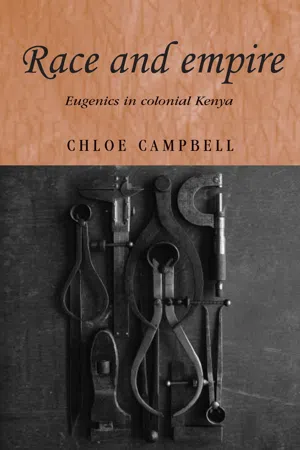
Race and empire tells the story of a short-lived but vehement eugenics movement that emerged among a group of Europeans in Kenya in the 1930s, unleashing a set of writings on racial differences in intelligence more extreme than that emanating from any other British colony in the twentieth century.
The Kenyan eugenics movement of the 1930s adapted British ideas to the colonial environment: in all its extremity, Kenyan eugenics was not simply a bizarre and embarrassing colonial mutation, as it was later dismissed, but a logical extension of British eugenics in a colonial context. By tracing the history of eugenic thought in Kenya, the book shows how the movement took on a distinctive colonial character, driven by settler political preoccupations and reacting to increasingly outspoken African demands for better, and more independent, education.
Through a close examination of attitudes towards race and intelligence in a British colony, Race and empire reveals how eugenics was central to colonial racial theories before World War Two.
- 214 pages
- English
- ePUB (mobile friendly)
- Available on iOS & Android
eBook - ePub
About this book
Information
CHAPTER 1
Introduction:
Nellie’s dance
In July 1933 an aristocratic farmer-settler, the Honourable Eleanor, or ‘Nellie’, Grant, went to a ball held for the navy by Kenya’s Acting Governor, Sir Henry Moore, at Government House, Nairobi. She had a ‘lovely sit-out’ with the Reverend Wright, Dean of Nairobi, and their conversation turned to some of the big issues of the day, religion and eugenics:
I gathered he thought the Church, tho’ fatuous, needn’t necessarily do much harm if you took it the right way. He is terrifically eugenic minded. We stayed v. late, & the daylight hurt a good deal the next mg.1
Nellie Grant attended the dance with a party who were all members of Kenya’s eugenics society, the Kenya Society for the Study of Race Improvement (KSSRI), whose inaugural meeting had been held earlier that evening in one of Nairobi’s most popular meeting places for Europeans, the New Stanley Hotel.2 The progression over the course of an evening from eugenic committee to grand social gathering reflects how comfortably the eugenics movement fitted with the attitudes of the colony’s social and administrative elite. This book explores eugenic thinking in British colonial culture; in particular, it seeks to examine how British eugenic thinking was adapted in a society brutally shaped by racial divisions. It is the story of an intense flirtation with eugenics among a group of Europeans in Kenya in the 1930s which unleashed a set of writings on racial differences in intelligence more extreme than that emanating from any other British colony in the twentieth century.
It should come as no surprise that Britons living in Kenya in the 1930s were influenced by eugenics: eugenic ideas were strikingly pervasive among the British educated middle and upper classes in the first half of the twentieth century, and most of the British inhabitants of Kenya, official and unofficial, came from these classes. What is remarkable about the eugenics movement in Kenya is the strength of its conclusions about race and intelligence, and the ease with which British eugenic principles could be used to construct such extreme scientific racism. So what were the essential principles that underlay British, and later Kenyan, eugenics? Francis Galton (1822–1911), the founding father of eugenics, asserted in an article of 1865 entitled ‘Hereditary Talent and Character’, and then in his 1869 book, Hereditary Genius, what was to become the basis of eugenics: he argued that human beings were unequal, and that these inequalities were hereditary.3 Galton described eugenics as ‘the study of agencies under social control that may improve or impair the racial qualities of future generations either physically or mentally’.4 Eugenics sought to use modern understandings of science and human reproduction to confront modern social demographic woes; this approach was compatible with a wide range of political and social views and it enabled eugenics to attract a broad constituency of supporters.
Eugenicists wanted to use the powerful concept of heredity to shape and control social change by selective breeding. The eugenics movement in Britain was particularly concerned with hereditary traits associated with social class; central to British eugenics was an understanding of the effects of demographics upon the relative social composition of the nation. It has been convincingly argued that the context of a declining birth rate, in particular a socially differential decline in the birth rate, was central to the development of British eugenics.5 It was feared that wealthy, professional families were likely to produce fewer children than members of the improvident pauper class who threatened to swamp the British racial stock with a degenerate and undesirable population.
The British Eugenics Education Society, founded in 1907 (renamed the Eugenics Society in 1926), always remained small, elite and slightly obscure; its journal, the Eugenics Review, was hardly a best-seller (its circulation was about 1,500 in 1939).6 However, there is little doubt that eugenic thinking had cultural influences that ‘transcended the limited institutional boundaries of a formal organization’.7 Eugenic thinking permeated many aspects of British cultural life in the first half of the twentieth century; it informed areas of social concern from birth control and the provision of family allowance to mental deficiency and the education of prisoners. Eugenic ideas pulsed through the literary world, parodied by Wodehouse, but also, it has recently been argued, shaping one of the most influential high modernist novels, Virginia Woolf’s Mrs Dalloway.8
Recent work by historians on different eugenic movements across the globe has further emphasised the extent of eugenics’ cultural resonance. In his review of recent literature on eugenics, Frank Dikötter gives an indication of the breadth of the movement’s cultural significance, pointing out that support for eugenics could be found in countries as varied as ‘Brazil, India and Sweden’:
Eugenics was a fundamental aspect of some of the most important cultural and social movements of the twentieth century, intimately linked to ideologies of ‘race’, nation and sex, inextricably meshed with population control, social hygiene, state hospitals, and the welfare state … It was part of such widely discussed issues as evolution, degeneration, civilization, and modernity, and touched on a wide variety of emerging fields like maternity, psychiatry, criminology, public health, and sex education.9
Recent histories of eugenics in non-English speaking regions and comparative studies of eugenics in different countries have widened our understanding of eugenic thought, breaking away from the narrow, Anglo-American model that tended previously to dominate perceptions of the subject.10 But imperial eugenic movements have not yet been brought fully into this discussion; I seek to redress this neglect by locating eugenics in the colonial sphere and tracing the transportation and mutation of British eugenic thought as it moved through the imperial conceptual network. Using Kenya colony as a case study, the book will show how the African imperial enterprise generated a novel eugenic project and how eugenic thinking articulated some of the most profound biological anxieties about race and degeneracy in colonial culture. As well as expressing the cultural fears of colonialism, eugenics also expressed the modernity of the colonial project in Africa: the newness of settler society and the perceived rawness of African development presented an ideal opportunity to create a society modelled on eugenic insights. Kenya could be a laboratory for ‘scientific colonisation’,11 untainted by the degenerative effects of misguided old-world sentimentality about nurture.
The fuller cultural implications of imperialism have, like eugenics, only recently been explored by historians – part, in fact, of the intellectual project of this ‘Studies in Imperialism’ series is to develop the cultural history of empire. Central to this book is the idea of empire as a cultural system through which thoughts and practices were exchanged and modified. In the case of the eugenics movement in colonial Kenya, Britain began as the source in this imperial system of exchange of ideas, but a more complex interaction developed between the metropole and colony. The Kenyan eugenicists started to export their ideas back to the British Eugenics Society and scientific establishment when they produced research and theories that were new and distinctive. The Kenyan eugenicists claimed specialist knowledge on the issue of race and intelligence; the appropriation of this niche, unfamiliar to many British eugenicists, for a time gave the Kenyan research a surprising and distorted authority within the British Eugenics Society. This book shows how eugenics and imperialism – two major forces in early twentieth-century cultural history – were intimately connected; how, in fact, eugenics served as a scientific bulwark that fortified the ideology of imperialism.
The dramatic pungency of Kenyan eugenics and the violence with which the African population was problematised originated in the peculiarities of Kenyan settler culture. A frontier mentality and a peculiarly British snobbery and colonial complacency shaped Kenyan settler society; these forces also directed the shape of Kenya’s eugenic thought, which was characterised by an aggressive racial prejudice and a bullish sense of its own intellectual importance. The small size of Kenya’s settler population (European inhabitants of Kenya numbered 16,812 in 193112) and the relative absence of a professional intelligentsia meant that it was easier for a single, maverick figure to dominate eugenic ideas within the colony without the credentials that in Britain would have been necessary in gaining a similar level of intellectual authority. The importance of the Kenyan eugenicists’ ideas also became strangely magnified within the colony because they chimed so powerfully with overwhelming settler preoccupations and anxieties about the African population and its advancement. As we shall see in Chapter 3, the Kenyan eugenicists’ theories were transported to Britain in the 1930s and caused considerable controversy and debate on the role of race in science. In retrospect it is surprising that the Kenyan eugenicists managed to be taken as seriously as they were, albeit for a short time, in the metropole. This can partly be explained by the distorting effects of the colonial network: Kenyan settlers tended to be well-connected within the British establishment and the seriousness with which the Kenyan eugenicists’ ideas were regarded by the colony’s political and social elite meant that their voices, for a time, echoed disproportionately loudly in Britain.
By the 1930s, Kenya’s settler community was already notorious in Britain for its ‘Happy Valley’ set – scandalously decadent and promiscuous aristocrats whose antics in Africa gave the colony a reputation for a raffish drug-addled glamour and eroticism. This chaotic group of enfants terribles was in fact merely a conspicuous minority. Yet there was certainly some truth to the perception that Kenya’s white settlers tended to be more aristocratic than, for example, those who settled in South Africa or Southern Rhodesia (now Zimbabwe). As David Anderson has put it: ‘From the earliest days of white settlement, Kenya established a reputation as a home for the English gentry, with a distinctly military orientation … While Kenya attracted the officer class, Rhodesia made do with rank and file … Kenya was a colony for gentlemen, not for artisans or the white working class.’13 What is more, the racial dynamics of the colony fostered a powerful sense of privileged entitlement in settler society. The cheapness of land and African labour allowed British settlers to re-enact a landed-gentry lifestyle that had dwindled almost to the point of obsolescence in Britain by the early twentieth century. These aspirations were reinforced by the social and political dominance of certain major landowners. The most prominent figures in Kenya’s European immigrant community – men like Lord Delamere and Ewart Grogan – demonstrated theatrical individualism and revelled in their maverick frontiersman identity, whilst also enjoying the benefits that came from belonging to the British social elite.14 These settler-pioneers personified the semi-feudal, pre-industrial social and racial values that shaped Kenya’s settler culture and social identity.
The white population of Kenya was not exclusively composed of debauched and drugged aristocratic younger sons and charismatic land magnates acting out a seigneurial fantasy that was no longer sustainable in modern Britain. There were many smaller landowners, typically from a British upper-middle class, ex-military background, who struggled against their own agricultural incompetence and the marginality of the settler economy to make a living as farmers. There was also an increasing urban and professional population. In fact, only 28 per cent of the European population were occupied in agriculture in 1931: 24 per cent were in commerce; 20 per cent in government; 11 per cent in industry; and 13 per cent were missionaries or professionals.15 By 1931, 50 per cent of the European population lived in Nairobi and Mombasa.16 Despite this, settler society idealised an imagined colonial rural simplicity, dismissing the intellectual pretensions of modern, urban society in Britain. This distrust of urbanisation and modern urban social relations was a powerful trait among settlers. As a counterpoint, the supposed preindustrial simplicity of the African population was often eulogised by settlers; perhaps most famously seen in Blixen’s Out of Africa (first published in 1937).17
Settler culture also idealised the strictly maintained but benignly paternalistic class relations that were imagined in this pastoral fantasy, and which enabled them to view the African population as a childlike yeomanry who required the authoritative leadership of Europeans. The reality behind these Kenyan race relations was far more sinister. From early on in Kenya’s colonial history, the settlers earned the colony a reputation for brutality and racial violence that non-settler territories avoided. As David Anderson has put it:
By the early 1920s, the deaths of several African servants from beatings at the hands of their European masters earned Kenya’s white settlers an unenviable reputation for brutality … Physical violence was an integral and characteristic part of European domination in Kenya from the beginnings of colonial rule, and by the 1920s it was largely engrained as part of Kenya’s peculiar pattern of ‘race relations’. Happy Valley … as some liked to call the White Highlands, was always a violent place if you were an African.18
The eugenicists in Kenya were mostly urban professionals and government officers eager to form what was considered an ‘intellectual’ movement. Only a small proporti...
Table of contents
- Front Cover
- Title Page
- Copyright Page
- Contents
- Acknowledgments
- General editor’s introduction
- 1 Introduction: Nellie’s dance
- 2 British eugenics, empire and race
- 3 Kenyan medical discourse and eugenics
- 4 Metropolitan responses
- 5 Settler attitudes to eugenics and race
- 6 Biology, development and welfare
- 7 Conclusion: the decline of the eugenics empire
- Abbreviations in notes
- Bibliography
- Index
Trusted by 375,005 students
Access to over 1.5 million titles for a fair monthly price.
Study more efficiently using our study tools.
Frequently asked questions
Yes, you can cancel anytime from the Subscription tab in your account settings on the Perlego website. Your subscription will stay active until the end of your current billing period. Learn how to cancel your subscription
No, books cannot be downloaded as external files, such as PDFs, for use outside of Perlego. However, you can download books within the Perlego app for offline reading on mobile or tablet. Learn how to download books offline
We are an online textbook subscription service, where you can get access to an entire online library for less than the price of a single book per month. With over 1.5 million books across 990+ topics, we’ve got you covered! Learn about our mission
Look out for the read-aloud symbol on your next book to see if you can listen to it. The read-aloud tool reads text aloud for you, highlighting the text as it is being read. You can pause it, speed it up and slow it down. Learn more about Read Aloud
Yes! You can use the Perlego app on both iOS and Android devices to read anytime, anywhere — even offline. Perfect for commutes or when you’re on the go.
Please note we cannot support devices running on iOS 13 and Android 7 or earlier. Learn more about using the app
Please note we cannot support devices running on iOS 13 and Android 7 or earlier. Learn more about using the app
Yes, you can access Race and empire by Chloe Campbell in PDF and/or ePUB format, as well as other popular books in History & African History. We have over 1.5 million books available in our catalogue for you to explore.