This book is a detailed exploration of the working practices of a community of scientists exposed in public, and of the making of scientific knowledge about climate change in Scotland. For four years, the author joined these scientists in their sampling expeditions into the Caledonian forests, observed their efforts in the laboratory to produce data from wood samples and followed their discussions of a graph showing the evolution of the Scottish temperature over the past millennium in conferences, workshops and peer-review journals. This epistemography of climate change is of broad social and academic relevance – both for its contextualised treatment of a key contemporary science, and for its original formulation of a methodology for investigating expertise.
This book is relevant to United Nations Sustainable Development Goal 13, Climate action
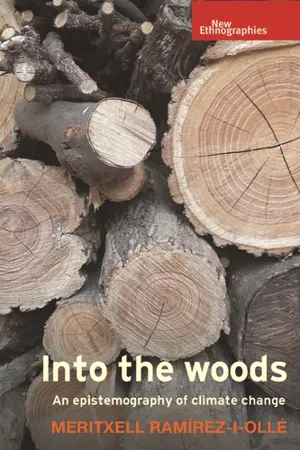
- 136 pages
- English
- ePUB (mobile friendly)
- Available on iOS & Android
eBook - ePub
About this book
Trusted by 375,005 students
Access to over 1.5 million titles for a fair monthly price.
Study more efficiently using our study tools.
Information
1
Fieldwork
Every year at the beginning of August, since 2006, Professor Rob Wilson has been busy putting the finishing touches to an annual fieldwork expedition in the Scottish Highlands. Rob is the leader of the ‘Scottish Pine Project’, a dendroclimatological project aiming to use Scots pine trees (Pinus Sylvestris L.) to reconstruct the climatic history of Scotland over the last two millennia. During fieldwork, the members of the Scottish Pine Project and other occasional participants like me collect pieces of Scots pine wood from forests, buildings and lakes across the Scottish Highlands. Rob and his colleagues referred to these pieces of wood as ‘samples’. To count as a sample in the Scottish Pine Project and in most dendroclimatological projects, the wood has to yield useful information about changes in temperature or precipitation from year to year, as reflected in the variation in the width of the layers of tree growth or so-called ‘tree-rings’. Samples that have variable patterns of tree-rings are described as being ‘sensitive’ to climate, as opposed to ‘complacent’ samples that show a uniform sequence of growth.
Whether a sample is a good source of climatic information depends on the tree species and its location. Trees growing in extreme environments are known to have more variable tree-ring patterns, because changes in weather (more rain or warmer temperatures) affect their growth more distinctively. In Alpine climates like the Scottish Highlands, trees are incapable of growing because it is too cold and wet. The authors of one of the first dendroclimatology textbooks, Marvin Stokes and Terah Smiley (1968), illustrated the relationship between growing conditions and tree-ring patterns with a drawing of one tree growing on water-saturated ground (which produced ‘complacent’ tree-rings) and another tree on a rocky, dry slope (which produced ‘sensitive’ tree-rings). Dendroclimatologists commonly sample those areas or ‘sites’, like the rocky slopes of the Scottish Highlands (Figure 1.1), where trees are most likely to be affected by changes in precipitation or temperature and hence produce sensitive tree-rings. This sampling practice is referred to as the ‘principle of site selection’, which has the purpose, as one textbook author explains (Speer, 2010: 21), ‘to maximize the [climate] signal recorded in the trees’.

1.1 The fieldwork practice of purposively sampling trees that grow on rocky slopes (‘the principle of site location’) is based on the assumption that their rings will provide better climatic information because they are more ‘sensitive’ to changes in climate.
Initially, the Scottish Pine Project team only sampled Caledonian forests growing on the high-elevation areas of the Scottish Highlands because Rob knew that Scots pine trees growing at such locations were very sensitive to changes in temperature. In 1984, the dendroclimatologist Malcolm Hughes published the first temperature reconstruction for Scotland from this tree species (Hughes et al., 1984); thirty years later, Rob sought to build upon Hughes's work by expanding the number of samples and their geographical extension. Building on previous studies of past ecologies, Rob had learnt that, due to deforestation, only about 1 per cent of the ancient pine woodlands in the Scottish Highlands remains. Rob's aim was to conduct an exhaustive sampling of this 1 per cent of remnant pines. As Rob wrote, optimistically, on the website of the Scottish Pine Project, ‘Long term plan is to sample ALL remaining semi-natural pine woodlands in Scotland. We are almost there’ (Wilson, 2019).
In order to generate more samples from places other than pinewood forests, Rob assembled a team of colleagues who helped him to identify and extract partially fossilised wood preserved in lakes (which they called ‘subfossil’) and historical buildings across the Scottish Highlands. With these three types of samples (living, subfossil and historical), they had built up what they called a ‘network of sites’. In May 2014, Rob sent me an email with two maps saying, ‘This is where we were in May 2006 and this is where we are now’ (Figure 1.2). One map had only seven dots, representing the areas that Hughes had sampled in the 1980s. Rob used these sites as a starting point in 2006, when he initiated the Scottish Pine Project. The other map had forty-four dots, and included the names of all the new areas that Rob and his team had sampled up to 2014. This second map has kept growing since I finished the research for this book, as Rob and his team have continued sampling new areas and generating new data, which is why Figure 0.1 should be seen as an incomplete epistemic object (see Introduction).


1.2 Rob and Miloš created these two maps to illustrate the growth in the number and geographical scope of the sampling sites since the start of the Scottish Pine Project in 2006.
The sampling design of the Scottish Pine Project was not only purposive and geographically extensive but also iterative. The three expeditions in which I participated (2012, 2013 and 2015) were concentrated around two lakes in the Cairngorms – Loch an Eilein and Loch Gamhna – in the eastern part of the Scottish Highlands. Every year, we sampled a few metres of the lake banks. Likewise, we always extracted two or three wooden cores from each living tree and a couple of subfossil disks from each submerged log. Rob defended the decision to take multiple samples by saying that he was a ‘great believer in the principle of replication’. This principle states that the climate signal and information that is assumed to exist in trees can be enhanced by averaging the data from replicate samples. Rob and his dendroclimatology colleagues believe that the ‘noisy’ factors affecting tree growth will be minimised if data from more and more samples are averaged (Chapter 3). The fieldwork practice of generating as many samples as possible explains why Rob welcomed students, partners and amateurs like me who, if properly trained, could become useful workforce.
Dendroclimatologists have historically been criticised for their sampling strategy by those who uphold random sampling as the standard of scientificity as it supposedly eliminates the risk that samples reflect the researcher's point of view. In his textbook, Harold Fritts (1976: 17) dismissed ‘Critics in the past who have questioned the validity of selecting the most drought-sensitive trees for sampling rather than selecting trees randomly (Glock, 1955). Such judgement fails to recognise that the dendrochronologist has a particular strategy in mind which requires that his samples be affected similarly by a given set of growth-limiting factors.’ In one interview I conducted with a reputed dendroclimatologist, he told me about an ‘incident’ that happened to him in the early stages of his career in a conference talk, when a member of the audience criticised his results for not ‘having degrees of freedom’. This dendroclimatologist explained to me, ‘You see? This is the type of pure statistician response as classically considered with an experiment design with random sampling and control; that was the way she was educated. But if you are doing a climate reconstruction, and time matters, we must try to select the oldest and most sensitive trees. There's no way around it!’ When I once asked Rob his opinion about this matter, he was equally convinced that purposive sampling in dendroclimatology was justified. He expressed his opinion with an eloquent analogy: ‘You would not go to the tropics to study glaciers!’
While Rob and the other dendroclimatologists to whom I talked were convinced that purposive sampling was the most appropriate strategy for dendroclimatological projects (‘There's no way around it’), they have also been examining the possibility that their sampling strategy has some limitations. In particular, a group of dendrochronologists have recently identified the ‘Modern-Sample Bias’, which is seen to arise from sampling only the oldest trees (Melvin et al., 2013). Similarly, at an international dendrochronology conference I attended in Melbourne in January 2014, one of the most commented on presentations among the attendees to whom I talked was about the biases and effects of different sampling strategies on the resulting data (this presentation was eventually published in a paper; Nehrbass-Ahles et al., 2014).
The ‘epistemological conundrum’ that Rob and the members of the Scottish Pine Project faced at this stage of the making of Figure 0.1 was to satisfy themselves and their critics that, despite the known limitations of purposive sampling, the samples they had generated during fieldwork were untainted by personal or systematic bias and were a reliable starting point for producing knowledge of past climate in Scotland. In this chapter, I explain how they sought to resolve this challenge by detailing the work involved in producing credible samples; such work is narrated around a typical day of fieldwork in the Scottish Pine Project expeditions that I attended.
Labour of fieldwork divisions
The setting up and running of the Scottish Pine Project fieldwork expedition depended on substantial coordination in establishing divisions of expertise, responsibilities and tasks, and distributing the appropriate materials among participants. The philosopher Rolland Munro (1997) coined the expression ‘labour of division’ – as distinct from the traditional notion of ‘division of labour’ – to refer to the work of creating and upholding divisions that characterise the functioning of complex organisations and societies, including scientific ones. As the leader of the fieldwork expedition, Rob was in charge of arranging people in terms of their associated duties and skills, and the success of the expedition essentially lay in fieldworkers’ accepting such arrangements.
The labour of divisions involved in the Scottish Pine Project fieldwork expedition was clearly reflected in the timetable that Rob sent to participants in the weeks leading up to the expedition in August 2013, where we were distributed by days, sub-teams and ‘number of beds needed’ (Figure 1.3). Timetabling took more than six months of preparation: we needed to agree on the exact dates of the expedition; Rob had to apply for and secure funding to cover the trip's expenses; he had to prepare and check all the necessary equipment, request access to the sampling areas from landowners and from government agencies, and fill in the safety and insurance forms; and he had to find accommodation and transportation for all fieldworkers.

1.3 As seen in this timetable, fieldwork required substantive labour of division of time, people, tasks and equipment (including beds and cars). For those wanting to remain anonymous, I have blanked out their names.
Rob created sub-teams that worked independently of each other, each under the supervision of a different leader. ‘Stewart’ was responsible for the ‘lake sonar survey team’, while ‘Leah’ was in charge of the ‘historical sampling team’ with ‘Anne’, Rob's technician (their identities have been anonymised). I was in the ‘lake subfossil sampling’ and the ‘10mm tree coring’ teams led by Rob and his friend Dr Björn Gunnarson, the head of a dendroclimatology laboratory in Sweden. Rob's undergraduate and doctoral students were also part of the ‘lake subfossil sampling’ and the ‘10mm tree coring’ teams. Notably, Miloš had been Rob's undergraduate student at St Andrews and, in Rob's words, was ‘one of the best undergradua...
Table of contents
- Cover
- Half-title page
- Series page
- Title page
- Copyright page
- Epigraph
- Contents
- Figures
- Boxes
- Preface: saving climate science
- Acknowledgements
- Series editor’s foreword
- Introduction: epistemography
- 1 Fieldwork
- 2 Dendrochronology
- 3 Standardisation
- 4 Reconstruction
- 5 Controversy
- Bibliography
- Index
Frequently asked questions
Yes, you can cancel anytime from the Subscription tab in your account settings on the Perlego website. Your subscription will stay active until the end of your current billing period. Learn how to cancel your subscription
No, books cannot be downloaded as external files, such as PDFs, for use outside of Perlego. However, you can download books within the Perlego app for offline reading on mobile or tablet. Learn how to download books offline
Perlego offers two plans: Essential and Complete
- Essential is ideal for learners and professionals who enjoy exploring a wide range of subjects. Access the Essential Library with 800,000+ trusted titles and best-sellers across business, personal growth, and the humanities. Includes unlimited reading time and Standard Read Aloud voice.
- Complete: Perfect for advanced learners and researchers needing full, unrestricted access. Unlock 1.5M+ books across hundreds of subjects, including academic and specialized titles. The Complete Plan also includes advanced features like Premium Read Aloud and Research Assistant.
We are an online textbook subscription service, where you can get access to an entire online library for less than the price of a single book per month. With over 1.5 million books across 990+ topics, we’ve got you covered! Learn about our mission
Look out for the read-aloud symbol on your next book to see if you can listen to it. The read-aloud tool reads text aloud for you, highlighting the text as it is being read. You can pause it, speed it up and slow it down. Learn more about Read Aloud
Yes! You can use the Perlego app on both iOS and Android devices to read anytime, anywhere — even offline. Perfect for commutes or when you’re on the go.
Please note we cannot support devices running on iOS 13 and Android 7 or earlier. Learn more about using the app
Please note we cannot support devices running on iOS 13 and Android 7 or earlier. Learn more about using the app
Yes, you can access Into the woods by Meritxell Ramírez-i-Ollé in PDF and/or ePUB format, as well as other popular books in Biological Sciences & Global Warming & Climate Change. We have over 1.5 million books available in our catalogue for you to explore.