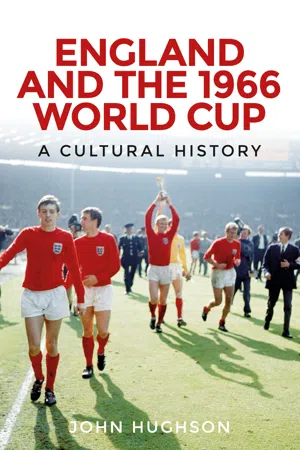
England and the 1966 World Cup presents a cultural analysis of what is considered a key 'moment of modernity' in the nation's post-war history. Regarded as having an importance beyond its primary sporting purpose, the World Cup in England is examined within the complexity of the cultural, social and political changes that characterised the mid-1960s. Yet, although addressing the importance of non-sport related connections, the book maintains a focus on football, discussing it as a 'cultural form' and presenting an original perspective on the aesthetic accomplishment in football tactics by England's manager, Alf Ramsey. The study considers the World Cup in relation to the cup tradition, England as the World Cup host nation, the England squad and masculinity, the modernism of England's manager Alf Ramsey, design and commercial aspects of the World Cup, a critical engagement within existing academic accounts, and an examination of how England's victory has been remembered and commemorated.
- 236 pages
- English
- ePUB (mobile friendly)
- Available on iOS & Android
eBook - ePub
About this book
Trusted by 375,005 students
Access to over 1.5 million titles for a fair monthly price.
Study more efficiently using our study tools.
Information
1
This is England ’66: an introduction
Let homage be rendered to the various sports, and in particular to football. For, still more than the king of sports, football is the king of games. (Jean Giraudoux)
English people of a certain age may well remember where they were when England won the World Cup on 30 July 1966.1 During the preparation and writing of this book I have informally heard a number of firsthand memories in this regard, both from people I know, and people I have met in passing.2 In each case the memory of seeing the World Cup Final, mostly on television, was recalled with such apparent vividness to confirm my belief, held from the outset, that this is a topic well worthy of thoroughgoing academic attention. Fifty years on, this may not be the only book by an academic published in 2016 on England’s World Cup victory, but it is likely to be the only one written by someone over the age of fifty-five who did not watch the match at the time. In July 1966 I was eight years old and, while the World Cup Final was being played at Wembley Stadium, I was asleep in my bed at home in the early hours of a western Sydney morning. Had I been able to watch the match, I may well have done so. Attending state schools with a significant number of fellow students from the diversity of European migrant communities residing in my neighbourhood, I developed an interest in the sport we referred to as soccer from a fairly young age. I have my own memories – perhaps more hazy than vivid, but certain enough to remark upon – of standing around in the schoolyard discussing the replays of either Match of the Day or The Big Match on local television. As it was only these broadcasts of football from abroad that we got to see on a weekly basis, for an Australian child, becoming a soccer fan meant developing a keen interest in the English League.
I have no memory of first hearing about England winning the World Cup in 1966. It just seems to have lodged within my awareness, at a formative stage, as an accepted fact of football history. This taken for granted understanding was accompanied by an assumption that winning the World Cup would involve a fairly uncomplicated response of national pride for English people. Facile views of this kind came under challenge once I took up studying sport seriously, yet the example of the 1966 World Cup did not return to my attention until I started living and working in Britain as an academic in the 1990s. When it came to my attention it did so as a matter of surprise. The surprise was not so much to read academic criticism of England’s victory being manipulated for ideological and commercial reasons, but journalistic criticism of the victory itself, based on dissatisfaction with the way in which the England team had gone about playing football. Of related surprise was seeing depictions of the England manager, Sir Alf Ramsey, as a figure of ridicule. I remembered seeing photographs in my childhood and youth of Ramsey as a distinguished looking and understandably proud man.3 That his popular image in England did not necessarily match to that which I had assumed for him became a matter of intrigue that festered away for some time and has now taken shape as a point of inquiry in this book. I now understand the reasons why some mock the persona of Ramsey, although, like his biographer Leo McKinstry, I think the representations are based in snide caricature.4 However, rather than the primary interest here being in defending Ramsey’s image, it is in understanding how his caricaturing connects to criticism of the circumstances surrounding England’s winning of the World Cup in 1966. If there is a key protagonist in this book, then it is Ramsey. Criticisms of England’s World Cup victory are so closely tied to him that he demands more than the already considerable attention he would receive in a study of this topic. A central argument in my book is that criticism of Ramsey, for the style of football he had England play in the 1966 World Cup, fails to recognise that he was a modernist in a way not unrelated to art. His innovation to playing strategy has not been denied, but references to him ‘modernising’ football tend to regard him as a ruthless technocrat devoid of aesthetic sensibility. The case presented here suggests otherwise and is intended to free Ramsey from an association with sterile scientific management.
The one particular episode that supposedly highlights Ramsey’s lack of appreciation for the aesthetics of football is his exclusion of the virtuoso player Jimmy Greaves from the World Cup Final team. Ramsey’s treatment of Greaves offers an indictment that no critic of the England manager can miss. From the outset of the World Cup finals tournament Greaves looked an uncomfortable fit within the playing ‘system’ Ramsey had developed. However, Greaves’s undeniable goal-scoring potential secured his selection in the England team for the three Group stage games. In the last of these games, against France, Greaves sustained a laceration to his left leg that put him on the injury list for at least the next game, the quarter-final against Argentina. A photograph shows a despondent and solitary Greaves in the bathtub after the match, his bandaged leg rested on a chair to elevate it above the water. Upon seeing this image I was reminded of Jacques-Louis David’s painting, The Death of Marat, in which the assassinated French revolutionary leader lies prone in his bathtub just seconds after taking his last breath.5 David was an ally of Marat and the painting depicts Marat’s martyrdom to the revolutionary cause. We cannot assume an ambition for the photograph of Greaves at the time it was taken, but can now see it as prescient of Greaves’s fall from favour under Ramsey in the England team and, even as a first step towards his declining fortunes in club football. The injury sidelined Greaves for both the quarter-final against Argentina and the semi-final against Portugal. He was declared fit for the Final against West Germany, but Ramsey preferred to stick with Geoff Hurst, the player who had replaced Greaves for the games against Argentina and Portugal. Journalists debated ahead of the Final as to whether or not Greaves should return to the team at the expense of either Hurst or the other forward player Roger Hunt. With England going on to win the World Cup, one might assume the matter to be settled in admission that Ramsey made the correct decision. However, this has not been so. With the passing of time the World Cup win has become incidental to the critics’ bigger concern over the Greaves absence from the England team symbolising the death of English football in 1966 and, in this light, the image of Greaves in the bathtub becomes all the more poignant.6

1 A dejected Jimmy Greaves in the bathtub ponders the implications of his leg injury.
The creatively gifted Greaves appeared to provide a link with the best of a heroic past that Ramsey was willing to overlook in his single-minded quest to have England win the Jules Rimet trophy. But Greaves was no old-fashioned hero. He was a hero well-suited to the bright lights of the 1960s. He appealed to a ‘modern romantic’ sensibility of the time. His face was prominent in commercial advertisements in newspapers and magazines, giving him a celebrity profile that extended beyond football. Greaves’s orientation to life and football was the diametrical opposite of Ramsey’s. Ramsey was uninterested in and wary of activities extraneous to football. He believed professional football players should be fully focussed on football and, if they were, there was time for little else. Ramsey’s modern outlook applied only to football. In other ways he was quite traditionally English. This may seem at odds with claiming Ramsey as a modernist, but not when considered in relation to Alexandra Harris’s compelling thesis on the tendency for English modernists to retain romantic attachments to idealised aspects of English life.7 Ramsey did just this and, like the writers, architects, designers and artists Harris discusses, he too may be regarded as a ‘romantic modern’.
In a country where modernism has struggled to gain popular appeal – especially in architecture – it is not so surprising that the sharp-lined geometry of Ramsey’s playing ‘system’ has had its critics. Remarks about the aesthetics of football being made via seemingly exclusive reference to a romanticised ‘beautiful game’, suggest little appreciation for the type of football that Ramsey fostered. Ramsey’s preoccupation with winning the World Cup has also been a sign, for some, of his lack in aesthetic vision. Yet I would argue that the unswerving ambition to win the tournament provided the framework within which his aesthetic vision was developed. Baudelaire predicted the modernist aesthetic in art when he wrote of the possibility of beauty residing in ‘the essential quality of being the present’.8 Ramsey understood this in relation to football. He did so because he understood the very nature of football as a modern activity, circumscribed by the present, in terms of ‘seasons’ and tournaments. I argue that the playing ‘system’ developed by Ramsey to win the 1966 World Cup was guided by an aesthetic awareness of related functionalist priority and that the result is comparable to a constructivist art project. This may present a challenge to more conventional ways of seeing football, but, for that, no apology should need to be made.

England’s winning of the 1966 World Cup makes for a rather different book than one that would have involved a discussion of England hosting the World Cup finals without its national team going on to win the Jules Rimet trophy.9 Inevitably, in an academic book concerned with questions related to English identity, the implications of the World Cup victory become the focus of enquiry. This becomes most explicit in the final chapters of this book as discussion turns to themes of memory – how the World Cup win is remembered, commemorated and, indeed, criticised. Discussion of the World Cup Final on 30 July 1966 occurs, in one way or another, in all chapters. Discussion of the World Cup finals, as an overall event, occurs in the first two full-length chapters as well as a later chapter concerned with locating the World Cup tournament coming to England within the cultural mood of the mid-1960s. This discussion is thankfully spared the contemporary demand for referring to football World Cup finals as mega-events. ‘Mega-event’ was not on the terminological radar in the 1960s and a now quainter term such as tournament still seems to suffice as a descriptor of the World Cup as an event in 1966.
Prominent within the lexicon of jargon that accompanies ‘mega-events’ is the term ‘legacy’. Promising a ‘legacy’ is now a core component of any city’s bid to host the Olympic Games, and the assessment of post-Games’ legacy delivery has emerged as an academic cottage industry. Compared to the Olympic Games, World Cup ‘legacy management’ is still at an early stage of development.10 In 1966 there was no requirement for a legacy plan to be set out in advance. Legacy, without being explicitly referred to at the time, came on to the agenda in regard to the expectations accompanying government funding of stadia improvements ahead of the World Cup. This issue is discussed in Chapter 3. Apart from this understanding of legacy, it can also be considered in relation to unexpected outcomes from the 1966 World Cup. As such, legacy pertained to matters either directly related to football or to off-field events. A controversy that occurred in the Final provides an example of the former. Disputation remains to this day as to whether or not the ball actually crossed the line for England, and whether Geoff Hurst was rightly awarded the goal granted to them by referee Dienst in the first half of extra time. As such, the incident has provided a legacy by way of its influence to subsequent debates over the usage of goal line technology in international football. An off-field example of legacy relates to what can reasonably be recalled as the 1966 World Cup’s most unusual sideshow occurrence. In March 1966, the Jules Rimet trophy was stolen from a rare stamp exhibition at Westminster Central Hall, where it was on display as publicity for the forthcoming World Cup finals tournament. In a happening of incredibly good fortune, which rescued the Football Association (FA) from extreme embarrassment, the trophy was found by Pickles the dog while out walking with his owner David Corbett in their south London neighbourhood. Pickles earned a sizeable reward for Mr Corbett and, for himself, an invitation to the celebration banquet following the World Cup Final.11 The legacy of the episode was a lesson in the need for greater security. The FA commissioned the making of a replica trophy that was used for public exhibition purposes with the real trophy being kept under lock and key until the conclusion of the tournament. Despite greater care with security being taken over the years, the Jules Rimet trophy was again stolen, seemingly for good, in Brazil in 1983.12
In broadest intention England and the 1966 World Cup is offered as a contribution to the academic study of English cultural life. I maintain a long-held view that sport is a ‘form’ of culture and for this reason warrants scholarly attention. In The Making of Sporting Cultures I argued that some sports are so prominent within particular national contexts that they require mentioning in any reference to the ‘common culture’ of those nations. Accordingly, I so identified football within an English common culture.13 This understanding underpins my interest in the subject matter of the present book. The theme of football and an English common culture is addressed most obviously in the next chapter and it remains influential to the discussion in other chapters throughout the book. A focus on the English experience of the World Cup leaves little room for attention to how the World Cup in England was experienced by other participant nations, not only the teams and supporters that visited in 1966, but supporters who observed the World Cup from abroad. There are a host of studies that could be written, and hopefully the approaching fiftieth anniversary year will serve as a prompt to scholars with the requisite language skills and access to vernacular materials to undertake such work.14 Historical research is necessarily ambitious. According to Raymond Williams:
It is only … our own time and place that we can expect to know, in any substantial way. We can learn a great deal of the life of other places and times, but certain elements, it seems to me, will always be irrecoverable … The most difficult thing to get hold of, in studying any past period is this felt sense of the quality of life at a particular place and time: a sense of the ways in which the particular activities combined into a way of thinking and living.15
Williams’s modest approach to ‘cultural history’ remains influential to the study undertaken for and presented in this book. The related challenge has been to connect the 1966 World Cup in England to what Williams refers to as the ‘structure of feeling’ relevant to a given place and time. In this case it has required dealing with certain mythologies, such as the ‘Swinging Sixties’, not in a dismissive but a negotiated way, in an attempt to understand how...
Table of contents
- Cover
- Half Title
- Title Page
- Copyright
- Contents
- List of figures
- Acknowledgements
- 1 This is England ’66: an introduction
- 2 The Cup tradition and England 1966
- 3 When football first came home: the World Cup in England
- 4 Alf Ramsey and the importance of being earnest: masculinity, modernity and the 1966 World Cup squad
- 5 Wingless wondering: modernism and the Ramsey ‘system’
- 6 ‘Out of time’: the World Cup and 1960s’ culture
- 7 ‘Tomorrow never knows’: the mythology of England’s World Cup victory
- 8 ‘An unforgettable day’: memories of England’s World Cup victory
- 9 That was the World Cup that was
- Bibliography
- Index
Frequently asked questions
Yes, you can cancel anytime from the Subscription tab in your account settings on the Perlego website. Your subscription will stay active until the end of your current billing period. Learn how to cancel your subscription
No, books cannot be downloaded as external files, such as PDFs, for use outside of Perlego. However, you can download books within the Perlego app for offline reading on mobile or tablet. Learn how to download books offline
Perlego offers two plans: Essential and Complete
- Essential is ideal for learners and professionals who enjoy exploring a wide range of subjects. Access the Essential Library with 800,000+ trusted titles and best-sellers across business, personal growth, and the humanities. Includes unlimited reading time and Standard Read Aloud voice.
- Complete: Perfect for advanced learners and researchers needing full, unrestricted access. Unlock 1.5M+ books across hundreds of subjects, including academic and specialized titles. The Complete Plan also includes advanced features like Premium Read Aloud and Research Assistant.
We are an online textbook subscription service, where you can get access to an entire online library for less than the price of a single book per month. With over 1.5 million books across 990+ topics, we’ve got you covered! Learn about our mission
Look out for the read-aloud symbol on your next book to see if you can listen to it. The read-aloud tool reads text aloud for you, highlighting the text as it is being read. You can pause it, speed it up and slow it down. Learn more about Read Aloud
Yes! You can use the Perlego app on both iOS and Android devices to read anytime, anywhere — even offline. Perfect for commutes or when you’re on the go.
Please note we cannot support devices running on iOS 13 and Android 7 or earlier. Learn more about using the app
Please note we cannot support devices running on iOS 13 and Android 7 or earlier. Learn more about using the app
Yes, you can access England and the 1966 World Cup by John Hughson in PDF and/or ePUB format, as well as other popular books in History & British History. We have over 1.5 million books available in our catalogue for you to explore.