- 210 pages
- English
- ePUB (mobile friendly)
- Available on iOS & Android
eBook - ePub
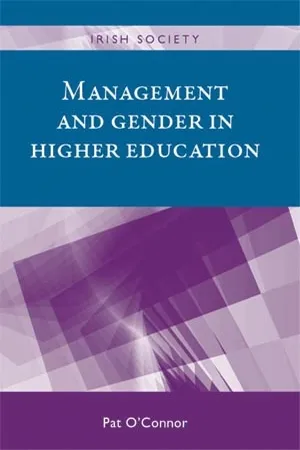
Management and gender in higher education
About this book
This book is a definitive examination of higher education: locating it in a wider neo-liberal context involving the state and the market, with a specific focus on recent higher policy and on the elite group of senior managers in universities. Written in a clear accessible style, it provides an in-depth analysis of university structures, cultures and practices at senior management level. Despite the managerialist rhetoric of accountability, we see structures where access to power is through the Presidents' 'blessing', very much as in a medieval court. We see a culture that is less than comfortable with the presence of women, and which, in its narratives, stereotypes and interactions exemplifies to a rather nineteenth-century view of women. Sites and sources of change are also identified. In a global context where diversity is crucial to innovation, it challenges us to critically reflect on management and on higher education.
Information
Topic
StoriaSubtopic
Istruzione superiore1
The big picture: universities in a changing society
Introduction
This book is concerned with higher education, and particularly with the gendered world of senior management in public universities. Higher education in general and universities in particular can be seen as the site of a power struggle ‘since it is power that ultimately determines whose values gain priority and who pays the costs’ (Clark, 1983: 264). The outcome of such power struggles determines the shape and purpose of higher education, nationally and internationally. There are limits to the power of those in senior management. These limits partly reflect the complex relationship between higher education and the state in contemporary society. Even more fundamentally, their power is limited by the changing relationship between the state and the market, both nationally and internationally. Those in senior management have little or no impact on the convulsions of national or international capitalism. Thus their positioning is complex: they are simultaneously at the top of their own organizations and in a less than powerful position in relation to the external structures of the state and the market.
In Ireland, with a small number of notable exceptions, social scientific research has tended to focus on the powerless. This has heightened a tendency to use their characteristics, lifestyles or choices as explanatory factors, rather than looking at elites and their priorities and experiences. This study was seen as a useful counterbalance in providing insights into the nature and transmission of privilege, by focusing on career paths leading to senior management positions; on support in accessing them; on gendered cultures, practices, stereotypes and narratives; and on the experience of being in such positions. It thus provides an important insight into a specific Irish elite, from the vantage point of an academic and practitioner who was part of that elite for ten years.
The focus on the most senior managerial group in Irish public universities senior management can be seen to include those at the top three levels (i.e. at presidential, vice-presidential, dean or executive director level, although the titles vary between institutions). Some of these positions are held by academics, who undertake managerial responsibilities for a limited period of time and who become ‘manager-academics’ (Deem, 2006). However, other professional managers at vice presidential or executive director level (for example, in finance or human resources) are also included. The balance between academics and other professional managers in this senior management group varies between universities, as do its specific composition and size, although the president and vice presidents are always included.
In focusing on those at the highest level of senior management, attention is concentrated on a privileged group in terms of income, although their societal status is somewhat more problematic in a society where the university management system is opaque. Those in senior management in higher education can, at least potentially, shape the internal culture of their organisations and influence that of the wider higher educational context. Within their own organizations they play a critical role in defining and implementing recruitment procedures; overseeing curricula and prioritizing expenditures. They are also involved in ‘the creation of knowledge, both in the local sense of organizational and managerial knowledge, and in the broader, more pervasive, sense of knowledge in and of society, indeed, of what counts as knowledge’ (Hearn, 1999: 125). In all sorts of ways, their actions affect the life chances of those employed in these organizations and of the students who attend them. In so far as education is seen as relevant to economic growth, their decisions have wider societal, economic and cultural implications.
This chapter is concerned with the wider institutional and societal context, since this is seen as essential for understanding the challenges facing higher education in the twenty-first century. Thus it will look at the nature of the university as an institution; the relationships between the university, the state and the market; it will explore ideas about excellence and merit. Historically universities have been gendered institutions. Even now, they tend to be hierarchically male dominated, with the overwhelming majority of those in senior management positions being men. It will be argued that definitions of excellence and merit are typically constructed by those in power to legitimate and perpetuate their own position and privileges (Blackmore, 2002; van den Brink and Benschop, 2012). Indeed, Maher and Tetreault (2007) concluded that the term excellence is used, not so much as a mark of quality, but as a mark of privilege. As one moves up the career hierarchy in most organizations, merit frequently appears to be less defined by human capital (i.e. ability, education and experience) than social capital (i.e. social ties and political behaviour) (Sealy, 2010). Gendered processes effectively limit the available talent. Yet any kind of positive action for women typically generates references to meritocracy, the assumption being that the appointments of all men are unaffected by anything other than merit. Thus, in a context where women constitute roughly six out of ten university graduates in Europe, and more than half the labour force, ignoring them means that the pool of talent is artificially reduced so that less competent men will end up being selected (Eagly, 2011; genSET, 2009 and 2010). Typically, however, the choice is presented as between excellence and diversity, the implication being that the former can only be achieved at the expense of the latter. It will be shown later in this chapter that this is increasingly seen as a problematic assumption.
In Ireland, there has been a tendency, particularly since the 2000s, to see gender inequality as an irrelevant concern. However, there is increasing evidence that such inequality is related to a variety of indicators of national well-being, including economic growth, social cohesion as well as personal happiness and well-being (Wilkinson and Pickett, 2010). The United Nations (UNDP, 1997: 39) concluded that ‘no society in the world treats its women as well as its men’, while the OECD (2012c: 18 and 13 respectively) refers to ‘[p]ersistent discriminatory social institutions and cultural norms’ and concluded that: ‘[g]ender equality is not just about economic empowerment. It is a moral imperative’.
With a small number of notable exceptions, little research attention in Ireland has been paid to gendered processes in university senior management. The positive consequences of real diversity in management groups has been documented internationally, with particular attention being paid to its impact on ‘groupthink’ (Janis, 2011), and on the emergence of more innovative and creative solutions (Davies, 2011). ‘Groupthink’ was seen as contributing to the very unsatisfactory governance arrangements that were partly responsible for the recent economic crisis in Ireland (Clancy et al., 2010; Murphy, 2012). Diversity is important in providing young people with role models: same-sex role models being important in women’s career orientation, confidence and success (Mannion, 2011; Sealy and Singh, 2010). Of course gender diversity does not always guarantee the existence of diversity of thought. However, it is symbolically important in challenging the equation between masculinity and authority and in affirming women’s existential value (Therborn, 2005).
In summary, this book is concerned with higher education and with the elite and the gendered world of senior management.
The university as an institution
Universities are one of the most enduring institutions historically and cross-nationally dating back to the late middle ages (Scott, 2006). In different countries and at different times universities have been established to transmit professional skills; to progress nationalism; to promote democratization; to create a professional elite; to legitimate access to power; to train young people for employment; to enhance economic growth; to promote internationaliza-tion; to enhance individual or collective social and cultural life, etc. The Irish Universities Act (1997) identifies an extensive range of objectives including advancing knowledge; contributing to the social and cultural life of society; encouraging critical thinking; fostering the Irish language and culture; facilitating the attainment of national economic and social goals; training professional and managerial elites; acting as a societal resource in terms of knowledge and research; facilitating life-long learning and promoting gender equality. Clark (1983) suggests that, beyond saying that universities are concerned with knowledge (its creation, use, application and conservation) it is impossible to adequately describe what their purpose is. This fluidity in terms of purpose can be seen as a strength and a weakness since, although it has ensured their survival, at any one point in time, their essence can be lost. Yet universities internationally appear to have a taken-for-granted institutional legitimacy, deriving from ‘wider environmental meanings, definitions, rules, and models’ (Meyer et al., 2007: 188). The lack of clarity about their purpose has enabled universities to become part of wider social projects, which have legitimated their activities and provided funding for those involved in them.
Wider social projects have also influenced the kinds of people who have had access to higher education in particular societal contexts. Thus, for example, traditionally, universities were concerned with the education of a (male) elite and were ‘linked to the reproduction of gender and class privilege’ (Morley, 2005a: 111). In an Irish context, women’s access to university education occurred in the context of institutional and nationalistic ambitions and tensions, as well as feminist actions, and emerged despite reservations by the catholic hierarchy about undermining women’s traditional roles (Harford, 2010). Thus the shape of knowledge-based institutions, and the definition of those who can legitimately access them, has been intimately linked with the strength of different interest groups, at particular times and places.
A definition of the purpose of universities as concerned with teaching, research and community service obscures such issues, although in a sense it can be seen as capturing much of what universities actually do in practice. However, at different times and places these activities have been differentially valued. Thus Newman (1996) in his classic work saw teaching students as the defining characteristic of a university, albeit that the curriculum was very much narrower than would be normal today. His perception of teaching as a core activity is still a taken-for-granted assumption by students and their parents. On the other hand, the Humboltian dream of a university in nineteenth-century Germany was concerned with the production of original scholarship. In that context the focus was on appointing the best researchers in arts and science; providing them with academic freedom, and building curricula around their areas of expertise. This concept is still very powerful (and if restricted to applied research, is attractive to industry). However, the hegemonic position frequently accorded to (limited areas of) science and technology in this perspective, has implications as regards the marginalization and financial neglect of subjects (such as the humanities and the social sciences) that evoke high levels of student demand, although they are seen as of little relevance to industry.
The public/private good deriving from a university education has also generated a good deal of interest, albeit that the definition of that public good has varied. Thus for example, in the United States, the role of the university in creating a viable democracy and an active citizenry, based on the all-round development of the student, emerged as a key theme in the nineteenth century and continues to exist in part of that higher educational system (Giroux, 2011; Harkavy, 2006). In this context, the assumption has been that the more educated individuals and societies are, the greater the possibility of ‘social progress, and with it a more just and equitable order’ (Meyer et al., 2007: 202). The importance of the university as a provider of services to the nation state has also been stressed in the United States, and is part of a public-good argument. The democratization of education includes assumptions about the equality of status between fields of study (Scott, 2006; Webber and Jones, 2011) with the university being seen as a place for ‘public intellectuals’ (Burawoy, 2004; Corcoran and Lawlor, 2012; O’Connor, 2012) who bridge the gap between the academy and the wider society.
For Marginson (2007b: 311 and 315), public goods are those that can be ‘consumed by any number of people without being depleted’ and ‘the benefits cannot be confined to individual buyers’, in a context where they ‘are made broadly available across populations’. There has been an increasing tendency not to value the public goods provided by public higher educational institutions, nationally and globally: such public goods including ‘knowledge, collective literacy and common culture’ as well as ‘a structure of social opportunity’, publicly accessible research infrastructure and access to cultural objects (Marginson, 2007b: 318). There is no global policy space to discuss education as a public good. The main global forum for higher education is the World Trade Organization/GATS negotiating framework, which commodifies education and sees it as similar to private goods. Internationally, higher education is increasingly seen as a private good in the sense of increasing individual cultural, social or economic capital. This is part of what lies behind the international pressure to ensure that students make a financial contribution to the cost of their higher education (Brown, 2011). However, as levels of education increase in the society as a whole, the economic and social advantages conferred on an individual by higher education decreases, within that particular society (although it does provide them with a global competitive advantage).
In Ireland, the state’s support for universities ultimately reflects a perception of higher education as contributing to the creation of ‘knowledge economy’ and hence to economic growth (although the president of Ireland has a much broader view: Higgins, 2012). It was the former perception of higher education that facilitated the state’s ongoing investment in it, as a time when expenditure on it was being curtailed elsewhere (W...
Table of contents
- Cover
- Half Title
- Title Page
- Copyright
- Contents
- Series editor’s foreword
- Acknowledgements
- Prologue: my own journey
- 1 The big picture: universities in a changing society
- 2 Finding a compass and mapping the terrain
- 3 Policy priorities: instrumentality, scientization, degendering
- 4 Gentleman’s club or medieval court?
- 5 There is no problem; or, if there is, the problem is women
- 6 ‘Think manager–think male’?
- 7 An attractive job, but no place for a woman?
- 8 Summary and conclusions
- Appendix: socio-economic realities in contemporary Irish society
- References
- Index
Trusted by 375,005 students
Access to over 1.5 million titles for a fair monthly price.
Study more efficiently using our study tools.
Frequently asked questions
Yes, you can cancel anytime from the Subscription tab in your account settings on the Perlego website. Your subscription will stay active until the end of your current billing period. Learn how to cancel your subscription
No, books cannot be downloaded as external files, such as PDFs, for use outside of Perlego. However, you can download books within the Perlego app for offline reading on mobile or tablet. Learn how to download books offline
Perlego offers two plans: Essential and Complete
- Essential is ideal for learners and professionals who enjoy exploring a wide range of subjects. Access the Essential Library with 800,000+ trusted titles and best-sellers across business, personal growth, and the humanities. Includes unlimited reading time and Standard Read Aloud voice.
- Complete: Perfect for advanced learners and researchers needing full, unrestricted access. Unlock 1.5M+ books across hundreds of subjects, including academic and specialized titles. The Complete Plan also includes advanced features like Premium Read Aloud and Research Assistant.
We are an online textbook subscription service, where you can get access to an entire online library for less than the price of a single book per month. With over 1.5 million books across 990+ topics, we’ve got you covered! Learn about our mission
Look out for the read-aloud symbol on your next book to see if you can listen to it. The read-aloud tool reads text aloud for you, highlighting the text as it is being read. You can pause it, speed it up and slow it down. Learn more about Read Aloud
Yes! You can use the Perlego app on both iOS and Android devices to read anytime, anywhere — even offline. Perfect for commutes or when you’re on the go.
Please note we cannot support devices running on iOS 13 and Android 7 or earlier. Learn more about using the app
Please note we cannot support devices running on iOS 13 and Android 7 or earlier. Learn more about using the app
Yes, you can access Management and gender in higher education by Pat O'Connor in PDF and/or ePUB format, as well as other popular books in Storia & Istruzione superiore. We have over 1.5 million books available in our catalogue for you to explore.