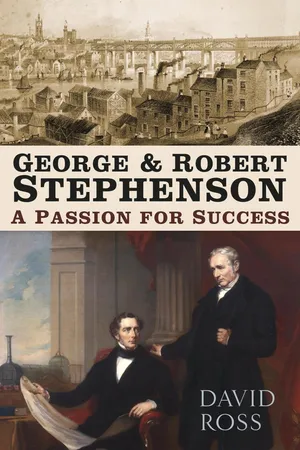
From poverty to immense wealth, from humble beginnings to international celebrity, George and Robert Stephenson's was an extraordinary joint career. Together they overshadow all other engineers, with the possible exception of Robert's friend Isambard Kingdom Brunel, for one vital reason: they were winners. For them it was not enough to follow the progress made by others. They had to be the best. Colossal in confidence, ability, energy and ambition, George Stephenson was also a man of huge rages and jealousies, determined to create his own legend. Brought up from infancy by his father, Robert was a very different person. Driven by the need to be the super-successful son his father wanted, he struggled with self-distrust and morbid depression. More than once his career and reputation teetered on the edge of disaster. But by being flawed, he emerges as a far more appealing and sympathetic figure than the conventional picture of the 'eminent engineer.' David Ross's new biography of George and Robert Stephenson sheds new light on these two giants of British engineering.
- 320 pages
- English
- ePUB (mobile friendly)
- Available on iOS & Android
eBook - ePub
About this book
Trusted by 375,005 students
Access to over 1.5 million titles for a fair monthly price.
Study more efficiently using our study tools.
Information
Publisher
The History PressYear
2010Print ISBN
9780750988926
9780752452777
Edition
2eBook ISBN
9780752496740
PART ONE: GEORGE
1
A WORKING BOY
In the summer of 1854 Robert Stephenson made a nostalgic visit to Tyneside, accompanied by Samuel Smiles who was writing the biography of George Stephenson. At the village of Wylam they met a few ancient men who remembered George as a youth, and recalled his parents. One ‘old Wylam collier’ is quoted as saying of ‘Old Bob’ Stephenson that: ‘Geordie’s fayther war like a peer o’ deals nailed thegither, an’ a bit o’ flesh i’ th’ inside; he war queer as Dick’s hatband – went thrice aboot, an’ wudn’t tie. His wife Mabel war a delicat boddie, an’ varry flighty. They war an honest family, but sair hadden doon i’ th’ world.’1
Wylam had changed less than many places, but seventy-three years on from George Stephenson’s birth, and six from his death, it was already hard to recreate the nature and spirit of the community in which he grew up during the 1780s and ’90s. Viewed from the mid-1850s, the later years of George III’s reign seemed in many ways as remote as the times of King Henry. Familiar landmarks were shrunk into a new context of encroaching streets and sky-darkening chimneys. Even the recent past was diminished in perspective by the huge rapidity with which population, commerce and industry had expanded, and by the impact of scientific and technological advance.
But every generation is modern in its time, and Wylam in the last years of the eighteenth century was not an old-fashioned place. Coal-mining had gone on in this region for centuries, but during George’s boyhood many new pits were being sunk to cater for the growing demands of local industry as well as the London market. Shafts were beginning to go deep, with workings leading off at different levels, making a pattern of intersections and connections which every underground worker had to imprint in his brain. Above those pitch-dark labyrinths, steam engines of the sort built by Boulton & Watt of Soho, Birmingham, great sighing monsters, operating at low pressure, powered the winding gear and pumps. When one section was worked out, a new pit was sunk and as much machinery as possible transferred to it, along with the workforce. New buildings to house machines and people were put up, using the local rubble-stone. Pit-villages were quite small, their population numbered in hundreds. To an outsider, the inhabitants might seem all of a kind, but each community was as structured as a tribe, with individuals’ status relating to tasks, skills and wages. At the bottom in every sense, the men and boys2 who hacked at the coal face with picks had the most exhausting and dangerous work, suffering a high toll of injuries and deaths. Broken or crushed heads and limbs from roof collapses and rock-falls, or death by asphyxiation or burning, were a daily hazard. Gas seeped constantly into the Northumberland mines, both lighter-than-air methane and dense low-lying ‘choke-damp’. Surface workers had a relatively easier life. Most were coal-shovellers or wagon-pushers, but some had been trained to operate machines or to record output and payments. All worked hard for small wages, twelve-hour shifts for six days a week. In the 1790s and early 1800s most of the miners were Northumbrians and had family connections in the farms and villages round about, but a sense of kinship between the new pit communities and the old agricultural settlements was thinning out. The rhythms of life were too different. Existence in farm and pit cottages was at an equally basic level in terms of space, furnishing and sanitation, but the colliers lived in a cash-based society. Ready money, plus hard labour and a shift-based work pattern that kept men and youths in groups, encouraged pastimes such as fist-fights, dog-fights and wrestling, made even more exciting by cash bets on the results, and all fuelled by ale. It was a rough-and-ready lifestyle, viewed with apprehension by outsiders at the time, and with horror by later writers. Here is the respected French commentator on the condition of the English people around 1815, Elie Halévy:

Wylam from the south
The miners lived like utter savages absolutely cut off not merely from the middle class, but also from the other sections of the labouring classes … it required constant effort to overcome the obstinate carelessness of the miners. Savages are always careless, and the miners lived, as we said above, like absolute savages both in the dirty and ruined villages in which they spent the night and in the subterranean galleries where of necessity there was less supervision than in the workshops of a factory.3
Distaste for, even loathing of, a sub-human Morlock species oozes through every phrase. Brutish conditions encourage the production of brutish people, and in the mining villages drunkenness and violence were commonplace. Most of the inhabitants could not read or write. Violent sport, gambling, drinking and casual sexual liaisons were elements of their social life. But that is to shine the light only on the grubbier side of the seam, while decent living in almost intolerable conditions, a strong sense of community, pride in skills and a long-established self-reliance are all ignored. Illiteracy encouraged self-entertainment through an oral tradition of folk songs, ballad-making, verbal wit and good-natured (mostly) mockery of themselves and their ‘betters’. A Londoner visiting the Northumbrian coalfield wrote in 1816: ‘I find them a very industrious quiet people, perfectly subservient in every respect to their viewers or other masters; and amongst them are many who, though illiterate characters, are possessed of much scientific practical knowledge and wonderful natural ability.’4 The writer had met George Stephenson, but evidently did not consider him unduly remarkable. These communities also harboured men like William Locke, who from 1795 was a leading banksman at the Water Row colliery pit-head, his job being to note the amount of coal as it came up by the corf-ful and apportion it among the miners, who were paid accordingly. He carried in his pocket a copy of Alexander Pope’s Essay on Man, rich in such phrases as, ‘Order is Heaven’s first law’, and the by-then almost proverbial, ‘An honest man’s the noblest work of God’. One of his grandchildren would be Alfred Austin, Tennyson’s successor as poet laureate, who wrote of him: ‘… he was that extraordinary thing, a Roman Catholic Puritan. Of scrupulous honour and severe integrity, he applied to others the standard of speech and conduct he imposed on himself.’5 William Locke, clearly not a savage, was not local to Tyneside, but he was a working man, not a ‘gentleman apprentice’.
Nor were the Stephensons savages, although the family was illiterate. Old Bob maintained a young family on 12s a week. But their life seems to have been happy. Bob’s duties, if ill-paid, were not excessively onerous, even for such a slightly-built man. He enjoyed the company of children and had a reputation as teller of tales like ‘Sinbad the Sailor’ and ‘Robinson Crusoe’ (neither is a traditional English folk-tale, though both had by then found their way into an English oral tradition), and also invented yarns of his own. He had a strong feeling for the natural world, and an affinity for animals and birds. In winter, robins came to his engine-house for crumbs, and at home he liked to tame blackbirds. In summer he took his young sons on country rambles looking for birds’ nests, and on nutting expeditions in autumn. Mabel Stephenson’s father, George Carr, worked as a bleacher and dyer at Ovingham, a few miles up the river. His wife was Eleanor Wilson, a farmer’s daughter, who had been strong-minded enough to defy her father in marrying a man considered to be her social inferior. Her name would be passed on to the eldest daughter of Bob and Mabel. Until 1789 the family lived in the cottage known as High Street House, which still exists, now as a Stephenson memorial site. It looks quite substantial with its upper storey, but four families inhabited it, with the Stephensons in a single room on the ground floor. Between 1779 and 1792 Mabel bore six children, all of whom survived into adult life. The eldest, James, had his father’s easy-going and unambitious nature. George was next, born on 9 June 1781, followed by Eleanor in 1784, Robert in 1788, John in 1789 and Ann in 1792. Nothing suggests that Bob and Mabel had any aspirations for their children other than to be decent and respectable working folk like themselves. School was out of the question – it could not be afforded, even for the two older boys. Perhaps, however, the father’s feeling for nature and gift for story-telling brought a kind of masculine gentleness into home life that was not typical of all families. The unavoidable proximity of old and young, male and female, could turn a single-room dwelling into a crucible of violence or a pit of physical and moral squalor. To make it clean, trim and homelike, to feed everyone, if only on oatmeal ‘crowdie’, and keep them clothed and healthy, was a constant struggle. It was a rough life, but later, when George Stephenson would be happy to relate how his boyhood was hard and impoverished, he never referred to it with distaste or loathing.
A region of about five square miles, with the River Tyne flowing between Ovingham and Newburn as its southern boundary, formed the early world of young George: a rural countryside, of farms and woodland, sloping gradually up from the river towards the blue rim of the moor lands. Only three miles away were Hadrian’s Wall and the remains of the Roman fort at Vindolanda. An enquiring child might have wondered what buildings these grass-grown foundations had once supported, but this boy responded to a more modern music. A few yards from the front door, a set of wooden tracks ran parallel to the river and, on these rails, horses pulled trains of chaldrons – coal wagons – downstream to where the coal would be transferred on to flat-bottomed keels (the Tyne becomes tidal just below Wylam); they would then be floated down to the estuary to be reloaded in brigs for shipment as the ‘sea-coal’ that kept the myriad fires of London burning. Far beneath the ground lay the coal seams, and a local expertise had developed in assessing the best places to sink pits. Among the woods and green fields, and the occasional parklands set around country houses, new structures rose: the winding gear, engine-houses and chimneys of collieries.
In 1789 the pit at Wylam closed down, and the Stephensons left High Street House for another one-roomed home, away from the river at Dewley Burn colliery, where Bob was taken on as a fireman. With a playmate, Bill Thirlwall, George paddled and puddled in the little clayey streams, made sluices for watermills and model engines out of clay. They had a model winding-machine set up on a bench outside Bill’s home, with twine for a rope and hollowed-out corks for the corves or baskets in which coal was brought to the surface.6 Once a boy was 7 or so, it was desirable to find him a job, for a penny or two a day, to help the family budget and get him out of the way, but also to find him something to occupy his time. George began to earn money, at the rate of 2d a day, to look after the cows of Grace Ainsley who lived at Dewley Farm. The cows grazed around the unfenced colliery wagon-way, and the boy had to keep the track clear for coal wagons and make sure the animals stayed on their own territory. As he grew older and stronger, George moved on to leading plough-horses and hoeing turnips, doubling his wages to 4d a day, but his older brother Jemmy was already employed at the pit, and George was keen to follow him. Barely in his teens, he was taken on as ‘a “corf-batter” (knocking the dirt from the corves employed in drawing the coals)’ and pick-carrier, taking miners’ picks to the smithy for sharpening.7 Shortly afterwards his farm experience stood him in good stead when he was employed to drive the gin-horse on its unending trudge round the windlass, at a wage of 8d a day. He moved or was transferred to Black Callerton pit, about 2 miles away, to drive the gin-horse there. From this time he was recalled by one of Smiles’ informants as ‘a grit growing lad with bare legs and feet … very quickwitted and full of fun and tricks’.8 George would have worn breeches without stockings and no shoes, at least outside winter time. Despite a 2-mile walk at each end of his shift, he had time to catch and tame blackbirds, as his father did, and apparently to let them fly about inside the cottage. His mother’s thoughts on this are not recorded.
George was about 14 when he was promoted from the gin-horse to be an assistant fireman to his father. Soon after this, Dewley Burn pit was worked out and the family had to move again, first to a short-lived pit, ‘the Duke’s Winning’, owned by the Duke of Northumberland. Still in a one-roomed home, even more uncomfortably full with the three older children by now adolescent, and three beds taking up most of the space, one for the parents, one for the boys and one for the girls, they lived at Jolly’s Close behind the village of Newburn. At 15, George was taken on as a fireman at the ‘Mid Mill Winning’ pit. He was growing tall and rangy, developing a sinewy strength. When this pit closed two years later, he went to fire a pumping engine at Throckley Bridge close by, where his wages were raised to 12s a week: ‘I am now a made man for life,’ he announced.9
His father was transferred from the failed pit to a new one at Water Row, close to the river about half a mile upstream from Newburn. The engineer in charge was Robert Hawthorn, himself once an engineman, now superintendent of all machinery at the Duke’s pits, and the first to spot George’s talents. While Old Bob was, as ever, the fireman, young George was given the job of plug-man, or engineman – a post of greater responsibility and better paid. At 17 he was earning more than his father. The plug-man had to ensure that the pumping engine was working properly and drawing efficiently. Plugging came into it when the shaft was temporarily dried out and he had to go down and plug the suction tube so that the pump should not draw. How George had attracted Hawthorn’s attention is not known, but it can be reasonably supposed that he had a more than usual interest in the workings of the machinery and showed it in his remarks or questions when Hawthorn came round to make his inspections.
Seen in his own perspective, this period, just at the turn of the eighteenth century, is the crucially defining one of George Stephenson’s life. Until now he had been just another collier boy, noticeably brighter than most, but not seen as significantly different to his own brothers or workmates. He had a responsible job and a wage that few working-class youths could match. The rest of his life could have been spent as an engineman. Something, internal or external, or both, prompted Stephenson not to stop there. Perhaps Hawthorn encouraged him, but far more important was the inner drive, or daemon, that turned interest into ambition and wish into action.
As he grew into young adulthood, this drive took full possession of George, making him examine himself and recognise his gravest deficiency, his inability to read, write or calculate. More than in any of his later great tests of will and determination, he had to confront this alone and decide what to do about it. It was not just the effort involved or the time to be put in after a long shift. A convention was being breached – unwritten but powerful – that said in effect: ‘You are a pit-head workman and the son of a pit-head workman. Reading and writing are not necessary for the likes of you. You can do your job and live your life without that.’ Among his own kindred, it might be taken as a sign of repudiation of his family and their way of life. In any case, it was putting his head above the parapet: the ambition to be more than an engine-minder could not be concealed, since the understood reason for acquiring these skills was to ‘get on’. Other able men saw opportunities for themselves and did the same thing; Stephenson was exceptional not in tackling his illiteracy, but in what he did with the chances he made for himself. If he had an urge to be one of the bosses, riding around giving instructions, as Robert Hawthorn (apparently rather imperiously) did, it was not the prime one: the nostril-tickling whiff of steam was his intoxicant. Above all, he wanted to understand machines; to know how and why they worked, what natural laws they obeyed, how their dimensions could be calculated and their workload defined. Already he had an intuitive grasp of how a steam engine functioned, as though his brain was ready-wired for the purpose. Now he was hungry to know more, partly because other things interested him too, ideas which he had picked up because they were in the air, being discussed, however vaguely, by technically-minded people everywhere. One of these was the perpetual motion machine. Theoretical knowledge of physics and dynamics had not yet reached the point at which ‘perpetual motion’, which requires a machine to give out more energy than it consumes, would have to be ruled out. George was intrigued by the idea. Perhaps he could devise a perpetual motion engine.
With such thoughts in mind, he subjected himself to the necessary discipline, attending ‘night schools’ – the only way of learning for working boys and youths. Bringing one or two friends, he first attended the class of Robert Cowens in Walbottle, a colliery hamlet behind Newburn, where he studied three times a week for a penny a session; then transferred in the winter of 1799 to a more convenient one run by a ‘Scotch dominie’, Andrew Robertson, in Newburn, where arithmetic was also on the curriculum (Scotland, with a much more extensive system of cheap education and four universities, exported many teachers to England). L.T.C. Rolt asserts astonishingly of Stephenson that ‘all reliable evidence indicates that his brain totally lacked the capacity to store theoretical knowledge, even of the simplest kind’.10 There is certainly plenty of evidence that George mistrusted theoretical knowledge, sometimes with good reason, as most sciences were still in their infancy, and also because some of the most vocal theoreticians among his later critics had scant grasp of practicalities. But even if he could not express it in formal terms, much of his own empirical approach would have ended up as floundering in the dark if he had lacked a basic grasp of theory. George’s mathematical education did not extend to trigonometry, and his delegation of such tasks as taking surveys and measurements would lead to problems. Thomas Summerside, a boyhood friend of Robert’s who knew George well in later years, wrote that George did not get much beyond the rule of fiv...
Table of contents
- Cover
- Half Title
- Title
- Copyright
- Contents
- Acknowledgements
- Introduction
- Part One: George
- Part Two: George & Robert
- Part Three: Robert & George
- Part Four: Robert
- Notes and References
- Bibliography
- Photo Section
Frequently asked questions
Yes, you can cancel anytime from the Subscription tab in your account settings on the Perlego website. Your subscription will stay active until the end of your current billing period. Learn how to cancel your subscription
No, books cannot be downloaded as external files, such as PDFs, for use outside of Perlego. However, you can download books within the Perlego app for offline reading on mobile or tablet. Learn how to download books offline
Perlego offers two plans: Essential and Complete
- Essential is ideal for learners and professionals who enjoy exploring a wide range of subjects. Access the Essential Library with 800,000+ trusted titles and best-sellers across business, personal growth, and the humanities. Includes unlimited reading time and Standard Read Aloud voice.
- Complete: Perfect for advanced learners and researchers needing full, unrestricted access. Unlock 1.5M+ books across hundreds of subjects, including academic and specialized titles. The Complete Plan also includes advanced features like Premium Read Aloud and Research Assistant.
We are an online textbook subscription service, where you can get access to an entire online library for less than the price of a single book per month. With over 1.5 million books across 990+ topics, we’ve got you covered! Learn about our mission
Look out for the read-aloud symbol on your next book to see if you can listen to it. The read-aloud tool reads text aloud for you, highlighting the text as it is being read. You can pause it, speed it up and slow it down. Learn more about Read Aloud
Yes! You can use the Perlego app on both iOS and Android devices to read anytime, anywhere — even offline. Perfect for commutes or when you’re on the go.
Please note we cannot support devices running on iOS 13 and Android 7 or earlier. Learn more about using the app
Please note we cannot support devices running on iOS 13 and Android 7 or earlier. Learn more about using the app
Yes, you can access George and Robert Stephenson by David Ross in PDF and/or ePUB format, as well as other popular books in History & Historical Biographies. We have over 1.5 million books available in our catalogue for you to explore.