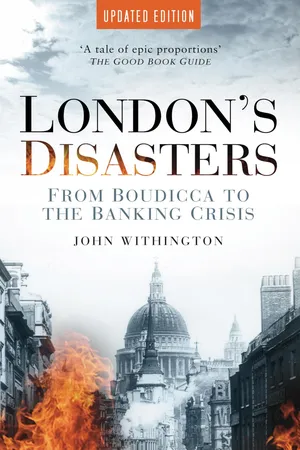
From AD 61, when Queen Boudicca – outraged at her treatment at the hands of the Romans – marched on the city and burned it to the ground, London has been hit by wave upon wave of destruction. This fascinating and unique book tells the story of over 2000 years of disaster – fire, water, disease, pollution, accident, storm, riot, terrorism and enemy action. It chronicles well-known episodes like the Great Plague of 1665 and the Blitz, as well as lesser-known events such as whirlwinds and earthquakes. This new edition also includes the recent terrorist attack on 7 July 2005, as well as a new section on the crises which have plagued the financial City, including the near-collapse of Britain's banks during 2008 and 2009. London's Disasters ultimately celebrates the spirit of the people of London who have risen above it all and for whom London is still a great city in which to live and work.
- 252 pages
- English
- ePUB (mobile friendly)
- Available on iOS & Android
eBook - ePub
About this book
Trusted by 375,005 students
Access to over 1.5 million titles for a fair monthly price.
Study more efficiently using our study tools.
Information
PART ONE
HOSTILE ACTION
ONE
WAR AND INVASION
London did not have to wait long for its first disaster. The city was founded by the Romans as Londinium around AD 50; a decade later, it lay in ruins – the only time in its history that a disaster has completely destroyed it.
The Roman city was built around Cornhill and Ludgate. By AD 60, it had spread over about 30 acres and become a busy trading centre. The houses had timber frames and thatched roofs and most were probably owned by Romans, well-to-do Gauls and other foreigners. The chain of events that began Londinium’s destruction started in modern-day Norfolk. There Prasutagus, King of the Iceni, had collaborated with the Romans and managed to construct a special relationship. His reward was to be allowed to remain semi-independent. Such arrangements, though, tended not to last beyond the death of the favoured individual.
In AD 61, the King died. He was survived by his widow Boudicca and two daughters. Prasutagus had hoped to safeguard their future by a will in which he left half of his considerable wealth to the Emperor Nero and half to his daughters. When he died, representatives of the procurator, the financial overlord of the province of Britain, appeared. They probably had instructions to seize the whole estate, but even if they did not, their arrogance and high-handedness provoked resistance.
The Romans responded brutally, flogging Boudicca and raping her daughters. It was not only the Iceni, though, whom they had alienated. The Iceni’s neighbours, the Trinovantes, whose territory lay in Essex and southern Suffolk, joined the Iceni. They bitterly resented having their lands and houses handed over to Roman war veterans, as well as the Romans’ efforts to make them worship the Emperor.
When the Britons went to war, the Roman Governor, Suetonius Paulinus, was campaigning far away in Anglesey with the XIVth Legion. In his absence, Boudicca’s host sacked and looted Colchester, massacring its Roman colonists, and destroyed part of a Roman legion that had tried to come to their rescue. When Suetonius heard the news, he raced down to London. His cavalry probably made it in three or four days, but the infantry was left far behind. With his depleted force, he decided that if he was to save the province, he had to abandon the city. So, in the words of the Roman historian Tacitus, ‘undeflected by the prayers and tears of those who begged for his help’, he led his soldiers off to the north, taking with him those Roman Londoners fit and willing to escape. The rest he abandoned to their fate. Some may have escaped into the territory of neighbouring tribes still friendly to Rome, but many were reluctant to leave, and the old and infirm could not.
When Boudicca’s army entered the city, the inhabitants were slaughtered. Tacitus complained the rebels did not want to take prisoners and make money from ransoms, they just wished to kill – cutting throats, hanging and crucifying ‘with a headlong fury’. They also burned down the city. The fearful intensity of the fire is clear from the way a heap of Roman coins found near the northern end of London Bridge have been partially melted together, and in the Museum of London, there are remains of coins and pottery burned as the city was destroyed. The ruins of Roman London also contain reddish fire debris 18 inches thick, another tangible reminder of the city’s first disaster.
Boudicca’s followers carried the destruction across the river to the settlement at Southwark, then they swung back north and meted out similar treatment to St Albans. Tacitus claims they killed 70,000 people in all. The figure is almost certainly a gross exaggeration, but the massacre was nonetheless a terrible one. The campaign, though, was to end in another massacre, this time of Boudicca’s host. It may have been 80,000 strong, but it was hampered by a long, unwieldy tail of women and children. Suetonius had probably gathered together a force of about 10,000, but its discipline and tactical sophistication enabled it to win a devastating victory. Tens of thousands of Britons were killed against just 400 Romans. Boudicca took poison rather than fall into the hands of her enemies.
Tradition has placed the fatal battle at a number of sites around London, like Stanmore Common to the north, or Honor Oak in the south. The favourite was Battle Bridge, near King’s Cross, with the body of Boudicca said to be buried at a site now occupied by one of the platforms of King’s Cross station, or under an ancient tumulus at Parliament Hill. No sign of the Queen was found, however, when the mound was excavated, and the view of historians nowadays is that the decisive battle probably took place in the Midlands.
Although Roman London was to encounter disaster from fire (see Chapter 5), in the two centuries after the defeat of Boudicca, it seems to have remained free from attack. Towards the end of the second century, however, work was begun on a major defensive wall and ditch on the landward side of the city, perhaps reflecting a fear that more turbulent times were on the way.
In 286, a Belgian named Marcus Carausius, hired by the Romans to fight barbarian pirates in the channel, declared himself Emperor of Britain. For ten years he and Allectus, who eventually deposed and murdered him, defied the Roman Empire. Then, in 296, Constantius Chlorus, who was the father of Constantine the Great and who would himself become Emperor, appeared to defeat and kill Allectus and win back Britain for Rome. Frankish mercenaries who had been hired by the rebel ‘emperor’, took refuge in London and began plundering the city. Fortunately for the citizens, some of Constantius’s ships sailed up the Thames. When the Franks saw them, they tried to escape, but, according to a contemporary account, the Romans ‘slew them in the streets’.
There was more trouble in 367 when the Saxons overran London. They were leaving loaded with plunder, driving prisoners in chains and cattle before them, when they were caught by the Roman general Theodosius, who had been despatched by the emperor. The Roman army routed the marauders and, when Theodosius entered the city, he was received with all the jubilation of a Roman triumph. Theodosius may also have strengthened London’s defences, and more work seems to have been done in the last decade of the fourth century too, but the barbarian tide could not be checked indefinitely, and besides, Rome was facing problems much nearer home, which meant it could no longer afford to protect outposts of the empire.
In the early years of the fifth century, the last Roman troops were withdrawn and, in 410, the Emperor Honorius warned Londinium it would have to look after itself. By this time, the citizens were probably hiring German mercenaries to protect them, perhaps giving them land to farm as payment, but they were not able to stop the comquest of England by Geramnic tribes. After the Romans left, Londinium and Southwark seem to have been largely abandoned, with the Anglo-Saxons initially settling outside the city walls, but, by the ninth century, they were moving back inside because of attacks from a new and fearsome enemy.
In 842, there was, according to some accounts, ‘great slaughter’ as the Vikings attacked London for the first time. In 851, they returned to kill once more, leaving the city a smouldering wreck. Then, in 871, London was occupied by the Danish Great Army, which probably stayed until 886 when Alfred the Great conquered the city. There followed a period of relative peace until 994 when the Norsemen, led by Svein Forkbeard, King of Denmark, and the future King of Norway, Olaf Tryggvason, invaded England with a fleet of ninety-four ships. They sailed up the Thames and set fire to London, but stubborn resistance from the defenders drove them off, and the city repulsed a further attack in 1009. In 1014, London submitted to Svein, but he died the same year and King Ethelred the Unready returned in alliance with another King Olaf of Norway. This one was known as Olaf the Fat during his lifetime, and after his death as a saint.
Seeing the Danes had massed their soldiers on the bridge between Southwark and London, Ethelred and Olaf tied ropes from their ships to the posts holding it up, and pulled it into the river, taking the soldiers with it. They then reconquered Southwark, and London capitulated. Two years later Ethelred died, and the kingdom fell to Svein Forkbeard’s son, Cnut, but London would face one more foreign invader before this tangled tale of dynastic rivalries reached its conclusion.
Cnut was succeeded in turn by his son, Harthacnut. Meanwhile, across the Channel, one of Ethelred’s sons, Edward, was living in exile with the Dukes of Normandy. Harthacnut invited him to return to England and on his death Edward became King, earning the nickname ‘the Confessor’ for his great piety. Edward’s Norman connections, though, led to more trouble. On his death, he left the throne to the English earl Harold Godwinson, but Duke William of Normandy, the future William the Conqueror, claimed that both Edward and Harold had promised it to him.
Determined to take England, William sailed across the Channel with his army. After defeating and killing Harold at the Battle of Hastings in 1066, William spent a month subduing the south-east before turning his attentions to London. He began by burning down Southwark. In response, London’s defenders crossed the bridge to take on the invader. They got rather the worse of the encounter, but London had a formidable garrison and William was reluctant to face the possibility of a bloody battle, so he withdrew to the west, devastating the country in a circuit of destruction.
London was spared further damage when the Anglo-Saxon nobles submitted to the conquering Duke at Berkhamsted. His coronation, though, proved the most disastrous in London’s history. When William was crowned on Christmas Day 1066, the crowd outside Westminster Abbey shouted its acclamation of him as King. Hearing the noise, the Norman soldiers inside believed it heralded the start of a revolt so they ran out into the street, setting fire to houses and hacking down the supposed rebels. In view of the turbulence of the previous 200 years, perhaps the most surprising thing was that what now followed for London were more than 800 years of freedom from enemy attack.
TWO
REBELLION AND RIOT
London may have been free from foreign attack, but it would sometimes face death and destruction at the hands of Englishmen. By 1377, the country had been enmeshed in the Hundred Years’ War with France for forty years. Hostilities, as ever, proved expensive, so the government levied a poll tax, which had to be paid by even the poorest peasants. The countryside seethed with increasing anger, and in Kent in 1381 an ex-soldier named Wat Tyler emerged as leader. His right-hand man was a renegade egalitarian priest, John Ball, who asked the famous rhyming question: ‘When Adam delved, and Eve span / Who was then the gentleman?’ By June, Tyler had gathered a band of 10,000 Kentish peasants and decided to lead them to London. On the way, they plundered Rochester and Canterbury. At the same time, another group of like-minded men set out from Essex. The Kentish rebels went to Blackheath to await a meeting with the King, while the Essex men camped at Mile End.
On 13 June, King Richard II, then aged fourteen, set off from the Tower with his advisers in the royal barge, intending to meet Tyler. But when he saw the angry crowd of peasants, he turned back, so the rebels got to work on Southwark, burning down the Marshalsea Prison, freeing the inmates and plundering Lambeth Palace. The Mayor, William Walworth, was sufficiently alarmed to order that the drawbridge on London Bridge be raised and secured to stop the rebels crossing the river. Confined to the south bank, they wrecked the highly profitable Bankside brothels, most of which were owned by the Bishop of Winchester, though some belonged to Walworth.
Then Tyler threatened to burn down houses on London Bridge if the drawbridge was not lowered. The alderman in charge, apparently refusing help from armed volunteers among the citizenry, promptly lowered it, and the rebels streamed across. They were soon reinforced by Jack Straw’s men from Essex and others from Surrey, as well as large numbers of Londoners, from vagrants to master craftsmen, with whom the poll tax was also deeply unpopular. One chronicler even believed the revolts in Kent and Essex had been incited from London. Soon the rebels were running riot in the City. In the mayhem that followed the inmates in the Fleet Prison were released, and legal records were burned at the Temple.
A key target was the King’s uncle, John of Gaunt, Duke of Lancaster, seen as the power behind the throne. The rebels attacked his opulent Savoy Palace, killing some of his servants and throwing furnishings, clothes, jewels and plate into the Thames. Tyler had insisted there should be no looting, but some of the rebels clearly thought that drinking the Duke’s wine did not count, and a number were killed when they had had rather too much, and were trapped in the cellars as the Palace burned above them.
By now the rebels were becoming an increasingly threatening and disorderly mob. They killed tax collectors, and some carried on sticks the heads of foreigners they had murdered; the decapitated bodies of Flemish merchants were said to have been piled forty high. In Cheapside, the mob summarily executed lawyers. Then Newgate was emptied of prisoners. They also managed to gain control of the Tower, and seized their arch-enemy, Simon Sudbury, Archbishop of Canterbury and Chancellor, the man widely seen as responsible for the government’s financial mismanagement. They also captured the King’s Treasurer, Robert Hales, Prior of the Hospital of St John, Clerkenwell, and executed them both on Tower Hill. For good measure, they burned down the priory too. The Archbishop’s cap was nailed to his skull and paraded through the streets, then displayed on London Bridge. There was a massacre in the City, and the mob burned down buildings at Westminster and along Holborn.
There followed King Richard’s finest hour. The rest of his reign might turn out a disaster, culminating in his being deposed and murdered, but now the fourteen-year-old monarch showed astonishing coolness and courage, not to mention duplicity and ruthlessness. While one band of rebels led by Jack Straw was attacking the Treasurer’s house at Highbury, Richard went with his courtiers to talk to another group at Mile End. He agreed to abolish their obligation to do feudal service and made a series of other concessions, as well as promising an amnesty to the insurgents. Charters guaranteeing these concessions were drawn up in Cheapside, and the Essex men began to disperse. The following day, Richard went to Smithfield, then a large open space west of the City wall, where Tyler’s men were gathered, to resume negotiations with them.
When they met, Tyler is supposed to have shaken Richard’s hand and said, ‘Brother, be of good cheer’, which was not how you were meant to speak to the King. William Walworth promptly stabbed him, and dragged him to the ground, while another of the King’s party finished him off. Richard then rode up to the wavering, confused rebels and offered himself as their leader. He took them to St John’s Fields, Clerkenwell, where the City militia had been raised. There the rebels were surrounded and persuaded to disperse without bloodshed. As the Kentish peasants were returning home, on London Bridge they would have seen the heads of Tyler and Straw, who had been executed, in the place where the Archbishop’s had been only a few hours earlier. Their exploits in London were followed by risings in four counties, but by the end of June, the revolt had been crushed and most of its local leaders killed. The concessions made by the King were quietly forgotten, though the poll tax was abolished.
Sixty-nine years later, the Hundred Years’ War was still being fought, but it was about to end in ignominy, with the loss of virtually all England’s possessions in France. The throne was occupied by the pious, well-meaning, but feeble-minded Henry VI, who founded Eton College and King’s College, Cambridge. By 1450, the government was bankrupt and once again it was the people of Kent whose patience snapped first. A man named Jack Cade led tens of thousands of them, including a number of gentry, to Blackheath, where they camped on 29 June 1450.
Ignoring an urgent appeal from the Lord Mayor to stay, the King fled north and left the city to defend itself. A hero of Agincourt, Sir John Fastolf, helped mount guards on the gates and along the wharves, and deploy projectile-throwing machines. He also sent his servant, John Payne, to Blackheath to find out what exactly it was the rebels wanted. They decided to behead him, and fetched an axe and block, but he managed to persuade them to let him go back and report their grievances instead. Their complaints about the selfishness and incompetence of the ‘kitchen’ cabinet surrounding the King would be calculated to appeal to many Londoners.
Payne delivered the message, and also told Fastolf about the size of Cade’s force, at which point his master retreated to the Tower. Cade’s men promptly took possession of Southwark on 1 July, making their headquarters at the White Hart Inn in Borough High Street. The next day, they cut the ropes of the drawbridge on London Bridge so that it could not be raised against them, and crossed the river. They caught Lord Saye and Sele, the Lord Treasurer of England, and decided to put him on trial. He refused to plead, so the rebels beheaded him in Cheapside and stuck his head on a spear. Then they tied his body to a horse’s tail and dragged it across the bridge to Southwark, where it was put on a gallows and quartered. His son-in-law, William Crowmer, the Sheriff of Kent, was also captured, and beheaded at Mile End; some twenty royal servants and a few other unpopular characters met a similar fate.
Cade had given a warning that any of his followers caught plundering would be executed, but with a force of 25,000 inside the City, there was soon looting of rich folk’s houses, assault, robbery and rape, and sympathy for the rebels began to evaporate. On 5 July, after they had retired to their Southwark headquarters for the night, another veteran of Henry V’s wars against the French got to work. Captain Matthew Gough took a group of men, killed Cade’s sentries, and occupied London Bridge. When the rebels heard the news, they rushed to the bridge and a fierce fight ensued, raging back and forth over its entire length. By now, a few of the inhabitants had fled, but most had stayed behind to try to protect their property. Some of them were now burned alive as Cade’s men set fire to their houses. Others were cut down in the street, and others still fell into the river and drowned. The battle raged for ten hours, and about two hundred were killed, including Gough himself. Then at eight in the morning, both sides agreed to a truce.
Many of the rebels were now inclined to head home with their booty, and the promise of a general pardon was enough to buy them off. Once Cade was out of town, though, the government offered a reward for him, dead or alive, and he was quickly run to ground in Sussex. Wounded, he was bundled into a cart, but died on the way back to London, where his naked corpse was mutilated and dragged on a hurdle over London Bridge to Newgate. His skull, in the time-honoured fashion, was displayed on the bridge, and, general pardon or not, dozens of rebels were rounded up and executed in Kent.
The most disastrous riot in London’s history would come more than 300 years later in response to a modest dilution of the laws discriminating against Roman Catholics. Lord George Gordon, a young MP on the make, spotted a way to advance his career. He became President of the Protestant Association, which got up a huge petition against the new law. On Friday 2 June 1780, he drew a crowd of 50,000 people to St George’s Fields in Lambeth and urged them to come with him to Parliament to present it. This was not a rabble; rather they were ‘the better sort of tradesmen’ – journeymen, apprentices, small employers. Indeed, a great deal of ‘respectable’ opinion was against the new law and the government of the City, the Court of Common Council, had asked for it to be repealed.
A hot sun was beating down, but Gordon told his supporters to dress in their ‘Sabbath day clothes’. The protesters marched three abreast and the main column was 4 miles long. At Westminst...
Table of contents
- Cover
- Title
- Copyright
- Contents
- Acknowledgements
- Part One – Hostile Action
- Part Two – Fires
- Part Three – Accidents
- Part Four – Acts of God
- Part Five – Acts of Mammon
- Bibliography
Frequently asked questions
Yes, you can cancel anytime from the Subscription tab in your account settings on the Perlego website. Your subscription will stay active until the end of your current billing period. Learn how to cancel your subscription
No, books cannot be downloaded as external files, such as PDFs, for use outside of Perlego. However, you can download books within the Perlego app for offline reading on mobile or tablet. Learn how to download books offline
Perlego offers two plans: Essential and Complete
- Essential is ideal for learners and professionals who enjoy exploring a wide range of subjects. Access the Essential Library with 800,000+ trusted titles and best-sellers across business, personal growth, and the humanities. Includes unlimited reading time and Standard Read Aloud voice.
- Complete: Perfect for advanced learners and researchers needing full, unrestricted access. Unlock 1.5M+ books across hundreds of subjects, including academic and specialized titles. The Complete Plan also includes advanced features like Premium Read Aloud and Research Assistant.
We are an online textbook subscription service, where you can get access to an entire online library for less than the price of a single book per month. With over 1.5 million books across 990+ topics, we’ve got you covered! Learn about our mission
Look out for the read-aloud symbol on your next book to see if you can listen to it. The read-aloud tool reads text aloud for you, highlighting the text as it is being read. You can pause it, speed it up and slow it down. Learn more about Read Aloud
Yes! You can use the Perlego app on both iOS and Android devices to read anytime, anywhere — even offline. Perfect for commutes or when you’re on the go.
Please note we cannot support devices running on iOS 13 and Android 7 or earlier. Learn more about using the app
Please note we cannot support devices running on iOS 13 and Android 7 or earlier. Learn more about using the app
Yes, you can access London's Disasters by John Withington in PDF and/or ePUB format, as well as other popular books in History & British History. We have over 1.5 million books available in our catalogue for you to explore.