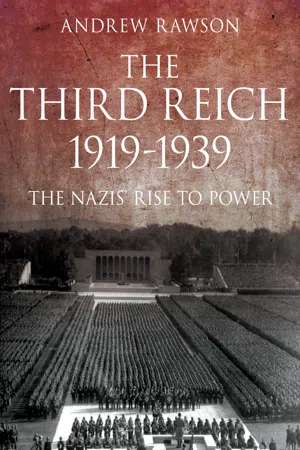
The Third Reich 1919-1939
eBook - ePub

The Third Reich 1919-1939

The Nazis' Rise to Power

  1. 320 pages
  2. English
  3. ePUB (mobile friendly)
  4. Available on iOS & Android
eBook - ePub

The Third Reich 1919-1939

The Nazis' Rise to Power

About this book

The rise of Hitler's Nazi Party is one of the defining phenomena of the twentieth century. The manner in which National Socialist ideologies took over life in Germany is difficult to comprehend over 75 years later. This fully illustrated book is a single volume encyclopedia on all aspects of this period in modern history. It starts with a shattered post-war Germany and charts the violent political tactics used by the Nazis to seize political control in 1933. The subsequent consolidation of power and brutal suppression of opponents followed as they took over all areas of society, introducing a new festival calendar to celebrate their takeover. The various military, political and youth organisations are considered, the Nazis' warped methods for maintaining law and order and their use of the press and propaganda to control the people and introduce their racial ideals. Chapters also cover art, culture, education, the economy, resistance, the leaders themselves, and more.

Frequently asked questions

Yes, you can cancel anytime from the Subscription tab in your account settings on the Perlego website. Your subscription will stay active until the end of your current billing period. Learn how to cancel your subscription.
No, books cannot be downloaded as external files, such as PDFs, for use outside of Perlego. However, you can download books within the Perlego app for offline reading on mobile or tablet. Learn more here.
Perlego offers two plans: Essential and Complete
  • Essential is ideal for learners and professionals who enjoy exploring a wide range of subjects. Access the Essential Library with 800,000+ trusted titles and best-sellers across business, personal growth, and the humanities. Includes unlimited reading time and Standard Read Aloud voice.
  • Complete: Perfect for advanced learners and researchers needing full, unrestricted access. Unlock 1.4M+ books across hundreds of subjects, including academic and specialized titles. The Complete Plan also includes advanced features like Premium Read Aloud and Research Assistant.
Both plans are available with monthly, semester, or annual billing cycles.
We are an online textbook subscription service, where you can get access to an entire online library for less than the price of a single book per month. With over 1 million books across 1000+ topics, we’ve got you covered! Learn more here.
Look out for the read-aloud symbol on your next book to see if you can listen to it. The read-aloud tool reads text aloud for you, highlighting the text as it is being read. You can pause it, speed it up and slow it down. Learn more here.
Yes! You can use the Perlego app on both iOS or Android devices to read anytime, anywhere — even offline. Perfect for commutes or when you’re on the go.
Please note we cannot support devices running on iOS 13 and Android 7 or earlier. Learn more about using the app.
Yes, you can access The Third Reich 1919-1939 by Andrew Rawson in PDF and/or ePUB format, as well as other popular books in History & Military & Maritime History. We have over one million books available in our catalogue for you to explore.

Information

CHAPTER NINETEEN

MILITARY HARDWARE

At the end of the First World War, the German armed forces were stripped of many of their heavy weapons. Tanks and military planes were banned and only a small number of old warships were allowed. The secret development of new weapons and secret training of crews progressed slowly under the Weimar Republic but they were accelerated under the Nazis. By the 1935 Nuremberg Rally, Germany was ready to show the world that it had a strong army and air force, while the navy was preparing to build new ships.

THE TANKS, PANZERS

The Treaty of Versailles had banned the design, manufacture and deployment of tanks but a secret study of First World War tactics concluded that the German army needed a range of tanks for different roles. The first tank prototype, called the ‘Large Tractor’, was tested in 1926 and it was armed with a 75mm gun. Two years later the ‘Light Tractor’ prototype appeared armed with a 37mm gun.
General Oswald Lutz and his chief of staff, Lieutenant-Colonel Heinz Guderian, developed the theory of mechanised warfare. Guderian was a First World War veteran who thought that radio communications were essential to control the fast moving armoured battles proposed by ‘lightning war’, Blitzkrieg.
Guderian wanted a mixture of tank designs supported by armoured halftracks carrying infantry and armoured cars carrying out reconnaissance. He initially wanted two designs. A slow moving tank, armed with a 37mm cannon and machine guns, would support the infantry. A fast tank, armed with a 75mm cannon and thick armour, would break through enemy lines. He later asked for a main combat tank combining the best features of the two designs. The breakthrough tank would be the Panzer IV while the main combat tank would be the Panzer III. He also asked for a heavy tank armed with a...

Table of contents

  1. Cover
  2. Title
  3. Copyright
  4. Contents
  5. One: Post-War Chaos in Germany
  6. Two: The Rise to Power
  7. Three: Adolf Hitler – The Führer
  8. Four: The Party
  9. Five: The Seizure of Power
  10. Six: Securing Power
  11. Seven: The Nazi State
  12. Eight: The Nazi Calendar
  13. Nine: Law and Order
  14. Ten: The Economy and Labour
  15. Eleven: Religion and Science
  16. Twelve: The Press, Radio and Propaganda
  17. Thirteen: Culture
  18. Fourteen: The Family, Welfare and Health
  19. Fifteen: Education, Youth and Sport
  20. Sixteen: Reclaiming Germany’s Borders
  21. Seventeen: Creating a Greater Germany
  22. Eighteen: Germany’s Armed Forces
  23. Nineteen: Military Hardware
  24. Twenty: The Storm Divison, Sturm Abteilung, SA
  25. Twenty-One: The Protection Echelon, Schutzstaffel, SS
  26. Twenty-Two: Enemies of the State
  27. Twenty-Three: Resistance