Chipping Norton today is a thriving Oxfordshire market town of some 6, 500 people at the eastern edge of the Cotswolds. Its handsome Georgian houses and iconic tweed mill are well known, but the town's history goes back much further, and by looking closely at its buildings and streets we can find survivals from earlier times all the way back to its medieval origins. This beautifully illustrated book – the result of a two-year project by the Chipping Norton Buildings Record – is divided into two parts. The first traces the development and changing fortunes of the town from its beginnings to about 1750, using new evidence from documents and buildings for an overview of Chipping Norton and its people in the past. The second part looks at each of the central medieval streets in turn and takes the reader on a walk to explore both what remains of its early fabric and what was once there.
eBook - ePub
The Making of Chipping Norton
A Guide to its Buildings and History to 1750
- 256 pages
- English
- ePUB (mobile friendly)
- Available on iOS & Android
eBook - ePub
The Making of Chipping Norton
A Guide to its Buildings and History to 1750
About this book
Trusted by 375,005 students
Access to over 1.5 million titles for a fair monthly price.
Study more efficiently using our study tools.
Information


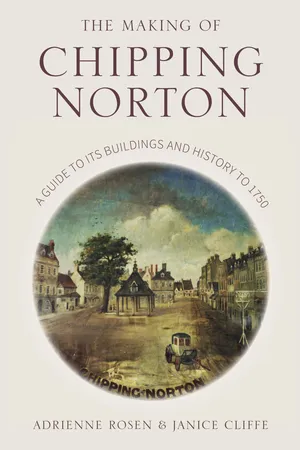
1 Frontispiece: Painting by an unknown artist of Chipping Norton market place, looking north, in the mid to late eighteenth century. The Talbot with its inn sign is at the right. In the centre is the old market house on the site of the present Town Hall. This view of the market place was reproduced a century later on the Oddfellows’ banner shown on the front cover. (By permission of Chipping Norton Town Council)
CHAPTER ONE
THE MEDIEVAL TOWN, 1000–1540
CHIPPING NORTON is a medieval town, planned and laid out on a hillside. As far as we know the site was at that time uninhabited, but the landscape around it had already been shaped by settlers, farmers and travellers over many centuries. Flint and pottery finds in the area and monuments including the Rollright Stones nearby are evidence of prehistoric settlement and clearance, and in Roman times there was a villa or small settlement to the south-east near Glyme Farm, but the origins of Chipping Norton lie in an Anglo-Saxon village whose location is unknown.
ORIGINS: VILLAGE AND CASTLE
The earliest document to mention Chipping Norton is Domesday Book, which in 1086 listed the settlement of ‘Norton’ with fifty-three households, or between 200 and 300 people.1 The name Norton means ‘north settlement or estate’ which suggests that it was established as a northern outpost of either Shipton-under-Wychwood, a royal manor, or Charlbury, which like Shipton had an important minster or mother-church. The need for a source of water, and the location of the church, both point to a location for the Anglo-Saxon settlement of Norton in the valley near the Common Brook. Traces of the early village must survive in the ground and no doubt they will be discovered one day by archaeologists.
Domesday Book also recorded the name of the new Norman lord of Chipping Norton, Ernulf de Hesdin from Picardy. Ernulf was given many manors in southern England by William the Conqueror, and he proved to be a skilful estate manager whose lands had increased in value by 1086. A document sealed in the 1090s by Ernulf in his house at Norton, in the presence of his wife and daughter, his sons, his chaplain and the knights of his household, tells us that he built a residence on his new estate, most likely a motte-and-bailey castle (a wooden tower set on an earthen mound or motte) on the earthwork now called the Castle Banks, or perhaps on the natural mound to the west now occupied by the Victorian house called The Mount. There was also a church at Norton. Ernulf and his wife Emmelina were generous benefactors to monasteries and they gave Norton’s church to the Benedictine abbey at Gloucester.2 This early church may have occupied the same site as the present parish church, but none of the original building has survived. The relationship between Chipping Norton’s church and Gloucester has endured for more than 900 years, and the Dean and Chapter of Gloucester as successors to the abbey are still today the patrons who nominate each vicar.

2 Street map of Chipping Norton before 1750, with original street names in brackets.

3 Medieval Chipping Norton in its locality, showing pre-1974 county boundaries, rivers and major routes.
The settlement was well connected with the wider world. From the north-west a major route from Worcester, Evesham and Stow-on-the-Wold passed just to the south of the modern town of Chipping Norton and on to Charlbury, Woodstock and Oxford. The name of Salford, a few miles to the west, indicates a route used for the transport of salt from Droitwich in Cheshire to south-east England. Another Anglo-Saxon route (the modern A361) ran from Banbury to Chipping Norton and then south to Shipton-under-Wychwood, Burford and the Thames crossing at Lechlade, and between these roads a network of trackways connected local communities.3
Ernulf’s lands at Norton descended to his daughter Avelina and then to his grandson William Fitzalan, whose descendants were to be lords of Chipping Norton for many generations thereafter. Their principal estates were in Shropshire where the Fitzalans were powerful barons in the Welsh Marches. Chipping Norton was remote from their strongholds at Oswestry and Clun, but it was a profitable estate in prime sheep-farming country and conveniently situated on a route between the family’s Shropshire lands and London. It was also within easy reach of the royal palace at Woodstock and the Forest of Wychwood where medieval kings enjoyed hunting with their nobles and counsellors. By 1300 the Fitzalans had transformed Norton with the construction of a stone castle, a church, a priory and a new town.
Impressive earthworks called the Castle Banks can be seen today to the north-west of the town, but very little is known about the castle that stood there and the site has never been excavated. The mound is divided into two by a bank and ditch, and in both sections it is evident that the remains of stone buildings lie beneath the surface. Another bank to the east partially encloses a further small area, which could be the site of Ernulf de Hesdin’s original motte and bailey. Below the steep north-west escarpment is the Brook where banks enclose a large medieval fishpond, now drained and known as Pool Meadow. The location of the castle’s main gate is uncertain: was it on the north where there is a gap in the outer bank, on the east facing uphill to the town, or on the south looking towards the road from Shropshire?

4 Aerial view of Chipping Norton in 1953 looking east with the church and the Castle Banks at lower left.
Chipping Norton’s castle appears to have been a fortified residence rather than a fortress. Due to its position on the side of a hill it had no moat, although there is a ditch on the south and west sides. It has been suggested that the castle was built in the early twelfth century or during the turbulent reign of Stephen, though it is not mentioned in written records, and the building probably underwent several phases of construction as the Fitzalans’ plans for Chipping Norton changed. The formidable scale of the earthworks shows that someone amongst its medieval owners had plans for a grand residence, and the ambitious landscaping of the valley with its fishpond – similar to the medieval ‘pleasaunce’ or pleasure-ground laid out near the Fitzalans’ castle at Clun – was probably associated with this phase, but it is not certain that plans for a substantial building were carried out. For much of its history the castle at Chipping Norton seems to have been occupied only intermittently. By the reign of Henry VI in the mid-fifteenth century a survey records that it was in poor condition and all that remained of its buildings were an ‘ancient hall’, a barn, a dovecote, a thatched cow-shed and a sheepcote, while the banks were used for grazing livestock.4
CREATING A NEW TOWN
Enterprising landowners across England and Europe created towns in the twelfth and thirteenth centuries as a way of maximising the income from their estates, as towns attracted trade and generated rents, tolls and fines. In Oxfordshire the towns of Burford and Banbury were well established by the mid 1100s. New research by Antonia Catchpole has concluded that Chipping Norton was probably founded in the mid to late 1100s, at the same period as the Bishop of Winchester’s new town of Witney.5
If this date is correct, the lord responsible for creating Chipping Norton was William Fitzalan, who succeeded his father in 1160 and died in 1210. In Shropshire he inherited the lordship of Clun and laid out a new town adjoining its castle. At Chipping Norton, his grandmother Avelina had founded an Augustinian priory and hospital at Cold Norton between 1148 and 1158 on the site of the present Priory Farm, and gave the priory the family’s manor of Over Norton. The grant was confirmed by William in 1204. The Fitzalans’ act of piety would diminish their own income, but the foundation of a town, if successful, would far outweigh the loss.6
The basic requirements of a new town were a large central market area; house or burgage plots along the main streets; back lanes providing access to the backs of the plots, which could later be developed into streets if demand for housing increased; a church for the townspeople; roads to bring customers to the town; and in some cases a new residence for the lord. These elements were sufficiently flexible to be adapted to the geography of the chosen site and could incorporate existing roads or buildings, so no two town plans are exactly the same. In the case of Chipping Norton the founders saw no need to provide a lordly residence or a new parish church in the town as the castle and St Mary’s stood nearby. The church was certainly rebuilt, and traces of a large twelfth-century arch in the east wall of the tower suggest that reconstruction coincided with the establishment of the new town. The size of the early church, close to its present length, reflects the intention to provide for a large community.
William Fitzalan’s surveyors chose a site for the new town at some distance from the castle, the church and the early settlement of Norton. We can only guess at their intentions, but the site they selected on the hillside above the castle and the church offered ample space to lay out all the necessary facilities on a grand scale. The rocky slope was unsuited to cultivation so the new buildings would not occupy valuable arable land. Evidence of the area’s earlier use for digging stone has been found in recent archaeological excavations on the plots behind the White Hart and nos 7-10 High Street which discovered quarry-pits of the eleventh or twelfth century.7 Below ground, the geology of the hillside offered building stone and firm footings for substantial masonry. The upper side of the market place stands on bands of the local Chipping Norton Limestone and Clypeus Grit, while buildings on the lower side are on mudstone or clay. Most importantly, the site offered a reliable water supply as an alternative to the Brook, as the alternating strata of limestone, clay and marlstone result in springs which emerge from the hillside, notably along the line of Spring Street. The selection in the twelfth century of this site on the side of a hill, rising from 175m at the west end of New Street to over 210m above Albion Street, has had practical consequences throughout Chipping Norton’s histor...
Table of contents
- Cover
- Title
- Copyright
- Contents
- About the Authors
- Preface and Acknowledgements
- Abbreviations
- Part I People, Town and Buildings of Chipping Norton to 1750
- Part II A Town Trail
- Glossary of Architectural Terms
- Further Reading and Sources
- Picture Credits
Frequently asked questions
Yes, you can cancel anytime from the Subscription tab in your account settings on the Perlego website. Your subscription will stay active until the end of your current billing period. Learn how to cancel your subscription
No, books cannot be downloaded as external files, such as PDFs, for use outside of Perlego. However, you can download books within the Perlego app for offline reading on mobile or tablet. Learn how to download books offline
Perlego offers two plans: Essential and Complete
- Essential is ideal for learners and professionals who enjoy exploring a wide range of subjects. Access the Essential Library with 800,000+ trusted titles and best-sellers across business, personal growth, and the humanities. Includes unlimited reading time and Standard Read Aloud voice.
- Complete: Perfect for advanced learners and researchers needing full, unrestricted access. Unlock 1.5M+ books across hundreds of subjects, including academic and specialized titles. The Complete Plan also includes advanced features like Premium Read Aloud and Research Assistant.
We are an online textbook subscription service, where you can get access to an entire online library for less than the price of a single book per month. With over 1.5 million books across 990+ topics, we’ve got you covered! Learn about our mission
Look out for the read-aloud symbol on your next book to see if you can listen to it. The read-aloud tool reads text aloud for you, highlighting the text as it is being read. You can pause it, speed it up and slow it down. Learn more about Read Aloud
Yes! You can use the Perlego app on both iOS and Android devices to read anytime, anywhere — even offline. Perfect for commutes or when you’re on the go.
Please note we cannot support devices running on iOS 13 and Android 7 or earlier. Learn more about using the app
Please note we cannot support devices running on iOS 13 and Android 7 or earlier. Learn more about using the app
Yes, you can access The Making of Chipping Norton by Janice Cliffe,Adrienne Rosen in PDF and/or ePUB format, as well as other popular books in History & Residential Architecture. We have over 1.5 million books available in our catalogue for you to explore.