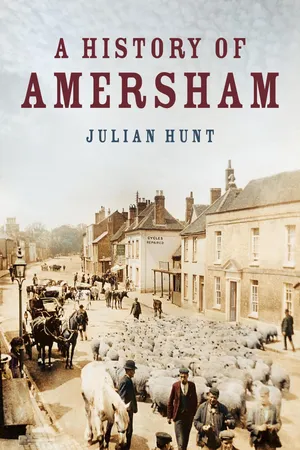
In this entertaining book the author identifies each of the old coaching inns which provide ample evidence of Amersham's importance as a stopping place on the great coach road from London to the Midlands. He traces the history of all the town's tanneries and proves that Weller's brewery is much older than previously believed and that its many maltings were selling vast quantities of malt to London brewers in the 17th century. He does not neglect the townspeople themselves, not least the Drakes of Shardeloes who dominated the political, religious and social life of Amersham for 350 years. Here he is able to draw on the unique knowledge of Barney Tyrwhitt Drake, a direct descendant. Julian Hunt's well-researched narrative is both comprehensive and easy to read. Splendidly illustrated, it is a significant contribution to the published history of Buckinghamshire and will be warmly welcomed in and around old Amersham itself.
- 132 pages
- English
- ePUB (mobile friendly)
- Available on iOS & Android
eBook - ePub
A History of Amersham
About this book
Trusted by 375,005 students
Access to over 1.5 million titles for a fair monthly price.
Study more efficiently using our study tools.
Information
One
Amersham in Domesday Book
In trying to grasp the history of a Buckinghamshire town, it must be accepted that its origin will often pre-date any event for which there is documentary evidence. It must also be recognised that any field boundaries, street patterns and house structures seen today are unlikely to be the earliest that have existed on the site. The historian can be excused therefore in commencing a history in 1086, when an understanding of earlier periods depends largely on place-name evidence and random archaeological finds from a wider area. Towns like Amersham emerge from the obscurity of the Dark Ages into the glittering light of Domesday Book, populous, productive and full of economic potential.
In 1066, the sprawling Chiltern parish of Amersham was already divided into six estates. The largest of these units was part of a portfolio of Crown property in Buckinghamshire, including lands in Chesham, Eton, Marlow and High Wycombe, which Edward the Confessor had settled on his wife, Queen Edith. As William the Conqueror claimed to be the rightful heir of King Edward, he could hardly dispossess Edith, even though she was the sister of the defeated Harold, so ownership of her Buckinghamshire estates remained unchanged until she died in 1075. Her land then reverted to the Crown and her manor of Amersham was granted to Geoffrey de Mandeville, who already owned seven other estates in Buckinghamshire.
The Manor of Amersham
The precise wording of the Domesday entry for Amersham is as follows:
Geoffrey de Mandeville holds Amersham. It answers for 7½ hides. Land for 16 ploughs; in lordship 2 hides; 3 ploughs there. 14 villagers with 4 smallholders have 9 ploughs; a further 4 possible. 7 slaves; meadow for 16 ploughs; woodland 400 pigs. The total value is and was £9; before 1066 £16. Queen Edith held this manor.1
In common with many royal estates, Queen Edith’s manor of Amersham enjoyed a very low rate of taxation. Estates were taxed according to their agricultural potential, normally measured in ‘hides’, or areas of arable land extending to about 120 acres. A typical Buckinghamshire village in Domesday Book is valued at 10 hides and often has the same number of ploughs at work. Queen Edith’s estate at Amersham was valued at 7½ hides, yet there were three ploughs on her home farm and nine more shared between 18 tenant farmers and smallholders. The presence of seven slaves may be explained by the practice of employing convicted prisoners on royal estates. Meadow land was highly valued, for, even in the warm climate of the 11th century, it was not easy to grow enough grass to over-winter the oxen which pulled the ploughs. In fact there was so much meadow on Geoffrey de Mandeville’s estate that the assessors noted there was sufficient for four more ploughs. The estate also had ample woodland, which, although crudely measured as an area sufficient to support 400 pigs, would have provided a surplus of structural timber and firewood which could be sold outside the parish. It would be normal practice for the owner of an estate the size of Amersham to provide a corn mill, where the tenants would have to grind their corn. As there is no mention of a mill on Geoffrey de Mandeville’s property, we must assume the tenants were accustomed to use one or other of the three mills which stood on the smaller Amersham estates which had been detached from the main manor before 1066.

1 This view from Rectory Wood gives some impression of what Amersham might have looked like at the time of Domesday – a village of about twenty farmsteads, with at least 1,200 acres of arable land, ample meadow and woodland and three water mills.
Other Domesday Manors
Well before the Norman conquest, five farmsteads had been detached from the main manor of Amersham, each of them assessed at half a hide. It may be that Edward the Confessor, his wife Edith, or their predecessors, had given these estates to particularly loyal followers. It would have been politically difficult for King William to dispossess these Englishmen whilst they enjoyed the protection of Queen Edith, but all but one had been replaced by Normans by 1086.
In Amersham Roger holds ½ hide from the Bishop [of Bayeux]. Land for 1 plough; it is there with 3 smallholders. 1 mill at 4s; meadow for 1 plough. The value of this land is and always was 20s. Alwin, Queen Edith’s man, held this land; he could sell.
Alwin also occupied Queen Edith’s estates at Dinton and Linslade.
In Amersham Aelmer holds ½ hide from the Count [of Mortain]. Land for 2 ploughs; they are there, with 1 villager and 1 smallholder. Meadow for 2 ploughs; woodland, 20 pigs. The value is and always was 20s. Siward, Aldeva’s man, held this land; he could sell.
Siward is described elsewhere in Buckinghamshire Domesday as a man of Earl Harold.
In Amersham Wulgeat holds ½ hide from Hugh [de Bolbec]. Land for 2 ploughs; they are there with 2 villagers and 3 smallholders. 1 mill at 5s; woodland, 20 pigs. The value is and always was 20s. He also held it before 1066; he could sell.
Wulgeat is highly unusual as an Englishman who held on to his land, albeit as a sub-tenant of the new Norman owner, Hugh de Bolbec. He would have enjoyed the protection of Queen Edith until 1075, but he may have had another guarantor, as he is mentioned elsewhere in Buckinghamshire Domesday as a man of Wulfwig, Bishop of Lincoln.
In Amersham Thurstan [Mantle] holds ½ hide. Land for two ploughs; 1 there; another possible. 2 villagers with one smallholder. Meadow for 2 ploughs; woodland, 30 pigs. The value is and was 13s 4d; before 1066, 20s. Thorkell, King Edward’s man, held this land; he could sell.
Thorkell’s estate is estimated to have been worth 20s. per year, exactly the same valuation as the other four half-hide manors in Amersham.
Jocelyn the Breton holds ½ hide in Amersham. Land for 1 plough; it is there with 5 smallholders. 1 mill at 4s; meadow for 1 plough. The value is and always was 20s. Aelfric, Godric the Sheriff’s man, held this land; he could sell.

Aelfric, like the other four Saxon tenants at Amersham, was a freeholder. He would pay a token rent to his overlord, in this case Godric, Sheriff of Buckinghamshire and Berkshire in 1066.
Amersham’s Agricultural Resources in 1086
The entries for the six Amersham estates are listed in Domesday Book according to the rank of their Norman overlords. Their agricultural potential is apparent from the table.
The table shows that Amersham and its sub-manors had an agricultural labour force of at least 43 men in 1086, which suggests a total population of about 215. Between them, Amersham’s farmers had 19 ploughs. The plough shares themselves were not of great value, but as each was pulled by a team of eight oxen, this represents 152 draught animals. Such a large number of animals which could not be slaughtered as winter approached would be a great burden on the farmers. It is recorded, however, that they had meadow land for 24 ploughs, meaning they could cut and store sufficient grass to feed 192 oxen during the winter. Their meadow by the river was probably supplemented by permanent pasture on Amersham Common and Wycombe Heath, which these animals could graze for at least part of the winter. The Domesday assessors certainly didn’t see lack of pasture as a problem, for they noted that there was sufficient land for six more ploughs. Three of the smaller estates in Amersham had water mills, together worth 13 shillings, which would have produced more flour than the local bakers could have consumed. The area of woodland around Amersham was quantified as enough to support 470 pigs, but its real value was as a source of wood for building and for fuel.

2 Pipers Wood is typical of Amersham’s remaining woodland. At Domesday, the woodland was measured as sufficient for about 500 pigs to feed on the nuts and underwood. Most of the trees would have been pollarded, so as to produce a regular supply of firewood without cutting down whole trees.

3 At the time of Domesday, Amersham had three corn mills, two valued at 4s. each and one at 5s. Town Mill is almost certainly on one of these Domesday sites.
It is tempting to link Amersham’s five smaller Domesday estates with farms which appear on the modern map. Three of them had water corn mills, confirming that some of their land was adjacent to the River Misbourne. Three of them had significant areas of woodland, but this may be explained by their proximity to Amersham Common or to Wycombe Heath, where the neighbouring farmers claimed unlimited grazing and the right to cut the wood growing there. Mantles Green Farm might have its origin in the half hide belonging to Thurstan Mantle in 1086. Weedon Hill Farm might also be associated with the Count of Mortain’s half hide, because the tenant, Aelmer, also held the hamlet of Weedon in Hardwick, a vale parish just north of Aylesbury. Such simplistic connections should be resisted, however, for the arable land belonging to these five ancient units may well have been intermixed in the common fields of the parent manor. Further sub-manors, like Raans, Shardeloes and Woodrow, were detached from the main manor of Amersham after the Conquest, further complicating the pattern of land ownership.

4 The village of Coleshill was anciently an upland pasture belonging to the Manor of Tring. Its association with Tring predates the formation of English counties and it is therefore listed in the Hertfordshire section of Domesday Book.
The Manor of Coleshill
The Domesday subdivision of Amersham was further complicated by the fact that the hamlet of Coleshill was reckoned as part of Hertfordshire. The Domesday Book entry for Tring includes a two hide ‘berewick’, or distant farmstead, where eight farmers had two ploughs.2 That this entry refers to Coleshill is confirmed by a royal grant of 1151 in which Tring and its distant subsettlement are given to the Abbey of Faversham in Kent. These possessions soon reverted to the Crown and Coleshill was granted in 1175 to the Mandevilles, lords of the manor of Amersham. Coleshill, however, remained in Hertfordshire and this anomal...
Table of contents
- Cover
- Title
- Copyright
- Contents
- List of Illustrations
- Acknowledgements
- Foreword
- 1. Amersham in Domesday Book
- 2. A New Town in the Chilterns
- 3. Amersham Farms and Farmers
- 4. Trade and Industry
- 5. Turnpike Roads and Coaching Inns
- 6. The Drakes of Shardeloes
- 7. Churches and Chapels
- 8. Schools
- 9. Caring for the Poor
- 10. The Railway and Amersham on the Hill
- Notes
Frequently asked questions
Yes, you can cancel anytime from the Subscription tab in your account settings on the Perlego website. Your subscription will stay active until the end of your current billing period. Learn how to cancel your subscription
No, books cannot be downloaded as external files, such as PDFs, for use outside of Perlego. However, you can download books within the Perlego app for offline reading on mobile or tablet. Learn how to download books offline
Perlego offers two plans: Essential and Complete
- Essential is ideal for learners and professionals who enjoy exploring a wide range of subjects. Access the Essential Library with 800,000+ trusted titles and best-sellers across business, personal growth, and the humanities. Includes unlimited reading time and Standard Read Aloud voice.
- Complete: Perfect for advanced learners and researchers needing full, unrestricted access. Unlock 1.5M+ books across hundreds of subjects, including academic and specialized titles. The Complete Plan also includes advanced features like Premium Read Aloud and Research Assistant.
We are an online textbook subscription service, where you can get access to an entire online library for less than the price of a single book per month. With over 1.5 million books across 990+ topics, we’ve got you covered! Learn about our mission
Look out for the read-aloud symbol on your next book to see if you can listen to it. The read-aloud tool reads text aloud for you, highlighting the text as it is being read. You can pause it, speed it up and slow it down. Learn more about Read Aloud
Yes! You can use the Perlego app on both iOS and Android devices to read anytime, anywhere — even offline. Perfect for commutes or when you’re on the go.
Please note we cannot support devices running on iOS 13 and Android 7 or earlier. Learn more about using the app
Please note we cannot support devices running on iOS 13 and Android 7 or earlier. Learn more about using the app
Yes, you can access A History of Amersham by Julian Hunt in PDF and/or ePUB format, as well as other popular books in History & British History. We have over 1.5 million books available in our catalogue for you to explore.