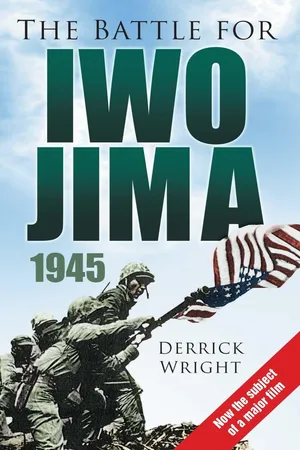
Iwo Jima was the United States Marine Corps' toughest ever battle and a turning point in the Pacific War. In February 1945, three Marine Divisions stormed the island's shores in what was supposed to be a ten-day battle, but they had reckoned without General Tadamichi Kuribayashi, the enemy commander. 'Do not plan for my return,' wrote Kuribayashi in one of his many letters to his wife, Yoshii. He knew that he and his garrison could not defeat the Marines, but he was determined to exact a fearful toll in American casualties. In the 36-day battle for Iwo Jima, which eclipsed all that had gone before, the Marines lost nearly 6,000 men and the Japanese garrison was virtually wiped out.
- English
- ePUB (mobile friendly)
- Available on iOS & Android
eBook - ePub
The Battle for Iwo Jima 1945
About this book
Information
One
No Sparrows and No Swallows
In the beginning, Iwo Jima was just an unknown island in the north Pacific Ocean. In the end, it was to become the island of death. The Nanpo Shoto is a chain of bleak islands stretching for 750 miles into the Pacific from the edge of Tokyo Bay. With the exception of a few barren outcrops, the three principal groups are the Izu Shoto, the Bonin Islands, and at the end of the chain, the Volcano Islands. The islands aroused little interest over the centuries, although it is recorded that in 1543 a Spanish captain called Bernard de Torres visited the Volcano Islands, and the Bonins were briefly explored by Sadayori Ogasawara, a Japanese mariner, in 1593. Much later, in 1673, an Englishman called Gore set foot on Iwo Jima and named it Sulphur Island after the foul-smelling clouds of gas he saw rising from the earth. He professed an intense dislike of the place, and rapidly departed – an action that would have met with the US Marines’ approval nearly three hundred years later.
Over the years, there were brief attempts at colonization, the most successful being in the 1830s, when a strange group consisting of British, Portuguese, Italians, Hawaiians and a sole American called Nathaniel Savory of Massachusetts sailed to Chi-Chi Jima and claimed the island on behalf of the British Crown. By 1891, the Japanese had asserted sole authority over the whole of the Nanpo Shoto, and began a discreet colonization of the inhabitable islands, finally bringing them under the jurisdiction of the Tokyo prefecture.
When in 1941 the Japanese Empire launched its attack on Pearl Harbor and America and Japan went to war, the population of Iwo Jima numbered 1,091. The islanders occupied a number of small villages, the capital, Motoyama, Nishi, Kita and Minami being the largest. The principal industry was the refining of sulphur, the only natural commodity, although this was supplemented by a small sugar cane plantation and some fishing. A great deal of the food for the island was brought in by ship, and water was a constant problem – there was no natural supply, and a system of concrete cisterns had to be constructed to collect rainwater, but even so, water was still imported.
Iwo Jima is 660 nautical miles south of Tokyo, and 625 miles north of Saipan in the Mariana Islands – almost halfway, a location that was to give the island immense importance later in the war. From the air, Iwo Jima has been described as resembling a pork chop, others see an ice cream cone: For the Marines who fought there in 1945, it simply looked like Hell: ‘I don’t have to worry about going to Hell,’ said one veteran, ‘I’ve been there already.’
The island is some 4½ miles long, with its longest axis running from south-west to north-east; it tapers from 2½ miles wide at the northerly section to a mere ½ mile in the south, giving a total land area of around 7½ square miles. At the base of the island lies Mt Suribachi, a 550 ft high dormant volcano – a strategically important feature with commanding views over most of the island. The beaches that stretch north and north-east from Mt Suribachi are terraced at various heights and widths by storms and constant wave action. There is no harbour or anchorage on the island, and the surf conditions, even in good weather, are not particularly conducive to landing operations.
In the centre of this lower part of Iwo Jima lay Airfield No. 1 (the Japanese used the prefix Motoyama for the three Airfields on the island, but for simplicity, they will be referred to in this book as ‘Nos 1, 2 and 3’). Airfield No. 1 was constructed on a plateau, and had three runways, together with taxiways and revetments. Further north, at the wider part of the island, a second plateau, roughly a mile in diameter, housed Airfield No. 2, and a little further north lay the as yet unfinished third airfield.
The ground that slopes away from this northern plateau is a mass of gorges, valleys, ridges and hillocks – perfect ground for defensive fighting. At various points all over the island, foul-smelling clouds of sulphurous vapour are vented from fissures in the earth. The north-easterly shore of Iwo Jima, between Kitano Point and Tachiiwa Point – a distance of some two miles, is a mass of steep cliffs leading to barren, rocky shores. The climate is variable – cool from December to April (63–70˚F), and warmer from May to November (73–80˚F), and the annual rainfall is around 60 in. The poor soil allows only coarse grass and stunted trees to grow – Army Major Yokasuka Horie wrote to his wife: ‘It has been written in the geographical books that this is an island of sulphur, – no water, no sparrows and no swallows.’
As early as March 1944, reinforcements were on the way to Iwo Jima. The Japanese High Command watched with increasing alarm the inexorable progress of Adm. Nimitz’s Marines across the Pacific from Tarawa to the Marshall Islands and on to Peleliu, Saipan, Tinian and Guam. They knew that with airfields in the Marianas, the Americans would be looking to Iwo Jima, the only island in the whole of the Nanpo Shoto range capable of housing major airfields, as a halfway haven for their Superfortress bombers. After centuries of obscurity, the island had assumed a position of major strategic importance.
In May 1944, Lt.-Gen. Tadamichi Kuribayashi was summoned to the office of Gen. Tojo, the Japanese Prime Minister, and informed that he would be the next commander of the garrison on Iwo Jima. Whether by accident or design, the appointment was a stroke of genius. Kuribayashi, descendant of a long and distinguished military line, was also a Samurai, the warrior caste of Japan that has its origins in the middle ages. At 53, he could look back on a career spanning thirty years, including a spell as an attaché in America.
Like another great Japanese commander, Adm. Yamamoto, he had witnessed at first hand the vast industrial potential of America, and was of the opinion that war with it was futile. Kuribayashi had followed the progress of the war with growing dismay. The heady days of victory in 1941 and 1942 were over, and the forces of the Empire were being rolled back on land and sea – he knew that an Allied victory was now inevitable. Certain in the knowledge that the Americans would eventually secure Iwo Jima, he viewed the appointment as both a challenge and a death sentence: ‘Do not plan for my return,’ he wrote in one of his frequent letters to Yoshii, his wife.
Kuribayashi had carefully studied the tactics of the Japanese commanders on the various islands that had fallen to the US Marines in the Pacific – Tarawa, Kwajalein, Peleliu and the Marianas – and realized that previous methods of defence had failed. Nowhere had the attempts to thwart an invasion on the beaches worked, even at Tarawa, where shallow water on the reefs surrounding the island of Betio had forced large numbers of the invaders to wade hundreds of yards to the beach under murderous fire, and he regarded the traditional banzai charge as little more than frenzied suicide.
He was intrigued by the battle for Peleliu in the Palau Islands, where the Japanese commander had conducted a fighting retreat into the Umurbrogol Mountains and waged a suicidal battle of attrition among the caves valleys, gorges and rocks. This was a different concept – as the commander had put it: ‘It is most urgent to lead the enemy to confusion and destruction by concentrating firepower from our strongpoints remaining in his midst, even though partially trampled under foot by landings, and to carry out strong counter-attacks from previously planned and prepared positions.’ Kuribayashi approved of this strategy – the enemy would not be defeated, but they would pay heavily for every inch of Iwo Jima.
Once he had arrived on the island, Kuribayashi lost no time in implementing his strategy despite opposition from Gen. Osuga and Col. Hori, two of the Army staff who had been with the original reinforcements sent out in March. His first order was for the return of all civilians to the homeland – their presence would serve no useful purpose, and they would be a drain on the limited supplies of food and water. With the arrival of more troops and Korean labourers, a massive programme of tunnelling got under way. Cave experts were flown in from Japan to advise the Army on important aspects of the programme, such as reinforcement of strongpoints, ventilation and direction.
The tunnellers had an important advantage, since most of the sub-surface of the island was made up of soft pumice-like volcanic rock which could be cut relatively quickly with hand tools. In the nine months available to the defenders before the invasion, an astonishing complex of tunnels, caves, gun emplacements, pillboxes and command posts was constructed. It was found that the volcanic ash mixed well with cement, and provided a cheap and convenient building material – when reinforced with steel wire, the Japanese were able to provide their bunkers with up to four feet of defensive protection. Many of the tunnels and all of the command posts, some of them up to seventy-five feet underground, were wired for electricity, and in the northern part of the island in particular, the tunnels linked positions that were up to half a mile apart. Tunnels were built above other tunnels, and ‘spidertraps’ (covered pits in the ground) were arranged so that during the battle, Marines often found themselves destroying one position only to find the same enemy sniper popping up minutes later from another position fifty or sixty yards away. Many Marines, resting during the night, reported hearing voices and movement coming from the ground beneath them, and after the capture of Mt Suribachi at the southern end of the island, many of the defenders joined the troops fighting in the north by by-passing the Marine lines through one or other of the labyrinth of tunnels.
The tiny ‘Grasshopper’ spotter planes used to locate enemy positions often returned with the news that they hadn’t seen the enemy at all, only groups of Marines. Private First Class (Pfc) Jesse Cass, a BAR man with the 4th Division, writes:
I landed on Iwo on the fourth day. I was assigned to cover three flamethrowers and we spent two days burning out Jap positions near the quarry. On the third day we were closing in on a cave when a mortar shell landed among us. One of the flamethrower guys was killed and I got a piece of metal in my face – they carried me away and I was on a hospital ship before night. During the whole of my time on Iwo Jima I never saw a Jap.
A new command was based in Iwo Jima – the 109th Infantry Division, which was supplemented by troops originally destined for the defence of Saipan. By the time of the American victory in the Marianas in July, the defences of Iwo Jima were formidable. Supplying the island was a problem: with no harbour of its own, the transport ships were compelled to dock at Chichi Jima in the Bonin Islands, where supplies, weapons, troops and ammunition were transferred onto small vessels for the 150-mile trip to Iwo Jima.
This route soon attracted the attention of the Americans, and became a target for bombers and submarines operating from the Marianas. An early casualty was the 26th Tank Regiment, deployed from Yokahama on 14 July, which fell victim to the submarine USS Cobia when it sank the transport Nisshu Maru with the loss of twenty-eight tanks. Aware of the Japanese build-up on Iwo Jima, the US Navy sent a Task Force under Rear-Adm. Joseph J. Clark to attack the island on 15 June. Aircraft from seven carriers pounded the airfields and engaged the Japanese fighter force in fierce dogfights in which ten of the Japanese planes were shot down. The following day, the Japanese failed to intercept the Americans, and the Navy planes bombed and strafed the island at will, destroying a number of aircraft on the ground, and taking many photographs of the installations and terrain which were of great value when compared with later shots to evaluate the progress of the build-up of the Japanese defences. Clark made a third visit on 24 June, and this time the enemy responded by sending up their entire fighter force of eighty planes, but the pilots were young and inexperienced, and only fourteen of them escaped the Hellcats and Corsairs of the Navy.
In June, Maj. Yoshitaka Horie was sent to Iwo Jima to become a member of Gen. Kuribayashi’s staff. As an officer who knew and had served under the General and survived the war, his observations are of great value. Horie was aware of the tunnels that were being constructed throughout the island: ‘In order to connect with each defensive position we planned to make 28,000 metres of underground tunnels, and began this work in December 1944, but by the time the American forces landed on Iwo Jima, we had only made 5,000 metres.’ However, in view of the masses of subterranean workings that were discovered after the battle, this is a major underestimation.
Gen. Kuribayashi issued a document to his troops called the ‘Courageous Battle Vows’, in which he explained what was expected of them:
We shall dedicate ourselves and our entire strength to the defence of this island. We shall grasp bombs, charge enemy tanks, and destroy them. We shall infiltrate into the midst of the enemy and annihilate them. With every salvo we shall, without fail, kill the enemy. Each man will make it his duty to kill ten of the enemy before dying. Until we are destroyed, to the last man we will harass the enemy with guerrilla tactics.
With his defences prepared and his men ready to fight to the finish, Kuribayashi waited serenely for the approaching American invasion force: ‘I sing some songs and go to bed by six,’ he wrote to his wife.
Two
Superfortress
The stories of the battle for Iwo Jima and the bombing campaign waged by the 20th Air Force against the Japanese mainland are irrevocably linked. Prior to the invasion of Saipan, Tinian and Guam (the three largest islands in the Marianas group) by the Marines of the 2nd, 3rd and 4th Divisions, the B29 Superfortress bombers had been limited to carrying out raids on the southern islands of Japan from bases in central China. Beleaguered by problems – including the need to fly all their aviation fuel over thousands of miles of inhospitable country, poor navigation by inexperienced crews, and the limitation of small bomb loads – the offensive had proved to be ineffective. Now, with the establishment of five huge airfields 1,500 miles south-east of Tokyo, the way was open for a massive offensive against the whole of the Japanese mainland.
The main obstacle to these missions was Iwo Jima. Situated halfway between Japan and the Marianas, it had two active airfields, with a third under construction. The B29s heading north were constantly under attack from fighters on the island, and the radar station on Mt Suribachi, primitive as it was, was capable of giving the homeland two hours’ warning of an impending attack.
As the airfields on the Marianas took shape, Japanese bombers flying from Iwo Jima made frequent raids, destroying aircraft and installations. It was obvious that Iwo Jima had to come under American control, not only to neutralize the enemy attacks, but to provide a forward refuge for damaged bombers, as a base for air–sea rescue operations, and for P51 Mustang fighters to escort the Superfortresses on the second leg of their long trip to Japan.
A number of years before the outbreak of the Second World War, far-sighted planners within the Air Force had explored the concept of a ‘super-bomber’. Working on the assumption that Germany would overrun Europe in a future war, the Air Force chiefs envisaged an aircraft with a range of 5,000 miles or more, a top speed of 400 m.p.h., and a large bomb load. The outbreak of the war in 1939 gave the programme an added impetus, and specifications were given to the four largest aircraft manufacturers – Boeing, Consolidated-Vultee, Lockheed and Douglas. By early 1940, the choice had narrowed to two, Boeing and Consolidated, and both were given contracts worth over $85,000 to proceed with wind tunnel tests. Concurrently, the Wright Aeronautical Corporation was commissioned to produce a larger and more powerful version of its Cyclone radial engine which had proved to be so successful in the B17 Flying Fortress. In September 1942, the Boeing option, the B29, made its maiden flight in Seattle, and the world’s most advanced bomber was born.
The revolutionary design produced a number of ‘firsts’: the first bomber to have pressurized areas for the crew, allowing the plane to fly at very high altitudes, and the first to have a remotely-controlled gunnery system. The only manned gun was in the tail, the remaining four low-profile turrets were controlled by gunners operating computers that calculated target speed, distance, altitude and direction.
To give the aircraft the speed the specification demanded, the B29 was designed with long, narrow wings, a feature known as high wing loading, common on modern airliners, but novel in the 1940s. High wing loading results in high landing speeds – which was to provide difficulties for the first crews – and, of course, high landing speeds means long runways, an added task for the Seabee construction crews hacking the wartime airfields out of virgin jungle.
Unfortunately, the Superfortress programme did not proceed as smoothly as the Air Force or Boeing had anticipated. The new Wright Cyclone R-3350 engines were prone to overheating problems – indeed, the second B29 prototype crashed into a meat-processing factory on the edge of Boeing’s airfield near Seattle with one of its engines blazing, resulting in the death of the chief test pilot, Edmund T. Allen, and ten members of the project development team, and the whole programme was delayed for...
Table of contents
- Cover
- Title
- Copyright
- Contents
- Acknowledgements
- Preface
- Maps
- 1 No Sparrows and No Swallows
- 2 Superfortress
- 3 Operation Detachment
- 4 ‘Our Most Redoubtable Adversary’
- 5 ‘A Great Day to Die’ (D-Day)
- 6 The Jaws of Hell (D+1–D+2)
- 7 Corpsmen: ‘Jewels of the Battlefield’
- 8 ‘The Flag Is Up!’ (D+3–D+5)
- 9 ‘The Meatgrinder’ (D+6–D+8)
- 10 ‘Oh God, Not Another Ridge’ (D+9–D+11)
- 11 Stalemate (D+12–D+15)
- 12 On To the Sea (D+16–D+19)
- 13 The Last Round (D+20–D+26)
- 14 Epilogue (D+27–D+36)
- Appendix 1: Medal of Honor Winners
- Appendix 2: The Flag-raising
- Appendix 3: US Command and Staff List
- Appendix 4: US Task Force Organization
- Appendix 5: Japanese Command Structure, Iwo Jima
- Appendix 6: US Task Organization
- Appendix 7: 20th Air Force Command Structure, April 1944–July 1945
- Appendix 8: Casualties
- Select Bibliography
Trusted by 375,005 students
Access to over 1.5 million titles for a fair monthly price.
Study more efficiently using our study tools.
Frequently asked questions
Yes, you can cancel anytime from the Subscription tab in your account settings on the Perlego website. Your subscription will stay active until the end of your current billing period. Learn how to cancel your subscription
No, books cannot be downloaded as external files, such as PDFs, for use outside of Perlego. However, you can download books within the Perlego app for offline reading on mobile or tablet. Learn how to download books offline
Perlego offers two plans: Essential and Complete
- Essential is ideal for learners and professionals who enjoy exploring a wide range of subjects. Access the Essential Library with 800,000+ trusted titles and best-sellers across business, personal growth, and the humanities. Includes unlimited reading time and Standard Read Aloud voice.
- Complete: Perfect for advanced learners and researchers needing full, unrestricted access. Unlock 1.5M+ books across hundreds of subjects, including academic and specialized titles. The Complete Plan also includes advanced features like Premium Read Aloud and Research Assistant.
We are an online textbook subscription service, where you can get access to an entire online library for less than the price of a single book per month. With over 1.5 million books across 990+ topics, we’ve got you covered! Learn about our mission
Look out for the read-aloud symbol on your next book to see if you can listen to it. The read-aloud tool reads text aloud for you, highlighting the text as it is being read. You can pause it, speed it up and slow it down. Learn more about Read Aloud
Yes! You can use the Perlego app on both iOS and Android devices to read anytime, anywhere — even offline. Perfect for commutes or when you’re on the go.
Please note we cannot support devices running on iOS 13 and Android 7 or earlier. Learn more about using the app
Please note we cannot support devices running on iOS 13 and Android 7 or earlier. Learn more about using the app
Yes, you can access The Battle for Iwo Jima 1945 by Derrick Wright in PDF and/or ePUB format, as well as other popular books in History & Military & Maritime History. We have over 1.5 million books available in our catalogue for you to explore.