
eBook - ePub
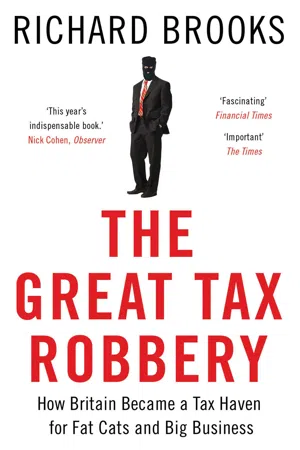
The Great Tax Robbery
How Britain Became a Tax Haven for Fat Cats and Big Business
- 304 pages
- English
- ePUB (mobile friendly)
- Available on iOS & Android
eBook - ePub
About this book
Investigative journalist and former tax-inspector Richard Brooks charts how the UK has become a global tax haven that serves the super wealthy, all with the Government’s help. Discover:
• Why thousands of British state schools and NHS hospitals are owned by shell companies based in offshore tax havens
• How British companies like Vodafone strongly influence tax laws
• Why multinationals like Google and Starbucks can operate almost tax-free in the UK
• How the taxman turns a blind eye to billions in illegally evaded tax in secret Swiss bank accounts
• How footballers like Wayne Rooney use image rights companies to reduce their tax liability
Unpicking the tangled mess of loopholes that well known multinationals, bankers, and celebrities use to circumvent tax, this is a bold manifesto for a system where we all contribute out fair share.
• Why thousands of British state schools and NHS hospitals are owned by shell companies based in offshore tax havens
• How British companies like Vodafone strongly influence tax laws
• Why multinationals like Google and Starbucks can operate almost tax-free in the UK
• How the taxman turns a blind eye to billions in illegally evaded tax in secret Swiss bank accounts
• How footballers like Wayne Rooney use image rights companies to reduce their tax liability
Unpicking the tangled mess of loopholes that well known multinationals, bankers, and celebrities use to circumvent tax, this is a bold manifesto for a system where we all contribute out fair share.
Frequently asked questions
Yes, you can cancel anytime from the Subscription tab in your account settings on the Perlego website. Your subscription will stay active until the end of your current billing period. Learn how to cancel your subscription.
No, books cannot be downloaded as external files, such as PDFs, for use outside of Perlego. However, you can download books within the Perlego app for offline reading on mobile or tablet. Learn more here.
Perlego offers two plans: Essential and Complete
- Essential is ideal for learners and professionals who enjoy exploring a wide range of subjects. Access the Essential Library with 800,000+ trusted titles and best-sellers across business, personal growth, and the humanities. Includes unlimited reading time and Standard Read Aloud voice.
- Complete: Perfect for advanced learners and researchers needing full, unrestricted access. Unlock 1.4M+ books across hundreds of subjects, including academic and specialized titles. The Complete Plan also includes advanced features like Premium Read Aloud and Research Assistant.
We are an online textbook subscription service, where you can get access to an entire online library for less than the price of a single book per month. With over 1 million books across 1000+ topics, weāve got you covered! Learn more here.
Look out for the read-aloud symbol on your next book to see if you can listen to it. The read-aloud tool reads text aloud for you, highlighting the text as it is being read. You can pause it, speed it up and slow it down. Learn more here.
Yes! You can use the Perlego app on both iOS or Android devices to read anytime, anywhere ā even offline. Perfect for commutes or when youāre on the go.
Please note we cannot support devices running on iOS 13 and Android 7 or earlier. Learn more about using the app.
Yes, you can access The Great Tax Robbery by Richard Brooks in PDF and/or ePUB format, as well as other popular books in Business & Corporate Finance. We have over one million books available in our catalogue for you to explore.
Information
ā1
āWelcome to
Tax Dodge City
āI like paying taxes. With them I buy civilization.ā
American Supreme Court Judge Oliver Wendell Holmes, Jr, 1927
āIām mortified to have to pay 50%. I use the NHS [but] I canāt use public transport any more. Trains are always late, most state schools are shit, and Iāve gotta give you, like, four million quid ā are you having a laugh? When I got my tax bill in ⦠I was ready to go and buy a gun and randomly open fire.ā
Pop star Adele, 2011
As I contemplated the dazzlingly remunerative possibility of writing a book on tax avoidance, one slightly deflating factor in the calculations was the prospect of handing over 40% of the income to the taxman.
But a quick check of what I get in return lifts the gloom. For every pound I earn I will pay around 7 pence for immediate access to professional healthcare for my family, 5 pence for my childrenās education, 2 pence for living in relative security, around the same to have the country I live in defended and 11 pence for pensions and social security for my compatriots and my future self. I even contribute half a pence to aid the developing world and, less heart-warmingly, 3 pence in interest to the various institutions from which we have collectively borrowed in order to spend more on these things than we have paid in so far. I might have plenty of quibbles with how the government to which I hand over a large chunk of my income spends it, but I canāt doubt the overall value I get for my money. Despite all the waste in the system ā the misguided ventures, the mismanagement, the disastrous IT contracts, the consultantsā fees, the overpriced private finance deals ā as a provider of the things we need most of all the state remains fantastically efficient compared to any feasible alternative.
It cost HMRC just Ā£3.5bn to gather Ā£446bn in taxes in 2010/11, a collection fee of 0.8%. Even if the costs incurred by businesses in playing their part in the process were added to this figure, it would still be far lower than that for other revenue-raising organizations; a typical charity spends between 15 and 25% of its income on fundraising.ā1 Spending the money is relatively cost-effective; the Department for International Development, for example, spends 3% of its budget on running costs, whereas Britainās largest (and apparently well run) charity in the same sort of field, Oxfam, lays out 10% on support costs.ā2 The collective provision of healthcare through the National Health Service is far more efficient than private systems elsewhere in the world. An authoritative study into healthcare systems over twenty-five years published in the British Medical Journal in 2011 concluded: āIn cost-effective terms, i.e. economic input versus clinical output, the USA healthcare system was one of the least cost-effective in reducing mortality rates whereas the UK was one of the most cost-effective over the period.āā3 The central distinction between the systems is that one is privately funded, the other paid for by tax.
If this were a club only a fool would not join. In fact nobody does opt out, but plenty happily enjoy the benefits of membership without paying their subs. These include tax evaders, who in principle at least can be hauled before the club committee and given a good ticking off and a demand for arrears or ā in the more serious cases ā expulsion from the club for a short spell at Her Majestyās pleasure. They undermine it not just by depleting its funds, but by weakening their stake in it. Just as the best-run clubs comprise members paying their dues and demanding theyāre properly spent, so honouring tax obligations strengthens a countryās democracy.
Tax evasion is simple enough: itās the cash-in-hand plumbing job or piano lesson that doesnāt make it onto a tax return, the offshore income that remains hidden from the taxman, or the more sophisticated fraud involving multiple business accounts and dodgy invoices. It is strictly criminal, although in almost all cases it is punished only with civil penalties. Prosecutions for evasion of direct taxes (like income tax) run at just thirty per year even though the offence is estimated by HMRC to cost around Ā£5.5bn annually (a similar amount is charitably assigned to taxpayersā āerrorā and āfailure to take reasonable careā).ā4 Other observers argue credibly that the figure is in fact far higher, perhaps over Ā£40bn, since the Revenue somehow manages to overlook large swathes of the black economy it should be pinning down.ā5 Evasion of indirect taxes (VAT and customs levies like tobacco duty) officially costs about Ā£7bn annually and generates around 350 prosecutions.ā6 Tax credit fraud amounting to around Ā£400m a year generates 60 or so prosecutions.ā7 Benefit frauds, which cost Ā£1bn a year, were prosecuted 9000 times in 2009/10.ā8 This table shows the hierarchy of tolerance towards cheating the public purse:

So theft by the poor warrants the full force of the law and evading duties on booze and fags is pretty serious too. A dim view has been taken of the former ever since the birth of the welfare state, the noble intentions of which were not to be undermined by the dishonest. Now itās the stuff of eye-catching tabloid stories and makes a politically unmissable target. Customs and excise frauds have older and more piratical origins and for hundreds of years have faced the stern law-enforcement traditions of Customs officers.
But evasion of direct taxes meets with more understanding, perhaps reflecting the historical reluctance of the income tax authorities to question a personās honesty when incomes were not always meticulously recorded, nor expected to be. Income tax evasion, usually a crime of omission, can also be harder to prosecute, as the Revenue was famously reminded in 1989 with the acquittal of Ken Dodd by a hometown jury, even though there was no dispute he had taken a fortune in cash and omitted it from his tax return. And income left off a tax return might turn out not to be taxable in the first place, as a 2012 jury found to be the case with the thousands of pounds deposited in football manager Harry Redknappās Monaco bank account by his chairman Milan Mandaric.
There is plenty of prejudice behind the inconsistencies, too. Less well represented, the poor make easier targets than the rich. Claiming from the state a benefit to which one is not entitled is viewed less sympathetically than evading a payment that should be made. The former is theft, the latter a bit of ducking and diving. But in truth the intention is similar in both cases. Indeed, tax evasion is likely to involve greater sums and be driven by greed alone with no element of need (a tax evader, by definition, has the means to pay his dues). Yet wealthy ātax scroungersā face no meaningful deterrent in the way that benefit fraudsters do; prosecutions for the thousands of rich individuals secretly stashing millions in offshore tax havens, for example, are forsaken in favour of generous āamnestiesā and inter-governmental agreements that effectively decriminalize the richest form of tax evasion.
Mind the gap
This apparent indifference to certain forms of tax dodging can turn to the most remarkable defensiveness. In May 2005 I asked for information on a concept that the Revenue had been working on for some years: the āTax Gapā. This is the difference between what the tax authorities collect and what they would do if everyone played by the letter and spirit of the rules. After putting up a series of risible arguments against disclosing this information ā it would āemboldenā people to dodge tax and even hit the stock market (which would never do) ā the Revenue was told to hand over the data by the Information Commiss...
Table of contents
- Praise for The Great Tax Robbery
- About the Author
- 1 ⢠Welcome to Tax Dodge City
- 2 ⢠An Unwelcome Guest
- 3 ⢠Opportunity Knocks
- 4 ⢠Foreign Adventures
- 5 ⢠Breaking Up Isnāt Hard to Do
- 6 ⢠A Rich Manās Kingdom
- 7 ⢠Sell-Out
- 8 ⢠Hear No Evil, See No Evil
- 9 ⢠On Her Majestyās Offshore Service
- 10 ⢠Poor Show
- 11 ⢠Called to Account