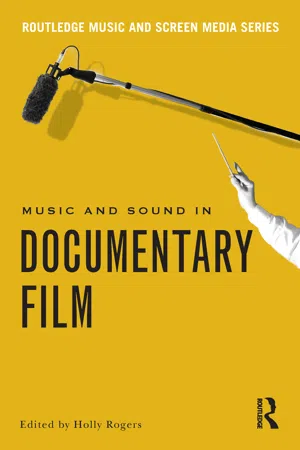
This collection of fourteen essays provides a rich and detailed history of the relationship between and music and image in documentary films, exploring the often overlooked role of music in the genre and its subsequent impact on an audience's perception of reality and fiction. Exploring examples of documentary films which make use of soundtrack music, from an interdisciplinary perspective, Music and Sound in Documentary Film is the first in-depth treatment on the use of music in the nonfiction film and will appeal to scholars and students working in the intersection of music and film and media studies.
- 210 pages
- English
- ePUB (mobile friendly)
- Available on iOS & Android
eBook - ePub
Music and Sound in Documentary Film
About this book
Information
Chapter 1 Resounding City Films
Vertov, Ruttmann and Early Experiments with Documentary Sound Aesthetics
DOI: 10.4324/9781315851556-2
The concepts of the ‘document’ and ‘documentary’ as associated with evidence are linked to both the historical rise of media of mechanical reproduction (photography, phonography, cinema) and the professional field of history in the nineteenth century.1 This simultaneous development gave rise to notions of knowledge acquisition by observing palpable traces of the past, as enabled by historical documentation (written or otherwise). In early cinema, a preoccupation with street scenes allowed the film camera to open up new ways in which to understand social life. Indeed, both documentary photography and film have subsequently been understood as developing a visual language able to comment on the modern city and its inhabitants.2 More specifically, the silent ‘city films’ of the 1920s have been revisited in recent scholarship as a case in point for both formal experimentation and social commentary on urban modernity, often with the aid of (dialectical) montage. The most well-known European examples of this transnational genre include short city films, such as Alberto Cavalcanti’s Rien que les heures (1926) and Jean Vigo’s Á Propos de Nice (1930) and the feature-length films of Walther Ruttmann (Berlin: Sinfonie der Großstadt, 1927) and Dziga Vertov (Man with a Movie Camera, 1929).
This chapter revisits the genre of the city film and investigates how the representation of urban sound was approached by directors like Cavalcanti, Ruttmann and Vertov between the mid-1920s and mid-1930s. The analysis will pay close attention to the ‘symphony’ motif developed in silent city films, a motif used as an analogy for filmic structure, formal experimentation or as a metaphor for the social body. During the 1920s, as Kurt London has observed, European films increasingly adopted a symphonic structure, with the dramatic action usually running according to the following sequence: Introduction – Main and subsidiary theme – Development – Recapitulation – Coda.3 Along with the symphony, notions of melody and rhythm were drawn on as metaphors for experiments in cinematic style and action, from the work of Soviet directors like Sergei Eisenstein to the visual experiments of figures like Hans Richter and Viking Eggeling. This essay examines the different ways in which the ‘symphony’ metaphor was adopted across silent and sound film and situates its relevance in a medial awareness heightened by the significant crossovers of radio and film experimentation during the 1920s. 4 While audiovisual experimentation is at the forefront of this investigation, close attention will also be paid to the technological, political and aesthetic concerns governing early sound documentary practice.
In recent scholarship, there has been an effort to reincorporate the city film genre into the broader history of cinema. Keith Beattie, for instance, has suggested that more recognition be given to the centrality of visual language and to this genre’s links to early cinematic forms of display and tricks. This represents an effort to reevaluate the city film from outside of traditional accounts of documentary history, which have tended to emphasise content and information over form and poetic expression.5
While this intervention is a welcome challenge to the dominant focus on the serious aspects in documentary, dubbed by theorist Bill Nichols as the ‘discourses of sobriety’, Beattie’s approach nevertheless significantly downplays the role of sound within the nonfiction tradition, from silent film onwards.6 Beattie’s account is consistent with the broader field of documentary studies, in which theoretical debates have traditionally focused on the indexical qualities of the film image. Since the 1990s, however, a growing number of scholars have begun to give more attention to the role of sound within documentary film. Apart from camerawork, it has been argued, two of the most important documentary codes consist of commentary/voice and authentication through sound/music.7 Such scholarship has drawn attention to the importance of sound in establishing the rhetoric of documentary and its claims to ‘truth’, as well as contributing to the techniques of nonfiction dramatisation.
Despite such important groundwork, however, existing studies on nonfiction film sound have focused on relatively narrow fields of investigation and only rarely elaborate on the portrayal of modern cities and their inhabitants. In what follows, the fundamental oppositions that emerged in early documentary practice will be examined in relation to the urban as a crucial site for thinking through ‘real sound’ in the late 1920s and early 1930s. This chapter focuses in particular on the distinctions that arose between outdoor and studio recording techniques; synchronous and montage editing; and between the themes of labour and leisure. The first section will outline several examples – in the work of Dziga Vertov, Joris Ivens and John Grierson’s GPO Film Unit – that illustrate such tensions and oppositions in early documentary sound practice. The analyses will show how attempts to distinguish between fact and fiction reveal the politics of representing urban sound, often evidenced by the positioning of spoken voice, scored music and sound effects/ambient noise within the sound design.8 Such broader developments in documentary sound practice will form the basis of a closer investigation of German filmmaker Walter Ruttmann, best-known for his development of rhythmic montage in Die Sinfonie der Großstadt. Ruttmann’s later city films of the 1930s will provide a case in point for considering shifts in both the representation of urban modernity and documentary sound aesthetics within the production context of National Socialist-era cinema.9
Experiments in Documentary Sound
Compared to the introduction of synchronous sound in the feature film, documentary audiovisuality was slow to emerge; despite several early attempts at newsreel synchronisation for Fox Movietone in 1927 (as evidenced in James Deaville’s chapter), most newsreels did not switch to sound until 1932 or later and even then tended to rely on stock music and studio voice-overs, rather than on location sound recordings. When it did appear, the synchronisation of music and voice with the documentary image led to widespread worry – particularly amongst the modernist avant-garde – that it would interfere with cinema’s modernist project, and silent documentary film continued until at least the 1960s. In what follows, I will dwell on three concerns – outdoor recording (of original source sounds), montage editing and a thematic stress on workers’ labour – which are bound up with political investments in the documentary representation of urban sound. I will focus on the work of Vertov, Ivens and members of Grierson’s GPO Film Unit, all of whom have been described as the first filmmakers to fully explore the possibility of soundscape composition within documentary.10
Prior to the 1920s, the ability to document urban sound in European cities was prevented due to the technological difficulty of making wax disc recordings outdoors and the primary use of the gramophone for speech and music studio recordings. In the 1910s, Vertov, inspired by Futurist responses to urban and mechanical noise, began to create sound poetry by using a phonograph with recording and playback functions. In 1916, as part of this ‘Laboratory of Hearing’, the artist experimented with the various tonalities of a waterfall and a lumber mill, although he was ultimately disappointed by the limitations of phonographic recording at this time.11
In the following decade, Vertov was involved in the theorisation and practice of Cinema-Eye, a broader project intended to develop cinema as a dynamic art form in response to and for Soviet society in the wake of revolution. In the many statements and texts by Vertov in this period, he continually asserts the necessity for a radical approach to filmmaking, in order to educate the masses and generate political consciousness. Intrinsic to the Cinema Eye method, as initially developed for newsreels, was the recording of real events, often with a hidden camera, which would subsequently be reorganised through the technique of montage editing.
With footage taken over a period of several years, Vertov’s city film experiment, Man with a Movie Camera, is commonly cited in terms of its innovative visual organisation, use of optical effects and heightened medium awareness. And yet this silent feature-length film, which depicts a multitude of urban settings spanning from morning until night, was originally conceived as a sound film.12 Vertov had already predicted the potential of sound media both theoretically, in his article ‘From Kino-Eye to Radio-Eye’ (1926) and practically, in the film Radio Kino Pravda (1925), which provided visual versions of sonic events, such as radio waves. In a statement about Man with a Movie Camera in early 1929, the filmmaker also spoke about the ‘Radio Eye’ (Radioglaz), an idea related to his desire to radically dispense with artificial or staged cinema and radio programming.13
In addition to its morning-to-night structure, Man with a Movie Camera foregrounds its own construction, with the film’s production from camera and lab processing to editing and cinema screening offered as a central thread. This self-reflexive awareness extends to sequences of imagined sound and media connectivity. The film’s opening scene introduces the cameraman, followed by shots of a cinema, as projectionist, lighting technician and audience members prepare to view a film. In terms of imagined sound, the film displays the ringing of a bell and close ups as a conductor and pit orchestra prepare to perform to the film. In terms of imagined sound, an exemplary scene takes place halfway through the film, when alarm bells are shown ringing for both ambulance and fire crews, who drive rapidly through urban traffic. Shortly after this fast-paced sequence, which includes shots of the filmmaker documenting the action, a montage sequence increases the speed, with work activity (factory, mining, offices) interspersed with women rapidly patching connections on a telephone switchboard. These sequences allude to noisy sounds in the metropolis, the multiple movements of machines and workers’ labour and the connectivity of subjects through modern transmission media. The final 10 minutes of the film depict a former church, now the Lenin’s Workers’ Club, where radio amateurs are gathered. Here, too, the imagined sounds of piano accordion, sound effects, singing and dancing are visualised through superimpositions on a radio loudspeaker and black background (figure 1.1). This sequence, which also depicts listeners’ reactions to the radio sounds, is followed by a final resolution to the film, which foregrounds the cinema audience’s point of view and their reactions to the montage sequences, closing with the superimposed image of the camera lens over the cameraman’s eye.
In his proposal for the film, dated 1928, Vertov provided the subtitle ‘A Visual Symphony’, describing his ‘non-acted’ film as an experiment in visual language that dispensed with intertitles, script and theatrical conventions like acting and sets.14 He was later incensed that the German press perceived Man with a Movie Camera as a film that was made after Ruttmann’s Berlin film, which had used the symphony concept to govern its five-act structure.15 One key difference is that Vertov’s film disrupts the usual temporal ordering of the city symphony, allowing for film material to be reused in other timeframes and with its footage drawn from multiple Soviet cities. Vertov argued for the pioneering role of Soviet documentary and its preexisting use of the symphony motif:

The majority of kino-eye films were constructed as a symphony of labor, as a symphony of the whole Soviet land, or as a symphony of a particular city. In addition, the action in these films frequently developed from early morning to evening. Thus in Part One of Kinoglaz … a city awakens and comes to life. And in Forward, Soviet! a day gradually develops into evening and concludes at midnight. […] Ruttmann’s recent experiment should therefore be regarded as the result of years of kino-eye’s pressure through work and statements, on those working in abstract film.16
Vertov’s comments suggest that the Soviet investment in the symphony for early cinema experiments had already established its own variant of the city film, in which montage editing was used to reveal the multitude of everyday minutiae that together made up a coherent whole. The symphony metaphor was also drawn upon in early 1920s Soviet culture as a way in which to incorporate industrial sounds into music composition. This is evidenced by avant-garde composer Arseny Avraamov’s ‘Symphony of the Factory Sirens’ (1922), which was staged as a large-scale public performance comprising a sound machine with whistles, factory sirens, military artillery and numerous vehicles as orchestral instruments.
In Russia, sound film production was delayed until around 1930 as inventors such as Pavel Tager (Moscow) and Alexander Shorin (St. Petersburg) sought to develop homegrown alternatives to European and American synchronisation ...
Table of contents
- Cover Page
- Half Title Page
- Title Page
- Copyright Page
- Table of Contents
- Series Foreword
- Preface
- Introduction: Music, Sound and the Nonfiction Aesthetic
- 1 Resounding City Films: Vertov, Ruttmann and Early Experiments with Documentary Sound Aesthetics
- 2 Sounding the World: The Role of Music and Sound in Early ‘Talking’ Newsreels
- 3 Race, War, Music and The Problem of One Tenth of Our Nation (1940)
- 4 Music, Science and Educational Film in Post-War Britain
- 5 Reinventing the Documentary: The Early Essay Film Soundtracks of Chris Marker
- 6 Water Music: Scoring the Silent World
- 7 Music and the Aesthetics of the Recorded World: Time, Event and Meaning in Feature Documentary
- 8 Irish Sea Power: A New Version of Man of Aran (2009/1934)
- 9 Excavating Authenticity: Surveying the Indie-Rock Doc
- 10 More Than Background: Ambience and Sound-Design in Contemporary Art Documentary Film
- 11 Sonic Ethnographies: Leviathan and New Materialisms in Documentary
- Afterword
- List of Contributors
- Index
Trusted by 375,005 students
Access to over 1.5 million titles for a fair monthly price.
Study more efficiently using our study tools.
Frequently asked questions
Yes, you can cancel anytime from the Subscription tab in your account settings on the Perlego website. Your subscription will stay active until the end of your current billing period. Learn how to cancel your subscription
No, books cannot be downloaded as external files, such as PDFs, for use outside of Perlego. However, you can download books within the Perlego app for offline reading on mobile or tablet. Learn how to download books offline
Perlego offers two plans: Essential and Complete
- Essential is ideal for learners and professionals who enjoy exploring a wide range of subjects. Access the Essential Library with 800,000+ trusted titles and best-sellers across business, personal growth, and the humanities. Includes unlimited reading time and Standard Read Aloud voice.
- Complete: Perfect for advanced learners and researchers needing full, unrestricted access. Unlock 1.5M+ books across hundreds of subjects, including academic and specialized titles. The Complete Plan also includes advanced features like Premium Read Aloud and Research Assistant.
We are an online textbook subscription service, where you can get access to an entire online library for less than the price of a single book per month. With over 1.5 million books across 990+ topics, we’ve got you covered! Learn about our mission
Look out for the read-aloud symbol on your next book to see if you can listen to it. The read-aloud tool reads text aloud for you, highlighting the text as it is being read. You can pause it, speed it up and slow it down. Learn more about Read Aloud
Yes! You can use the Perlego app on both iOS and Android devices to read anytime, anywhere — even offline. Perfect for commutes or when you’re on the go.
Please note we cannot support devices running on iOS 13 and Android 7 or earlier. Learn more about using the app
Please note we cannot support devices running on iOS 13 and Android 7 or earlier. Learn more about using the app
Yes, you can access Music and Sound in Documentary Film by Holly Rogers in PDF and/or ePUB format, as well as other popular books in Media & Performing Arts & Film & Video. We have over 1.5 million books available in our catalogue for you to explore.