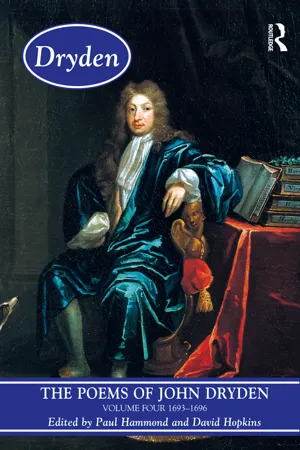
Volume Four covers poems published between 1693 and 1696, principally Dryden's translations from Juvenal and Persius, and those from Ovid and Homer included in the miscellany Examen Poeticum (1693). This new edition represents the most informative and accessible edition of Dryden's poetry, incorporating extensive new research and providing an invaluable resource for all those interested in English poetry and Restoration culture.
eBook - ePub
The Poems of John Dryden: Volume Four
1686-1696
- 402 pages
- English
- ePUB (mobile friendly)
- Available on iOS & Android
eBook - ePub
The Poems of John Dryden: Volume Four
1686-1696
About this book
Trusted by 375,005 students
Access to over 1.5 million titles for a fair monthly price.
Study more efficiently using our study tools.
Information
134 The First Satire of Juvenal
Date and publication. Printed in The Satires of Decimus Junius Juvenalis (1693), reprinted 1697. See headnote to ‘Discourse Concerning Satire’ in Volume III for further details, and for D.’s sources. In addition to the previous translations which D. consulted throughout his work on Juvenal, for this satire he also used Thomas Wood’s Juvenalis Redivivus, or, The First Satyr of Juvenal taught to speak plain English (1683), a free imitation which transposes the poem to Restoration England, and includes complimentary references to D.
The First Satire of Juvenal
Argument of the First Satire
The poet gives us first a kind of humorous reason for his writing: that being provoked by hearing so many ill poets rehearse their works, he does himself justice on them by giving them as bad as they bring. But since no man will rank himself with ill writers, ’tis easy to conclude that if such wretches could draw an audience, he thought it no hard matter to excel them, and gain a greater esteem with the public. Next he informs us more openly why he rather addicts himself to satire than any other kind of poetry. And here he discovers1 that it is not so much his indignation to ill poets, as to ill men, which has prompted him to write. He therefore gives us a summary and general view of the vices and follies reigning in his time. So that this first satire is the natural groundwork2 of all the rest. Herein he confines himself to no one subject, but strikes indifferently3 at all men in his way: in every following satire he has chosen some particular moral which he would inculcate, and lashes some particular vice or folly (an art with which our lampooners4 are not much acquainted). But our poet being desirous to reform his own age, and not daring to attempt it by an overt act of naming living persons, inveighs only against those who were infamous in the times immediately preceding his; whereby he not only gives a fair warning to great men that their memory lies at the mercy of future poets and historians, but also with a finer stroke of his pen brands even the living, and personates them under dead men’s names.
I have avoided as much as I could possibly the borrowed learning of marginal notes and illustrations,5 and for that reason have translated this satire somewhat largely. And freely own (if it be a fault) that I have likewise omitted most of the proper names because I thought they would not much edify the reader. To conclude, if in two or three places I have deserted all the commentators, ’tis because I thought they first deserted my author, or at least have left him in so much obscurity that too much room is left for guessing.
The First Satire
Still shall I hear, and never quit the score, Stunned with hoarse Codrus’ Theseid o’er and o’er? Shall this man’s elegies and t’ other’s play Unpunished murther a long summer’s day? [5] Huge Telephus, a formidable page, Cries vengeance, and Orestes’ bulky rage Unsatisfied with margins closely writ Foams o’er the covers, and not finished yet. No man can take a more familiar note [10] Of his own home, than I of Vulcan’s grot, Or Mars his grove, or hollow winds that blow From Etna’s top, or tortured ghosts below. I know by rote the famed exploits of Greece, The Centaur’s fury, and the golden fleece. [15] Through the thick shades th’ eternal scribbler bawls, And shakes the statues on their pedestals. The best and worst on the same theme employs His Muse, and plagues us with an equal noise.
Provoked by these incorrigible fools, [20] I left declaiming in pedantic schools, Where with men-boys I strove to get renown, Advising Sulla to a private gown. But since the world with writing is possessed, I’ll versify in spite, and do my best [25] To make as much waste paper as the rest.
But why I lift aloft the satyr’s rod, And tread the path which famed Lucilius trod, Attend the causes which my Muse have led: When sapless eunuchs mount the marriage-bed, [30] When mannish Mevia, that two-handed whore, Astride on horseback hunts the Tuscan boar; When all our lords are by his wealth outvied Whose razor on my callow beard was tried; When I behold the spawn of conquered Nile, [35] Crispinus, both in birth and manners vile, Pacing in pomp, with cloak of Tyrian dye Changed oft a day for needless luxury, And finding oft occasion to be fanned, Ambitious to produce his lady-hand, [40] Charged with light summer-rings his fingers sweat, Unable to support a gem of weight: Such fulsome objects meeting everywhere, ’tis hard to write, but harder to forbear.
To view so lewd a town, and to refrain, [45] What hoops of iron could my spleen contain? When pleading Matho, borne abroad for air, With his fat paunch fills his new-fashioned chair, And after him the wretch in pomp conveyed Whose evidence his lord and friend betrayed, [50] And but the wished occasion does attend From the poor nobles the last spoils to rend; Whom ev’n spies dread as their superior fiend, And bribe with presents, or when presents fail They send their prostituted wives for bail. [55] When night-performance holds the place of merit, And brawn and back the next of kin disherit; For such good parts are in preferment’s way, The rich old madam never fails to pay Her legacies, by nature’s standard given: [60] One gains an ounce, another gains eleven; A dear-bought bargain, all things duly weighed, For which their thrice-concocted blood is paid, With looks as wan as he who in the brake At unawares has trod upon a snake, [65] Or played at Lyons a declaiming prize, For which the vanquished rhetorician dies.
What indignation boils within my veins, When perjured guardians, proud with impious gains Choke up the streets, too narrow for their trains! [70] Whose wards, by want betrayed, to crimes are led Too foul to name, too fulsome to be read! When he who pilled his province’scapes the laws, And keeps his money though he lost his cause: His fine begged off, contemns his infamy, [75] Can rise at twelve, and get him drunk ere three: Enjoys his exile, and, condemned in vain, Leaves thee, prevailing province, to complain!
Such villainies roused Horace into wrath, And ’tis more noble to pursue his path [80] Than an old tale of Diomede to repeat, Or labouring after Hercules to sweat, Or wandering in the winding maze of Crete; Or with the wingèd smith aloft to fly, Or fluttering perish with his foolish boy.
[85] With what impatience must the Muse behold The wife by her procuring husband sold? For though the law makes null th’ adulterer’s deed Of lands to her, the cuckold may succeed: Who his taught eyes up to the ceiling throws, [90] And sleeps all over but his wakeful nose. When he dares hope a colonel’s command, Whose coursers kept, ran out his father’s land; Who yet a stripling Nero’s chariot drove, Whirled o’er the streets, while his vain master strove [95] With boasted art to please his eunuch-love.
Would it not make a modest author dare To draw his table-book within the square And fill with notes, when lolling at his ease, Maecenas-like, the happy rogue he sees [100] Borne by six wearied slaves in open view, Who cancelled an old will, and forged a new: Made wealthy at the small expense of signing With a wet seal, and a fresh interlining.
The lady next requires a lashing line [105] Who squeezed a toad into her husband’s wine: So well the fashionable med’cine thrives, That now ’tis practised ev’n by country wives, Pois’ning without regard of fame or fear, And spotted corps are frequent on the bier. [110] Would’st thou to honours and preferments climb? Be bold in mischief, dare some mighty crime Which dungeons, death or banishment deserves: For virtue is but dryly praised, and starves. Great men to great crimes owe their plate embossed, [115] Fair palaces, and furniture of cost, And high commands: a sneaking sin is lost. Who can behold that rank old letcher keep His son’s corrupted wife, and hope to sleep? Or that male-harlot, or that unfledged boy, [120] Eager to sin, before he can enjoy? If nature could not, anger would indite Such woeful stuff as I or S——ll write.
Count from the time since old Deucalion’s boat, Raised by the flood, did on Parnassus float; [125] And scarcely mooring on the cliff implored An oracle how man might be restored; When softened stones and vital breath ensued, And virgins naked were by lovers viewed; Whatever since that golden age was done, [130] What human kind desires, and what they shun, Rage, passions, pleasures, impotence of will, Shall this satirical collection fill.
What age so large a crop of vices bore, Or when was avarice extended more? [135] When were the dice with more profusion thrown? The well-filled fob not emptied now alone, But gamesters for whole patrimonies play; The steward brings the deeds which must convey The lost estate: what more-than-madness reigns, [140] When one short sitting many hundreds drains, And not enough is left him to supply Board-wages, or a footman’s livery?
What age so many summer-seats did see? Or which of our forefathers fared so well [145] As on sev’n dishes at a private meal? Clients of old were feasted; now a poor Divided dole is dealt at th’ outward door, Which by the hungry rout is soon dispatched: The paltry largess, too, severely watched [150] Ere given, and every face observed with care That no intruding guest usurp a share. Known, you receive: the cryer calls aloud Our old nobility of Trojan blood, Who gape among the crowd for their precarious food. [155] The Praetor’s and the Tribune’s voice is heard; The freedman justles and will be preferred; ‘First come, first served’, he cries, ‘and I, in spite Of your great lordships will maintain my right. Though born a slave, though my torn ears are bored, [160] ’tis not the birth, ’tis money makes the lord. The rents of five fair houses I receive: What greater honours can the purple give? The poor patrician is reduced to keep In melancholy walks a grazier’s sheep: [165] Not Pallas nor Licinius...
Table of contents
- Cover
- Half Title
- Title Page
- Copyright Page
- Table of Contents
- Preface
- List of Illustrations
- Chronological Table of Dryden’s Life and Publications
- Abbreviations
- Bibliography
- The Poems
- Appendix A. The Contents of Examen Poeticum and The Annual Miscellany
- Appendix B. Congreve’s Commendatory Poem on Dryden’s Persius
- Index of Titles
- Index of First Lines
Frequently asked questions
Yes, you can cancel anytime from the Subscription tab in your account settings on the Perlego website. Your subscription will stay active until the end of your current billing period. Learn how to cancel your subscription
No, books cannot be downloaded as external files, such as PDFs, for use outside of Perlego. However, you can download books within the Perlego app for offline reading on mobile or tablet. Learn how to download books offline
Perlego offers two plans: Essential and Complete
- Essential is ideal for learners and professionals who enjoy exploring a wide range of subjects. Access the Essential Library with 800,000+ trusted titles and best-sellers across business, personal growth, and the humanities. Includes unlimited reading time and Standard Read Aloud voice.
- Complete: Perfect for advanced learners and researchers needing full, unrestricted access. Unlock 1.5M+ books across hundreds of subjects, including academic and specialized titles. The Complete Plan also includes advanced features like Premium Read Aloud and Research Assistant.
We are an online textbook subscription service, where you can get access to an entire online library for less than the price of a single book per month. With over 1.5 million books across 990+ topics, we’ve got you covered! Learn about our mission
Look out for the read-aloud symbol on your next book to see if you can listen to it. The read-aloud tool reads text aloud for you, highlighting the text as it is being read. You can pause it, speed it up and slow it down. Learn more about Read Aloud
Yes! You can use the Perlego app on both iOS and Android devices to read anytime, anywhere — even offline. Perfect for commutes or when you’re on the go.
Please note we cannot support devices running on iOS 13 and Android 7 or earlier. Learn more about using the app
Please note we cannot support devices running on iOS 13 and Android 7 or earlier. Learn more about using the app
Yes, you can access The Poems of John Dryden: Volume Four by Paul Hammond, David Hopkins, Paul Hammond,David Hopkins in PDF and/or ePUB format, as well as other popular books in Literature & European Literary Collections. We have over 1.5 million books available in our catalogue for you to explore.