Nursing & Health Survival Guide
eBook - ePub

Nursing & Health Survival Guide

  1. 70 pages
  2. English
  3. ePUB (mobile friendly)
  4. Available on iOS & Android
eBook - ePub

Nursing & Health Survival Guide

About this book

A pocket-sized reference tool for quick access to crucial information in any community or antenatal setting.

The Nursing & Health Survival Guides have evolved - take a look at our our app for iPhone and iPad.
Frequently asked questions

Yes, you can cancel anytime from the Subscription tab in your account settings on the Perlego website. Your subscription will stay active until the end of your current billing period. Learn how to cancel your subscription.
At the moment all of our mobile-responsive ePub books are available to download via the app. Most of our PDFs are also available to download and we're working on making the final remaining ones downloadable now. Learn more here.
Perlego offers two plans: Essential and Complete
  • Essential is ideal for learners and professionals who enjoy exploring a wide range of subjects. Access the Essential Library with 800,000+ trusted titles and best-sellers across business, personal growth, and the humanities. Includes unlimited reading time and Standard Read Aloud voice.
  • Complete: Perfect for advanced learners and researchers needing full, unrestricted access. Unlock 1.4M+ books across hundreds of subjects, including academic and specialized titles. The Complete Plan also includes advanced features like Premium Read Aloud and Research Assistant.
Both plans are available with monthly, semester, or annual billing cycles.
We are an online textbook subscription service, where you can get access to an entire online library for less than the price of a single book per month. With over 1 million books across 1000+ topics, we’ve got you covered! Learn more here.
Look out for the read-aloud symbol on your next book to see if you can listen to it. The read-aloud tool reads text aloud for you, highlighting the text as it is being read. You can pause it, speed it up and slow it down. Learn more here.
Yes! You can use the Perlego app on both iOS or Android devices to read anytime, anywhere — even offline. Perfect for commutes or when you’re on the go.
Please note we cannot support devices running on iOS 13 and Android 7 or earlier. Learn more about using the app.
Yes, you can access Nursing & Health Survival Guide by Alison Edwards in PDF and/or ePUB format, as well as other popular books in Medicine & Health Care Delivery. We have over one million books available in our catalogue for you to explore.

Information

Publisher
Routledge
Year
2014
eBook ISBN
9781317905745
Edition
1

Abdominal examination

  • Ensure woman’s bladder is empty
  • Make sure the woman is comfortable
  • Get consent

Inspection

  • Examine the abdomen for the following: shape, size, scarring, rashes, striae gravidarum (stretch marks), a saucer-shaped dip at the umbilicus (suggests an occipito posterior [OP] position), bruising or trauma (? domestic violence), surgical scars.

Palpation

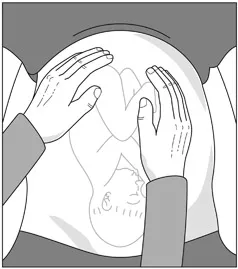
  • Fundal palpation – begin at the fundus (top) of the uterus with both hands to identify which pole (head or bottom) of the fetus is situated there. NB If a woman is expecting twins then two poles are likely to be felt here.
Tip As a general rule, a head is harder and rounder than a bottom and is ballotable (can be rocked from side to side).
Figure 1 Fundal palpation
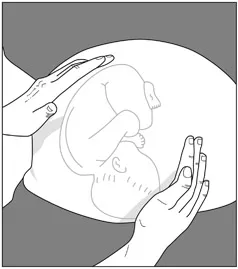
  • Lateral palpation – with one hand support the abdomen and use it to gently push the fetus towards the other side. With the other hand (not your fingertips as this is uncomfortable) palpate from top to bottom to feel for either a firm back or limbs.
  • Swap over to palpate down the other side of the uterus to confirm your findings.
Figure 2 Lateral palpation
  • Pelvic palpation
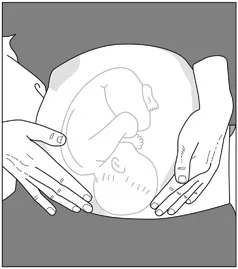
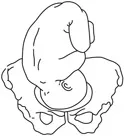
  • Method 1 – using both hands as shown in Figure 3. This will enable you to confirm the fetal presentation in addition to confirming the level of engagement.
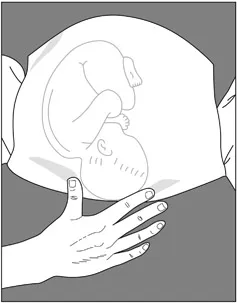
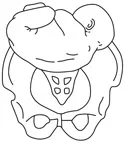
  • Method 2 – the Pawlic’s grip, as illustrated in Figure 4, but this is much more uncomfortable for the woman.
Figure 3 Two-handed palpation
Figure 4 Pawlic’s grip

Auscultation

  • Ask about pattern of fetal movements – refer if pattern has changed.
  • Current NICE guidance (Antenatal Care 2003, 2008a) does not recommend listening to the fetal heart at routine antenatal visits. However, it can be reassuring for parents to hear their baby.
  • Using a Pinard’s stethoscope count the fetal heart rate for a full minute.
  • Check the maternal pulse at the same time to ensure that it is the fetal heart you are hearing.
  • Following this, a Doppler device can be used.
Tip Remember not to lay the woman completely flat. The weight of the uterus can put pressure on the maternal vena cava, reducing maternal and fetal blood supply and causing supine hypotensive syndrome. As you get more practiced there is no need to have the woman semi-recumbent; she could be sitting or even standing – whichever is most comfortable for her.
Tip The fetal heart is best heard over the anterior shoulder of the fetus.

Measurement

  • Measure symphysis–fundal height.
  • Use the tape measure with the centimetres on the underside to reduce bias.
  • Secure the tape measure at the fundus with one hand.
  • Measure down the longitudinal axis of the uterus to the symphysis pubis.
  • Plot the result on the customised growth chart.

Expected Findings

Presentation – cephalic (head), breech (bottom). (Shoulder and cord presentations are possible but unlikely to be detected by palpation alone.)
Lie – longitudinal, oblique or transverse.
Figure 5 Longitudinal lie
Figure 6 Oblique lie
Figure 7 Transverse lie
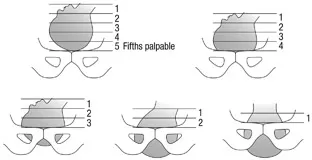
Engagement – the number of fifths of the fetal head palpated above brim of pelvis. Engagement has occurred when only two to three fifths of the fetal head can be felt.
Figure 8 Engagement
Figure 8 Engagement
Source: Reproduced from ‘ABC of labour care: Labour in special circumstances’, by Geoffrey Chamberlain and Philip Steer, BMJ (1999) 318: 1124–1127 © 1999 with permission from BMJ Publishing Group Ltd
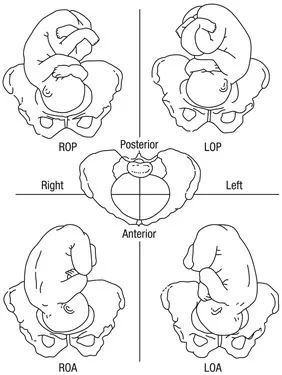
Position – the direction the occiput of the fetal skull faces, e.g. right occipital anterior (ROA), left occipital arterior (LOA), left occipital posterior (LOP), right occiptal posterior (ROP).
Figure 9 Fetal position
Source: From http://www.brooksidepress.org. Used with permission

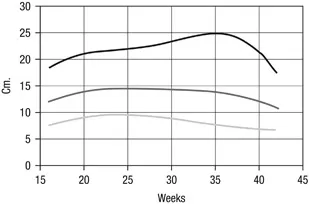
Amniotic fluid index

Figure 10 Amniotic fluid index in a normal singleton pregnancy
Figure 10 Amniotic fluid index i...

Table of contents

  1. Cover Page
  2. Title Page
  3. Copyright Page
  4. Contents
  5. Dedication
  6. Abdominal examination
  7. Amniotic fluid index
  8. Anaemia
  9. Anatomy
  10. Antenatal appointments
  11. Antenatal screening
  12. Benefits
  13. Bishop's score for induction of labour
  14. Blood pressure taking
  15. Blood values
  16. BMI
  17. Booking advice
  18. British Sign Language
  19. Calculating Estimated Due Dates
  20. Cholestasis
  21. CMACE Top Ten recommendations
  22. CTG interpretation
  23. Customised growth charts
  24. Diabetes
  25. Drug administration
  26. Emergencies
  27. Female circumcision
  28. Functions of the placenta
  29. Methods of induction
  30. Minor disorders
  31. Substance misuse
  32. Support groups
  33. Useful websites
  34. Venepuncture
  35. Vulnerable groups of women
  36. General abbreviations
  37. References
  38. Backmatter