- 384 pages
- English
- ePUB (mobile friendly)
- Available on iOS & Android
eBook - ePub
About this book
ISO 14001 is the star standard among the International Organization for Standardization's ISO 14000 series of environmental management standards. It has seen spectacular growth since its launch in September 1996. Worldwide registrations are set to pass the 20,000 mark in 2000 with 20 times that number reportedly waiting in the wings.In 30 explicit but concise chapters, ISO 14001: Case Studies and Practical Experiences seeks to unravel the truth behind what can and cannot be achieved by ISO 14001 and aims to provide readers with enough knowledge to make choices about its relevance and importance not only to their worlds but also to society. Written by leading practitioners, certifiers, consultants, government and academics, the book examines both the real benefits and the shortcomings organizations have experienced with ISO 14001. We learn from both.Far more ambitious than an implementation guide, the book will provide those readers struggling with the standard first-hand experiences of the real issues they will face in implementing their EMS and, just as importantly, what certifiers look for when they visit firms. ISO 14001: Case Studies and Practical Experiences is a warts-and-all expose of ISO 14001: the issues tackled; the problems faced and overcome; and, above all, the astonishing flexibility of its uses and the diversity of its users.This important book is a must for businesses, researchers, consultants, government officials, students, NGOs and support organisations who want more than just another how-to-do-it manual; but rather the truth about how ISO 14001 is really working on the ground.
Part 1
Implementation, Maintenance and Integration
1
Deployment and Operation of a Business-Wide EMS
This chapter discusses one company’s approach to deploying and operating a business-wide, third-party-registered ISO 14001 environmental management system (EMS). The term ‘business-wide’ as used here means implementation of a common global approach to environmental management which is specified under a single EMS platform.
Lucent Technologies Microelectronics Group (Microelectronics) is a business unit of Lucent Technologies, with over 12,000 employees worldwide. It grew out of Western Electric’s semiconductor components business, which was the first in the world to manufacture transistors. Microelectronics is a market leader in the design and manufacture of opto-electronic and integrated circuit products. These products provide our customers with clear-cut, innovative application solutions for worldwide data, voice and video communications. They include:
- Digital signal processors for modems, wired, cordless and cellular phones
- Standard-cell application-specific integrated circuits for disk drives and other applications
- Field-programmable gate arrays for telecommunications networks
- Components and subsystems such as photodetectors, laser modules, receivers, and transmitters for fibre-optic telecommunications networks
◢ Why implement a business-wide EMS?
Since 1991, Microelectronics has had a formal team called EnAcT (Environmental Action Team) to address environmental issues that affect the business. The EnAcT consists of environmental management representatives from all Microelectronics manufacturing locations worldwide. While the international community was debating the final details of ISO 14001 during 1995, Microelectronics—working through the EnAcT—determined that environmental management needed a more formalised definition and structure if further improvements in Microelectronics’ global environmental management and performance were to be realised.
Environmental performance included complying with all legal and other environmental requirements (e.g. governmental voluntary programme agreements, customer specifications, etc.), establishing and meeting environmental objectives and targets that go well beyond legal compliance, and formally including community environmental concerns and issues in decision-making on environmental improvement projects. It was also determined that implementation of a Microelectronics-defined business-wide, global EMS, meeting the ISO 14001 standard elements, was key to improving environmental management and performance. ISO 14001 was also viewed as the quality tool needed to implement Microelectronics’ environment, health and safety (EHS) vision:
To fully integrate environmental, health and safety considerations into the business decision-making process, thus making these endeavours a value-added proposition to the customer, company and community.
Business benefits
In 1995, Lucent Technologies established a goal that required its operating units to implement an EMS based on recognised standards by the end of 1999. In addition to allowing Microelectronics to be the first Lucent unit to meet this goal, implementation of a business-wide, ISO 14001-certified EMS also provided a number of benefits to the business.
Market research indicated that a number of Microelectronics’ customers (e.g. Siemens, Ericsson) were interested in using ISO 14001 as a tool to improve the environmental performance of their suppliers. As many companies work to present themselves as environmentally responsible organisations, they also want to ensure that their suppliers are too. Microelectronics receives many supply chain questionnaires asking if it has implemented ISO 14001 or other EMS standards.
One Microelectronics
Establishment of a business-wide EMS has allowed Microelectronics to fully enhance its ‘One Microelectronics’ approach to environmental management. This enables environmental issues affecting more than one location/product to be elevated to group level and addressed in a cost-effective manner for implementation at all applicable locations. Aspect action teams address such environmental issues. These teams consist of employees who are closest to the environmental issue and are most likely to succeed in making the change.
A ‘One Microelectronics’ business approach allowed us to integrate into the existing ISO 9000 quality management system infrastructure and capitalise on lessons learned associated with gaining ISO 9000 certification. For example, proven ISO 9000 processes for documentation control, auditing and corrective/preventative action programmes were readily adapted for ISO 14001 implementation, thus lowering implementation costs.
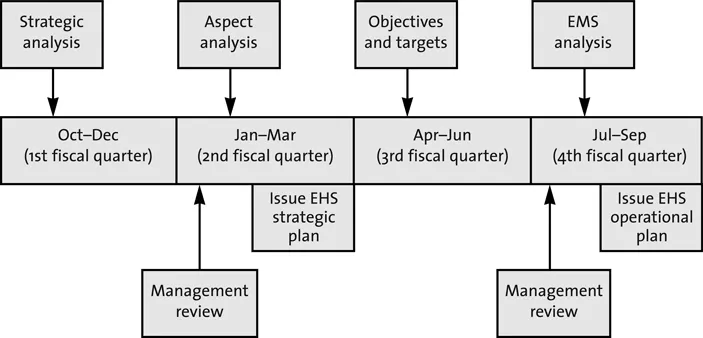
Figure 1.1 Microelectronics EMS planning calendar
The Microelectronics EMS was designed to allow more formal involvement with the local community, including local and state regulators, in the company’s EMS and environmental decision-making through its local environmental advisory groups (LEAGs). LEAGs are further discussed under the Communication with community and customers section.
In the past, cross-organisational roles and responsibilities were loosely defined, which led to some confusion and wasted resources from duplication of effort. Documentation of environmental management roles and responsibilities across the business and locations led to clearly defined expectations and improved human resource utilisation. As part of this effort, Microelectronics specified the services required of Lucent Technologies Global EHS Centre1 in a contractual agreement.
The Microelectronics EMS was designed so that it coincides and integrates environmental decision-making into the annual business planning cycle. As shown in Figure 1.1, technological advancements and new legal or other environmental requirements are reviewed to formulate a draft EHS strategy during the first fiscal quarter. This strategic input, taken with significant environmental aspect analyses, is then discussed among EnAcT members during the second fiscal quarter to determine group and location objectives and targets. These are formulated, along with project plans, and then reviewed by management for funding and approval. Additionally, the Microelectronics EMS is reviewed by EnAcT members and management during the last fiscal quarter. Finally, project plans to accomplish objectives and targets are documented in an annual EHS operational plan, issued during the last fiscal quarter. Further discussion on implementation of relevant ISO 14001 planning elements can be found later in this chapter.
A business case, covering implementation and operation of a third-party-certified ISO 14001-based EMS, was prepared and approved by the Microelectronics executive committee. The committee consisted of the Microelectronics group president, the vice-presidents and directors of key business operational functions. Following business case approval, a Microelectronics ISO 14001 implementation team was formed. This ISO 14001 team was tasked to formalise and document the Microelectronics EMS platform requirements and processes needed to gain business-wide ISO 14001 certification. There were two factors that motivated the team:
- Top management support and endorsement for Microelectronics to be an environmental leader (e.g. the president participated in Microelectronics’ ISO 14001 awareness video)
- Desire to meet Lucent Technologies EHS goals for 2000, and set an example as the first operating unit in Lucent Technologies to gain ISO 14001 certification
During initial development of Microelectronics EMS processes, the ISO team worked with the US Environmental Protection Agency (EPA) as part of Project XL2 to address their EMS concerns. Project XL is an EPA voluntary programme designed to reinvent US ‘command-and-control’ environmental regulation with innovative solutions to improve company environmental performance.
The entire process from ISO 14001 business case development to receipt of ISO 14001 certification took 18 months (see Fig. 1.2).
On 2 April 1997, Microelectronics obtained one of the world’s first known ‘business-wide’ ISO 14001 certifications. The certification covers Microelectronics’ EMS which ties all Microelectronics locations together with corporate support organisations under one ISO 14001 certificate. This type of EMS was established so that common environmental improvement opportunities could be identified and solved in one go for all locations through deployment of the aspect action teams. To obtain this business-wide ISO 14001 certification, Microelectronics headquarters and its ten global manufacturing/design locations in six countries, with five US locations in four different states, received ISO 14001 audits by Lloyds Register Quality Assurance. In addition, the Lucent Technologies Global EHS Centre was reviewed since it had documented responsibilities as a supplier to support the Microelectronics EMS.
◢ Design of the business-wide EMS
The Microelectronics EMS is based on ISO 14001 principles and comprises five major components:
- Environmental policy
- Planning
- Implementation and operation
- Checking and corrective action
- Management review
As previously discussed, the Microelectronics EMS planning and management review elements (e.g. significant environmental aspects determination, objectives and targets identification, EMS reviews) are tied to the annual business cycle, thus ensuring that environmental management is continually improved.
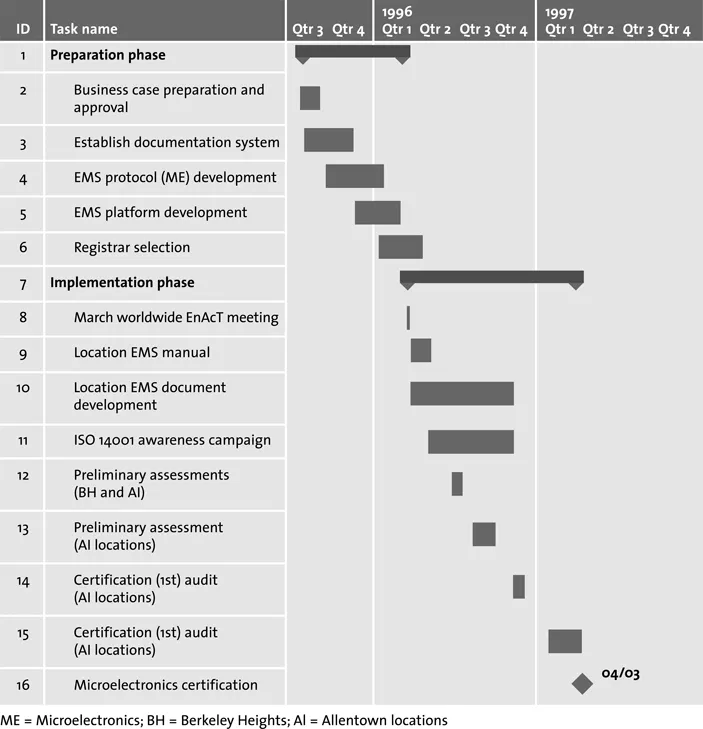
Figure 1.2 Microelectronics ISO 14001 certification time-line
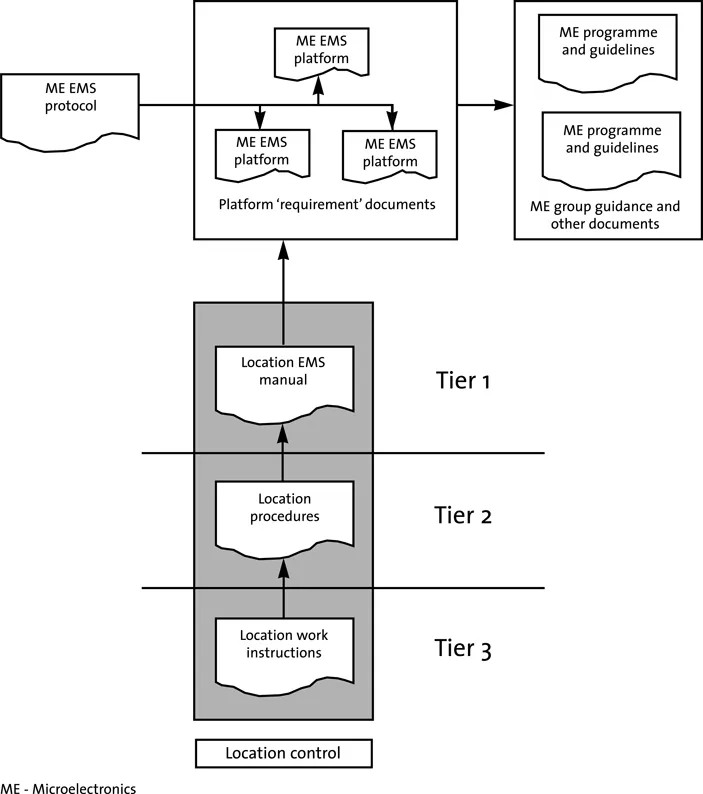
Figure 1.3 EMS documentation structure
As with all EMSs, the Microelectronics EMS is defined by an environmental policy which is signed by the group president. This policy applies to all employees worldwide. The Microelectronics group environmental policy was later changed to an EHS policy.3
The specific requirements of the Microelectronics EMS are defined in a Microelectronics EMS protocol document that links to a series of Microelectronics EMS platform documents (see Fig. 1.3). To ensure real-time availability of the documents by employees, the documents are controlled and made accessible via the company’s intranet. These platform documents address each ISO 14001 element and specify Microelectronics’ EMS requirements and processes of the ‘One Microelectronics’ approach to environmental management. Companion documents known as Microelectronics programme and guideline documents provide guidance on implementation of specific environmental programmes and are also made available on the intranet. All locations were required to prepare an EMS manual which ties the Microelectronics EMS platform document requirements to location EMS procedures.
In developing the Microelectronics EMS, many existing processes such as environmental training and awareness, and emergency preparedness and response were documented. New Microelectronics EMS processes were also documented and implemented, such as defining environmental aspects and conducting EMS audits. The key to building a business-wide EMS was to define a strong, common approach to the planning elements of ISO 14001. In doing so, significant environmental aspects are similarly defined and thus managed through the Microelectronics EMS worldwide. This framework allows locations a degree of flexibility in implementation such as how best to define operational controls and training programmes to ensure adequate environmental management. Allowing flexibility for implementation recognises the fact that cultural variations exist across the business and that many current location-specific environmental management programmes can continue working as long as the EMS recognises them.
◢ Microelectronics EMS planning elements
Environmental aspects
The Microelectronics EMS prescribes a common methodology for determining environmental aspects and minimum criteria that must be applied to define significant environmental aspects.
Environmental aspects are identified by the location based on the aspect classes shown in Figure 1.4. The classes are defined to encompass all actual and potential location interactions with the environment. These include consumption of resources such as energy, water and materials, releases to air and water, wastes, and local environmental interactions such as those affecting the land or surrounding community. The classes are defined such that they group similar types of aspects and are convenient given typical location organisation, record-keeping routines, etc.
Environmental aspects are further characterised by the location in terms of quantitative and qualitative factors such as amount of materials consumed or emitted, applicable regulations, etc. Based on defined qualitative and quantitative factors, the aspects are evaluated by the location to determine which aspects are significant. Significance is determined on an absolute rather than relative basis, i.e. regardless of how an aspect compares to any other aspects, including those at other locations. Given the chemically intensive nature of the Microelectronics business operations, significance criteria focused on chemical management activities. The Microelectronics EMS specifies an aspect as significant if it fulfils specific minimum conditions such as:
- The aspect is subject to Lucent go...
Table of contents
- Cover
- Half Title
- Title
- Copyright
- CONTENTS
- Foreword
- Introduction
- PART 1: Implementation, maintenance and integration
- PART 2: Certification and registration experiences
- PART 3: Use of information technology,ISO14031 and other tools and methods
- PART 4: Communication, training, empowerment and cultural issues
- PART 5: Involving stakeholders: contractors, suppliers, customers and other stakeholders
- PART 6: Incorporating products, design and technology
- PART 7: Environmental and economic benefits
- PART 8: Sustainability and ISO 14001
- Bibliography
- List of Abbreviations
- Author Biographies
- Web Resources
Trusted by 375,005 students
Access to over 1.5 million titles for a fair monthly price.
Study more efficiently using our study tools.
Frequently asked questions
Yes, you can cancel anytime from the Subscription tab in your account settings on the Perlego website. Your subscription will stay active until the end of your current billing period. Learn how to cancel your subscription
No, books cannot be downloaded as external files, such as PDFs, for use outside of Perlego. However, you can download books within the Perlego app for offline reading on mobile or tablet. Learn how to download books offline
Perlego offers two plans: Essential and Complete
- Essential is ideal for learners and professionals who enjoy exploring a wide range of subjects. Access the Essential Library with 800,000+ trusted titles and best-sellers across business, personal growth, and the humanities. Includes unlimited reading time and Standard Read Aloud voice.
- Complete: Perfect for advanced learners and researchers needing full, unrestricted access. Unlock 1.5M+ books across hundreds of subjects, including academic and specialized titles. The Complete Plan also includes advanced features like Premium Read Aloud and Research Assistant.
We are an online textbook subscription service, where you can get access to an entire online library for less than the price of a single book per month. With over 1.5 million books across 990+ topics, we’ve got you covered! Learn about our mission
Look out for the read-aloud symbol on your next book to see if you can listen to it. The read-aloud tool reads text aloud for you, highlighting the text as it is being read. You can pause it, speed it up and slow it down. Learn more about Read Aloud
Yes! You can use the Perlego app on both iOS and Android devices to read anytime, anywhere — even offline. Perfect for commutes or when you’re on the go.
Please note we cannot support devices running on iOS 13 and Android 7 or earlier. Learn more about using the app
Please note we cannot support devices running on iOS 13 and Android 7 or earlier. Learn more about using the app
Yes, you can access ISO 14001 by Ruth Hillary in PDF and/or ePUB format, as well as other popular books in Business & Business General. We have over 1.5 million books available in our catalogue for you to explore.