Defining Management charts the expansion of management as an idea and practice from a time when it was limited to churches and households to its current ubiquity, focusing in particular on the role of business schools, consultants, and business media in this process.
How did an entire industry develop around business schools, consultants, and business media who are now widely considered the authorities regarding best management practice? This book shows how these actors – on their own and in interaction –
became taken-for-granted and gained such definitional power over management and managers,
expanded across the globe from often modest and not always respected origins, and
impacted, and continue to impact businesses and, increasingly, the broader economic and social context.
Building on extant and some new research, the book is unique in bringing together issues and actors that have been examined elsewhere separately.
Any student or professional of management interested in the evolution of their field or the rise of business schools, consultants and business media will find this book both novel and thought-provoking.
Trusted by 375,005 students
Access to over 1.5 million titles for a fair monthly price.
Today, the term “management” is everywhere, describing, as the corresponding entry in Merriam-Webster’s Dictionary (9 September 2015) suggests, “the act or art of managing: the conducting or supervising of something (as a business).” That “as a business” is put into parenthesis and uses the comparator “as” is significant: It shows that the term is no longer confined to the “administration of business concerns or public undertakings; persons engaged in this,” as the earlier entry in The Concise Oxford Dictionary noted (Fowler, Fowler, and Thompson 1995). Over the past decades, the application of management as a term and as a practice has decisively moved beyond business, and even public administration, to all kinds of organizations, including hospitals, universities, and museums, and even entered into everyday life – a development that some authors have referred to, usually critically, as “managerialism” (e.g., Enteman 1993; Fitzsimons 1999; Locke and Spender 2011). It has also spread internationally with the word “manager” now used in many languages concurrent with or in place of native terms to denote people with responsibility for others – an early example being the German publication Manager Magazin, founded in 1971, addressed at people traditionally referred to as leitende Angestellte or Führungskräfte, literally translated as leading employees or leadership forces, respectively.
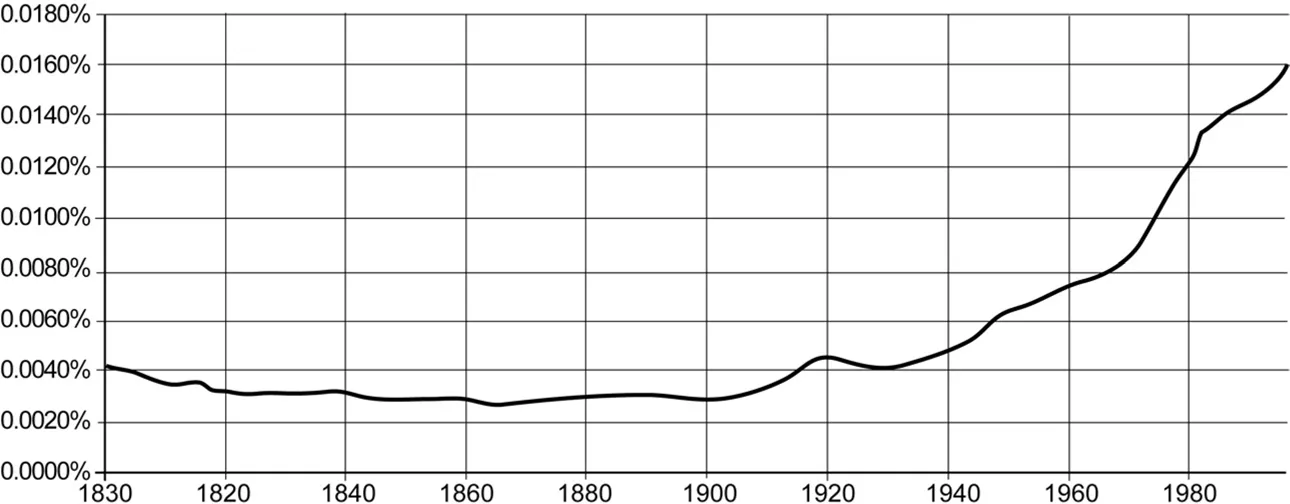
But even in English, the term itself did not come into more widespread use until after World War II, as suggested by Figure 1.1, which is based on a limited sample, i.e. Google Books, yet indicative of a broader trend.
Figure1.1 The Occurrence of “M/management” in Google Books 1800–2000
Such a restrictive earlier use is actually not surprising given the origins of the word, which can be traced back to the mid-sixteenth-century Italian word maneggiare, which in turn is based on the Latin word for hand, manus, and, in this early context, referred particularly to the handling of horses (Oxford Dictionaries and Online Etymology Dictionary, 19 July 2015). In the eighteenth and nineteenth centuries, “management” was used for small units, namely churches and households. For instance, a humoristic book on The Church Rambler; or, Sermon Taster included “a pleasant account of the humours, management and principles of the Great Pontif Machiavel” (Wildair 1724). Another of many more examples is the title of a sermon about “the duty of a Christian church to manage their affairs with charity” (Balch 1735). The nineteenth century saw the first “management” bestseller: Beeton’s Book of Household Management by Isabella Beeton (see Figure 1.2). First published in 1861, the book had 1,112 pages and 2,751 numbered entries, most of them recipes but also descriptions of the duties of the various household staff. The book sold two million copies already by 1868 and is still in print (Stark 2001; Russell 2010).
Figure1.2 Cover of Beeton's Book of Household Management
The activity referred to today as management was described at the time in other terms, which can for instance be found in an eight-volume book on Modern Business Practice published in 1912, which did not discuss management in the text but, in its glossary of commercial terms, contained a somewhat circular definition of a “manager” as “a person appointed by a company to manage its business, or by a proprietor to manage an office or shop or department, or other undertaking” (Raffety 1912: Vol. 8, 206).
How management spread from such a rather narrow use and became so ubiquitous is therefore a phenomenon that deserves attention by all those involved in practicing or studying it. And, while it has received some attention both in more popular and more academic literatures, quite a few authors have used the term rather indiscriminately without historicizing it – for instance by tracing “basic management techniques” back to ancient Sumer in 3000 bc (Pindur, Rogers, and Kim 1995; see also Witzel 2001). As Chapter 2 will discuss in more detail, most histories of management have either examined how its practice has evolved with the corresponding (business) organizations – with summary accounts to be found in business history textbooks (e.g. Chandler, McCraw, and Tedlow 1996; Blackford 2008; Amatori and Colli 2011); or how certain individuals, characterized usually as “innovators,” developed new, meaning: better ideas of how to manage – a progressive story told in books on the history of management thought (e.g. Wren and Bedeian 2009; Witzel 2012).
More recent literature, also discussed in Chapter 2, has drawn attention to a different set of actors, in particular business schools, management consultants, and business publications. This literature points to another phenomenon worthy of attention, namely the fact that these sets of actors are today widely considered what could be called “authorities” on management by defining what is “world-class” or “best practice” – a fact also highlighted by a study of “cited experts” in the above mentioned Manager Magazin between 1980 and 1996. While there was a declining trend for managers as experts, down from around 60 to just over 30 percent, consultants and academics more than doubled their joint share, respectively from under 15 percent to over 30 percent, with the remainder made up by other practitioners (Faust 2002: 158–160).
When looked at in detail, this kind of authority or definitional power is quite stunning: Take the story of a British top manager, told by himself in the aptly titled documentary Masters of the Universe (Films of Record 1999: Part 1), of how he bought Michael Hammer and James Champy’s (1993) book Reengineering the Corporation at the train station on his way home from London, read it twice over the weekend – ignoring his wife, and, when returning on Monday morning, bought all the available copies at that same book store, took them to the office and distributed them to his managers, telling them: “This is what we’re doing. Read it, we are going to work to this thing.” And he was clearly not the only manager finding the book appealing, since it remained on the New York Times non-fiction best-seller list for a staggering 41 weeks. It also warranted Hammer’s inclusion on Time magazine’s 1996 list of “America’s 25 Most Influential People” (Hevesi 2008).
Interviewed for the same documentary Hammer himself pointed to an even wider use of his ideas by expressing regret to not have negotiated a commission on all the fees management consultants generated from latching on to the reengineering concept, which he estimated to be “well in the billions of dollars.” A vice president of Capgemini, a large consulting firm, indirectly confirmed this approach – referred to by an academic study as “hitchhiking on a hype” (Benders, van den Berg, and van Bijsterveld 1998) – stating that they always tried to spot “the next wave.” Some of these firms apparently not only looked for new ideas but also tried to boost them by buying thousands of copies of their books themselves in order to drive up their rank on best-seller lists (Micklethwait and Wooldridge 1996: 23–24). The representative of another of the large global consulting firms, Andersen Consulting, now Accenture, also stated that annually his firm received three million applications from want-to-be consultants worldwide – sounding very surprised himself: “When I heard the number, I fell off my chair.” Perhaps most stunning, these actors have even succeeded in penetrating the Vatican, where a recent observer noted the presence of “a group of M.B.A. types speaking English” and pointed to the reliance “on major companies from the capitalist world: McKinsey, Deloitte Consulting, EY (formerly Ernst & Young)” for the management of its finances (Stille 2015) – with Pope Francis himself turned into a kind of rockstar by the global media.
Again, this is even more surprising when going back in time. Take another interview from the historical part of the documentary mentioned above: an engineer, who was hired in the early 1930s by Bedaux, then the largest global consulting firm – employing just over 200 efficiency engineers in offices in the US, the UK, France, Italy, and Germany (Kreis 1992: 157; Kipping 1999: 197–198). The number sounds ridiculously low today – even when taken relative to the size of the corporate economy. More surprising, even if probably told jokingly, is that, rather than admitting to joining a consulting firm, he preferred telling his mother that he was hired as a pianist at the local brothel (Films of Record 1999: Part 1). Or take famed Stanford sociologist Thorstein Veblen, who in 1918 compared departments of business to departments of athletics and categorically stated that neither of them should have a place in “the corporation of learning” (Veblen 1918: 209–210). University presidents must be glad not to have listened to him, since business schools nowadays tend to be the most popular – and richest – parts of many academic institutions.
How did this change? When did it become not only acceptable but desirable to be a business graduate or to join a consulting firm, and since when did executives look at business books sold at train stations and airports to tell them what to do? In other words, when and how did what today are called business schools, management consultants, and business media become taken-for-granted and gain such definitional power over management? This book will trace this process from the origins of these actors to their authoritative role today. As such it will also contribute to the story of the expansion of management itself, since both developed largely in parallel. Defining Management, the title of this book, in that sense has a double meaning: On the one hand, it refers to the current ability of these actors to define what “good” management is. On the other hand, it points to the role these authorities have had in the process of management becoming ubiquitous. To examine this process of authority building, the book takes a perspective that is historical, comparative, and integrative by:
Looking at developments over time, since it does not take the authority or even legitimacy of these three sets of actors as a given, but shows how they were constructed gradually since the late nineteenth century. The historical narrative is subdivided into four parts, with the two World Wars and the 1980s, when most of the globe was opened to capitalism, providing important transitional and transformational periods with respect to all three authorities.
Comparing their trajectories in different countries/regions, since these authorities did not develop in the same way around the world, but saw the emergence of a variety of models and patterns, which were also transmitted across national boundaries. This helps identify those models that eventually became dominant and to understand how they developed. Tracing these developments in some detail also contributes to understanding the depth at which these models took hold outside their own countries.
Integrating the narratives for all three sets of actors, building on the so far isolated literatures for each of them, supplementing them with original eviden...
Table of contents
Cover Page
Half Title Page
Title Page
Copyright Page
Contents
List of Illustrations
Acknowledgements
1 Introduction: The Rise of Management
2 Background Views on the Development of Management
3 Approach Three “Fields” in Historical, Comparative, and Integrative Perspective
PART I Diverse Origins
4 The Emergence of Schools of Commerce
5 Accountants and Efficiency Engineers as Early Consultants
6 Modest Beginnings for Business Publishing
PART II In Search of Directions
7 Establishing a Place for Business Education
8 Old Certainties and New Departures in Consulting
9 Broadening Audiences for Business Publications
PART III Post-World War II Expansion
10 Making Business Education Scientific
11 The Assertion of Management Consulting
12 Growth and Diversification of Management Publishing
PART IV Markets Reign
13 The Business School and the MBA Become “Global”
14 Consulting as Global Big Business
15 Mergers and Mass Markets in Media
16 Conclusions Commoditizing Management?
Index
Frequently asked questions
Yes, you can cancel anytime from the Subscription tab in your account settings on the Perlego website. Your subscription will stay active until the end of your current billing period. Learn how to cancel your subscription
No, books cannot be downloaded as external files, such as PDFs, for use outside of Perlego. However, you can download books within the Perlego app for offline reading on mobile or tablet. Learn how to download books offline
Perlego offers two plans: Essential and Complete
Essential is ideal for learners and professionals who enjoy exploring a wide range of subjects. Access the Essential Library with 800,000+ trusted titles and best-sellers across business, personal growth, and the humanities. Includes unlimited reading time and Standard Read Aloud voice.
Complete: Perfect for advanced learners and researchers needing full, unrestricted access. Unlock 1.5M+ books across hundreds of subjects, including academic and specialized titles. The Complete Plan also includes advanced features like Premium Read Aloud and Research Assistant.
Both plans are available with monthly, semester, or annual billing cycles.
We are an online textbook subscription service, where you can get access to an entire online library for less than the price of a single book per month. With over 1.5 million books across 990+ topics, we’ve got you covered! Learn about our mission
Look out for the read-aloud symbol on your next book to see if you can listen to it. The read-aloud tool reads text aloud for you, highlighting the text as it is being read. You can pause it, speed it up and slow it down. Learn more about Read Aloud
Yes! You can use the Perlego app on both iOS and Android devices to read anytime, anywhere — even offline. Perfect for commutes or when you’re on the go. Please note we cannot support devices running on iOS 13 and Android 7 or earlier. Learn more about using the app
Yes, you can access Defining Management by Lars Engwall,Matthias Kipping,Behlül Üsdiken in PDF and/or ePUB format, as well as other popular books in Business & Business General. We have over 1.5 million books available in our catalogue for you to explore.