![]()
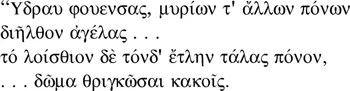
I slew the Hydra, and from labour pass’d
To labour—tribes of labours! Till, at last,
Attempting one more labour, in a trice,
Alack, with ills I crowned the edifice.
Text and publication
First publ. in Britain by Smith, Elder, 18 Dec. 1871, and in the United States by James R.Osgood & Co. in 1872, in a volume also containing Ffine at the Fair and Hervé Riel; repr. 1888. The MS used as printer’s copy is at Balliol College, Oxford: it was probably copied from a rough draft, but contains significant evidence of running revision and some drafting, with many interpolated lines: see below for a more detailed description. The American text (1872) was set from advance proofs, even though it was published well after the first English edition. A letter of 28 Mar. 1872 from James R. Osgood to B. may offer an explanation: Osgood refers to confusion over payment for Balaustion, and advises B. that proof sheets should be posted ‘at least four weeks before publication’ to ensure simultaneous publication in Britain and the United States (transcript at Wellesley College). 1872 gives some insight into the state of the proofs in the period shortly before publication. There are only six substantive verbal variants (see l. 605n.) but a host of variants in punctuation, spelling, and capitalization, affecting 729 lines (just over a third of the poem). Some of these variants (e.g. American spellings) were introduced by the printers, but it is clear that B. made many changes in punctuation after the despatch of the proofs to America. The issue of capitalization is harder to interpret: where upper-case forms appear in both MS and 1871, it seems likely that their conversion to lower-case in 1872 was done by the printers, unless we assume that B. changed all these forms in the proofs sent to America, and then changed them back again; however, there are puzzling inconsistencies in 1872, which retains some capitalizations and even introduces a handful of its own.
B. also sent proof sheets of the poem to his close friend, the French critic Joseph Milsand; Milsand’s suggested changes, and B.’s responses to them, are noted below at ll. 316, 336, 358, and 365–6. B. wrote to Milsand thanking him for his suggestions on 13 May 1872: ‘There is not one point to which you called attention which I was not thereby enabled to improve,—in some cases, essentially benefit. The punctuation was nearly as useful as the other more apparently important assistance … I like your corrections, and shall one day punctuate all my past work on that principle … The fact is, in the case of a writer with my peculiarities and habits, somebody quite ignorant of what I may have meant to write, and only occupied with what is really written,—ought to supervise the thing produced’ (ABL; full text in Scribner’s Magazine, July 1896, p. 111). B. took his own advice, sending many of his subsequent productions to Milsand at proof stage.
Revision in 1888 was light, and almost all in the second half of the poem; only a couple of passager seem to have caught B.’s eye (e.g. following l. 1321), and the persistence of errors originating in 1871 (especially affecting the placing of quotation marks around inset speeches) suggests that B. did not pay much attention to the text of the poem for this edition.
The manuscript
MS 389 at Balliol College, Oxford is the printer’s copy. It is bound with the MSS of Balaustion’s Adventure, Fifine at the Fair, and Aristophanes’ Apology, and consists of the title page and 69 leaves, numbered by twos (i.e. page 1 is followed by a page with no number, then page 2, then a page with no number, etc.; the only exception is page 6, which is followed by an unnumbered page and then a shortened page marked ‘6.*’). Both internal and external evidence (see below, Composition) suggest that B. was copying from a rough draft, freely revising and adding to the text as he did so. There are dozens of cancelled readings, many of which show B. changing his mind mid-way through a line; for a graphic example see l. 2059n. There are also many interpolated lines, though few of these introduce a new element into the text; almost all are expansions or modifications of the original draft, and there is no evidence that they belong to a second phase of composition: they are all in the same ink and orthography as the ...