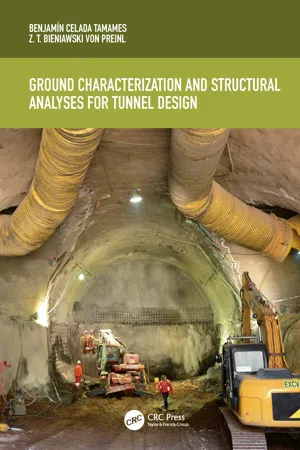
Ground Characterization and Structural Analyses for Tunnel Design
eBook - ePub

Ground Characterization and Structural Analyses for Tunnel Design

  1. 454 pages
  2. English
  3. ePUB (mobile friendly)
  4. Available on iOS & Android
eBook - ePub

Ground Characterization and Structural Analyses for Tunnel Design

About this book

This practical and design-oriented book focuses on ground characterization and structural calculation, as part of the active structural design methodology. With a focus on rock tunnelling it offers a comprehensive rather than a topic-based perspective, deriving sound tunnel design criteria and methods from basic principles. Ground characterization includes excavations, site investigation, and in situ stress determination, culminating in geotechnical classifications. The book then deals with various construction methods and their appropriate calculations, which range from constitutive models for the stress-strain behaviour of an excavation and tunnel support elements to a full stress–strain analysis methodology.

The heavily practical approach of the book draws on the authors' twenty years of tunnelling experience in Spain and South America. It will help any young or established professional who wants to develop a career in the underground field across both civil engineering and geology. As it incorporates the very fundamentals of tunneling design, it can be used as a support for tunneling courses or as a textbook for master's and PhD courses.

Benjamín Celada was Chief Tunnel Engineer at Hunosa and Potasas de Navarra S.A. before founding Geocontrol S.A. He has also worked for twenty years as Professor of Underground Works at the Polytechnic Mining University in Madrid, Spain.

Z. T. Bieniawski directed the Rock Mechanics Department of the Council for Scientific and Industrial Research in Pretoria, then taught at the Pennsylvania State University for twenty years.

Trusted by 375,005 students

Access to over 1 million titles for a fair monthly price.

Study more efficiently using our study tools.

Information

Publisher
CRC Press
Year
2019
Print ISBN
9780815386629
eBook ISBN
9781351168465

Chapter 1

Typology of underground excavations and design issues

Benjamín Celada Tamames
Everything that lives changes. We shouldn’t be satisfied with some unaltered traditions.
C. G. Jung

1.1 Introduction

In 1961 Karoly Szechy published the book titled Alagutepitestan which, in 1967, was translated into English as The Art of Tunnelling. This book was a memorable milestone in the synthesis of the knowledge that should be applied for tunnel design, but it had to live together with the obstacle derived from the limited knowledge about rock mechanics of those years.
In the year 1964 Leopold Rabcewicz published the first part of his work about the new Austrian tunneling method (NATM) which revolutionized the concepts of tunnel design and construction which had existed up to that time.
The key to the huge and positive influence that the NATM has had in tunnel design lies in recognizing the relevant role that ground behavior has in tunnel stabilization, which revolutionized the previous concepts based on the prevalence of the lining with respect to the excavated media.
Another prominent milestone in tunnel design was the publication, in 1980, of Evert Hoek and Edward Brown’s book, Underground Excavations in Rock, in which they put the rock mass in the spotlight when constructing tunnels and achieve an excellent assemblage of the principal concepts that are present in tunnel design. Since the publication of this book, which still continues to be a reference point in tunnel design, 35 years have passed and during this tim huge development in tunnel design has occurred, as a result of the large tunneling construction activity in recent decades.
In Spain, during the period between 1995 and 2012, extensive activity in tunnel construction has been witnessed, including some particularly challenging constructions, such as never-seen-before performance in the use of Tunnel Boring Machines, both in soil and in rock.
This book updates the criteria and methodology for tunnel design based on important experiences occurring in the last decades, with the aim of being of help to the improved design of safe and economic tunnels.

1.2 Typology of underground excavations

The concept of underground excavation implies the construction under the ground surface but, also, this concept assumes that the construction work is done without removing the existing ground between the excavation and the surface.
In the case that the ground removal above the tunnel was necessary for its construction, it has to be kept in mind that it fully loses its resistant capacity, meaning the ground cannot play an active role in tunnel stabilization.
In fact, tunnels constructed by removing the ground up to the surface are referred to as cut-and- cover tunnels, to be distinguished from tunnels constructed with conventional procedures, whose typology is presented in the following sections.

1.2.1 Microtunnels

Microtunnels are those tunnels whose width is less than 3 m. This width substantially determines the construction methods which, in practice, are reduced to mini Tunnel Boring Machines and jacking pipes. Microtunnels are beyond the scope of this book.

1.2.2 Tunnels

Tunnels are underground excavations ...

Table of contents

  1. Cover
  2. Half-Title
  3. Title
  4. Copyright
  5. Contents
  6. In Memoriam
  7. Editors
  8. 1 Typology of underground excavations and design issues
  9. 2 Tunnel design methodologies
  10. 3 Site investigations
  11. 4 In situ state of stresses
  12. 5 Laboratory tests
  13. 6 Engineering classifications of rock masses
  14. 7 Methods for tunnel construction
  15. 8 Constitutive models to characterize the ground behavior
  16. 9 Types of tunnel supports
  17. 10 Stress–strain analysis
  18. Index

Frequently asked questions

Yes, you can cancel anytime from the Subscription tab in your account settings on the Perlego website. Your subscription will stay active until the end of your current billing period. Learn how to cancel your subscription
No, books cannot be downloaded as external files, such as PDFs, for use outside of Perlego. However, you can download books within the Perlego app for offline reading on mobile or tablet. Learn how to download books offline
Perlego offers two plans: Essential and Complete
  • Essential is ideal for learners and professionals who enjoy exploring a wide range of subjects. Access the Essential Library with 800,000+ trusted titles and best-sellers across business, personal growth, and the humanities. Includes unlimited reading time and Standard Read Aloud voice.
  • Complete: Perfect for advanced learners and researchers needing full, unrestricted access. Unlock 1.4M+ books across hundreds of subjects, including academic and specialized titles. The Complete Plan also includes advanced features like Premium Read Aloud and Research Assistant.
Both plans are available with monthly, semester, or annual billing cycles.
We are an online textbook subscription service, where you can get access to an entire online library for less than the price of a single book per month. With over 1 million books across 990+ topics, we’ve got you covered! Learn about our mission
Look out for the read-aloud symbol on your next book to see if you can listen to it. The read-aloud tool reads text aloud for you, highlighting the text as it is being read. You can pause it, speed it up and slow it down. Learn more about Read Aloud
Yes! You can use the Perlego app on both iOS and Android devices to read anytime, anywhere — even offline. Perfect for commutes or when you’re on the go.
Please note we cannot support devices running on iOS 13 and Android 7 or earlier. Learn more about using the app
Yes, you can access Ground Characterization and Structural Analyses for Tunnel Design by Benjamín Celada,Z.T. Bieniawski in PDF and/or ePUB format, as well as other popular books in Technology & Engineering & Geology & Earth Sciences. We have over one million books available in our catalogue for you to explore.