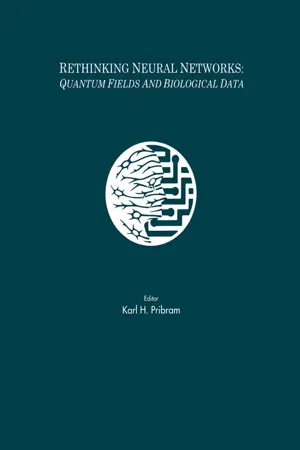
The result of the first Appalachian Conference on neurodynamics, this volume focuses on processing in biological neural networks. How do brain processes become organized during decision making? That is, what are the neural antecedents that determine which course of action is to be pursued? Half of the contributions deal with modelling synapto-dendritic and neural ultrastructural processes; the remainder, with laboratory research findings, often cast in terms of the models. The interchanges at the conference and the ensuing publication also provide a foundation for further meetings. These will address how processes in different brain systems, coactive with the neural residues of experience and with sensory input, determine decisions.
- 564 pages
- English
- ePUB (mobile friendly)
- Available on iOS & Android
eBook - ePub
About this book
Information
Publisher
Psychology PressYear
2014Print ISBN
9781138985384
9780805814668
Edition
1eBook ISBN
9781317780946
II. Quantum Neurodynamics
Chapter 4
The Basics of Quantum Brain Dynamics
1. Motivation
One of the major purposes of this first Appalachian conference is an exposition of several prototypes of quantum neurodynamics, and intensive discussion will be expected to open a new direction in the research activity of BRAINS founded by Dr. Karl Pribram in Radford University. We wish to take part by addressing a small exposition of the basic concepts and ideas of quantum brain dynamics coined originally by Dr. Hiroomi Umezawa catching Pribram's enthusiasm in which the fundamental physical process of the brain can be described within the realm of quantum field theory.
Issues on the research activity in the field of brain science today seem to be arising from the unbalance of research interests between physical science and brain science. In good old days a scientist like Descartes investigated the fundamental law and processes of the brain from the point of view of the fundamental law of the materialistic world he found. Today, scientists are scattered into many different fields and the brain belongs to brain scientists officially.
The brain stands on the very intersection of the materialistic world and the mind world. It seems therefore natural to expect the same order of research activity from physical science as that from brain science. Unfortunately, this is not the case. Knowing very well the fundamental law of materialistic world, that is, quantum mechanics and quantum field theory, physicists are in general not interested in investigating the fundamental process of the brain function, even though their activity comes from that. However, it seems of certain importance that a few great physicists founded once quantum mechanics and quantum field theory have made deep considerations on the brain function. Among them are Bohr, Schrödinger, Pauli, Böhm and Josephson. We can guess their common deep insights:
For better understanding of the fundamental law of the mind world, it may help us to see fundamental processes of the brain as fundamental physical processes from the point of view of the fundamental law of the materialistic world, that is, quantum mechanics and quantum field theory.
2. Emergence of Quantum Field Theory
First of all, it is necessary to understand the conventional way to see the matpriaiistic world. Although the fundamental law of the materialistic world is provided by quantum theory, that is, quantum mechanics and quantum field theory, it is very hard in most cases to investigate the real sophisticated natural phenomena in the materialistic world directly in terms of quantum theory. Therefore, physicists developed an approximative description of the materialistic world given by quantum statistical mechanics, classical statistical mechanics and classical electromagnetism which is valid only for investigating natural phenomena of matters in which all the huge number of atomic ingredients manifest thermal disorder.
It succeeded in describing the fundamental feature of matters in or near thermal equilibrium, and then has been believed accidentally by many scientists to be the most fundamental theory of physics convenient for investigating also such natural phenomena of life as the brain function.
Consequently, the conventional way to see the brain stands on the approximative law of the materialistic world. There, quantum and classical statistical mechanics, classical electromagnetism and quantum chemistry offered us an empirically unified standpoint. Approximative and empirical laws of living matters have been built up by patching many fragmentary results or knowledge obtained in this empirically unified standpoint. Among them are chemical biology, biological physics, physical biology and molecular biology. They do not provide us with a good framework for clarifying the essential aspect of natural phenomena of life, because they gathers only the thermally disordered behaviors of living matters.
The essential aspect of such natural phenomena of life as the brain function may be a fact that they are resulting from certain fundamental processes of fully quantum theoretical nature in which all the atomic ingredients manifest ordered behavior and no longer suffer from thermal disorder. What is needed definitely seems to provide the brain scientists with a proper framework of quantum theory valid for investigating the fundamental process of living matters full of ordered natural phenomena. We call such a framework describing the fundamental physical process of the brain from the point of view of the fundamental law of the materialistic world, that is, quantum mechanics and quantum field theory, “quantum brain dynamics” and abbreviate it by “QBD”.
Of course, such a fundamental framework is not restricted to the brain function. It may provide us also with a drastically new way to see life. We call the more general framework in which the fundamental physical process of living matters can be investigated from the fundamental point of view of quantum theory “quantum biodynamics”and abbreviate it also by “QBD”. It is time, in September 1992, to declare quantum mechanics and quantum field theory respectable in both brain and life sciences.
3. History of Quantum Brain Dynamics
There may be many different ways to approach to quantum brain dynamics and quantum biodynamics just as you can easily find in other addresses of this conference. It is our principle role to present you the basic concepts and ideas of a long-standing world-wide approach to QBDfs coined originally by Umezawa in 1960's.
Let us start from a historical sketch of the development of Umezawa's quantum brain dynamics.
In 1944 Schrödinger emphasized that the essential aspect of natural phenomena of life is to create order in the disordered environment against the second law of thermodynamics. (Schrödinger, 1944) Living matters are matters eating entropy and producing order. Other matters are all subject to the second law of thermodynamics and well described by quantum statistical mechanics. However, quantum statistical mechanics becomes poor in investigating the order-creating process against the second law of thermodynamics. For such aim, we have to work directly with quantum mechanics and quantum field theory, and if necessary introduce a completely new approximation suitable for describing ordered natural phenomena of life. When we apply quantum mechanics or quantum field theory to ordered natural phenomena, it is of extreme importance that we have to use appropriate approximations which may keep the general and fundamental features of such phenomena clear. Certainly, quantum statistical mechanics may not provide us with a good approximation.
Pribram is an outstanding brain scientist who claimed the emergence of incorporating quantum theoretical method of investigation into the brain science about ten years after Schrödinger's deep insight on the long-standin...
Table of contents
- Cover
- Half Title
- Title Page
- Copyright Page
- Table of Contents
- Acknowledgements
- Foreword
- Keynote Evolution of Complexity of the Brain with the Emergence of Consciousness
- Viewpoint Neurodynamics and Synergetics
- Section I. The Dendritic Microprocess
- Section II. Quantum Neurodynamics
- Section III. Nanoneurology
- Section IV. Perceptual Processing
- Afterword
- List of Authors Cited
Trusted by 375,005 students
Access to over 1.5 million titles for a fair monthly price.
Study more efficiently using our study tools.
Frequently asked questions
Yes, you can cancel anytime from the Subscription tab in your account settings on the Perlego website. Your subscription will stay active until the end of your current billing period. Learn how to cancel your subscription
No, books cannot be downloaded as external files, such as PDFs, for use outside of Perlego. However, you can download books within the Perlego app for offline reading on mobile or tablet. Learn how to download books offline
Perlego offers two plans: Essential and Complete
- Essential is ideal for learners and professionals who enjoy exploring a wide range of subjects. Access the Essential Library with 800,000+ trusted titles and best-sellers across business, personal growth, and the humanities. Includes unlimited reading time and Standard Read Aloud voice.
- Complete: Perfect for advanced learners and researchers needing full, unrestricted access. Unlock 1.5M+ books across hundreds of subjects, including academic and specialized titles. The Complete Plan also includes advanced features like Premium Read Aloud and Research Assistant.
We are an online textbook subscription service, where you can get access to an entire online library for less than the price of a single book per month. With over 1.5 million books across 990+ topics, we’ve got you covered! Learn about our mission
Look out for the read-aloud symbol on your next book to see if you can listen to it. The read-aloud tool reads text aloud for you, highlighting the text as it is being read. You can pause it, speed it up and slow it down. Learn more about Read Aloud
Yes! You can use the Perlego app on both iOS and Android devices to read anytime, anywhere — even offline. Perfect for commutes or when you’re on the go.
Please note we cannot support devices running on iOS 13 and Android 7 or earlier. Learn more about using the app
Please note we cannot support devices running on iOS 13 and Android 7 or earlier. Learn more about using the app
Yes, you can access Rethinking Neural Networks by Karl H. Pribram in PDF and/or ePUB format, as well as other popular books in Psychology & Cognitive Psychology & Cognition. We have over 1.5 million books available in our catalogue for you to explore.