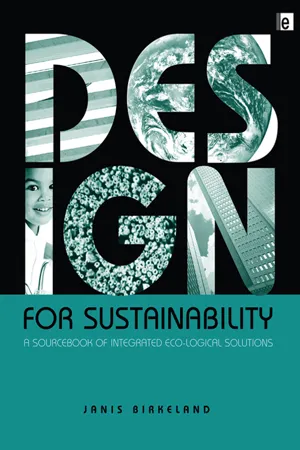
Design for Sustainability
A Sourcebook of Integrated Ecological Solutions
- 288 pages
- English
- ePUB (mobile friendly)
- Available on iOS & Android
About this book
With radical and innovative design solutions, everyone could be living in buildings and settlements that are more like gardens than cargo containers, and that purify air and water, generate energy, treat sewage and produce food - at lower cost. Birkeland introduces systems design thinking that cuts across academic and professional boundaries and the divide between social and physical sciences to move towards a transdiciplinary approach to environmental and social problem-solving. This sourcebook is useful for teaching, as each topic within the field of environmental management and social change has pairs of short readings providing diverse perspectives to compare, contrast and debate.
Design for Sustainability presents examples of integrated systems design based on ecological principles and concepts and drawn from the foremost designers in the fields of industrial design, materials, housing design, urban planning and transport, landscape and permaculture, and energy and resource management.
Frequently asked questions
- Essential is ideal for learners and professionals who enjoy exploring a wide range of subjects. Access the Essential Library with 800,000+ trusted titles and best-sellers across business, personal growth, and the humanities. Includes unlimited reading time and Standard Read Aloud voice.
- Complete: Perfect for advanced learners and researchers needing full, unrestricted access. Unlock 1.4M+ books across hundreds of subjects, including academic and specialized titles. The Complete Plan also includes advanced features like Premium Read Aloud and Research Assistant.
Please note we cannot support devices running on iOS 13 and Android 7 or earlier. Learn more about using the app.
Information
Table of contents
- Cover
- Half Title
- Title Page
- Copyright
- Contents
- List of Illustrations
- List of Acronyms and Abbreviations
- Chapter Outlines
- Preface
- Introduction
- Section 1: Designing Eco-solutions
- Section 2: The Concepts of Growth and Waste
- Section 3: Industrial, Urban and Construction Ecology
- Section 4: Design within Complex Social Systems
- Section 5: Permaculture and Landscape Design
- Section 6: Values Embodied in and Reinforced by Design
- Section 7: Design for Community Building and Health
- Section 8: Productivity, Land and Transport Efficiency
- Section 9: Design with Less Energy, Materials and Waste
- Section 10: Low-impact Housing Design and Materials
- Section 11: Construction and Environmental Regulation
- Section 12: Planning and Project Assessment
- Glossary
- Biographies of Contributors
- Index