eBook - ePub
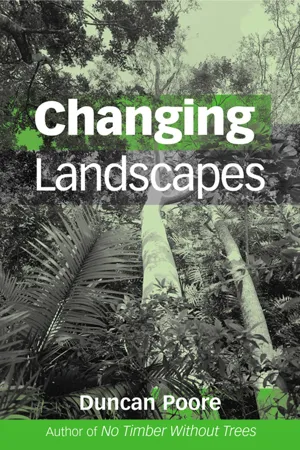
Changing Landscapes
The Development of the International Tropical Timber Organization and Its Influence on Tropical Forest Management
- 290 pages
- English
- ePUB (mobile friendly)
- Available on iOS & Android
eBook - ePub
Changing Landscapes
The Development of the International Tropical Timber Organization and Its Influence on Tropical Forest Management
About this book
This is the history of the International Tropical Timber Organization (ITTO); its aims, policies and achievements, through drawing on contemporary records and the author's own wide experience. The book uses examination of past successes and failures to formulate a 21st-century agenda for the most practical ways of improving the management of forests and deciding forest policies.
Trusted by 375,005 students
Access to over 1.5 million titles for a fair monthly price.
Study more efficiently using our study tools.
Information
1
The rise and fall of forests
__________________________
‘Although some societies may have lived, and perhaps some still live, in ecological harmony with their surroundings, depending solely on local resources and using these sustainably, this seems to have been a rare occurrence’
It may seem rather perverse to begin a book about forests and trade in this century with a flashback to the descent of the precursors of our species from the trees some 4 million years ago; but it is far from irrelevant. From that time onwards, the future of forests and of human beings have been intertwined – for land, food, shelter, fuel, medicine, materials and as a subject for belief in the sacred and supernatural.
Closed-canopy tropical rain forest is thought to have first become widespread in the Palaeocene (54–66 million years ago), when the climate was warmer than today and the continents were not yet entirely in their present positions. The forest then was more widespread than now, occurring not only in belts on both sides of the equator but also in a discontinuous band outside the tropics in all four continents. The Middle Miocene (10–16 million years ago) was again a period of warm climate – the continents having assumed more or less their present positions. The distribution of the forest in the Middle Miocene is shown in Figure 1.1. After that, the climate deteriorated, the forest withdrew to the tropical zone, and grasslands and deserts expanded.1
Figure 1.1 Distribution of closed-canopy tropical rain forests during the Middle Miocene, coinciding with the Miocene thermal maximum

Source: Morley, 2000. © John Wiley & Sons Limited. Reproduced with permission.
In Equatorial Africa, as the dense forest retreated towards the west, the first separation took place between the ancestral line of the apes, who remained in the forest, and the ancestors of man,2 who took to the plains and lived consecutively in open woodland, arid scrub-land, and savannas and open grasslands. Figure 1.2 shows the differentiation of hominid species in Africa with an indication of the habitats they occupied and the food they preferred.
Figure 1.2 Fossil hominids through time, showing probable habitat and dietary changes

Source: Stringer and McKie, 1996.
Early Homo sapiens lived and moved in open country – through the belts of savanna and steppe that lay between the tropical forests and the temperate forests to the north and south. By the time that these great movements of people were taking place, the world was in the grip of the Pleistocene glaciations. The distribution of forests then was very different from that of today; the present temperate and boreal regions were covered with ice and the rain forests of the tropics were much restricted (see Figures 1.3, 1.4 and 1.5).
Figure 1.3 Pleistocene refugia in New World rain forests

Source: Morley, 2000. © John Wiley & Sons Limited. Reproduced with permission.
Figure 1.4 Rain forest refugia in Equatorial Africa in the last glacial maximum (c 18,000 years BP)

Source: Morley, 2000. © John Wiley & Sons Limited. Reproduced with permission.
Figure 1.5 Southeast Asian climate and vegetation (c 18,000 years BP)

Source: Morley, 2000. © John Wiley & Sons Limited. Reproduced with permission.
Early men and women were very much a part of nature, subject to all the vicissitudes of heat, cold, droughts, floods, lightning, fire and natural disasters. Modern man is, of course, just as much a part of nature as his ancestors; it is only that, for a long time, the fortunate have been able to insulate themselves from direct exposure to elemental forces. It may be, however, that the insulation is now wearing rather thin. It is mistaken – and even dangerously misleading – to talk of man and ‘the’ environment. We are all part of nature; you are part of my environment just as much as I am part of yours; and everything that we do affects our surroundings in some way, however trivial.
The climate of the Earth has always changed and so have the configurations of the continents. The main belts of vegetation – equatorial and tropical forests, sub-tropical forest, savanna and steppe, semi-desert and desert, and temperate and boreal forests – have ebbed and flowed to settle in a dynamic equilibrium with the prevalent climate and distribution of land masses and oceans. In the case of forests, expansion would have meant the slow advance of the forest edge into grassland or heath as conditions gradually became suitable for the establishment of seedlings and young trees outside the forest – probably a scatter of trees rather than a solid front. Some young trees might leap considerable distances if they found a congenial niche. On the retreating edge, there would be death and failure of regeneration, leading to replacement of forest by other plant communities. In every instance, one must envisage these processes in terms of the germination, establishment, growth, fruiting and survival of individual trees: if conditions are suitable, advance; if unsuitable, retreat.
The early history of man involved gradual migration – starting about 100,000 years ago, from his presumed origins in East Africa into Europe, the Middle East, Central Asia and China and thence across the land bridge into North America and across the seas into Australia and Polynesia. The probable course and timing of these movements is shown in Figure 1.6. Routes followed the lines of least resistance, along the coasts or by the corridors between the forest and the desert, or between the forests and the ice sheets. These were hunter-gatherers – people who lived off the fish and wild animals they could hunt or trap, and by the roots, leaves and fruits they could collect. They avoided deep forest and kept to the steppes, savannas and drier woodlands where, no doubt, they collected wood to construct shelters and fires for cooking and used fire to flush out game. We do not really know how great the direct effect of this way of life may have been on the vegetation they passed through, but it is likely to have been relatively slight. However, there is strong evidence that the story was very different for the fauna, and this would certainly have had some repercussions on the vegetation.
Figure 1.6 The spread of Homo sapiens over the last 100,000 years

Source: Stringer and McKie, 1996.
The appearance of human beings in the Americas and Australia was followed by the disappearance of many of the large animals that were there when they arrived.3 Later, the same happened in New Zealand, which was colonized in the 11th century by people from Polynesia. It is particularly intriguing that extinction to the same degree does not seem to have happened in Africa or Eurasia. It is true that some large mammals such as the mammoth and the auroch did disappear, but generally most species seem to have survived. The hypothesis is that in Africa and Eurasia – but not in the other continents – the mammals and man evolved in constant contact with one another and that, accordingly, at the same time as man devised new methods of hunting, the mammals evolved new ways of avoiding capture or death. In the other continents, having evolved in the absence of man, they were unprepared and succumbed.
During this phase of human evolution, life was entirely based on the use of natural resources; life expectancy was short, most people apparently died of injuries, and human beings were still thin on the ground. We do not know whether there was any conscious effort towards living within the limits of local resources – what we might now call sustainable living. It is likely that people followed their prey, and when one site was hunted out, they moved on.
From the earliest times, there has been trade. Indeed it seems that the urge to barter and trade lies deep in human nature and, with developed speech, is one of the characteristics that separates mankind from other animals. Traded obsidian from Turkey is present in the Pre-pottery Neolithic site of Beitha in the Jordan Valley dating from between 8000 and 6500 BC; and, of course, the development of the Bronze Age depended entirely on trade in both copper and tin. Much of the economic life of the ancient world depended upon trade.
It is difficult to be sure when trade in timber started, but it clearly had become important by the early historical period. Timber for shipbuilding in Athens came from Macedonia and the Black Sea and even from Sicily.4 There was extensive trade in timber in the Mediterranean during the classical period, the cedars of Phoenicea being of special value. Alexander the Great arranged for sissoo wood (Dalbergia sissoo) to be imported from the Punjab for the pillars of his palace at Susa.5 There are records that timber was shipped from Labrador to Iceland between the end of the 10th century and the middle of the 14th century.6 But the attraction of wood did not necessarily lie only in the timber. The most important enticement to the Portuguese in Brazil in the 16th century was the dye brasile (from which the country took its name) extracted from the wood of the pau do brasil or brazilwood (Caesalpinia echinata). A flourishing and profitable trade was established with the local Indians in exchange for metal tools. And the spice trade was the great stimulus to the early European sea voyages to the East.
This begins to set the scene for this book – the interplay between the driving force of advancing technology, man’s exploitation of natural resources and his propensity for trade.
The pressure of an increasing population eventually forced most human societies to abandon their hunter-gatherer way of life and to become settled farmers and graziers. The crops and stock upon which they based their farming differed from continent to continent and was dependent on the presence of wild species that could be domesticated. Where there were no suitable wild species, no farming appeared (see Figure 1.7). As populations grew, cultivation gradually extended to take in most cultivable soils in any region possessing a suitable climate for agriculture – first those that were light and easy to cultivate, and later, as better tools were devised, the heavier and more recalcitrant soils. Thus, by the end of the 19th century, cultivation and settlement had spread almost universally throughout all the parts of the world where settlement was not limited by climate (either too cold or too dry), by infertile soils, or by the prevalence of disease. Such expansion was all at the expense of natural vegetation, either forest or grassland.
Figure 1.7 Centres of origin of food production

Source: Diamond, 1998. © 1997 by Jared Diamond. Used by permission of W. W. Norton & Company, Inc.
This, of course, is an over-simplified picture. Hunter-gatherers still remained, at low densities, in some places. Nomadic graziers continued on the fringes of the deserts and the Arctic. Many communities depended upon both farming and hunting or fishing, and many agricultural areas retained portions of forest.
Although some societies may have lived, and perhaps some still live, in ecological harmony with their surroundings, depending solely on local resources and using these sustainably, this seems to have been a rare occurrence. More usually, where the soil was robust and fertile the population multiplied and overflowed into denser settlements (especially where irrigation was possible); where the soil was fragile, populations became less capable of supporting their original numbers. Sophisticated societies were already, at this stage in their development, creating ‘ecological footprints’. For example, the arid limestone hills around Athens were, by the 5th century BC, becoming incapable of supporting the urban population, and colonies were established on the north shores of the Black Sea to provide supplies of grain and fish.7 Rome, too, depended on imports for its supplies of cereal – in this case from North Africa.
In fact, a dichotomy gradually developed, with the better soils being carefully farmed and husbanded with a liberal input ...
Table of contents
- Cover
- Halftitle
- Dedication
- Title
- Copyright
- Contents
- List of figures, tables and boxes
- Foreword
- Preface
- List of acronyms and abbreviations
- 1. The rise and fall of forests
- 2. Sustainable forest management: a response to destruction
- 3. Genesis of a treaty: the ITTA takes shape
- 4. ITTO’s early days: optimism and experiment
- 5. First assessment: living in a fool’s paradise
- 6. From Abidjan to Bali: a radical new agenda
- 7. The case of Sarawak
- 8. Ferment 1990–1992
- 9. Tropical forests, or all forests? Renegotiating the ITTA
- 10. Has the tropical timber trade any leverage? Policies 1991–1995
- 11. The many roads from UNCED
- 12. ITTO’s road to 1995: ENGOs diverge
- 13. 1995–2000: getting on with the job
- 14. Year 2000 Report: the curate’s egg
- 15. Reaction: false start, new energy
- 16. Policies in action: some case studies
- 17. ITTO: agent of change
- 18. Changing landscapes, future prospects
- Appendices
- Notes
- References
- Index
Frequently asked questions
Yes, you can cancel anytime from the Subscription tab in your account settings on the Perlego website. Your subscription will stay active until the end of your current billing period. Learn how to cancel your subscription
No, books cannot be downloaded as external files, such as PDFs, for use outside of Perlego. However, you can download books within the Perlego app for offline reading on mobile or tablet. Learn how to download books offline
Perlego offers two plans: Essential and Complete
- Essential is ideal for learners and professionals who enjoy exploring a wide range of subjects. Access the Essential Library with 800,000+ trusted titles and best-sellers across business, personal growth, and the humanities. Includes unlimited reading time and Standard Read Aloud voice.
- Complete: Perfect for advanced learners and researchers needing full, unrestricted access. Unlock 1.5M+ books across hundreds of subjects, including academic and specialized titles. The Complete Plan also includes advanced features like Premium Read Aloud and Research Assistant.
We are an online textbook subscription service, where you can get access to an entire online library for less than the price of a single book per month. With over 1.5 million books across 990+ topics, we’ve got you covered! Learn about our mission
Look out for the read-aloud symbol on your next book to see if you can listen to it. The read-aloud tool reads text aloud for you, highlighting the text as it is being read. You can pause it, speed it up and slow it down. Learn more about Read Aloud
Yes! You can use the Perlego app on both iOS and Android devices to read anytime, anywhere — even offline. Perfect for commutes or when you’re on the go.
Please note we cannot support devices running on iOS 13 and Android 7 or earlier. Learn more about using the app
Please note we cannot support devices running on iOS 13 and Android 7 or earlier. Learn more about using the app
Yes, you can access Changing Landscapes by Duncan Poore in PDF and/or ePUB format, as well as other popular books in Biological Sciences & Ecology. We have over 1.5 million books available in our catalogue for you to explore.