Images play an important role in developing consciousness and the relationship of the self to its surroundings. In this distinctive collection, editors Charles A. Hill and Marguerite Helmers examine the connection between visual images and persuasion, or how images act rhetorically upon viewers. Chapters included here highlight the differences and commonalities among a variety of projects identified as "visual rhetoric," leading to a more precise definition of the term and its role in rhetorical studies.
Contributions to this volume consider a wide variety of sites of image production--from architecture to paintings, from film to needlepoint--in order to understand how images and texts work upon readers as symbolic forms of representation. Each chapter discusses, analyzes, and explains the visual aspect of a particular subject, and illustrates the ways in which messages and meaning are communicated visually. The contributions include work from rhetoric scholars in the English and communication disciplines, and represent a variety of methodologies--theoretical, textual analysis, psychological research, and cultural studies, among others. The editors seek to demonstrate that every new turn in the study of rhetorical practices reveals more possibilities for discussion, and that the recent "turn to the visual" has revealed an inexhaustible supply of new questions, problems, and objects for investigation. As a whole, the chapters presented here demonstrate the wide range of scholarship that is possible when a field begins to take seriously the analysis of images as important cultural and rhetorical forces.
Defining Visual Rhetorics is appropriate for graduate or advanced undergraduate courses in rhetoric, English, mass communication, cultural studies, technical communication, and visual studies. It will also serve as an insightful resource for researchers, scholars, and educators interested in rhetoric, cultural studies, and communication studies.
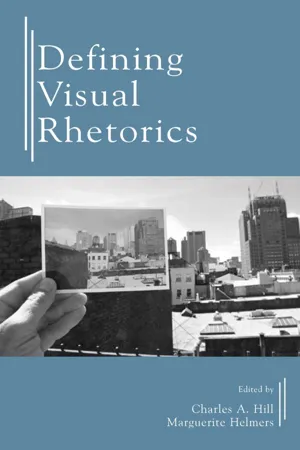
eBook - ePub
Defining Visual Rhetorics
- 356 pages
- English
- ePUB (mobile friendly)
- Available on iOS & Android
eBook - ePub
Defining Visual Rhetorics
About this book
Information
Table of contents
- Cover Page
- Title Page
- Copyright Page
- Preface
- Introduction
- Chapter One: The Psychology of Rhetorical Images
- Chapter Two: The Rhetoric of Visual Arguments
- Chapter Three: Framing the Fine Arts Through Rhetoric
- Chapter Four: Visual Rhetoric in Pens of Steel and Inks of Silk: Challenging the Great Visual/Verbal Divide
- Chapter Five: Defining Film Rhetoric: The Case of Hitchcock’s Vertigo
- Chapter Six: Political Candidates’ Convention Films: Finding the Perfect Image— An Overview of Political Image Making
- Chapter Seven: Gendered Environments: Gender and the Natural World in the Rhetoric of Advertising
- Chapter Eight: Echoes of Camelot: How Images Construct Cultural Memory Through Rhetorical Framing
- Chapter Nine: Doing Rhetorical History of the Visual: The Photograph and the Archive
- Chapter Ten: Melting-Pot Ideology, Modernist Aesthetics, and the Emergence of Graphical Conventions: The Statistical Atlases of the United States, 1874–1925
- Chapter Eleven: The Rhetoric of Irritation: Inappropriateness as Visual/Literate Practice
- Chapter Twelve: Placing Visual Rhetoric: Finding Material Comfort in Wild Oats Market
- Chapter Thirteen: Envisioning Domesticity, Locating Identity: Constructing the Victorian Middle Class Through Images of Home
- Chapter Fourteen: Framing the Study of Visual Rhetoric: Toward a Transformation of Rhetorical Theory
- About the Contributors
Trusted by 375,005 students
Access to over 1.5 million titles for a fair monthly price.
Study more efficiently using our study tools.
Frequently asked questions
Yes, you can cancel anytime from the Subscription tab in your account settings on the Perlego website. Your subscription will stay active until the end of your current billing period. Learn how to cancel your subscription
No, books cannot be downloaded as external files, such as PDFs, for use outside of Perlego. However, you can download books within the Perlego app for offline reading on mobile or tablet. Learn how to download books offline
Perlego offers two plans: Essential and Complete
- Essential is ideal for learners and professionals who enjoy exploring a wide range of subjects. Access the Essential Library with 800,000+ trusted titles and best-sellers across business, personal growth, and the humanities. Includes unlimited reading time and Standard Read Aloud voice.
- Complete: Perfect for advanced learners and researchers needing full, unrestricted access. Unlock 1.5M+ books across hundreds of subjects, including academic and specialized titles. The Complete Plan also includes advanced features like Premium Read Aloud and Research Assistant.
We are an online textbook subscription service, where you can get access to an entire online library for less than the price of a single book per month. With over 1.5 million books across 990+ topics, we’ve got you covered! Learn about our mission
Look out for the read-aloud symbol on your next book to see if you can listen to it. The read-aloud tool reads text aloud for you, highlighting the text as it is being read. You can pause it, speed it up and slow it down. Learn more about Read Aloud
Yes! You can use the Perlego app on both iOS and Android devices to read anytime, anywhere — even offline. Perfect for commutes or when you’re on the go.
Please note we cannot support devices running on iOS 13 and Android 7 or earlier. Learn more about using the app
Please note we cannot support devices running on iOS 13 and Android 7 or earlier. Learn more about using the app
Yes, you can access Defining Visual Rhetorics by Charles A. Hill, Marguerite Helmers, Charles A. Hill,Marguerite Helmers in PDF and/or ePUB format, as well as other popular books in Languages & Linguistics & Communication Studies. We have over 1.5 million books available in our catalogue for you to explore.