Children's Rights explores the relevance of children's participatory rights in education, particularly at a time when there are competing demands in meeting the rigid curriculum frameworks whilst taking into account children's entitlement to participate in matters affecting their lives. It engages with theoretical and practical models of participation with an aim to support reflective practice. The chapters are informed by wider academic debates and examples from research and everyday practice in early year settings, making it an accessible read for students, practitioners as well as researchers.
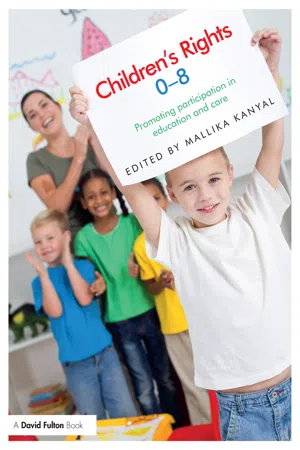
- 158 pages
- English
- ePUB (mobile friendly)
- Available on iOS & Android
eBook - ePub
About this book
Trusted by 375,005 students
Access to over 1.5 million titles for a fair monthly price.
Study more efficiently using our study tools.
Information
Topic
EducationSubtopic
Education GeneralPart I Childhood and children's rights
Chapter 1 History and development of children's rights
Christine Such
DOI: 10.4324/9781315815107-1
Aims of the chapter
- To outline the history of children’s rights, with a focus on the implementation of the United Nations Convention on the Rights of the Child (UNCRC, 1989) and its role in promoting the rights of the child.
- To identify how issues framing children’s rights appear to overlap with humanitarian and political concerns about child welfare.
- To consider why recognition of children’s participation is important in shaping the present agenda on the rights of the child, and the advancement of children as political selves.
Introduction
This chapter examines the history of children’s rights by identifying issues which are woven into child welfare. It will show how concerns about the state of childhood emerged to influence the creation of UNCRC, 1989. The first part of the chapter examines themes in child welfare which shaped the passage of UNCRC, 1989. The Convention, for example, is significant because of how it positions the child, both as subject, and as the object of rights, which has implications for child welfare and children’s well-being (Tomas, 2008). The second part of the chapter explores the role of UNCRC to reveal why a more child-centred approach to the study of childhood and children’s welfare emerged (Hagglund and Thelander, 2011). Such an open approach to working with children encourages practitioners to use participatory strategies which position the children, even the young child, as active and competent beings (MacNaughton et al., 2007; Papatheodorou and Moyles, 2009). These approaches to children’s welfare have parallels with research, and to the study of childhood, in which the child is participant and subject of their world (Alanen, 2011; James, 2010). James (2010) argues for the need to research children’s daily lives and to consider not only what sets children’s lives apart from adults but also to contextualise these experiences. In part this approach shows why adult voices, especially those of parents and professionals, have dominated debates on children’s rights. A theme throughout this book is how children’s rights to participation shape current professional practice, and understanding of their everyday lives. Later chapters in this book explore these themes in more detail.
Rights — what rights?
There is a special quality to children’s rights which Tomas (2008) identifies when she describes children as being both the subject and object of rights. To be the object of rights stresses children’s dependent status, and reliance on adults to meet children’s welfare. Three different models are used by MacNaughton, Hughes and Smith (2007) to represent the young child in relation to adults in policy making in the Western world. The models are useful in showing the genesis of adult control and how it operates to contain, and even deny, children’s engagement in decision making. For example, in the first model, MacNaughton et al. (2007) show how the young child is treated as a possession of adults who mould appropriate behaviours. In the second model, the child is subject to adult control in order to protect children’s innocence and foster their development. The final model accepts the child as participant yet only able to act when they are deemed by adults as sufficiently competent to do so. The idea of the child as participant represents the child as subject of rights. The three models provide a useful framework to show how adult control constrains young children’s participation in policy making. One way of exploring these different aspects which I have used in my own teaching is by asking students to create a wish list of children’s rights and then rank their importance, as shown in Box 1.1: Making a ‘wish’ list of children’s rights.
Furthermore, Ennew (2008) explains why notions of children’s citizenship need to be developed to appreciate children’s involvement and here she offers an alternative view of why children’s participation is limited by adult authority. She shows how within the aegis of the United Nations children’s involvement in meetings about children’s rights is limited by adults. Wall (2011: 92) identifies why ‘political spaces in which children are empowered to express their own distinctive and submerged points of views’ are necessary to encourage children’s inclusion. What is important is that children have space to express their views, and for adults to listen and respect these views, and take seriously children’s involvement (MacNaughton et al., 2007). Thus the nature of the relationship between children, their parents and wider adult society is important to understanding children’s rights and why recognition of rights to protection dominates rights to participation.
Box 1.1 Making a ‘Wish' List of Children's Rights
Make a list of rights which children should have. List at least five different ideas.
- With a partner share your ideas and decide which rights are the most important and place them in order of importance. As you decide on your priorities share your reasons. Compile your list and be prepared to share.
- Each pair of students will present one idea starting with their first priority.
- As each pair shares their ideas a list will be made and priorities will be shown. At the end a final list will be produced by the class.
By sharing their ideas and listing rights in order of priority students will debate which rights are important to children’s lives and why. Students readily identify young children’s need to be protected from abuse, and explain its importance to child welfare and to professional concerns about the nature of childhood. Few students cite the need for young children’s rights to participation and when they do these rights are listed below rights of protection.
The exercise is useful because it raises further questions about the nature of human rights in general and the issues affecting children’s rights, and if they are rights holders (Franklin, 1995, 2002; Fortin, 2008; MacNaughton et al., 2007; Milne, 2008; and Ennew, 2008).
Alanen (2011: 147) encourages students, and professionals working with children, to question existing social practices to reveal how ‘children’s lives are organised and regulated, and childhood undervalued in modern societies’. Only then can alternative strategies which promote a better life for children emerge. She recognises that for this work to flourish children’s perspectives need to be presented as part of the process of claims-making. Reynolds, Nieuwenhuys and Hanson (2006) present a persuasive case for children’s inclusion using methods of ethnography of childhood to capture children’s perspectives. Johansson (2011) reveals how the (adult) researcher becomes ‘co-producer’ with children in ethnographic studies of children’s lives, which opens up questions about the nature of these research relationships. In the next section the rights granted to children under UNCRC, 1989 are explored and the nature of relationships between children and adults is examined.
UNCRC, 1989 and why it is special
Children have been described as the last group in society to be granted access to rights, long after adult suffrage (Franklin, 1995, 2002). Childhood is seen as a passing phase, so that rights denied to us when we are young are ours to claim in our adult years. At what point we make this transition and become full rights holders will differ between societies and across the generations.
The UNCRC, 1989 is special because it presents a watershed in establishing a rights framework for children which includes their right to participation. The rights set out in UNCRC cover economic, social, cultural, civil and political rights for children, aged 18 or less (Jones, 2011). When it was passed, this Convention was critical to establishing agreement between countries on the rights granted to children to improve their lives. The Convention includes a number of specific articles which include children’s rights to provision of services, their rights to protection and to participation in society. Significantly, Black (1996: 1) describes how ‘children’s emergence as a topic of public and political concern has been striking. At national and international levels, leaders in all parts of the world have begun to identify themselves with family and children’s issues’.
Franklin (1995, 2002) provides a useful perspective on children’s rights by differentiating between legal, moral, welfare and liberty rights to appreciate the status of children’s rights. It helps to explain the special position of children vis-à-vis adults. Legal rights are rights which can be enforced by law and which are written, for example the right to education. Here the emphasis is on setting clear objectives which can be monitored and their outcomes evaluated. Kaufman and Rizzini (2009: 425) argue that ‘legal norms can become powerful tools in advocacy by national, as well as international organisations on behalf of children’ which contribute to changing attitudes and actions. Welfare rights, for example the right to shelter, appear more concrete because they are linked to the principle of acting in the best interests of the child to promote their well-being. It is a principle which underpins child and family welfare and is directly linked to the need to provide child protection. In contrast moral rights, for example children’s right to express a choice, or young children’s right to play, are rights we aspire to, and which we claim as inspirational goals to achieve. Often it is adults who make these claims on behalf of children. They are more elusive because they depend on what society values. Equally, liberty rights, such as the right to participate in decision making, for example the right to vote, appear more illusionary for children. Children’s rights to participation and involvement are presented either as unnecessary or as a step too far because it challenges adult authority.
Children’s dependency on their parents limits their status as rights holders. Ultimately it is parents who take responsibility for their children and exercise a duty of care. Thus children’s welfare and their rights can only be realised through parents and other adults (Roche, 1999). Franklin’s (1995, 2002) work highlights the difficulties of challenging adult authority to address children’s rights. The tensions shown in Figure 1.1 between children’s rights and parental rights reveal that children’s perceived lack of competency and agency reinforce their dependency on others. The strain between children’s and parents’ rights is difficult to reconcile because the nature of these relationships is bounded by ties of intimacy and care (fohansson, 2011). Gittins (1998) traces the idea of children’s dependency on others, especially to their parents, with the notion that children belong to their parents and are their ‘property’ and thus a private concern. She shows how these ideas frame legal and economic relationships between parent and child. Underlying these relationships are the perceived differences between adults and children, in terms of knowledge, experience and power. Children’s lack of competency and their immaturity is compared unfavourably to adults (Freeman, 1995, 2000). Freeman (2009) identifies problems of interpretation and ambiguity surrounding the issues illustrated in Figure 1.1. The tensions highlight philosophical questions about societal views of childhood and why children’s dependency on others limits their freedom to act (Gittins, 1998; Roche, 1999; Johansson, 2011). The child lacks experience of the world, and the necessary autonomy to act in their own self-interest. Johansson (2011) explains why children’s dependency on adults frames ideas about the nature of the relationship between parent and child, and these also shape ideas on child welfare.

Children’s right to participation lags behind their right to protection from abuse. One reason for this is because giving children a voice, and the right to have a say about what happens to them, involves recognition of children’s agency and...
Table of contents
- Cover Page
- Half Title Page
- Title Page
- Copyright Page
- Dedication
- Contents
- Children’s rights: 0-8 years
- Acknowledgements
- Introduction—Mallika Kanyal
- Part I Childhood and children's rights
- Part II Children's participation Theory and practice
- Part III Children's participation and research
- Index
Frequently asked questions
Yes, you can cancel anytime from the Subscription tab in your account settings on the Perlego website. Your subscription will stay active until the end of your current billing period. Learn how to cancel your subscription
No, books cannot be downloaded as external files, such as PDFs, for use outside of Perlego. However, you can download books within the Perlego app for offline reading on mobile or tablet. Learn how to download books offline
Perlego offers two plans: Essential and Complete
- Essential is ideal for learners and professionals who enjoy exploring a wide range of subjects. Access the Essential Library with 800,000+ trusted titles and best-sellers across business, personal growth, and the humanities. Includes unlimited reading time and Standard Read Aloud voice.
- Complete: Perfect for advanced learners and researchers needing full, unrestricted access. Unlock 1.5M+ books across hundreds of subjects, including academic and specialized titles. The Complete Plan also includes advanced features like Premium Read Aloud and Research Assistant.
We are an online textbook subscription service, where you can get access to an entire online library for less than the price of a single book per month. With over 1.5 million books across 990+ topics, we’ve got you covered! Learn about our mission
Look out for the read-aloud symbol on your next book to see if you can listen to it. The read-aloud tool reads text aloud for you, highlighting the text as it is being read. You can pause it, speed it up and slow it down. Learn more about Read Aloud
Yes! You can use the Perlego app on both iOS and Android devices to read anytime, anywhere — even offline. Perfect for commutes or when you’re on the go.
Please note we cannot support devices running on iOS 13 and Android 7 or earlier. Learn more about using the app
Please note we cannot support devices running on iOS 13 and Android 7 or earlier. Learn more about using the app
Yes, you can access Children's Rights 0-8 by Mallika Kanyal in PDF and/or ePUB format, as well as other popular books in Education & Education General. We have over 1.5 million books available in our catalogue for you to explore.