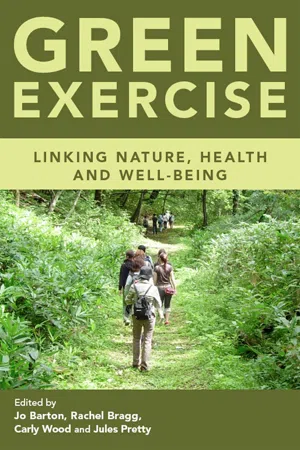
The concept of Green Exercise has now been widely adopted and implies a synergistic health benefit of being active in the presence of nature. This book provides a balanced overview and synthesis text on all aspects of Green Exercise and integrates evidence from many different disciplines including physiology, ecology, psychology, sociology and the environmental sciences, and across a wide range of countries.
It describes the impact of Green Exercise on human health and well-being through all stages of the lifecourse and covers a wide spectrum from cellular processes such as immune function through to facilitating human behavioural change. It demonstrates the value of Green Exercise for activity and education purposes in both schools and the workplace, as well as its therapeutic properties. Green Exercise is an effective intervention for vulnerable groups and promoting healthy ageing, with activities including wilderness therapy, therapeutic horticulture and the use of forests and water. Chapters also integrate cross-cutting key themes which are relevant to all stages of the lifecourse and have significantly contributed to the Green Exercise research base, such as forest bathing and blue exercise.
The book also explores the future of Green Exercise, the way in which research can be used to influence green design and planning and how health, social care and environmental agendas can be integrated to enable Green Exercise to be more widely used as a mechanism for improving health.
Trusted by 375,005 students
Access to over 1.5 million titles for a fair monthly price.
How environmental and social context shapes health and well-being
Jules Pretty and David Pencheon
DOI: 10.4324/9781315750941-1
Well-being in modern societies
Asclepius was the Greek god of healing and medicine. From the 6th century BCE, some 800 Asclepian healing temples were built across the eastern and central Mediterranean. Typically, these were situated far from settlements on hilltops and promontories overlooking the sea, such as at Epidaurus, Pergamon and Kos, where light was multidirectional from sky and water, winds plentiful, and aromatics from pine forests and thyme-rich garrigue filled the air. At that time, it was assumed that well-being emerged from natural places (Hart, 1965; Gesler, 1993; Koenig, 2000). It is now increasingly being recognised that the natural and social context of individuals is a key determinant of well-being, providing protection against stressors and improving resilience and recovery (Sternberg, 2009; NEA, 2011).
The past century has seen great advances in health care and treatment. Mortality rates have fallen in most countries, and average lifespans are extending. Since the mid-1960s, mean life expectancy worldwide has risen from 56.0 to 70.4 years, and under-5 mortality has fallen sharply from 153 to 52 per 1000 live births; in the UK, under-5 mortality has fallen from 22 to 5 per 1000 (UNICEF, 2012). Over the same period, however, a new wave of health and well-being problems in modern societies has emerged largely as a result of changing lifestyles and the environments that shape these lifestyles (CMO, 2013).
Affluent societies are characterised by high levels of material consumption, abundant food and calories, a lower incidence of regular physical activity (increased sedentariness), a shifting demographic with a growing proportion of elderly people with care needs and often lacking social support, fractured community and family structures, growing inequality, fewer pro-social behaviours, and unchanged levels of average life satisfaction (Hossain et al., 2007; Pretty et al., 2015). Some of these find expression in the fast-increasing incidence of obesity, type 2 diabetes, mental ill-health, dementias, some cancers, and cardiovascular disease (Hossain et al., 2007). Mental disorders now account for a large proportion of the disease burden in many countries, affecting 13–20 per cent of 12–24 year olds in most industrialised countries (Patel et al., 2007), though it is important to note that perceptions of what constitutes mental ill-health have changed over the decades (Phelan et al., 2000). Communities and indeed whole countries have become wealthier, yet increased material consumption has displaced important protective life choices and behaviours that are in turn partly conditioned by policy and markets (Layard, 2006; Royal Society, 2012).
It is now clear that continuing increases in GDP in affluent countries have not been associated with increases in well-being (Royal Society, 2012; Pretty, 2013). Latitudinal analyses across countries show a characteristic consumption cliff and affluent uplands shape: at low per capita GDP, well-being increases with rising GDP; after a threshold, well-being is largely independent of GDP across the affluent uplands (Figure 1.1). More surprisingly, longitudinal analyses over 50–60 years show that well-being in already affluent countries has remained resolutely stable even though per capita GDP has risen (e.g. between 3 and 8 fold in the UK, USA and Japan) (Figure 1.2).
Figure1.1 Changes in per capita GDP and life satisfaction, UK (1946–2011) (Pretty, 2013)
Figure1.2 Relationship between GDP and HDI at country level (n=173) (Pretty, 2013)
Despite the apparent lack of well-being dividend once countries have become affluent by GDP or other consumption measures, consumption patterns in many countries continue to converge on those of the richest. As the poorer take similar choices, seeking to use natural capital and environmental services in similarly damaging ways, so pressure on both natural and social systems grows (MEA, 2005; NEA, 2011).
Previous research has shown that the factors of consumption between different country groups are still substantially different (Table 1.1). Vehicle ownership in the Affluent North America-Europe-Oceania countries is 91 times greater than in the poorest countries, and in Affluent Asia 54 times greater than the poorest. Oil consumption in the Affluent North America-Europe-Oceania countries is four times greater than in the fastest developing countries. With world population expected to rise by 2–3 billion from the current 7.5 billion by mid-century before stabilising (assuming low- to medium-fertility scenarios), this will add further to consumption.
Table1.1Factors of consumption from poorest to fast developing and most affluent countries
Consumption metrics
Poorest to Affluent North America–Europe–Oceania
Poorest to Affluent Asia
Fast developing (BRICs and CIVETS) to Affluent North America–Europe–Oceania
Fast developing (BRICs and CIVETS) to Affluent Asia
Motor vehicles
91.4×
54.3×
5.3×
3.2×
Domestic water
28.5×
16.6×
2.3×
1.4×
CO2 emissions
118.0×
90.0×
2.7×
2.1×
Oil consumption
38.0×
97.3×
3.9×
10.0×
Meat consumption
11.9×
4.8×
2.3×
1.3×
Note: BRICs are Brazil, Russia, India, China; CIVETS are Colombia, Indonesia, Vietnam, Egypt, Turkey and South Africa
Source: Pretty (2013)
The global metrics developed to demonstrate the impacts of human activities on finite Earth conclude that at current world population and existing levels of consumption, planetary overshoot has already occurred. These include the Human Development Index (UNDP), Genuine Progress Indicator (Daly and Cobb, 1989), Ecological Footprints using global hectare equivalents (WWF, 2012), the Happy Planet Index (NEF, 2013), and planetary boundaries (Rockstrom et al., 2009). Overshoot implies more resources are being used than can be regenerated each year. Climate change is likely to be one of the indicators of the negative side-effects of such consumption (IPCC, 2013). The Royal Society (2012) stated that indefinite growth is impossible in a finite world, yet conventional economic growth remains a primary goal in most countries. As a result, behaviours and policy choices that improve well-being and health tend to have been displaced, despite the fact that GDP continues to be used as a poor proxy for sustainable and equitable prosperity.
Tackling well-being and health challenges
The term ‘health’ is generally taken to incorporate physical health, mental or emotional health, social health, spiritual health, lifestyle and functionality. The World Health Organization (1948) definition of health remains the most widely cited and states that “health is a state of complete physical, mental and social (individual) well-being, and not merely the absence of disease or infirmity”. In a similar way, well-being is a positive physical, social and mental state; it is not just the absence of pain, discomfort and incapacity. It requires that basic needs are met, that individuals have a sense of purpose, that they feel able to achieve important personal goals and participate in society (Pencheon, 2012; ONS, 2013).
It is unlikely that apparently wealthy countries will have the financial capability to spend the necessary additional resources to solve the next wave of health problems brought about by high material consumption, unless new models of health and social care are developed. Jackson (2009) concluded that modern society has been “betrayed by affluence”, and Dasgupta (2010) observed that “the rogue word in GDP is gross”, as it does not deduct the costly depreciation of vital natural and social assets. A concept of the wealth of nations should include measures for natural capital, social capital and individual well-being. GDP currently does not (Pretty, 2013). This suggests the need to prioritise new interventions to improve well-being and health and combine these with existing medical treatments. Such interventions should focus on both direct treatment of individuals and the contextual conditioning brought about by social and natural environments. These external environments condition internal physiological, hormonal and neural pathways, which in turn directly influence well-being and health. In this way, health is no longer described as simply a lack of disease, and highlights the need to revisit our (often contextual) framing of what it means to be healthy.
In the past two decades, a wide range of empirical evidence has emerged to show that well-being is improved by physical activity, diet and nutrition, direct engagement with nature and green places, attachments to people, attachments to personal possessions, the mind, and the fulfilment of values. The evidence has implications for the design of health and social care systems (models of care, hospitals and other health and care service buildings), transport policy, green space availability and use, food systems, social care policy and practice, the work place, leisure choices and child policy.
Evidence further suggests that there are substantial economic, financial and environmental gains to be made by adopting new interventions and choices (CMO, 2013). There remains, however, some scepticism and misunderstanding over both the evidence and its potentially powerful implications. Evidence to support seven interconnected themes of Asclepian healing is increasingly challenging some of the tenets of modern health care, the most powerful of which is that not all health care currently does good, and that much health care is important and needed largely because we have failed to create societies, cultures and economies that promote well-being.
Heresy 1: Sensory inputs from natural places improve well-being
The natural environment provides important ecosystem services that underpin economies (MEA, 2005; NEA, 2011). It also provides health services (Pretty et al., 2011; Jackson et al., 2013). Ecosystems provide four generic health benefits i) direct positive effects on mental and physical health; ii) indirect positive effects by facilitating nature-based activity and social engagement (providing locations for contact with nature, physical activity and social engagement), all of which positively influence health, and catalysing behavioural change towards healthier lifestyles (improving life pathways, activity behaviour, consumption of healthy foods); iii) reducing the threats to health arising from pollution and disease vectors (through purification and control functions, such as local climate regulation, noise reduction, and scavenging of air pollutants), and iv) direct benefits to health care: e.g. most drugs can trace their origin back to natural products (from simple painkillers to complex anti-cancer drugs); and there are likely to be many more undiscovered th...
Table of contents
Cover Page
Half Title Page
Title Page
Copyright Page
Table of Contents
List of figures and tables
List of contributors
Preface
1 The seven heresies of Asclepius: how environmental and social context shapes health and well-being
2 Nature in buildings and health design
3 Green exercise for health: a dose of nature
4 How to get more out of the green exercise experience: insights from attention restoration theory
5 The benefits of green exercise for children
6 Learning on the move: green exercise for children and young people
7 The health benefits of blue exercise in the UK
8 Forest bathing in Japan
9 Healthy parks, healthy people: evidence from Australia
10 Green care: nature-based interventions for vulnerable people
11 Care farming and probation in the UK
12 Wilderness and youth at risk: approaches for positive behaviour change through the outdoors
13 Green exercise in the workplace
14 Green exercise and dementia
15 The benefits of greener and healthier economies
Bibliography
Index
Frequently asked questions
Yes, you can cancel anytime from the Subscription tab in your account settings on the Perlego website. Your subscription will stay active until the end of your current billing period. Learn how to cancel your subscription
No, books cannot be downloaded as external files, such as PDFs, for use outside of Perlego. However, you can download books within the Perlego app for offline reading on mobile or tablet. Learn how to download books offline
Perlego offers two plans: Essential and Complete
Essential is ideal for learners and professionals who enjoy exploring a wide range of subjects. Access the Essential Library with 800,000+ trusted titles and best-sellers across business, personal growth, and the humanities. Includes unlimited reading time and Standard Read Aloud voice.
Complete: Perfect for advanced learners and researchers needing full, unrestricted access. Unlock 1.5M+ books across hundreds of subjects, including academic and specialized titles. The Complete Plan also includes advanced features like Premium Read Aloud and Research Assistant.
Both plans are available with monthly, semester, or annual billing cycles.
We are an online textbook subscription service, where you can get access to an entire online library for less than the price of a single book per month. With over 1.5 million books across 990+ topics, we’ve got you covered! Learn about our mission
Look out for the read-aloud symbol on your next book to see if you can listen to it. The read-aloud tool reads text aloud for you, highlighting the text as it is being read. You can pause it, speed it up and slow it down. Learn more about Read Aloud
Yes! You can use the Perlego app on both iOS and Android devices to read anytime, anywhere — even offline. Perfect for commutes or when you’re on the go. Please note we cannot support devices running on iOS 13 and Android 7 or earlier. Learn more about using the app
Yes, you can access Green Exercise by Jo Barton, Rachel Bragg, Carly Wood, Jules Pretty, Jo Barton,Rachel Bragg,Carly Wood,Jules Pretty in PDF and/or ePUB format, as well as other popular books in Biological Sciences & Ecology. We have over 1.5 million books available in our catalogue for you to explore.