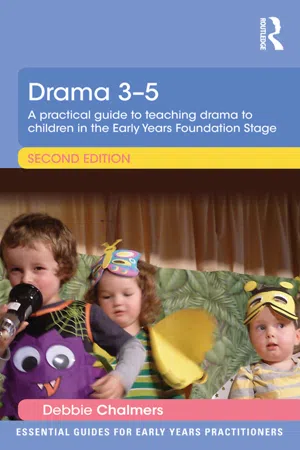
Would you like to offer constructive, creative and exciting new dramatic learning experiences to the children in your setting?
The importance of using drama to promote active and creative learning in the early years is widely recognised, and this fully updated second edition of Drama 3-5 will guide and inspire practitioners in all settings, allowing them to lead drama with confidence and enthusiasm. Young children participating in well planned drama activities learn to express themselves clearly and develop strong social skills, more self-confidence and a greater understanding of co-operation and team-work.
Drama 3-5 contains a wide range of accessible activities and sample session plans, drawn from the author's many years of extensive experience, which have all been fully and successfully tried and tested with children from 3-5 years. The book also explains the theory and value of all of the activities, as well as possible extensions and the ways in which they contribute to the learning objectives and goals of the Early Years Foundation Stage, allowing practitioners to encourage and assess children's progress. Key chapters include:
Building confidence
Encouraging social interaction
Mime and expression
Speech and language
Co-operation and teamwork
Performance skills
This book offers the tools and understanding needed for confident dramatic play and learning, making it an ideal companion to support every practitioner who wants to explore, develop and enjoy drama and have fun with their children.
Trusted by 375,005 students
Access to over 1.5 million titles for a fair monthly price.
Young children are naturally dramatic. They learn about the world and make sense of their experiences through acting out scenes in the role play area or with small world figures, where they may choose and develop characters, try them out, enjoy them and then discard them in favour of the next game. Some children naturally play in this way from a very young age, often because they have been encouraged to do so at home, while others learn to do it by copying and joining in with their peers. Some children will need more help and support as they may find this type of play more challenging and do not choose it spontaneously.
Opportunities for drama with the right equipment, a well-planned programme, some good ideas, confidence, flexibility and lots of enthusiasm make a vital contribution to the development of all children.
Before Each Session
Allow time to set up your equipment and prepare your space. Ensure that the room you are using is cleared of all furniture and toys that could present a safety risk or a distraction factor. Children will only appreciate drama as an activity in its own right if they are encouraged to move around and concentrate on stories and songs in a large, clear space. There should be no danger of them bumping into tables and chairs or losing concentration because they are looking longingly at rows of inviting toys on shelves or the floor!
When arranging private classes, it is a good idea to make a selection of children’s books available before sessions begin, so that clients are prepared to arrive in good time, knowing that they will have something to do with their child and will not feel embarrassed to stand around waiting or struggle to control their child who sees a large empty space and wants to run around. A calm moment spent reading a story or looking at a book can put children into a focused frame of mind from which they will be receptive to a drama session, while running around in a hall is likely to over excite or tire them and lead to accidents and upsets before the session begins.
Providing photograph albums from previous terms, showing photographs of (unnamed) children taken in classes, performances and parties with parents’ permission, can be a wonderful talking point between clients and children. Older members of the class grow in self-esteem by seeing themselves in your ‘special book’ and can be asked to find themselves and their friends and explain what was going on in the pictures to newer members, whose ambition then becomes to have their photograph in your book too!
However, always remember to ask for permission before taking photographs of children and provide a simple way for parents to refuse if they need to. They could talk privately to you or to any staff member, or write their name on a list that you have provided. In this way, parents will not feel embarrassed to withhold their permission and can feel confident that they will not be asked to explain their reasons before other parents.
It is possible to sensitively exclude young children from photographs without their knowledge if necessary, to avoid them becoming upset or feeling unwanted. For example, you could point the camera in their direction too, but never press the button; take pictures when they are at the far side of a group and just outside the frame; take pictures but then erase them from a digital camera; or give all of the pictures to the child’s parent.
Looking at photographs can be an excellent opportunity for you to chat informally with children in a friendly way. You may find out that the shy child who is not yet able to answer any questions within the group actually has extremely well-developed language skills and mature understanding, or that the child who appeared to be paying little attention last week remembers every song and character mentioned.
Managing Time
It is important to start on time, being flexible by two or three minutes. If a child is just taking off their coat or using the toilet, it is courteous to wait for them to join the group. If a client has requested your advice or indicated their need to give you some information about their child, it is not appropriate to end the conversation by looking at the clock, unless you feel that more than a minute or two will be required and you can offer to talk after the session instead.
Figure1.1 Families enjoy sharing books and photographs before a session begins
If clients see that you never start on time because you wait for those who are regularly late, they will all begin to arrive later and later and sessions will run into difficulties. However, it is important to let clients know that if they are sometimes late, they are still able to join in at whatever point you have reached and to make the child feel that they are always welcome.
Since parents are paying for a whole session, you must ensure they have the time you promised. But, if they have a commitment immediately after the class, such as collecting another child from school, they will find it worrying to attend if you run late and do not finish within five minutes of the time agreed. Clients do not continue with a class in the long term if they find fitting it into their schedule too stressful.
It may be appropriate to mention some very special news to the group before beginning – such as a child’s birthday on that very day or a new baby sibling born since the last time you saw a child – but discourage children from expecting to think up a tale about a very minor event with which to regale the entire group every week, as this wastes too much precious learning time and causes fidgeting and loss of focus at the wrong time.
If you make it clear to children that you would like to talk to them and hear what they have to say after the drama session, take care to remember and listen as promised; they will usually be happy to wait. This is an excellent opportunity for children to learn how and when to make appropriate conversation and to practise temporary postponement of gratification.
Including Everybody
When children come together to begin a drama session, they need to feel that they are all equally important and valued within the group and that others are pleased they have come. Confident, talkative children will want their teacher to listen to their latest news or answer their questions, while quieter children may hope that you will notice their toy or new T-shirt or hairstyle. Others may not wish to be the centre of attention or may even be wearing a very attractive garment that they happen to dislike. The aim here is to comment only on the things that children would like you to mention – this gets easier with practice, but nobody gets it right every time!
Through your day to day conversations with parents, carers and colleagues, you will know when a child is feeling particularly tired or fragile, excited or very energetic, coping with an upheaval or trauma or disappointed that their best friend is absent. Background information enables you to make allowances for certain behaviours, accept that a child is temporarily making slower progress, or offer extra support or challenges and stimulation to ensure that children can derive maximum benefit from each session.
Check that the floor is safe and clean enough to work on. It would be unusual to find a nursery with an unsafe floor surface, but some shared settings may have the use of a hall with a wooden floor. Children should always wear shoes if there is any danger of splinters and never just slippery socks or tights to dance on a polished floor. Remember that you may want to include activities such as sliding like a caterpillar, pretending to ice skate, crawling on hands and knees like an animal or rolling in imaginary mud or leaves.
Carpet is not the best floor surface for drama activities, as it does not allow satisfying sounds when stamping and jumping and can harbour dust that could affect allergic children. However, it is safe and can be used if there is no alternative. Vacuum the carpeted area before the children’s arrival to ensure cleanliness, safety and to allow dust time to settle. If you are using a hard floor surface, ensure that it will not be too cold or too warm for children to stand, sit and lie on and remind children to take especial care not to fall and bump their heads.
Pre-schools, crêches or children’s centres may find it appropriate for children to participate in drama activities in smaller groups and choose to use a room that is separate from the main play areas, if they have one. They may even find that the best large and non-distracting space available to them is an entrance hall or lobby area. Childminders will need to clear or adapt spaces within their homes to allow a group of children to act, dance and move around safely. For some rooms, it might be a good idea to purchase a rug or piece of carpet, vinyl or plastic that may be unrolled for each drama session. Schools and settings within community centres may have access to large PE mats, which are excellent as they will not slip and can break the impact of a fall.
Action songs don’t need a great deal of space, but provide healthy exercise and opportunities to learn and practise new skills. Speech, singing, rhythm activities and using percussion instruments are easily explored while children move between the formations of a circle, line or group and individual spaces. Standing up or sitting down changes the situation and the focus enough to recapture a young child’s interest. Stories, rhymes or poems may be acted out within a very small area and working close to each other can add to the atmosphere of concentration and fun. Drama can be shared successfully within a smaller space and, with support, children quickly learn to adjust their speed and direction to negotiate a safe pathway around each other. This is a learning objective within the prime area of Physical Development (Moving and handling).
At other times, children may be encouraged to experiment further with different ways of moving within a large space and to participate in racing, chasing and dancing games outside, in the garden or at the park. Clean grass is a safe surface for children to use and mats may be placed under and beside equipment where safety surfaces have not been installed. Drama activities such as imaginative games and role play should also take place outside and can involve large resources including wheeled toys, climbing equipment, tents and dens, which encourage children to pretend to be different people, characters or animals and support the creation of scenarios, sequences and stories. These will contribute to the early learning goals within the specific areas of Understanding the World (People and communities) and Expressive Arts and Design (Being imaginative).
Maintaining Relationships
As you will need to prepare your drama sessions in advance, ensure that colleagues understand the importance of sticking to agreed times and giving the full length of time promised to each session. Settings offering part-time sessions to their children must follow their timetable and complete activities, as well as allowing enough time for free flow play, before the children are collected. Those offering full daycare will also have a routine of activities, free playtimes, meals and rest periods that they need to adhere to. Agree with colleagues how long each group of children might concentrate and enjoy drama activities, starting with slightly shorter sessions and gradually building up to longer ones if this is their first experience of drama.
The staff team should make time to chat with each other for a few moments at the beginning and end of each session. It is good for children to see that the adults in their setting get on well, respect each other and work together consistently for the good of the group. A friendly relationship will ensure that both you and they feel happy to raise and discuss any areas of potential concern before they become problems. In this way difficulties can be minimised or prevented. Seek advice on identifying areas where extra support may benefit a child by chatting with the appropriate key person. You will be able to offer each other valuable insights into a child’s behaviour and abilities, to record and confirm areas of progress and celebrate achievements. This may be particularly helpful for children with special needs.
Some children who are unable to overcome shyness or communicate with others can ‘find a voice’ and thrive through exploring drama. Others find it a good area for channelling their energies and demonstrating their creative potential, showing concentration and imaginative skills previously undiscovered in other activities.
If you share your lesson plans with your colleagues, they will be more able to support your teaching and also develop possible extension activities for children who have enjoyed the themes they worked on in drama. Offering a few weeks of lesson plans at a time and in advance may facilitate the best co-operative working between you.
Students, apprentices, trainees and voluntary staff should be particularly encouraged to participate in music, singing, movement, dance and drama sessions, as they can quickly lose inhibitions, be inspired to offer ideas and develop greater confidence when working with groups of children in this way. It will be necessary to have realistic expectations of their abilities at first and to take pleasure in their developing skills and confidence along with the children’s, but do make it clear from the beginning that all adults must participate fully and encourage all children to join in and work to the best of their abilities. It is unacceptable for them to talk to each other about unrelated topics, display embarrassment when acting or singing, or to allow children to ‘opt out’ and sit on their laps to watch! Enthusiasm and co-operation are the most important skills to maintain throughout.
Figure1.2 Encourage the children to start each session with happy, smiling faces
In a nursery, pre-school, children’s centre or school setting, children will have arrived and settled in before their drama class begins, so they will all arrive in the room as a group at the agreed time. It is important to greet all children and staff warmly and indicate how pleased you are to see that they are all ready for their drama session.
Suitable opening comments might be:
I’m so pleased to see that you are ready with such happy smiling faces.
I was glad when I remembered it was Tuesday today, because it’s our drama day.
Isn’t it lovely to have this room all ready for us to use for dancing, acting and singing?
I’ve brought my special bag of things for us to look at later.
I remembered how good you all were at being cats last week and I was excited to think about which animals we might be today.
Table of contents
Cover Page
Half Title Page
Series Page
Title Page
Copyright Page
Table of Contents
Introduction
1 A good beginning
2 Warming up
3 Building confidence
4 Encouraging social interaction
5 Mime and expression
6 Movement and dance
7 Speech and language
8 Rhythm and singing
9 Taking turns
10 Co-operation and teamwork
11 Ending on a high
12 Performance skills
Appendix 1: Example plan for a simple drama session
Appendix 2: Example plan for a more advanced drama session
Appendix 3: Practical and legal requirements
Index
Frequently asked questions
Yes, you can cancel anytime from the Subscription tab in your account settings on the Perlego website. Your subscription will stay active until the end of your current billing period. Learn how to cancel your subscription
No, books cannot be downloaded as external files, such as PDFs, for use outside of Perlego. However, you can download books within the Perlego app for offline reading on mobile or tablet. Learn how to download books offline
Perlego offers two plans: Essential and Complete
Essential is ideal for learners and professionals who enjoy exploring a wide range of subjects. Access the Essential Library with 800,000+ trusted titles and best-sellers across business, personal growth, and the humanities. Includes unlimited reading time and Standard Read Aloud voice.
Complete: Perfect for advanced learners and researchers needing full, unrestricted access. Unlock 1.5M+ books across hundreds of subjects, including academic and specialized titles. The Complete Plan also includes advanced features like Premium Read Aloud and Research Assistant.
Both plans are available with monthly, semester, or annual billing cycles.
We are an online textbook subscription service, where you can get access to an entire online library for less than the price of a single book per month. With over 1.5 million books across 990+ topics, we’ve got you covered! Learn about our mission
Look out for the read-aloud symbol on your next book to see if you can listen to it. The read-aloud tool reads text aloud for you, highlighting the text as it is being read. You can pause it, speed it up and slow it down. Learn more about Read Aloud
Yes! You can use the Perlego app on both iOS and Android devices to read anytime, anywhere — even offline. Perfect for commutes or when you’re on the go. Please note we cannot support devices running on iOS 13 and Android 7 or earlier. Learn more about using the app
Yes, you can access Drama 3-5 by Debbie Chalmers in PDF and/or ePUB format, as well as other popular books in Pedagogía & Gestión del aula. We have over 1.5 million books available in our catalogue for you to explore.