Some of the greatest movies and television series have been written by script partners. Script Partners, Second Edition brings together the experience, knowledge, and winning techniques of Hollywood's most productive partnerships—including Lucy Alibar & Benh Zeitlin (Beasts of the Southern Wild ), Craig Borten & Melisa Wallack (Dallas Buyers Club), and Andrew Reich & Ted Cohen (Friends). Established and aspiring screenwriters will learn how to pick the right partner and the right project, co-create character and story structure, co-draft and revise a script, collaborate in film school and in the film industry, and manage both the creative and business sides of partnerships.
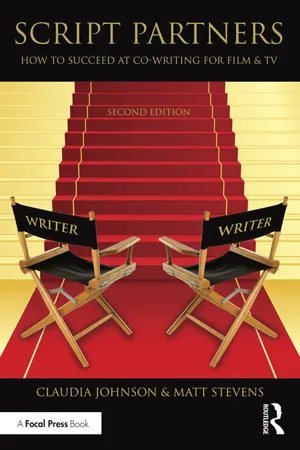
eBook - ePub
Script Partners: How to Succeed at Co-Writing for Film & TV
- 256 pages
- English
- ePUB (mobile friendly)
- Available on iOS & Android
eBook - ePub
Script Partners: How to Succeed at Co-Writing for Film & TV
About this book
Trusted by 375,005 students
Access to over 1.5 million titles for a fair monthly price.
Study more efficiently using our study tools.
Information
One
Why Collaborate? The Top Ten Reasons to Write With a Partner
“She got gaps. I got gaps. Together we fill the gaps.”
—Rocky Balboa (Sylvester Stallone), Rocky
What do feature films like Some Like It Hot, Annie Hall, Top Gun, Fargo, There’s Something About Mary, Amélie, Sideways, Beasts of the Southern Wild, Gravity, Dallas Buyers Club, The Conjuring, the Pirates of the Caribbean franchise, and the Despicable Me franchise have in common besides their success?
They were co-written by collaborative screenwriting teams: Billy Wilder & I.A.L. Diamond, Woody Allen & Marshall Brickman, Jim Cash & Jack Epps, Jr., Joel & Ethan Coen, Peter & Bobby Farrelly, Jean-Pierre Jeunet & Guillaume Laurant, Jim Taylor & Alexander Payne, Lucy Alibar & Benh Zeitlin, Alfonso & Jonás Cuarón, Craig Borten & Melisa Wallack, Chad & Carey Hayes, Terry Rossio & Ted Elliott, and Cinco Paul & Ken Daurio.
Many episodes of successful television and web series are also co-written by teams such as Andrew Reich & Ted Cohen, head writers and executive producers of Friends and the 2014 web series Robin Banks and the Bank Roberts, and Patrick Massett & John Zinman, co-writers and co-producers of Friday Night Lights and The Blacklist (as well as co-writers on the films Lara Croft: Tomb Raider and Gold).
Each year the list of script partners and their successes grows longer. Why? Because as we and the writing teams interviewed here have discovered, collaborative scriptwriting is one of the most productive and successful ways to write (and the rewards often transcend success).
In fact, it can double your chance for success, as Harold Ramis discovered when he worked with different partners, from Douglas Kenney & Chris Miller (Animal House) to Peter Tolan (Analyze This; Analyze That).
“It just adds so much to the work,” Ramis told us during a break from editing Analyze That. “Peter, for instance, will add just tremendously funny things and great scenes, great dialogue. And there’s this synergistic benefit—it makes my work better, and together we’re better than probably either of us alone. I can enjoy writing alone, but I think I’ve never been as good as with other people. If I were limited by my own ability, my own imagination, I would be probably less than half as successful as I am,” he confessed, laughing.
Despicable Me writers Cinco Paul & Ken Daurio agree via email. “Well, first of all, working with a partner is a lot more fun. And secondly, in writing comedy it’s good to have another person there to help determine whether something is actually funny or not. It was really beneficial to us earlier in our careers when we were pitching a lot—with two people you can act out scenes, really make a show out of a pitch.”
Their career is the very picture of success, including being chosen by Theodor Seuss Geisel’s widow, Audrey Geisel, to write the film adaptations of Horton Hears a Who! and Dr. Seuss’ The Lorax.
“We both know on some level we could do this by ourselves,” Andrew Reich says when we interview him and Ted Cohen on the Warner Bros. lot. “We both could, but we’re better together and prefer it that way.”
Why should you or any writer who wants to work in this biz consider collaborating? Because—the envelope, please—the top ten reasons are …
1. Learning to Write With a Partner Can Get You Hired—Not Fired—in the Industry
How’s that for a hook and setting the stakes? But don’t take our word for it. Patrick Massett & John Zinman, during our interview at their Sherman Oaks production office, talk about the advantages of hiring writing teams for a TV series.
| PATRICK: | I like teams. I understand the benefit of a partner. So when I look at a partnership, I think if they seem like they’re right for the job, then I’m totally wide open to hiring them. |
| JOHN: | Yeah, I like partnerships, and it’s a collaborative environment, so they’re already people who are, you have to assume, disposed toward collaboration. So I think in the TV world especially, writing teams are a good bet. You’ve got to spend a lot of time with the people you hire. Are they gonna mix? Are they gonna be additive to the group? And if a partnership is additive, then they’re gonna probably win the job over a single writer. |
Massett & Zinman know from long experience that successful script partners have already learned how to play well with others, a crucial skill in the highly collaborative environment of a TV writers’ room.
| PATRICK: | You can have eight great people in a room that all jive and then one person who doesn’t, and it fucks the whole thing up. |
| JOHN: | It really does. |
| PATRICK: | That one bad apple thing? True that. Completely spot-on in regards to a writer. |
| JOHN: | It can crush a writers’ room. |
| PATRICK: | It’s an energy suck. It’s a creative suck. |
| JOHN: | Truly, you’ve got to fire that person i mmediately. You just do. It’s hard to do because you don’t want anyone to get fired. But some people are “no” people. |
| PATRICK: | And they don’t come back with an idea. That’s one of the rules of the writing room. You don’t like someone else’s idea, you have to sort of— |
| JOHN: | “No, I don’t think Sharon should walk in and shoot him. I think Sharon should walk in and talk to him first and then go to the drawer and turn and explain why”—as opposed to notes like, “I hate that, I hate that idea.” |
| PATRICK: | There are writers who will sit in a room and say just that, period, end of sentence. |
| JOHN: | Look, you have to have thick skin. You can’t be in a writers’ room and not have thick skin, but you also want to know that your colleagues have your back. One person who’s pejorative or passive-aggressive— |
| PATRICK: | Dismissive. |
| JOHN: | Dismissive, demeaning, it just shuts people up, especially the younger writers. I mean, older writers are gonna be like, “Fuck you.” Younger writers are gonna be afraid they’re gonna get fired or be afraid that they’re not good enough, and then you’ve got a bad room. Because one person is just being a dick. Of course, as producers you’ve gotta ask around too. Most people have reputations. [Laughter] It’s a small town. |
2. It’s a Dog-Eat-Dog Business—and Vice Versa—but When You Write With a Partner, There’s Always One Person in Town Looking Out for Your Interests
The misery curve for screenwriters is legendary. It’s a daunting task to write a screenplay and even more daunting to write a good one. Conventional wisdom says it takes five to ten years to learn the craft of screenwriting, and five to ten screenplays before you finally sell one. There are exceptions, of course, keeping hope alive that perhaps, just perhaps, writing screenplays is easy.
It isn’t.
And getting a screenplay produced is even harder. Screenplays are like sperm—there’s a one-in-a-million chance they’ll get made.
Jim Cash & Jack Epps, Jr., wrote seven screenplays before Top Gun was produced, and even that iconic film almost didn’t happen. When Paramount shelved the script after a shakeup at the studio-exec level, Cash & Epps were beyond frustration. But their partnership kept them going, as Epps tells us at his USC office.
“Jim and I, when we were getting beat up—You just feel like throwing in the towel but you’ve got someone there to push you. There’s somebody there to say, ‘Hey, let’s do this. Come on. We can do this.’ And that really helps a lot.”
Nicole Yorkin & Dawn Prestwich (Judging Amy; The Killing) spent their first four years writing scripts that didn’t sell. The Farrelly brothers spent nine years hawking their screenplays around Hollywood before they made their first film. So screenwriters must find effective ways to keep discouragement from overcoming determination.
And writing together does just that, Lee & Janet Scott Batchler (Batman Forever; Pompeii) tell us over coffee in Pacific Palisades.
| JANET: | Sometimes we both get down at the same time. It just works that way. Sometimes we sort of pull each other through. |
| LEE: | The best baseball player in the world has a batting slump. |
| JANET: | And the best baseball players in the world are batting somewhere in the .300s. Nobody hits a thousand. We just have to keep reminding each other of that. We sort of have to goose each other to get going sometimes. |
And in this tough business, writing partners have each other’s back.
“You’ve always got one person in town who’s looking out for your best interests,” says Robert Ramsey, who wrote numerous scripts with Matthew Stone (Life; Intolerable Cruelty; Man of the House) in an office overlooking Griffith Observatory and the famous Hollywood sign.
Yes, you have to find the right writing partner, and once you start selling your screenplays you’ll make half the money, but most writing teams believe that’s a small price to pay. Bottom line: The advantages of sharing the writing outweigh the disadvantages of sharing the bottom line.
3. Two Imaginations Are Better Than One—Better Brainstorming and Creative Breakthroughs
There are some terrific techniques (clustering, for example) for exploring ideas alone on paper, but brainstorming (or “spitballing,” as William Goldman calls it in Adventures in the Screen Trade) by definition requires more than one person. According to Conceptual Blockbusting, it was invented as a group problem-solving technique and given its name by Alex Osborn, a leader in advertising, who outlines four rules for successful brainstorming sessions:
- Rule 1. No evaluation (internal or external criticism) of any kind is permitted.
- Rule 2. All participants should be encouraged to think of the wildest ideas possible (because, as Osborn believes, “it’s easier to tame down than think up”).
- Rule 3. Quantity of ideas should be encouraged (quantity helps control our internal evaluation, and quantity, he also believes, leads to quality).
- Rule 4. Participants should build upon or modify the ideas of others (because, in Osborn’s words, “combinations or modifications of previously suggested ideas often lead to new ideas that are superior to those that sparked them”).
We were amazed and impressed (with ourselves!) when we recently read these rules, because over the years we’ve developed a similar set of unwritten rules for brainstorming our screenplays.
Before we make an outrageous suggestion, we say, “I’m just playing.” That’s code for “Brace yourself, this could be bullshit,” but it buys us a license to offer the wildest and possibly dumbest ideas without getting dumped on (Rule 1).
In our more insecure moments, if we think the idea is really outrageous, we’ll say, “You’re gonna hate this” or “Get out your barf bag,” but we throw the idea into the mix anyway so we can explore it. Because, like Alex Osborn, we’ve learned that the more outrageous the idea, the better (Rule 2).
A wild idea can always be tamed—unless it turns out to be brilliant—but it can also release a whole herd of ideas (Rule 3)...
Table of contents
- Cover
- Title
- Copyright
- Dedication
- Contents
- FOREWORD
- INTRODUCTION AND ACKNOWLEDGMENTS
- Chapter 1 Why Collaborate? The Top Ten Reasons to Write With a Partner
- Chapter 2 A Film School Survival Kit or How Collaboration Helps You Get In, Get Along, and Get Ahead
- Chapter 3 Finding the Right Writing Partner
- Chapter 4 Making the Creative Relationship Work
- Chapter 5 Solving the Space–Time Conundrum
- Chapter 6 Choosing the Right Project
- Chapter 7 Co-Creating Character
- Chapter 8 Co-Creating Story and Structure
- Chapter 9 Co-Drafting the Script
- Chapter 10 Co-Writing the Rewrite
- Chapter 11 Making the Business Relationship Work
- CONCLUSION
- AFTERWORD
- BIBLIOGRAPHY
- INDEX
Frequently asked questions
Yes, you can cancel anytime from the Subscription tab in your account settings on the Perlego website. Your subscription will stay active until the end of your current billing period. Learn how to cancel your subscription
No, books cannot be downloaded as external files, such as PDFs, for use outside of Perlego. However, you can download books within the Perlego app for offline reading on mobile or tablet. Learn how to download books offline
Perlego offers two plans: Essential and Complete
- Essential is ideal for learners and professionals who enjoy exploring a wide range of subjects. Access the Essential Library with 800,000+ trusted titles and best-sellers across business, personal growth, and the humanities. Includes unlimited reading time and Standard Read Aloud voice.
- Complete: Perfect for advanced learners and researchers needing full, unrestricted access. Unlock 1.5M+ books across hundreds of subjects, including academic and specialized titles. The Complete Plan also includes advanced features like Premium Read Aloud and Research Assistant.
We are an online textbook subscription service, where you can get access to an entire online library for less than the price of a single book per month. With over 1.5 million books across 990+ topics, we’ve got you covered! Learn about our mission
Look out for the read-aloud symbol on your next book to see if you can listen to it. The read-aloud tool reads text aloud for you, highlighting the text as it is being read. You can pause it, speed it up and slow it down. Learn more about Read Aloud
Yes! You can use the Perlego app on both iOS and Android devices to read anytime, anywhere — even offline. Perfect for commutes or when you’re on the go.
Please note we cannot support devices running on iOS 13 and Android 7 or earlier. Learn more about using the app
Please note we cannot support devices running on iOS 13 and Android 7 or earlier. Learn more about using the app
Yes, you can access Script Partners: How to Succeed at Co-Writing for Film & TV by Matt Stevens,Claudia Johnson in PDF and/or ePUB format, as well as other popular books in Mezzi di comunicazione e arti performative & Film e video. We have over 1.5 million books available in our catalogue for you to explore.