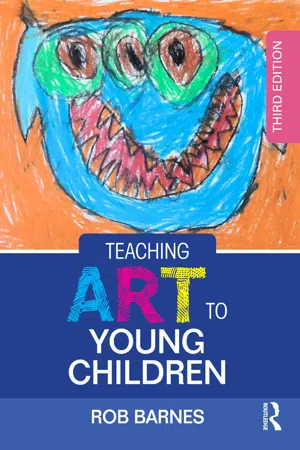
How can teachers develop best practice in art teaching?
This fully updated third edition of Rob Barnes' classic text blends practical ideas with sound principles of art education. Teachers and student teachers will find a range of ideas and tried and tested classroom examples; whilst for those looking for firm principles of art teaching and 'best practice' this book presents many important issues in art education with clarity and insight.
Based on first-hand experience of teaching children, this text uses many examples from early years and primary school contexts, and tackles essential topics with realism and imagination such as:
developing skills through using media
how children draw
encouraging artistic confidence in children
producing original artwork and making use of digital imagery
Rob Barnes' unique approach encourages teachers to develop and think about art as part of a rich curriculum of learning, highlighting how it shouldn't be taught in isolation but with purposeful links to other areas of the curriculum.
Trusted by 375,005 students
Access to over 1.5 million titles for a fair monthly price.
Art enables us to find ourselves and lose ourselves at the same time.
Thomas Merton, No Man is an Island
Creative activities confront how we feel about things. Expressing a mood, emotion or temperament through art becomes as valid as responding to another person, a moving sight or a meaningful experience. Both responding and expressing through art puts us in touch with qualities which are part of what makes us human. As such they give special significance and meaning to what we see with our eyes and the inner eye of the mind. They touch on part of us that nothing else can.
For children, art can be a means whereby they reconstruct and assimilate the experiences they have had. What might have been an incomplete inner vision can become clear enough for them to give meaning to what they encounter and can help to build up concepts of themselves in relation to the world. Nowhere is this more obvious than when young children cannot read or write. Their early art provides them with a personal language which describes the world they live in through the shapes and symbols they make when they draw. By adult standards those symbols are often poorly executed, even inadequate, but they are unique to the children who did them and crucial to their development. Clumsy and primitive the drawings may be, but they record an experience of perception and a stage reached in a child’s personal growth and awareness.
Most of us who are teaching would want to help this process and try to find ways of developing children’s artistic learning. By intuition we might find our way. More likely we might look at prevailing schemes and the National Curriculum. Some of this would inspire, but some would be vague and meaningless. Learning objectives are hard to determine if we are only presented with finished pieces of children’s work to puzzle over. Making links between principles and practice has traditionally proved difficult. In art teaching, an ethos of apparently vague and random objectives still characterizes many classrooms. It could be argued that the teachers should make these links for themselves but that would be to ignore the problems most of us have in putting theory into practice. An understanding of principles, the essential part of any theory, does not automatically lead to good practice.
It is not difficult to find children enjoying their artwork, coping with what we asked them to do and controlling materials. But how do we know if they are really learning anything? Are they engaged in anything worthwhile? Painting a cardboard box bright red all over may be enjoyable. It may be absorbing, but has it any educational value to the child so industriously occupied in doing it? Are any skills being learned so that subsequent artwork shows some development?
The themes in this book are intended to bring together principles and practice so that effective art teaching can evolve. Since the first and second editions of this book, art and technology have moved onwards as they always do, embracing the digital image, ‘installations’, ‘land art’ and ‘performance art’. Despite this, teachers still want to know basic things like how children draw, how to produce original artwork and what value art offers. Like most views on art and design, the arguments and suggestions set down here can undoubtedly be challenged. Art thrives on its multiplicity of viewpoints and its unwillingness to be governed by any hard and fast rules. For that reason, conceptual models have been avoided in favour of arguments which try to touch more on the experience of teaching art than on its various theories. The intention is to examine principles and practice together rather than try to separate them entirely. A frequently made assumption is that the two can successfully be divided and analysed. Yet though one may be associated with thinking, the other with doing, they are not necessarily separable.
Another, and perhaps less obvious, aim is to discuss art teaching in a context of ‘creative teaching’. Teachers are far more creative in their thinking than they often suspect, and art can be a way of using this creativity across the whole curriculum. To that end, many ideas in this book will be found to cover a far wider range of curricular interests than art alone. A creative teacher makes links with other areas of the curriculum, realizing that children do not learn piecemeal subject by subject, even if we conveniently structure curriculum documents as if they do.
Not many decades ago we would have believed that art was for a few gifted children. Nowadays, the majority of children are regarded as being creative and their artwork is readily cited as evidence of their creativity. The shift in viewpoint has partly resulted from the influence of a variety of educationists as well as changes in the way we see our roles as parent and teacher. In Victorian times, children were viewed as imperfect adults. Now they have qualities which we recognize make them perfectly childlike and capable of producing imaginative ‘Child Art’. They are able to produce artwork with special qualities which no adult could hope to emulate. We expect children to be taught as individuals as well as being part of a group, and we have organized our education system so that individual learning is valued.
There are now far more adults in the classroom than would be seen by previous generations of children. Classroom assistants work alongside teachers and some assistants take on a teaching role. This means that responsibility for teaching art is often shared between teachers and other adults, including parents. They too have a great deal to offer by becoming involved with their children’s projects outside the school day. Critics of this might say that the art produced no longer belongs to the child. That would be to ignore a strong social and bonding element to an art project that involves parents. Some projects can be almost as rewarding for parents as they are for children. For example, artwork done on a theme of Landmarks (Plate 42) can involve research at home to find out about sculpture such as ‘The Angel of the North’ or ‘The London Eye’. Such a theme involving parents can extend knowledge of what a landmark is and how it came to be where it is.
Plate42 London Eye. Age 11. 600 mm high.
Plate43 Pop Art. Age 9/10.
Plate44 Sea Monster. Age 10. 390 × 280 mm.
Plate45 World Cup Rattle. Age 7. 100 × 85 mm.
Plate46 Hundertvasser inspired. Age 7. 420 ...
Table of contents
Cover Page
Half Title Page
Title Page
Copyright Page
Table of Contents
List of illustrations
Foreword
Preface to the third edition
Acknowledgements
1 Learning through art
2 The value of art
3 Producing original artwork
4 How children draw
5 Developing ideas
6 Activities, curriculum and progression
7 Classroom organization
8 More activities for young children
9 Using paint
10 Sequencing printmaking
11 Collage as a medium
12 Design and problem-solving
13 Talking with children
14 Assessment and evaluation
15 Art and the digital image
16 Using media and techniques to build skills
17 Learning about artists and designers
18 Conclusions
Index
Frequently asked questions
Yes, you can cancel anytime from the Subscription tab in your account settings on the Perlego website. Your subscription will stay active until the end of your current billing period. Learn how to cancel your subscription
No, books cannot be downloaded as external files, such as PDFs, for use outside of Perlego. However, you can download books within the Perlego app for offline reading on mobile or tablet. Learn how to download books offline
Perlego offers two plans: Essential and Complete
Essential is ideal for learners and professionals who enjoy exploring a wide range of subjects. Access the Essential Library with 800,000+ trusted titles and best-sellers across business, personal growth, and the humanities. Includes unlimited reading time and Standard Read Aloud voice.
Complete: Perfect for advanced learners and researchers needing full, unrestricted access. Unlock 1.5M+ books across hundreds of subjects, including academic and specialized titles. The Complete Plan also includes advanced features like Premium Read Aloud and Research Assistant.
Both plans are available with monthly, semester, or annual billing cycles.
We are an online textbook subscription service, where you can get access to an entire online library for less than the price of a single book per month. With over 1.5 million books across 990+ topics, we’ve got you covered! Learn about our mission
Look out for the read-aloud symbol on your next book to see if you can listen to it. The read-aloud tool reads text aloud for you, highlighting the text as it is being read. You can pause it, speed it up and slow it down. Learn more about Read Aloud
Yes! You can use the Perlego app on both iOS and Android devices to read anytime, anywhere — even offline. Perfect for commutes or when you’re on the go. Please note we cannot support devices running on iOS 13 and Android 7 or earlier. Learn more about using the app
Yes, you can access Teaching Art to Young Children by Rob Barnes in PDF and/or ePUB format, as well as other popular books in Education & Early Childhood Education. We have over 1.5 million books available in our catalogue for you to explore.