- 224 pages
- English
- ePUB (mobile friendly)
- Available on iOS & Android
eBook - ePub
About this book
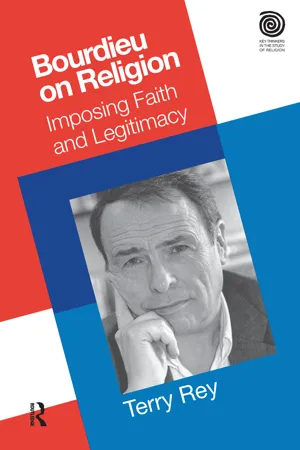
Pierre Bourdieu was one of the most influential social theorists of our time. He developed a series of concepts to uncover the way society works and to challenge assumptions about what society is. His ideas illuminate how individuals and groups find value and meaning and so have rapidly come to be seen as hugely productive in analysing how religion works in society. 'Bourdieu on Religion' introduces students to Bourdieu's key concepts: cultural, social and symbolic capital; habitus and field; and his challenge to the structures of social inequality. This study will be invaluable to any student interested in the relationships between religion, class and social power.
Information
Chapter 1
The Life, Work and Influences of a ‘Master of Suspicion’
I believe that, whatever slight chance I may have of not being finished off by consecration, I owe to the fact that I have worked to analyze consecration. I even think that I might be able to use the authority that this consecration has given me to give more authority to my analysis of the logic and effects of consecration.
(in Bourdieu and Wacquant 1992, 210)
Life
For someone who eventually became quite a public and politically engaged figure of iconic national stature and international renown, Pierre Bourdieu was rather guarded about his background and personal life. To date, the closest English-language text to a biography of Bourdieu, Michael Grenfell's Pierre Bourdieu: Agent Provocateur (2004), consists of merely five pages of 'Personal Biography', followed by a much longer and excellent discussion of the French 'Intellectual Climate' in which Bourdieu was educated and rose to prominence. Bourdieu held biography in general in contempt: 'To try to understand a life as a unique and self-sufficient series of events with no links other than the association with a subject whose constancy is no doubt merely that of a proper name, is nearly as absurd as to try to make sense of a route in the metro without taking into account the structure of the subway network, that is, the matrix of objective relations between the different train stations' (Bourdieu 1986a, 71). As for autobiography in particular, the great French sociologist was loath to engage in something that he viewed as tantamount to 'erecting oneself a mausoleum which is also a cenotaph' (in Bourdieu and Wacquant 1992, 213). Hence the first passage of Bourdieu's most (dare I say?) autobiographical book, Esquisse pour une auto-analyse (Outline for a Self-Analysis), which sits alone on a single page, reads: 'This is not an autobiography' (Bourdieu 2004, 6). Bourdieu was: apprehensive that details of his personal life could readily be (ab)used by his critics to discredit him and/or to try and explain away some element or another of his work (Bourdieu and Wacquant 1992, 202-204; Carles 2001). He even expresses relief that certain hints about his background embedded in some of his earliest work did not circulate widely, thereby effectively pre-empting any 'ill-intentioned or voyeuristic readers' (Bourdieu 2002, 12). But, because, as Gisèle Sapiro (2004, 77) rightly interprets Bourdieu to mean, any person's 'early experiences are determinant because they condition later experiences (through the integrative effect of the habitus)',1 it behooves us to take a brief look at Bourdieu's background for insight into the development of his understanding of the social world. As his own theory of human development would suggest, therefore, Bourdieu's personal rejection of religion, for instance, and the generally adversative attitude toward religion in his work are in considerable measure the products of his upbringing in a society that, especially among intellectuals just prior to and since the French Revolution, has long harbored deep collective suspicion of institutional religion.
Béarn
Pierre-Félix Bourdieu was born on the first day of August in 1930 to lower-middle-class parents: in Denguin, 'a tiny and remote village in Southwest France, a very "backward" place as city people like to say' (in Bourdieu and Wacquant 1992, 204). Denguin is located in the region of Beam, not far from the Pyrenees Mountains, in the Pyrénées-Atlartiques department of the republic. His native village counted only a couple of hundred residents at the time of Bourdieu's birth, most of them peasants, and did not eclipse the mark of 500 until sometime in the 1960s (Mairie de Denguin, n.d.). It was so remote that Bourdieu's schoolmates in the town of Pau, just 20 kilometers away, had never heard of it—and so they mocked it (Bourdieu 2004, 109). Bearnese, one of four sub-dialects of the Gascon language, is the language of quotidian life in Denguin, though Bourdieu recalls his father, Albert Bourdieu, recounting stories from his past 'in a vague mix of Bearnese, Spanish, and French' (ibid., 111). Some of these stories reflected the kinds of leftist values and commitments that distinguish Bearnese political culture (Bège 2004), such that Bourdieu's own left of left' political position derived in large part, as Loïc Wacquant (2005b, 11) explains, from 'his upbringing in a remote region of southwestern France where support for socialist ideals ran strong amidst the ambient conservatism, as did sympathy for the frente popular during the Spanish Civil War and the Communist-led Resistance to German occupation during World War II'. Pierre Bourdieu's father, moreover, himself possessed 'an anarchist and rebellious streak, which he also bequeathed to his only son'.
When Noemi Duhau married Albert Bourdieu she did so against the will of her parents. This was because they regarded Albert, the sharecropper who had left school at the age of fourteen, as someone socially below them, who by the standards of the local peasantry were 'une grande famille' (Bourdieu 2004, 112).2 Their material difficulties notwithstanding, Pierre Bourdieu seemingly had excellent parents who remained supportive of him throughout his education, his stint In the army, and as he embarked on his professional career as a scholar. He speaks fondly of his father's self-effacing concern for the most destitute of the village and of his delight in helping them: 'He taught me without speaking, and above all with his attitude, to respect "the lesser", among whom he counted himself, and also, even if he never explicitly said it, their struggles' (ibid., 111). In the retrospective words of Jacques Darringrand (in Bège 2004, 274), a onetime schoolmate of Pierre Bourdieu's, we can see that such lessons indelibly marked the future French intellectual giant in ways that would also come to distinguish his professional work:
There is no one be respects more than the street child, the laboring artisan, the disconcerted student, the unemployed, the homeless, the undocumented, the hopeless. He believes that to awaken to misery, injustice, and inanity is to lash out against them. He thinks that our society must find the where-with-all to fundamentally change and improve.
If his father's respect for local poor and destitute peasants was one of the young Pierre Bourdieu's first lessons in the realities of social inequality, the divergent backgrounds of his parents' respective families, and the resultant tensions over how he should be raised, was another. Being, as she was, from 'une grande famille', Noemi Bourdieu was far more intent than her husband on inculcating in their only son the same 'respect for conventions and conveyances' that she herself had been raised to embody. Especially interesting for our purposes, this included of course religion, against which the young Bourdieu rebelled, showing early in his life the kind of revolt against convention that would come to so strongly characterize his scholarly work:
With a most oppositional and somewhat anarchistic air, she clashed with my father when she wanted to impose upon me, without believing in them, a minimum of external conformity to local customs, especially religious, which I refused (above all because I was distressed by avertable panic at the very idea of Walking through the entire church, on Sunday, to take my place in the boys' pew), or distinctive ways of dressing or appearing in public, a white smock one day, and long pants another (not to mention the impeccable part that she insisted in making in my hair, which I would mess up the moment I got out the door), which revolted me because it all distinguished me from the others and exposed me to their ridicule
(Bourdieu 2004, 113-14).
Despite having as rich a Protestant history as any region of France, Catholic customs have always predominated in the Bearnese religious field. Bourdieu's native Denguin is about forty miles from Lourdes, the most important Catholic pilgrimage destination in all of France, and one of the most important in the world. The nearest city to Denguin is Lescar, a commercial center that was on the path of thousands of Catholic pilgrims from throughout medieval Europe who made their way to Santiago de Compostela in Spain. It is interesting to speculate that during his childhood Bourdieu was fully aware of the religious significance of these places, as he may also have been of the story of the cagot community that once existed just outside of Denguin (Centre Généalogique des Pyrénées Atlantiques 2006). Consisting chiefly of lepers, but in some cases also of religious heretics, the cagots were the social outcasts of medieval France, comparable to the 'untouchables' of India, who suffered persecution and ostracism on par with some of the worst forms of racist oppression in the modern world. They were the 'wretched of the earth' in medieval Béarn, victims of the most extreme instances of what Bourdieu calls 'symbolic violence', which sometimes took Catholic forms, like receiving the Eucharist On the end of a long stick and having a separate receptacle of holy water for their exclusive use.
On the elementary level Bourdieu shined as an exceptional student at the Lyoée Louis Barthou in Pau,3 the largest town near Denguin, from 1941 to 1947. From there he continued his studies in Paris upon his admission into the prestigious Lycée Louis le Grand, an originally Jesuit school that counts Diderot, Voltaire, Molière, Hugo and Sartre among its graduates, not to mention Jacques Chirac and two other presidents of the Fifth Republic. After three years at Louis le Grand, 1948-1951, Bourdieu scored highly enough on the standardized national examination to be counted among la crème de la crème of France's young adults that are admitted each year into the famous Ecole Normale Supérieure, also in Paris, the country's most prestigious preparatory school (which might more accurately in American terms be called a 'teachers' college') and alma mater to most of the celebrated French intellectuals of the twentieth century: Durkheim, Bergson, Sartre, Lévi-Strauss, Merleau-Ponty, Foucault and Derrida, the latter a classmate of Bourdieu's there.
It is noteworthy that Bourdieu's scholarly achievements were probably only made possible by the fiercely anti-clerical French Revolution, which wrenched education from the hands of the Catholic Church and guaranteed free access to it for all citoyens. Consideration of this momentous historical event and its sociocultural inertia in France provides some useful background for viewing Bourdieu's own iconoclasm. In a similar vein, a brief look at Béarn's history can also help illustrate features of French religious culture that shaped, as much as anything, Bourdieu's conceptualization of the 'religious field'. Denguin was named after Guy de tons, the Bishop of Lescar who, in addition to participating in the Crusades against the Moors, commissioned the construction of the Cathedral of Our Lady of the Assumption for Béarn's most important historical city in 1120. The Cathedral's own history, moreover, can serve as a microcosm of French religious history and the rise of the Catholic monopolization of the European religious field that is the dominant image one takes from reading Bourdieu on religion, just as it is a dominant paradigm in his social theory at large: 'Bourdieu's sociology of religion is, first and foremost, a sociology of Catholicism', as Erwan Dianteill (2004, 71) explains:
The accent thus falls on the process of monopolization of power by a single institution: The Catholic Church. From this point of view, the highest concentration of hierocratic power is reached in Western Europe before the Reformation. It is the genesis of this monopolization that most interests Bourdieu.
The Protestant Reformation radically altered the French religious field, as much in Béarn as anywhere. By the middle of the seventeenth century there were 30,000 Protestants (locally called 'Huguenots') in the region, for example, while the town of Pau itself, where Bourdieu would attend primary school three hundred years later, was already one-third Protestant. In Lescar, meanwhile, Protestants pillaged the cathedral during the reign of Jeanne III, the Queen of the Kingdom of Navarre from 1555-1572 who had imposed Calvinism on her subjects after her own conversion in 1556. Parts of southern France, including Béarn, belonged to Navarre up until 1620 and were ravaged during the French Wars of Religion from 1562 until the signing of the Edict of Nantes 1598, which granted to Protestants the same rights that Catholics enjoyed as the kingdom's subjects. Lescar's Cathedral of Our Lady of the Assumption, meanwhile, was duly emptied of its idols in 1563 and remained a Protestant church until 1620, when it became Catholic once again.
The cessation of religious violence wrought by the Edict of Nantes was short-lived, however, as King Louis XIV (reigned 1643-1714), along with his powerful prime minister, the Catholic Cardinal Mazarin, overruled the Edict of Nantes with the signing of the Edict of Fontainebleau in 1685, which made Protestantism illegal in their kingdom. A wave of religious persecution followed, as the Catholic Church, in conjunction with the crown and its army, took extreme measures to reestablish its monopoly over the French religious field. Central to this initiative was the crown's infamous dragonades campaign, in which the royal soldiers (dragoons,: hence the term dragonades) were quartered in the homes of Protestants in part to forcibly convert them to Catholicism. Consequently they drove as many as half a million Huguenots out of France. The relatively heavily Protestant region of Béarn was especially beleaguered by the dragonades. In and around Bourdieu's native village of Denguin. for instance, the local crown governor (intenerand), Nicolas-Joseph Foucault, combined Catholic zeal and military violence to personally succeed in making 20,000 converts, destroying their Protestant churches all along the way. In Lescar, meanwhile, restorations were underway on the city cathedral, which was by then back under Catholic control.
But the icons of the Cathedral of Our Lady of the Assumption would be destroyed once again, albeit for secular reasons this time, about 100 years later during the French Revolution, and its doors were closed to the Catholic faithful in the name of Reason, to whose goddess the famous Cathedral of Notre Dame in Paris was dedicated in 1 793. Also during the Revolution, the guillotine came to Béarn, where in Pau six Catholic priests were beheaded in 1794 (Goity n.d.). Some semblance of 'normalcy' was finally restored for the Catholic Church with the signing of the Concordat of 1802 between Napoleon and the Vatican, though much of its property, privilege and power in France Were lost forever, along with any and all hope of ever reestablishing its monopolistic dominance of the French religious field. It is one example—and for Bourdieu the example that hits literally closest to home—of the decline in institutional religion's symbolic power that Bourdieu seemed to think inevitable for the modern world, a world in which the State replaces the Church as the chief instrument of consecration (Engler 2003). This goes far in explaining the relatively little attention that Bourdieu pays to religion in his massive body of work (Dianteill 2004; Verter 2003).
The history and nature of the French religious field is of course far more complex than my cursory sketch intimates. This glimpse is intended, nonetheless, to provide some cultural and historical illustration of the world in which Bourdieu's own habitus was formed, including, most importantly for our purposes, his attitude toward religion. The generally anticlerical tone of his writings on religion, for instance, is not his alone but part of a characteristic sentiment of French intellectuals since the Enlightenment, a sentiment behind the French Revolution that remains inert in contemporary French society, especially among the French intelligentsia. According to Dianteill (2004, 81), furthermore, this also had an important influence on Bourdieu's development as a scholar and especially on his thinking about religion:
The end of the nineteenth century was thus a violent period of anti-clericalism, one that led to the 1905 law separating church and state. The Catholic Church lost its status of official religion at this time. It is in this anti-clerical context that French sociology is born. It constituted itself largely in opposition to the intellectual hold of religion, and singularly against Catholic influence in the university at the turn of the twentieth century. In one sense, being a sociologist necessarily meant not being 'one of them'... Bourdieu was not exempt from this form of anti-clericalism.4
Education
It is Somewhat surprising to learn that Bourdieu never underwent formal training in Sociology, a craft i...
Table of contents
- Cover
- Half Title
- Title
- Copyright
- Contents
- Preface
- Acknowledgements
- Introduction
- 1 The Life, Work and Influences of a 'Master of Suspicion'
- 2 Theory of Practice: Field, Habitus, Capital
- 3 Bourdieu's Writings on Religion
- 4 Outline of a Theory of Religious Practice: Eternalizing the Arbitrary in Colonial New England
- 5 Using Bourdieu to Interpret Religion: Applications and Limitations
- Conclusion
- Notes
- Concise Glossary of Key Terms
- Bibliography
- Index
Trusted by 375,005 students
Access to over 1.5 million titles for a fair monthly price.
Study more efficiently using our study tools.
Frequently asked questions
Yes, you can cancel anytime from the Subscription tab in your account settings on the Perlego website. Your subscription will stay active until the end of your current billing period. Learn how to cancel your subscription
No, books cannot be downloaded as external files, such as PDFs, for use outside of Perlego. However, you can download books within the Perlego app for offline reading on mobile or tablet. Learn how to download books offline
Perlego offers two plans: Essential and Complete
- Essential is ideal for learners and professionals who enjoy exploring a wide range of subjects. Access the Essential Library with 800,000+ trusted titles and best-sellers across business, personal growth, and the humanities. Includes unlimited reading time and Standard Read Aloud voice.
- Complete: Perfect for advanced learners and researchers needing full, unrestricted access. Unlock 1.5M+ books across hundreds of subjects, including academic and specialized titles. The Complete Plan also includes advanced features like Premium Read Aloud and Research Assistant.
We are an online textbook subscription service, where you can get access to an entire online library for less than the price of a single book per month. With over 1.5 million books across 990+ topics, we’ve got you covered! Learn about our mission
Look out for the read-aloud symbol on your next book to see if you can listen to it. The read-aloud tool reads text aloud for you, highlighting the text as it is being read. You can pause it, speed it up and slow it down. Learn more about Read Aloud
Yes! You can use the Perlego app on both iOS and Android devices to read anytime, anywhere — even offline. Perfect for commutes or when you’re on the go.
Please note we cannot support devices running on iOS 13 and Android 7 or earlier. Learn more about using the app
Please note we cannot support devices running on iOS 13 and Android 7 or earlier. Learn more about using the app
Yes, you can access Bourdieu on Religion by Terry Rey in PDF and/or ePUB format, as well as other popular books in Social Sciences & Religion. We have over 1.5 million books available in our catalogue for you to explore.