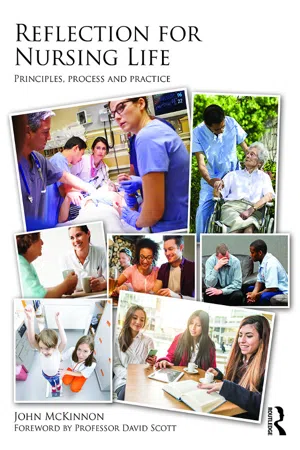
Reflection for Nursing Life
eBook - ePub

Reflection for Nursing Life

Principles, Process and Practice

  1. 138 pages
  2. English
  3. ePUB (mobile friendly)
  4. Available on iOS & Android
eBook - ePub

Reflection for Nursing Life

Principles, Process and Practice

About this book

Over the past decades, reflection has taken centre stage in nursing education but it is easy to get stuck in a superficial cycle of storytelling and self-examination, without getting any further insights into your own practice and abilities. Reflection for Nursing Life starts with a basic introduction to reflective practice and moves through to look at more critical perspectives, with guidance for reflecting on the complex realities of practice.

This accessible text is designed to support a deeper understanding of the value of reflection and its relationship with the needs of modern practice. Beginning with discussions of self-awareness and the reflective cycle, it goes on to explore ideas about critical incidents, critical reflection models and transformational learning. It integrates cutting-edge neuro-scientific research and thinking about emotional labour and intelligence in healthcare into mainstream reflective practice, drawing on both new and established ways of guiding learning and professional judgment.

Reflection for Nursing Life includes numerous exemplar reflective narratives, diagrams and exercises to help the reader identify their strengths and weaknesses, whilst tips for overcoming weaknesses and developing strengths are also provided. It is the ideal text for nursing students and practitioners looking to improve their reflective practice skills.

Frequently asked questions

Yes, you can cancel anytime from the Subscription tab in your account settings on the Perlego website. Your subscription will stay active until the end of your current billing period. Learn how to cancel your subscription.
At the moment all of our mobile-responsive ePub books are available to download via the app. Most of our PDFs are also available to download and we're working on making the final remaining ones downloadable now. Learn more here.
Perlego offers two plans: Essential and Complete
  • Essential is ideal for learners and professionals who enjoy exploring a wide range of subjects. Access the Essential Library with 800,000+ trusted titles and best-sellers across business, personal growth, and the humanities. Includes unlimited reading time and Standard Read Aloud voice.
  • Complete: Perfect for advanced learners and researchers needing full, unrestricted access. Unlock 1.4M+ books across hundreds of subjects, including academic and specialized titles. The Complete Plan also includes advanced features like Premium Read Aloud and Research Assistant.
Both plans are available with monthly, semester, or annual billing cycles.
We are an online textbook subscription service, where you can get access to an entire online library for less than the price of a single book per month. With over 1 million books across 1000+ topics, we’ve got you covered! Learn more here.
Look out for the read-aloud symbol on your next book to see if you can listen to it. The read-aloud tool reads text aloud for you, highlighting the text as it is being read. You can pause it, speed it up and slow it down. Learn more here.
Yes! You can use the Perlego app on both iOS or Android devices to read anytime, anywhere — even offline. Perfect for commutes or when you’re on the go.
Please note we cannot support devices running on iOS 13 and Android 7 or earlier. Learn more about using the app.
Yes, you can access Reflection for Nursing Life by John McKinnon in PDF and/or ePUB format, as well as other popular books in Medicine & Health Care Delivery. We have over one million books available in our catalogue for you to explore.

Information

Year
2016
eBook ISBN
9781317660095
Edition
1

1 Becoming a reflective practitioner – part oneSelf-awareness and the use of self

DOI: 10.4324/9781315766324-3
Box 1.1 Main points: Chapter 1
  • Self-awareness and the effective use of self are prerequisites to sound reflective practice.
  • Self-awareness is important to be able to exercise compassion and empathy.
  • Self-exploration is important to identify our values, prejudices and assumptions in life along with their root causes.
  • Reflexivity is the ability to use a situation as a measure for the self with a view to learning and positive change.
  • Mindfulness is the maximum possible resourcing of the self ‘in the present moment’.

Introduction

This opening chapter, rather than being concerned with the process and practice of reflection, lays part of the groundwork for effective engagement with reflection. We will define and explore consciousness, self-awareness and the use of self. Allied notions of mindfulness and reflexivity will also be discussed along with their relationship to desirable qualities in nursing such as empathy and compassion. We will draw on psychology, philosophy, neuroscience and learning theory to understand the importance of first possessing self-awareness and competence in the use of self before becoming reflective practitioners. Old and new narratives will be used to illustrate self-awareness, mindfulness and reflexivity. Exercises in self-awareness are contained within Tables 1.1, 1.2 and 1.3.
Table 1.1 Self-awareness exercise one
Who are you and where do you come from?
Where did you grow up?
What sort of person were you as a child?How has this changed and what things remain the same?
Talk about:
  • What makes you feel happy?
  • What makes you sad?
  • What makes you angry?
  • What makes you frustrated?
  • What makes you feel passionate?
What do the answers to the questions above tell you about the sort of person you are?
List the things that have influenced you as a person:
  • Your parents and other family?
  • Other relationships?
  • Your religion or code of life ethics?
  • Entertainment personalities and media?
What do you think the flaws in those different sources of influence might be?
Table 1.2 Self-awareness exercise two
  1. Talk about how someone who likes you would describe your personality.
  2. Now talk about how someone who dislikes you would describe your personality.
The chances are the truth lies somewhere in between these two perspectives on you!So having thought about the two different views of yourself, talk about the sort of person you want to be:
  • Your strengths.
  • Your weaknesses.
  • The opportunities you have in life.
  • Barriers that could prevent you getting where you want to go.
  • How you might you overcome the barriers you've identified, including the help and support you might recruit.
Table 1.3 Self-awareness exercise three
Your social presentation (how you come across to others):
  1. Describe your physical appearance:
    • Short, tall or medium height?
    • Small, large or medium frame?
    • The colour of your eyes.
    • Your hair.
    • Skin tone/colour.
  2. Describe your voice:
    • Tone.
    • Usual volume.
    • Accent.
  3. Think about what you do and say when you approach someone to speak to them for the first time:
    • How often do you smile?
    • Do you have a stare?
    • How do you greet them ‘physically’? (Shake hands? Nod your head?)
    • What do you say to them? (Use a greeting? Just start talking?)
Now go back over numbers 1–3 and think and talk about how this appears and impacts on others.In each area think and talk about the advantages and disadvantages for you.What can you change? What can you adjust? What effect would those changes and adjustments have on how you present to others?
There are a number of factors which may work to promote or inhibit reflection in a person; five of them are personal qualities and three relate to the available environment. Two of the personal qualities: self-awareness and reflexivity within the context of the use of self are the focus of this chapter. The remaining factors will be explored in Chapter 2.
Figure 1.1Gadamer theory

The individual as a conscious sentient being

First to become self-aware or to know ourselves we must be conscious. The term ‘consciousness’ is used in a very limited sense in some clinical practice settings and it can be confused with ‘wakefulness’. But a person can be awake but lack conscious awareness. Extreme examples of this exist in neurological disorders but we have all known people who are remarkably unaware of their social presentation and their impact on the world around them. Consciousness in sentient beings is a sense of self; our identity in the past, present and future (Damassio, 1999). It describes our ability to define our place in space and time; to ask and strive to answer questions such as ‘Who am I?’, ‘Where do I come from?’ and ‘Where am I going’. Gadamer's theory on life learning (Figure 1.1) shows how our past experience shapes how we interpret the present and ourselves as part of that experience. As time is perpetually moving forward and our experience accumulates, we are a different person today from the one we were yesterday and we become a different person tomorrow from the one we are today. This ‘extended’ consciousness is one of the features which separate humans from all other life on our planet (Figure 1.2). Extended consciousness is the knowing that we are who we are and that we know what we know. When we develop consciousness we begin to become self-aware. Once self-awareness is in place we are able to move forward making the most effective use of ourselves.
Figure 1.2Consciousness and self-awareness

Self-awareness and the use of self

The ‘use of self’ is the skilled sensitive shaping of one's personality and presence to achieve positive outcomes in relationships. The use of self both directs and is informed by personal learning from experience. The effective use of self begins with self-awareness arising out of a conscious knowledge of one's motives and social presentation together with how we may be perceived by others. It is the art of ‘making oneself the focus of one's own attention’ (Eckroth-Bucher, 2010: 300) or of developing a considered ‘understanding of ourselves’ (Jack and Miller, 2008: 31) in order to move effectively in the world. Table 1.1 provides a preliminary exercise in this area. Knowing oneself carries the notion of comparing one's behaviour to standards more easily applied to others; it is about discovering and seeking to close the gap between the ideal image of the self and actual reality (Eckroth-Bucher, 2010). Table 1.2 provides more help with this. Sound reflection and reflective practice rely on balanced powers of interpretation. The use of self, knowing oneself and the part one plays in situations past, present and future is essential before one can hope to interpret one's surroundings and the actions of others in a balanced way.
The concept of self-awareness is consistent with Gadamer's vision (1989) of humans perpetually and seamlessly interacting with the situation they inhabit and taking their share of responsibility for that situation. Consequently, our situation is moulded by us and we are moulded by our situation. This is not a new idea. Two thousand years ago the Greek Philosopher Solon advised ‘Know thy self!’ (Eckroth-Bucher, 2010: 298) and in the 18th century the power of self-awareness was highly valued by the poet Robert Burns (Figure 1.3).
Figure 1.3Robert Burns on self-awareness
A high degree of self-awareness is said to be crucial at the first encounter with any individual as a solid predictor of the level of trust and mutual respect that will characterise the ensuing relationship. We need to know how we seem to others before others can understand or benefit from us (Wilson and Crowe, 2008). This is particularly the case in emergency or acute settings where a bond of trust must be formed quickly. An example of this is given by Kirk (2007) in which a nurse in an anaesthetic room previously unknown to an anxious patient waiting to have major surgery, momentarily reassures her that she will be with her throughout the whole operation.
It is also noteworthy that being self-aware is also essential in conveying our point of view forcefully but effectively to others in times of conflict. Table 1.3 is an exercise linked to this part of the discussion. Furthermore, Wilde and Garvin (2007) argue that improved self-care is also the companion of self-awareness as self-aware people are more skilled in monitoring their own health and wellbeing.
Jack and Miller (2008) argue that there are three forms of self-awareness:
  1. Cognitive. This is a conscious reasoned self-awareness: a contemporaneous understanding of body language and personal presentation or deportment; the significance of facial expression, voice and body language.
  2. Affective. This is a reflective awareness; an ability to scrutinise one's perceptions and feelings together with the prejudices and assumptions these feelings may disguise. An examination of our feelings also helps us articulate nebulous situations we may otherwise struggle to describe or define.
  3. Behavioural. This is reflexivity borne of self-awareness: The self-aware person is able to respond in a way that changes the world interacting with the self through a corresponding change in the self. This includes an ability to adjust one's facial expression, vocal tone and volume, body language that befits the needs of a situation.
However, real life situations call upon us to use these forms of self-awareness in combination with each other. For example, feelings can be contagious. They can begin with us but be projected onto others. Conversely, they can be at the root of other people's perspectives and generate strong feelings in us (Zembylas, 2005). Skilled self-awareness helps untangle whose emotions belong to whom in an experience and respond appropriately (Jack and Miller, 2008). Self-awareness is a prerequisite to empathy and compassion. As we explore the relationship between these notions we can begin to appreciate their importance to nursing practice.
Empathy is the ability to grasp the frame of reference of another. According to Kirk (2007: 239) to exercise empathy is:
To understand what it is like to be in someone else's position (what it is like to live...

Table of contents

  1. Cover
  2. Half Title Page
  3. Title Page
  4. Copyright Page
  5. Dedication
  6. Contents
  7. List of figures
  8. List of tables
  9. List of boxes
  10. Foreword
  11. Introduction
  12. 1 Becoming a reflective practitioner – part one: self-awareness and the use of self
  13. 2 Becoming a reflective practitioner – part two: exploring the art of reflection
  14. 3 Why we need reflection
  15. 4 Critical incidents
  16. 5 Towards critical reflection
  17. 6 Transformative learning
  18. 7 Harnessing emotion to inform clinical judgement: a new framework for reflective practice
  19. Conclusion
  20. Glossary
  21. References
  22. Index