eBook - ePub
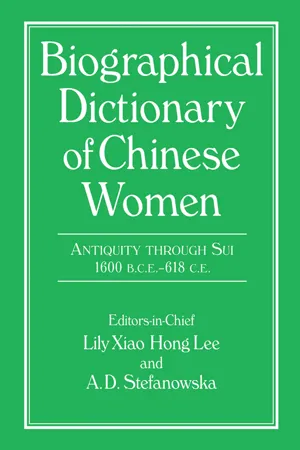
Biographical Dictionary of Chinese Women: Antiquity Through Sui, 1600 B.C.E. - 618 C.E
- 440 pages
- English
- ePUB (mobile friendly)
- Available on iOS & Android
eBook - ePub
Biographical Dictionary of Chinese Women: Antiquity Through Sui, 1600 B.C.E. - 618 C.E
About this book
This new volume of the "Biographical Dictionary of Chinese Women" spans more than 2,000 years from antiquity to the early seventh century. It recovers the stories of more than 200 women, nearly all of them unknown in the West. The contributors have sifted carefully through the available sources, from the oracle bones to the earliest legends, from Liu Xiang's didactic Biographies to official and unofficial histories, for glimpses and insights into the lives of women. Empresses and consorts, nuns and shamans, women of notoriety or exemplary virtue, women of daring and women of artistic or scholarly accomplishment - all are to be found here. The editors have assembled the stories of women high born and low, representing the full range of female endeavor. The biographies are organized alphabetically within three historical groupings, to give some context to lives lived in changing circumstances over two millennia. A glossary, a chronology, and a finding list that identifies women of each period by background or field of endeavor are also provided.
Trusted by 375,005 students
Access to over 1.5 million titles for a fair monthly price.
Study more efficiently using our study tools.
BIOGRAPHIES
Antiquity Through Zhou
Antiquity
Zhou (1027–221 B.C.E.)
Spring and Autumn Period (770–476 B.C.E.)
Warring States (475–221 B.C.E.)
A
The Abiding Wet Nurse of Wei
The Abiding Wet Nurse (Wei Jie Rumu) for the children of King Xia of Wei (Wei Wang Xia; one source gives his name as King Jia), fl. 661 B.C.E., was killed while protecting the last royal son of the state of Wei (in present-day Shanxi Province) after invaders from the state of Qin (present-day Shaanxi Province) had put the king and his other sons to death. Rather than accept a large monetary reward, she risked the punitive extermination of her own family to flee with the remaining prince. A turncoat Wei minister revealed her hiding place to the Qin, and although she covered the child with her own body in an attempt to protect him they were both killed, at least a dozen arrows piercing her body. Impressed with her loyalty and maternal instincts, the Qin king rewarded her brother with money and gave her a lavish burial. It was said that her kindness came from a good conscience, while she herself is quoted as saying that “all who nourish men’s children have a duty to keep them alive and not to kill them” (O’Hara, 145). Her biography is included in “Biographies of the Chaste and Righteous” in Biographies of Eminent Women (Lienü zhuan).
Constance A. COOK
Liu Xiang. Lienü zhuan. Sibubeiyao ed., 5.8a–9a.
O’Hara, Albert R. The Position of Woman in Early China According to the Lieh Nü Chuan, “The Biographies of Chinese Women.” Taipei: Mei Ya, 1971; 1978, 144–147.
Accomplished Woman of the Jiang Clan: see Wen Jiang, Wife of Duke Huan of Lu
Ah-liao: see Yue Woman
Ai Chiang of Duke Chuang of Lu: see Ai Jiang, Wife of Duke Zhuang of Lu
Ai Jiang, Wife of Duke Zhuang of Lu
Ai Jiang, or Mournful Woman of the Jiang Clan, d. 659 B.C.E., was a daughter of the royal house of Qi (in the north of present-day Shandong Province); she was also known as Furen Jiang Shi and as Minor Ruler (xiao jun). In 670, she was married to Duke Zhuang (Zhuang Gong, r. 692–661 B.C.E.), the ruler of Lu (in present-day Shandong Province) and son of Wen Jiang (q.v.). The marriage arrangements and exchange of gifts had begun three years earlier, the year of Wen Jiang’s death, and one source says Ai Jiang frequently had “illicit relations” with her future husband before she went to Lu. Ai Jiang had no children, but her younger sister, Shu Jiang, who had accompanied her when she went as a bride to Duke Zhuang, had a son named Kai whom Ai Jiang wished to appoint heir apparent. Ai Jiang was forced to flee, however, when her sexual liaison with her brother-in-law, Qingfu, was discovered. Qingfu nevertheless fulfilled Ai Jiang’s plan by killing the original heir apparent, which allowed her nephew, Kai, to inherit the title of Duke; he became known as Duke Min. Ai Jiang is said to have continued her affair with Qingfu, who was plotting with her to kill her nephew Duke Min and to usurp his position. When their plot was revealed they fled, Ai Jiang to Zhu and Qingfu to Qu. Duke Huan of Qi (Ai Jiang’s home state) intervened at this point, installing Duke Xi as the ruler of Lu, and in 659 the men of Qi caught Ai Jiang, killed her, and took her body back to Qi. However, at the request of Duke Xi her body was returned to Lu, where it was buried. In 652, her ancestral tablet was placed in the Grand Temple during the di sacrifice, an act that later commentators claimed was improper due to the circumstances of her death and burial. The author of the Zuo zhuan commented that Qi had been “too severe” in killing Ai Jiang because she should have been dealt with by her husband’s house of Lu, not her natal house of Qi.
In Biographies of Eminent Women (Lienü zhuan), where her biography is included in “Biographies of Pernicious and Depraved Women,” Ai Jiang is described as proud, lustful, corrupt, evil, and perverse.
Constance A. COOK
Chunqiu and Zuo zhuan. Zhuang 22, 24, Min 2, Xi 1, 2, 8. Taipei: Fenghuang chubanshe, 1977. Vol. 1, 3.59, 70–71; 4.8, 14; 5.1, 4–5, 45.
Legge, James, trans. The Chinese Classics, Vol. 5: The Ch’unts’ew, with the Tso chuen. Hong Kong: Hong Kong University Press, 1960; 1970, 101, 108, 126–136, 150–151.
Liu Xiang. Lienü zhuan. Sibubeiyao ed., 7.4a–b.
O’Hara, Albert R. The Position of Woman in Early China According to the Lieh Nü Chuan, “The Biographies of Chinese Women.” Taipei: Mei Ya, 1971; 1978, 194–196.
Takikawa Kametarō. Shiki kaichū kōshō [Shi ji]. Taipei: Hongshi, 1977, 33.31–33.34.
Aliao: see Yue Woman
B
Bao Si, Wife of King You of Zhou
Bao Si (the Woman of the Si Clan of Bao), fl. eighth century B.C.E., was the favored wife of King You (You Wang, r. 781–771 B.C.E.) of Zhou, in central China. She is blamed for the downfall of the Zhou house.
Legend has it that Bao Si was responsible for King You setting aside his Queen Shen, a daughter of the Marquis of Shen, and replacing the legitimate heir apparent with Bao Si’s son, Bo Fu. Bao Si’s evil nature was attributed to her natal house of Bao (in the southeast of present-day Shaanxi Province), which originated at the end of the Xia dynasty (c. 2100–1600 B.C.E.) when the spit of two dragons, named The Two Lords of Bao, was sealed in a vessel. It was not until the reign of King Li of Zhou (r. 878–841) that someone dared open the vessel, causing spit to flow out and fill the room. King Li had women undress and shout at it, believing this would stop its flow, but to no avail, for it changed into a dark tortoise (one source says a black snake), which entered the women’s quarters and impregnated a virgin concubine of about seven years of age. She did not become pregnant immediately: Biographies of Eminent Women (Lienü zhuan) says she became pregnant when she was about fifteen (“when she fixed up her hair as marriageable”), but places this event at least fourteen years after her impregnation at seven. Nevertheless, she bore the child during the time of King Xuan (Xuan Wang, r. 827–781), but fearing it, she cast it out onto the road to die; this infant was Bao Si. Two fugitives saved the infant and took her with them to Bao, where she grew into a very beautiful young woman. Because of her beauty, a prince of Bao who had committed some crime gave her to King You to avoid punishment.
King You was warned against Bao Si but he nevertheless took her as his wife and was, in the words of later commentators, “led astray” by her. In an effort to make her laugh, he repeatedly lit beacon fires to summon the lords to come to protect Zhou from supposed invaders. When the Marquis of Shen joined forces with western barbarian tribes and finally did attack in revenge for the improper dismissal of his daughter, Queen Shen, the house of Zhou was defeated because the protecting lords did not believe King You’s signals were genuine and were no longer prepared to respond. King You was killed in the attack, Bao Si was captured, and the nobles were reconciled with Zhou. Bao Si’s name is forever associated with beautiful women and the fall of dynasties, and her biography is included in “Biographies of Pernicious and Depraved Women” in Biographies of Eminent Women.
Constance A. COOK
Guoyu. “Jinyu” 1. Sibubeiyao ed., 7.2b.
Liu Xiang. Lienü zhuan. Sibubeiyao ed., 7,2b–3a.
O’Hara, Albert R. The Position of Woman in Early China According to the Lieh Nü Chuan, “The Biographies of Chinese Women.” Taipei: Mei Ya, 1971; 1978, 189–192.
Qu Wanli, ed. Shi jing shiyi. “Zheng yue,” Mao no. 192. Taipei: Huagang, 1977, 152–155.
Takikawa Kametarō, Shiki kaichū kōshō [Shi ji]. Taipei: Hongshi, 1977, 4.64–4.66.
Bo Ji, Wife of Duke Gong of Song
Bo Ji, the Older Woman of the Ji Clan (Song Gong Bo Ji), fl. early sixth century B.C.E., was the daughter of Duke Xuan (Xuan Gong, r. 608–591 B.C.E.) and Mu Jiang (q.v.) of the small state of Lu (in present-day Shandong Province) and a younger sister of Duke Cheng (Cheng Gong, r. 590–573). She is credited with unwavering obedience to the rules of propriety for women.
The first instance of her devotion to propriety related to her marriage in 582 to Duke Gong (Gong Gong, r. 588–575) of Song, a state that was slightly larger than and just to the south of Lu. Her intended husband did not come personally to welcome her when she arrived as a bride and, perceiving this to be a slight and a breach of protocol, she later refused to attend the ancestral temple for the completion of the marriage rites. Only after her widowed mother intervened did she comply. The second, fatal, instance took place in 543. The house in which she was staying caught fire one night, but she refused to leave until the matron and the governess arrived to accompany her out of the building, as required by the rules of righteousness. The matron arrived in time, but the governess did not and Bo Ji chose to remain and die in the fire, thereby attaining glory in the eyes of later Confucian scholars like Liu Xiang, author of Biographies of Eminent Women (Lienü zhuan). The fact that Liu Xiang praised this kind of extreme behavior on the part of women must surely have contributed to the appearance in late imperial China of the chastity cult. It is said that the state of Song was indemnified for Bo Ji’s death while she herself was immortalized when her biography was included in “Biographies of the Chaste and Obedient” in Biographies of Eminent Women.
Bo Ji’s death in the fire is also recorded in the Zuo zhuan, where the comment is made that in insisting on waiting for instructions at a time of crisis she had behaved more like a young girl than a married woman. In other words, she would have been justified in leaving the burning house alone: she had been a widow for nearly thirty years and must have been in her fifties at the time of her death.
Constance A. COOK
Chunqiu and Zuo zhuan. Cheng 9, Xiang 30. Chunqiu jing zhuan yinde. Shanghai: Guji shudian, 1983, 228, 330.
Legge, James, trans. The Chinese Classics, Vol. 5: The Ch’unts’ew, with the Tso chuen. Hong Kong: Hong Kong University Press, 1960; 1970, 555, 556.
Liu Xiang. Lienü zhuan. Sibubeiyao ed., 4.1b–2a.
O’Hara, Albert R. The Position of Woman in Early China According to the Lieh Nü Chuan, “The Biographies of Chinese Women.” Taipei: Mei Ya, 1971; 1978, 103–106.
Bo Ying, Wife of King Ping of Chu
Bo Ying (Chu Ping Bo Ying), fl. sixth century B.C.E., belonged to the Ying clan and was the daughter of a duke, possibly Duke Ai (Ai Gong, r. 538–501 B.C.E.), of Qin (present-day Shaanxi Province). She was married out to King Ping (Ping Wang, r. 528–516 B.C.E.) of Chu, a large state in what is now central China north of the Yangzi River, and her son became the ruler of Chu as King Zhao (Zhao Wang, r. 515–489 B.C.E.) upon the death of his father. When Wu (a state in the eastern region of present-day Jiangsu and Anhui provinces) captured the Chu capital of Ying (in present-day Hubei Province), King Zhao fled to his mother’s homeland of Qin in the northwest. Upon entering the capital, the victorious king of Wu took for himself all of King Zhao’s concubines and was about to take King Zhao’s mother as well. With great courage, however, she took up a sword and threatened suicide: “All you desire to get from me is pleasure; if you draw near to me, I will die. What pleasure will you have, if you first kill me?” Admon...
Table of contents
- Cover
- Half Title
- Title Page
- Copyright Page
- Table of Contents
- Preface
- Editors’ Note
- Acknowledgments
- Guide to Chinese Words Used
- Contributors
- Translators
- Chronology of Dynasties and Major Rulers
- Finding List by Background or Fields of Endeavor
- Biographies:
- Glossary of Chinese Names
- About the Editors
Frequently asked questions
Yes, you can cancel anytime from the Subscription tab in your account settings on the Perlego website. Your subscription will stay active until the end of your current billing period. Learn how to cancel your subscription
No, books cannot be downloaded as external files, such as PDFs, for use outside of Perlego. However, you can download books within the Perlego app for offline reading on mobile or tablet. Learn how to download books offline
Perlego offers two plans: Essential and Complete
- Essential is ideal for learners and professionals who enjoy exploring a wide range of subjects. Access the Essential Library with 800,000+ trusted titles and best-sellers across business, personal growth, and the humanities. Includes unlimited reading time and Standard Read Aloud voice.
- Complete: Perfect for advanced learners and researchers needing full, unrestricted access. Unlock 1.5M+ books across hundreds of subjects, including academic and specialized titles. The Complete Plan also includes advanced features like Premium Read Aloud and Research Assistant.
We are an online textbook subscription service, where you can get access to an entire online library for less than the price of a single book per month. With over 1.5 million books across 990+ topics, we’ve got you covered! Learn about our mission
Look out for the read-aloud symbol on your next book to see if you can listen to it. The read-aloud tool reads text aloud for you, highlighting the text as it is being read. You can pause it, speed it up and slow it down. Learn more about Read Aloud
Yes! You can use the Perlego app on both iOS and Android devices to read anytime, anywhere — even offline. Perfect for commutes or when you’re on the go.
Please note we cannot support devices running on iOS 13 and Android 7 or earlier. Learn more about using the app
Please note we cannot support devices running on iOS 13 and Android 7 or earlier. Learn more about using the app
Yes, you can access Biographical Dictionary of Chinese Women: Antiquity Through Sui, 1600 B.C.E. - 618 C.E by Lily Xiao Hong Lee,A.D. Stefanowska,Sue Wiles in PDF and/or ePUB format, as well as other popular books in History & Chinese History. We have over 1.5 million books available in our catalogue for you to explore.