- 224 pages
- English
- ePUB (mobile friendly)
- Available on iOS & Android
eBook - ePub
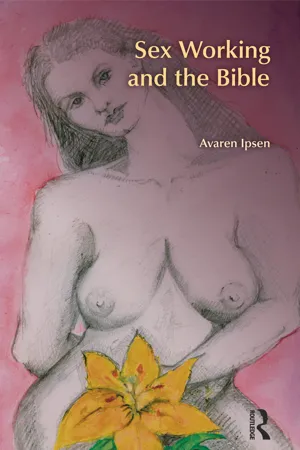
Sex Working and the Bible
About this book
The Bible contains many stories of prostitution. Feminist and liberation readings of these biblical narratives have often made sex workers invisible. 'Sex Working and the Bible' examines stories of biblical prostitution through the experiences and understanding of sex workers today. The Bible narratives - ranging across Rahab in the Book of Joshua, the story of Solomon and the two prostitutes, the anointing women traditions, and the apocalyptic vision of the whore of Babylon in Revelation - are set within both a practical and theoretical framework. This radical book offers a new, more inclusive way of approaching issues of gender, sexuality and prostitution in the Bible.
Information
Chapter 1
INTRODUCTION
A major challenge for the future is to prepare a theology that takes this culture into account, that considers prostitution through the exegesis of the prostitute in the Bible.1
If as the liberationists claim, Christ is neither male nor female in the sense that Christ represents the community of the poor, then Christ should be portrayed as a girl prostituted in Buenos Aires in a public toilet by two men. Obviously such portrayal would be considered indecent, because we are bringing to the surface the hidden face of the sexual oppression of women but for that very reason it should be seen as a true theology.2
If anything I have to say, if anything I have to offer, can help any woman feel more liberated in regards to her interpretation of the Bible and/or how she reads it, then I feel that I have done my job, because I feel that in terms of dealing with women, it’s incredibly oppressive.3
If the Bible has a liberating word for prostitutes, what might that be? In much contemporary discourse, the Bible is still used as an ideological tool to secure a sexual morality that both criminalizes prostitution and works to regulate the sexual behaviour of all “decent” women. Liberation theology claims to champion the cause of the poor and oppressed, which, theoretically, should include poor women’s issues. However, when it comes to issues of sexual morality, “liberation theology is still patriarchal and as such notoriously unsuspicious of given sexual structures of thought,” concludes liberation feminist Marcella Althaus-Reid.4 According to the feminist theologian Rita Nakashima Brock, there is a deeply religious substratum to current prostitution law that needs to be tackled before there is hope for legal reform that is liberating to prostitutes. Brock writes that “attempts to reformulate discussions of prostitution outside religious discourse has had little success in addressing any of the problems surrounding prostitution because the religious dimension forms a substructure that needs examination.”5 Thus, prostitution as a religio-moral issue has an enormous ideological impact on the structure of public policy that affects poor women. For this reason, how prostitution is interpreted biblically and otherwise needs close examination as a women’s rights issue.
It is widely thought that the Bible definitively proscribes the sexual behaviour of women and that the liberation case is hopeless when it comes to prostitutes. Biblical scholar Margaret Davies flatly asserts that the Christian Bible is of little use for the liberation of prostitutes in that “the NT excludes both male and female practicing prostitutes from the Christian community. They are treated as heinous sinners in need of repentance.”6 To counter this dismal impasse, theologian Rose Wu acknowledges that “by labeling prostitutes as ‘sinners,’ the voices of prostitutes are silenced” but calls upon feminist scholars to “break the silence, letting prostitutes tell their stories and interpret their experiences as an individual person as well as a corporate identity.”7 Is this oppressive sexual morality actually biblically based and, if so, in what way? Are liberation readings of prostitution in the Bible liberating to prostitutes? How would the interpretations differ if done from the standpoint of sex worker activists? This study hopes to address these questions and break out of the impasse described above.
Dorothy Smith, a feminist standpoint theorist, might characterize this situation of prostitution discourse as a “text mediated discourse” or “T-discourse.” T-discourses are organized by certain ideological codes which structure behaviour and thought into specific molds and patterns. The Bible, law and commentary, not to mention volumes of social scientific material are prime examples of such T-discourse, specifically focused on prostitution. According to Smith, “there are ‘ideological codes’ that order and organize texts across discursive sites, often having divergent audiences, and variously hooked into policy or political practice.”8 One way to break out from their power is to begin sociological investigations from the everyday lives of those for whom the discourse is a problem, to utilize these subjects as primary sources and then work backward to the institutional systems and texts that find the ideological codes necessary and useful. This strategy is to do what she calls “institutional ethnography,” that is, an ethnography of oppressive institutions and their impact on poor and oppressed people.9 Smith uses the “Standard North American Family” or SNAF as an ideological code that is often problematic for single mothers and other deviants from its norm. Smith found that this code was so pernicious it often unconsciously infected her own work that was explicitly trying to identify and problematize the code.10
I will utilize Marcella Althaus-Reid’s concept of the binary decency/ indecency as an ideological code comparable to SNAF in how it organizes the T-discourse of prostitution. Althaus-Reid argues that the dialectic of this binary is “at the root of theological control of behaviour that is admissible for women.”11 Indecent theology is “a positive theology that aims to uncover, unmask and unclothe that false hermeneutic that considers itself ‘decent’ and as such, proper and befitting for women especially in sexual matters.”12 As a hermeneutic that utilizes “indecent subjects” (prostitutes) as a methodological strategy, I hope to flesh out some of the operations of this ideological code of theological in/decency from the perspective of those for whom it is a problem: prostitutes. Althaus-Reid proposes that we engage in sexual storytelling from the margins in order to “learn from the voices of women and men how the system in which we live is organized by making the unusual usual, that is, by enforcing gender constructions considered normal by legislative means, in order to disrupt and tame the different manifestation of sexual behaviours in society.”13 This approach can perhaps help explain how this code continues to infect the T-discourses that are purportedly oriented towards human liberation: feminist and liberation theology.
This book explores biblical prostitution and contemporary liberation readings of it to determine what the limits of those readings might be for the actual class of people in the present. In order to test liberation readings of biblical prostitution, I conduct a qualitative analysis of feminist and liberation readings of biblical prostitution by reading with actual sex worker activists. This study is an explicitly interdisciplinary project that combines and draws upon the fields of biblical studies, critical social theory and liberation theology as they intersect and reflect upon the issues of poverty and sexuality. The primary reason for pursuing such an interdisciplinary project is to examine and amend these contradictions and limitations in current liberation and feminist readings of biblical sexual morality. These contradictions and limitations become clearly and dramatically apparent when using biblical prostitution as the case study for sexual morality.
According to the recent analysis of Elina Vuola in her work The Limits of Liberation, traditional liberation theology has not gone far enough in its preferential option for the poor because it has failed to utilize poor women as subjects of theology and has avoided the issue of sexuality in analyzing poverty. She writes “issues of sexual ethics—as (not) treated in LT [Liberation Theology] up to now—are both a challenge for the supposed commitment to praxis and a critique of the actual importance of praxis for the liberation method.”14 Argentinean feminist and liberation theologian, Marcella Althaus-Reid asserts that in liberation theology “the poor, as in any old-fashioned moralizing Victorian tale, were depicted as the deserving and asexual poor.”15 The problem is that the poor are generally anything but “decent” and many of the issues poor women face are sexual, such as sexual violence, back alley abortions, and prostitution. Furthermore, when it comes to women, classical liberation theologians tend to stop short of a gendered materialist analysis and fall into age-old idealist notions of womanhood and normative heterosexuality. According to Althaus-Reid, “to challenge God is not as indecent as to challenge the sexuality of theology. Sexual idealism pervades theology, including theology of liberation.”16 While liberation theologians claim to utilize a materialist approach, philosophical idealism most pertains when it comes to women. In idealist philosophy the idea, in this case the ideas of “woman” and normative sexuality are prior to any material reality. A true materialist approach looks first at the economic material reality as the matrix for ideas about women and sex, which change as the material contexts change. The church and theologians, including many liberation theologians, fail to let go of their essentialist ideas about women and family.
Liberation theologian Margaret Guider, working several decades in Brazil with the Pastoral da Mulher Marginalizada (PMM), indicates that prostitutes often have very different interpretations of the Bible than pastoral agents of the church of liberation.17 Guider found the text of Rahab in Joshua 2 and 6 to be the sole biblical text available for a “hermeneutic of retrieval” for prostitutes. She accepts the removal of the figure of Mary Magdalene, anointing woman and other women around Jesus as prostitutes in recent feminist scholarship that has limited the texts available for analysis.18 For example, Kathleen Corley’s contention that the women around Jesus were not really prostitutes is ideologically problematic for the liberation efforts of contemporary religious Brazilian sex workers,19 who want to see their lives reflected in the Christian story. Prostitutes’ rights activist Gabriela Leite asserts: “our love for Jesus and our self-respect will help greatly our religious understanding, as will our knowledge that in the past we were very important people for Christ and for the formation of Christianity. We want light to shine on our Christian story.”20 This conflict of attitudes is especially poignant when it boils down to the issue of the Brazilian church’s exclusion of prostitute women from the sacraments because many prostitutes do not understand why the church does not follow Jesus’ example in affirmatively relating to prostitutes.21 For Vuola and Guider, the “anti-female and anti-sexual anthropological underpinnings” of traditional church teachings are to blame for the way sexuality is being addressed by theologians.22 Guider notes, “the church of liberation was caught between its commitment to the oppressed as expressed in its teachings on social justice and its commitment to promote and to uphold traditional family values as expressed in its teaching on the family and human sexuality.”23 Having a “preferential option for the poor and oppressed” is all well and fine until it conflicts with church doctrines on sex.
In the realm of biblical studies, this project falls under the rubric of cultural criticism or ideological criticism, particularly as expressed by the calls made by Fernando Segovia and others for “flesh and blood,” “real” or “ordinary” readers to further the twin goals of “decolonization” and “liberation.”24 The South African scholar, Gerald West, has developed an interpretation strategy of “reading with” poor and oppressed populations, which is a good example of this emerging direction in biblical studies.25 This call resonates with the views of Gabrielle Leite, a leading Brazilian prostitutes’ rights activist who says: “A major challenge for the future is to prepare a theology that takes this culture into account, that considers prostitution through the exegesis of the prostitute in the Bible.”26 To engage this challenge, my project seeks to do biblical interpretation with prostitute women who have an elaborated standpoint and politic.27 For this reason, I chose to do my biblical interpretation with a prostitutes’ rights group. I hope to integrate their standpoint, rooted in existing liberation praxis, into a case study of knowledge production with marginalized women. It is a presupposition of this study that women who do sex work have important subjugated knowledge that deserves articulation and theoretical attention. This subjugated knowledge can produce interesting and vital results when undertaken within the discipline of biblical interpretation. The theoretical premises of feminist standpoint epistemology under gird and give a firm foundation for this hypothesis.
It is my hope that this attenuated option for prostitute women, or feminist standpoint method, can get beyond some impasses of traditional liberation and feminist approaches. Arguing that current feminist and liberation readings of biblical prostitution may not be liberating to prostitutes themselves, this study will offer an amendment to current feminist biblical theological hermeneutics that allows for the interpretation and praxis of prostitute women as readers of biblical texts who bring to the Bible their social theory of prostitution. Conflicts within the liberation discourses of Christianity prevent the “option for the poor” from being fully extended to poor women as theological subjects, especially with regard to sexuality. Althaus-Reid has helped to identify and name this conflict as “in/decent theology,” which refuses to engage with the “indecent” as theological subjects.
By showing the conflict of readings over sex work within liberation discourse, the goal of this study is not to claim there is only one correct reading or that...
Table of contents
- Cover
- Half Title
- Title
- Copyright
- Contents
- List of Illustrations
- Acknowledgements
- Chapter 1 INTRODUCTION
- Chapter 2 METHODOLOGICAL AND POLITICAL ANALYSIS: A PREFERENTIAL OPTION FOR PROSTITUTES?
- Chapter 3 RAHAB'S DEAL
- Chapter 4 SOLOMON AND THE TWO PROSTITUTES
- Chapter 5 ANOINTING WOMAN: "IN MEMORY OF HER": THE PREQUEL
- Chapter 6 THE WHORE BABYLON: VIOLENCE AGAINST PROSTITUTES
- Chapter 7 CONCLUSIONS: AMENDMENTS TO LIBERATION HERMENEUTICS
- APPENDIX 1 DISCUSSION QUESTIONS
- Bibliography
- Index of References
- Index of Names
Trusted by 375,005 students
Access to over 1.5 million titles for a fair monthly price.
Study more efficiently using our study tools.
Frequently asked questions
Yes, you can cancel anytime from the Subscription tab in your account settings on the Perlego website. Your subscription will stay active until the end of your current billing period. Learn how to cancel your subscription
No, books cannot be downloaded as external files, such as PDFs, for use outside of Perlego. However, you can download books within the Perlego app for offline reading on mobile or tablet. Learn how to download books offline
Perlego offers two plans: Essential and Complete
- Essential is ideal for learners and professionals who enjoy exploring a wide range of subjects. Access the Essential Library with 800,000+ trusted titles and best-sellers across business, personal growth, and the humanities. Includes unlimited reading time and Standard Read Aloud voice.
- Complete: Perfect for advanced learners and researchers needing full, unrestricted access. Unlock 1.5M+ books across hundreds of subjects, including academic and specialized titles. The Complete Plan also includes advanced features like Premium Read Aloud and Research Assistant.
We are an online textbook subscription service, where you can get access to an entire online library for less than the price of a single book per month. With over 1.5 million books across 990+ topics, we’ve got you covered! Learn about our mission
Look out for the read-aloud symbol on your next book to see if you can listen to it. The read-aloud tool reads text aloud for you, highlighting the text as it is being read. You can pause it, speed it up and slow it down. Learn more about Read Aloud
Yes! You can use the Perlego app on both iOS and Android devices to read anytime, anywhere — even offline. Perfect for commutes or when you’re on the go.
Please note we cannot support devices running on iOS 13 and Android 7 or earlier. Learn more about using the app
Please note we cannot support devices running on iOS 13 and Android 7 or earlier. Learn more about using the app
Yes, you can access Sex Working and the Bible by Avaren Ipsen in PDF and/or ePUB format, as well as other popular books in Theology & Religion & Biblical Studies. We have over 1.5 million books available in our catalogue for you to explore.