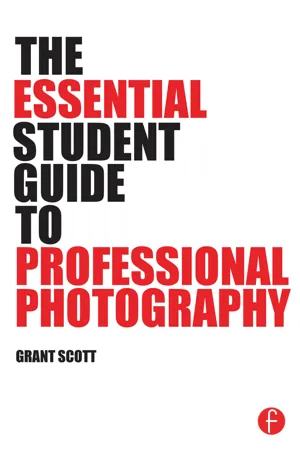
This essential reference for photography students explains how to become part of the professional community. By defining professional photography today, and exploring what is expected of professional photographers, the book demystifies this often-misunderstood and misjudged career track. The easily accessible text provides readers with valuable information, inspiration, and education on topics including developing your photographic voice, finding your area of specialization, exploring the moving image, building a website, and understanding self-presentation, promotion, legal aspects, and marketing. It also features inspirational projects for students to embark on their education in photography.
- 182 pages
- English
- ePUB (mobile friendly)
- Available on iOS & Android
eBook - ePub
The Essential Student Guide to Professional Photography
About this book
Information
Chapter 1
What is Professional Photography?
WHEN THE WORD ‘PROFESSIONAL’ is used in conjunction with the creation of photographs it is most often seen as a comment on the technical quality of an image. Camera manufacturers describe the most expensive cameras they produce as being for professionals and others as providing professional-quality images. They believe that we all want to be able to create professional images. But before we begin to discuss the role of the professional photographer we must first talk about what defines a professional photograph. What are considered to be professional images, and are they really professional?
Let’s deal with what elements are most commonly believed to constitute a professional image. The basic requirements are:
- ● Is the picture in focus?
- ● Is the lighting correct for the subject? Not too dark or too light.
- ● Is the photograph well composed?
- ● Is the subject in the center of the frame?
- ● Has the background been considered?
- ● Has it been softened by the use of depth of field?
In short, has the photographer been able to control a series of technical aspects and aesthetic judgments to create what is considered by many to be an ‘acceptable’ image? Camera manufacturers create cameras that make all of these judgments as easy as possible to make correctly and present automatic options for everything except the composition of the image. They do everything they can to help you create a ‘perfect’ image, but are these images professional? Well no! Professional photography is not based purely on creating ‘perfect images’ or mastering technical processes and techniques. Although this is definitely not a manual on how to take better photographs, it is important to have an understanding of the basic rules of photography to ensure that you are in control of creating your images. To that end your first step to working professionally is to stop using the automatic functions on your camera (except focusing, but even then you should not rely completely on the automatic function) and to concentrate on the composition of the image you want to create and the subject matter of that image. This is the beginning of creating images that are personal to you and the development of your own visual language and a step toward creating professional photographic images.
Anybody can be a great photographer if they zoom in enough on what they love.
Photographer: David Bailey
Creating a Visual Language
In 2014 alone 2.25 billion picture-taking devices were sold globally, with smart phones making up more than half of that total. In 2013 89 million digital cameras were sold—only 4 percent of the global sales of devices that take pictures. With that many people taking photographs with ‘nonprofessional’ equipment, it is essential that professional photographers can give their clients a reason to pay for their images. This reason will not be based purely on the mastery of technical skills, as this is something that many people can achieve. It will be based on the photographer’s ability to capture how he or she sees the world and persuade people who need photography within their business to react positively to the photographer’s way of seeing. Professional photography is a business that interacts with myriad other businesses, and it is that interaction that I hope to help you understand.
Billions of photos are shot every year, and about the toughest thing a photographer can do is invent an original, deeply personal, instantly recognizable visual style.
Art Critic, New York Magazine: Jerry Saltz
Photography has been a business since its creation, but its professional application was initially limited to the wealthy and those comfortable with its chemical requirements. However, the use of photography as a means of education goes back to its earliest days in the mid to late nineteenth century, when travel photography bought images of the world to those who could not afford to travel. This soon progressed to the documentation of wars and battles that filled the newspapers hungry to bring the new medium of photography to their news reporting and readers eager to see images direct from the battlefields of the American Civil War, and the Crimea and the Boer Wars. On the home front every high street contained a portrait photographer happy to document families, children and those wishing to have their portrait taken for the creation of a Carte d’Visite (a photographic calling/business card).


Two examples of nineteenth-century Carte d’Visite, one of the earliest forms of commercial portrait photography.


LIFE and Picture Post magazines were both published weekly and promoted quality photography and the importance of the photographic story. Both recorded high sales that were greatly diminished by the advent of television.
I wish more people felt that photography was an adventure the same as life itself and felt that their individual feelings were worth expressing. To me, that makes photography more exciting.
Photographer: Harry Callahan
Professional Photography is a Business
It was not until the beginning of the twentieth century, however, that the power of the photographic image became obvious to those wanting to sell products through advertising and magazines. The


Fashion magazines were an important showcase for professional photographers throughout the twentieth century, as they gave creative freedom to photographers shooting fashion, portraiture, food, interiors and social documentary images.

A graphic image taken from a fashion narrative shot by Ben Breading.
illustrated magazine was the most important vehicle for the growth and development of professional photography throughout the last century, providing a home for all genres of photography and in turn creating a professional model for the commissioning of photography from professional photographers. Weekly photo magazines such as LIFE and Picture Post brought the news, issues, everyday events and wonders of the world to every home until the global domination of television in the Sixties, while fashion magazines such as Vogue and Harper’s Bazaar pushed the boundaries of what was acceptable in both fashion photography and magazine design throughout the century.
French Vogue was always a photographer’s magazine.
Former Editor-in-Chief, French Vogue: Carine Roitfield
The Sixties saw the demise of the weekly photo magazine and the rise of the weekly newspaper supplement. Photography had found a new home and a new champion as the competition between newspapers became ever tougher and each strived to publish bigger and better supplements filled with the best photography and photographers’ work they could find. Professional photography was on a high and enjoying a golden period both creatively and financially. Brands saw the benefit of investing in photography to create ever more innovative advertising campaigns, and magazines with high readership circulations were the perfect environment from which to sell products. But as with all golden ages the end was inevitable, and as photography approached the conclusion of the twentieth century international global economic downturns started to have a direct impact on the advertising and publishing industries. The world of professional photography felt that impact hard, but just as it started to re-establish itself within the realities of a new economic climate the greatest change to how photographs were created and seen in over a hundred years took place.
The digital revolution saw the world of professional photography turned on its head, and we still haven’t stopped turning. This wasn’t just a photographic revolution but also a global communications revolution that has forced professional photographers to completely reassess their profession and their roles within it. For the established photographer this has ...
Table of contents
- Cover
- Half Title
- Title
- Copyright
- Dedication
- Contents
- CHAPTER 1 WHAT IS PROFESSIONAL PHOTOGRAPHY?
- CHAPTER 2 WHAT MAKES A PROFESSIONAL PHOTOGRAPHER?
- CHAPTER 3 HOW TO FIND YOUR HOTOGRAPHIC VOICE
- CHAPTER 4 UNDERSTANDING THE PHOTOGRAPHY BUSINESS
- CHAPTER 5 GOING IT ALONE, AND WHERE DO YOU FIT?
- CHAPTER 6 THE IMPORTANCE OF THE MOVING IMAGE
- CHAPTER 7 THE TWENTY-FIRST CENTURY PROFESSIONAL PHOTOGRAPHER
- A BRIEF GLOSSARY OF PROFESSIONAL PHOTOGRAPHY TERMS
- RESOURCES
- ACKNOWLEDGEMENTS
- INDEX
Trusted by 375,005 students
Access to over 1.5 million titles for a fair monthly price.
Study more efficiently using our study tools.
Frequently asked questions
Yes, you can cancel anytime from the Subscription tab in your account settings on the Perlego website. Your subscription will stay active until the end of your current billing period. Learn how to cancel your subscription
No, books cannot be downloaded as external files, such as PDFs, for use outside of Perlego. However, you can download books within the Perlego app for offline reading on mobile or tablet. Learn how to download books offline
Perlego offers two plans: Essential and Complete
- Essential is ideal for learners and professionals who enjoy exploring a wide range of subjects. Access the Essential Library with 800,000+ trusted titles and best-sellers across business, personal growth, and the humanities. Includes unlimited reading time and Standard Read Aloud voice.
- Complete: Perfect for advanced learners and researchers needing full, unrestricted access. Unlock 1.5M+ books across hundreds of subjects, including academic and specialized titles. The Complete Plan also includes advanced features like Premium Read Aloud and Research Assistant.
We are an online textbook subscription service, where you can get access to an entire online library for less than the price of a single book per month. With over 1.5 million books across 990+ topics, we’ve got you covered! Learn about our mission
Look out for the read-aloud symbol on your next book to see if you can listen to it. The read-aloud tool reads text aloud for you, highlighting the text as it is being read. You can pause it, speed it up and slow it down. Learn more about Read Aloud
Yes! You can use the Perlego app on both iOS and Android devices to read anytime, anywhere — even offline. Perfect for commutes or when you’re on the go.
Please note we cannot support devices running on iOS 13 and Android 7 or earlier. Learn more about using the app
Please note we cannot support devices running on iOS 13 and Android 7 or earlier. Learn more about using the app
Yes, you can access The Essential Student Guide to Professional Photography by Grant Scott in PDF and/or ePUB format, as well as other popular books in Art & Photography. We have over 1.5 million books available in our catalogue for you to explore.