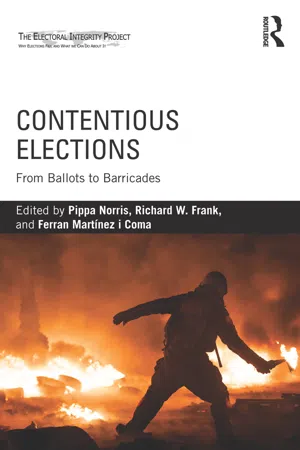
From Afghanistan to Zimbabwe the world has witnessed a rising tide of contentious elections ending in heated partisan debates, court challenges, street protests, and legitimacy challenges. In some cases, disputes have been settled peacefully through legal appeals and electoral reforms. In the worst cases, however, disputes have triggered bloodshed or government downfalls and military coups. Contentious elections are characterized by major challenges, with different degrees of severity, to the legitimacy of electoral actors, procedures, or outcomes.
Despite growing concern, until recently little research has studied this phenomenon. The theory unfolded in this volume suggests that problems of electoral malpractice erode confidence in electoral authorities, spur peaceful protests demonstrating against the outcome, and, in the most severe cases, lead to outbreaks of conflict and violence. Understanding this process is of vital concern for domestic reformers and the international community, as well as attracting a growing new research agenda.
The editors, from the Electoral Integrity Project, bring together scholars considering a range of fresh evidence– analyzing public opinion surveys of confidence in elections and voter turnout within specific countries, as well as expert perceptions of the existence of peaceful electoral demonstrations, and survey and aggregate data monitoring outbreaks of electoral violence. The book provides insights invaluable for studies in democracy and democratization, comparative politics, comparative elections, peace and conflict studies, comparative sociology, international development, comparative public opinion, political behavior, political institutions, and public policy.
Trusted by 375,005 students
Access to over 1.5 million titles for a fair monthly price.
Pippa Norris, Richard W. Frank, and Ferran Martínez i Coma
During the post-Cold War era, concern has risen about the proliferation of contentious elections and the number of polls held in a pervasive climate of fraud, mistrust, and intolerance that have ignited massive protests and violence.1 Far from having beneficial consequences, contentious elections raise red flags by potentially undermining democratic transitions in countries emerging from dictatorship, furthering instability and social tensions in fragile states, increasing uncertainty and risks for investors, and jeopardizing growth and development in low-income economies (Paris 2004; Doyle and Sambanis 2006; Paris and Sisk 2009; Collier 2009).
The most violent and disruptive contests are exemplified by the 2007 Kenyan election, which attracted global headlines and international concern when rival community leaders organized tit-for-tat coercion. This led to thousands injured, widespread rape, an estimated 1,200 deaths, about 42,000 houses and many businesses looted or destroyed, and more than 300,000 people displaced, costing the country more than one billion dollars and deterring potential investors (UNHCR 2008; Kiai 2008; Chege 2008; Gutierrez-Romero 2013). The extent of the disruption was exceptional. But, alas, the 2007 Kenyan election was not an isolated occurrence. During the last decade, estimates from the Hyde and Marinov NELDA dataset suggest that around 12 percent of all elections worldwide saw opposition boycotts, 17 percent experienced post-election riots or protests, and 18 percent had electoral violence involving at least one civilian fatality.2
To address these concerns and to deepen our understanding of these phenomena, this book brings together research from a wide range of scholars of international relations, comparative politics, and political behavior. This introductory chapter advances a new conceptual and theoretical framework useful for understanding the risks of contentious elections. Building upon this foundation, we then outline the overall plan of the book and indicate how contributors build on this theory. Using both surveys within specific countries, as well as broader types of cross-national evidence, successive chapters focus on how contentious elections affect citizens’ attitudes and behavior, as well influencing broader challenges to stability arising from leadership overthrow, electoral violence, and nationalist demands for secession. The conclusion presents a global perspective and cross-national evidence demonstrating that the risks of contentious elections are heightened under three conditions: in hybrid regimes (which are neither full-blown democracies nor dictatorships), in contests lacking fair procedures and impartial electoral authorities to serve as umpires, and in some of the world’s poorer societies and most fragile states. The conclusion also summarizes the book’s main findings and considers their broader implications for social science and for the public policy agenda.
The Concept of Contentious Elections
The subject of contentious politics has attracted a substantial literature, following the seminal work of Sidney Tarrow, Charles Tilly, and Doug McAdam (Tilly 1979; McAdam, Tarrow and Tilly 2001; Tilly and Tarrow 2006). This subfield has generated a wide range of research on diverse phenomenon such as social movements, collective actions, ethno-religious conflict, political strikes, civil wars, civil disobedience, resistance, terrorism, genocide, insurrection, and revolutions (e.g. Tarrow 1992; Kriesi et al. 1995; McAdam, McCarthy and Zald 1996; Kriesi, Della Porta, and Rucht 1998; Della Porta and Diani 1999; Aminzade et al. 2001) As McAdam and Tarrow (2010) note, however, the literatures on social movements and on electoral studies commonly travel along parallel tracks, with little cross-fertilization, despite the potential for fruitful interaction.
Drawing ideas loosely from this broad and rich research agenda, the concept of “contentious elections” is defined in this book as contests involving major challenges, with different degrees of severity, to the legitimacy of electoral actors, procedures, or outcomes. Using this conceptualization, contentious elections occur where deep disputes exist that challenge the legitimate authority of (i) electoral actors (such as concern about the lack of impartiality, authority, and independence of electoral management bodies, EMBs); (ii) the electoral procedures used throughout the electoral cycle (including disagreements about the rules of the game used to draw boundaries, register voters, candidates, and parties, allocate elected offices, regulate campaign finance and media, cast ballots, and translate votes into seats); and/or (iii) the electoral outcomes and thus challenges to the legitimacy of those winning office (including leaders, representatives, and political parties).
Contentious elections therefore reflect fundamental disagreements about the legitimacy of the contest. In general, the overarching concept of “legitimacy” represents broad acceptance of the underlying rules of the game, so that all actors willingly consent to the authority of the regime, without the need for force. Legitimacy, in Seymour Martin Lipset’s (1983: 64) words: “involves the capacity of a political system to engender and maintain the belief that existing political institutions are the most appropriate and proper ones for the society.”
What are the sources of legitimate authority? In his seminal exposition, Max Weber posited several ideal types, including traditional authority (such as customary patrimonial arrangements for leaders and elites or the belief that the monarch is divinely sanctioned to rule in theocracies), charismatic authority (flowing from the personal popularity of the leader), and rational-legal authority (where authority is derived from the institutional office allocated by the rule of law and constitutional principles). Each of the first two classic Weberian ideal types of authority can still be observed in a handful of contemporary states. Nevertheless the global spread of elections for the national legislatures in nearly all countries worldwide, and the use of direct elections for many executives, means that in most countries today governing authority derives from holding offices determined by the formal constitutional principles and electoral laws (Gandhi and Lust-Okar 2009; Norris 2014). This is true not just in long-established democracies, but also in popularly elected autocracies. Elections for national office are held today in most independent nation states worldwide, with the exception of a handful of outliers where the executive rules through one-party regimes lacking the fig-leaf of any direct elections for the national legislature (such as in Communist China), through family connections in absolute monarchies (such as emirs governing Saudi Arabia and Oman), through military juntas (such as in Egypt, after the army seized power and the Muslim Brotherhood was imprisoned and outlawed), and in personal dictatorships lacking direct elections (such as Colonel Gaddafi’s Libya). Legitimacy crises are triggered in states for diverse reasons. For instance, a major money-in-politics corruption scandal can bring down leaders. A government can be blamed for a severe failure of public policy, such as a financial disaster or currency crisis, which rocks the foundation of the state. Deadly violence can undermine the state’s capacity to protect its peoples and borders due to inter-communal tensions, demands for secession, civil wars, or military invasions. Or a ruling leader may die in office or be deposed by a coup without an obvious successor. But a crisis of legitimacy through contentious elections represents another additional risk— one that is greatly heightened by the spread of popular contests around the globe; and the dangers are compounded in many divided societies holding elections as part of peace-building initiatives after decades of bloodshed.
Therefore consensual elections ideally provide a mechanism to settle disputes over legitimate authority in a peaceful, democratic, lawful, and orderly way. Such contests can channel and curb competition among rival visions of society, leaders and political parties by securing agreement over the underlying rules of the game. Legitimacy flowing from the ballot box is one of the most effective and efficient mechanisms to ensure that citizens comply with the authority of elected rulers, facilitating the process of governance by voluntarily respecting the rule of law, and providing the state with revenues through complying with the honest payment of taxes. In the absence of electoral legitimacy, ruling elites can seek to govern through multiple alternative non-democratic mechanisms, including through patronage and clientalism, through populist and ideological appeals to followers, and, in repressive states, through the threat or use of force and coercion (Svolik 2012). Contentious elections, however, are expected to prove deeply problematic for regime stability, because they raise fundamental doubts about the legitimate authority of electoral management bodies, actors, and the rules of the game. Such challenges, by their nature, cannot be resolved easily through the standard mechanisms of the ballot box or the regular policy-making process.
Measuring the Concept of Contentious Elections
What evidence would allow us to better understand this phenomenon? When it comes to defining and measuring examples of contentious elections, at one level, like art, “we all know it when we see it.” During 2013 alone, for example, journalists reported large-scale demonstrations and riots challenging the legitimacy of elections in states as diverse as Malaysia, Venezuela, Mozambique, Cameroon, Uganda, Zambia, Cambodia, Thailand, Bangladesh, and Pakistan (Norris, Frank, and Martínez i Coma 2014). Few would dispute these are contentious elections. In some cases, however, post-election protests quickly faded away, and court cases were dismissed. In others, by contrast, mass discontent triggered security counter-reactions, partisan stalemate, social instability, inter-communal bloodshed, and deadly violence. Clearly such extremely diverse cases as the 2000 US election and Kenya in 2007 suggest a wide continuum of dissimilar disputes, making the relatively abstract concept of contentious elections difficult to measure with any degree of clarity and precision.
The phenomenon of a contested election can be detected most effectively, we argue, by examining empirical evidence for several symptoms, including:
low or declining trust and confidence in elections by citizens and elites;
contests generating peaceful mass demonstrations, opposition boycotts, or court challenges; and, in the most serious cases,
incidents of electoral violence occurring during or after polling day and nonpeaceful protests involving the deployment or threat of coercive tactics, the destruction of property, and/or physical harm to people.
Each of these elements underlying the overarching concept of contentious elections is expected to be related, generating a downward spiral deepening the severity of an electoral legitimacy crisis, as illustrated by the heuristic model presented in Figure 1.1. Several case studies presented subsequently in this book—focused on hybrid regimes such as Russia, Ukraine, and Azerbaijan—as well as cross-national comparative studies, demonstrate the connections theorized to exist among these elements.
Figure1.1A model of contentious elections
Although evidence to examine this phenomenon remains less than ideal on several aspects, a growing range of empirical indicators, which are useful to diagnose both mild and virulent symptoms of contentious elections, are becoming available from several sources. These indicators include reports from international election observer organizations, representative mass surveys monitoring attitudes and reported behavior within and across countries, events-based datasets derived from news media content analysis, forensic analysis of outliers in polling results and turnout at local level, crowd-sourcing election watch initiatives, and official legal records o...
Table of contents
Cover Page
Half Title Page
Title Page
Copyright Page
Table of Contents
List of Figures and Tables
List of Contributors
Preface and Acknowledgments
1 Contentious Elections: From Votes to Violence—Pippa Norris, Richard W. Frank, and Ferran Martínez i Coma
PART I Corroding Public Trust and Triggering Protest
PART II Catalyzing and Preventing Electoral Violence
PART III Conclusions
Selected Bibliography
Index
Frequently asked questions
Yes, you can cancel anytime from the Subscription tab in your account settings on the Perlego website. Your subscription will stay active until the end of your current billing period. Learn how to cancel your subscription
No, books cannot be downloaded as external files, such as PDFs, for use outside of Perlego. However, you can download books within the Perlego app for offline reading on mobile or tablet. Learn how to download books offline
Perlego offers two plans: Essential and Complete
Essential is ideal for learners and professionals who enjoy exploring a wide range of subjects. Access the Essential Library with 800,000+ trusted titles and best-sellers across business, personal growth, and the humanities. Includes unlimited reading time and Standard Read Aloud voice.
Complete: Perfect for advanced learners and researchers needing full, unrestricted access. Unlock 1.5M+ books across hundreds of subjects, including academic and specialized titles. The Complete Plan also includes advanced features like Premium Read Aloud and Research Assistant.
Both plans are available with monthly, semester, or annual billing cycles.
We are an online textbook subscription service, where you can get access to an entire online library for less than the price of a single book per month. With over 1.5 million books across 990+ topics, we’ve got you covered! Learn about our mission
Look out for the read-aloud symbol on your next book to see if you can listen to it. The read-aloud tool reads text aloud for you, highlighting the text as it is being read. You can pause it, speed it up and slow it down. Learn more about Read Aloud
Yes! You can use the Perlego app on both iOS and Android devices to read anytime, anywhere — even offline. Perfect for commutes or when you’re on the go. Please note we cannot support devices running on iOS 13 and Android 7 or earlier. Learn more about using the app
Yes, you can access Contentious Elections by Pippa Norris, Richard W. Frank, Ferran Martínez i Coma, Pippa Norris,Richard W. Frank,Ferran Martínez i Coma in PDF and/or ePUB format, as well as other popular books in Politics & International Relations & Comparative Politics. We have over 1.5 million books available in our catalogue for you to explore.