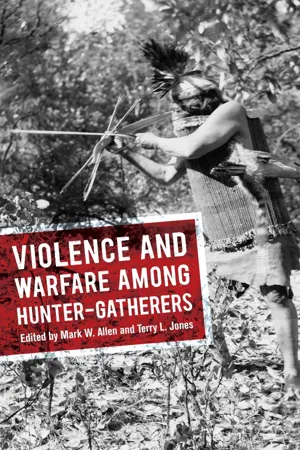
How did warfare originate? Was it human genetics? Social competition? The rise of complexity? Intensive study of the long-term hunter-gatherer past brings us closer to an answer. The original chapters in this volume examine cultural areas on five continents where there is archaeological, ethnographic, and historical evidence for hunter-gatherer conflict despite high degrees of mobility, small populations, and relatively egalitarian social structures. Their controversial conclusions will elicit interest among anthropologists, archaeologists, and those in conflict studies.
A Neglected Anthropology: Hunter-Gatherer Violence and Warfare
1
Hunter-Gatherer Conflict: The Last Bastion of the Pacified Past?
Mark W. Allen
When I arrived in New Zealand in the 1980s to begin dissertation research on the roles of warfare and economic power in the development of Maori chiefdoms, there was no shortage of recent scholarly research on cultural evolution, ecology, and social power, but there was little being written at the time about indigenous or prehistoric warfare. American archaeology was then in the midst of a multi-decadal moratorium on violence research that emphasized instead the ingenuity, ecological balance, and intergroup harmony of traditional, nonwestern subsistence adaptations. My research design relied heavily on a masterful and widely known ethnographic summary of Maori warfare by Andrew Vayda (1960) that had been penned before the anthropological pendulum had swung away from recognition of violence and warfare in traditional cultures. Because that work (and others) had established unequivocally the role of violent conflict in the evolution of Polynesian chiefdoms, New Zealand was one of the few places at the time where the archaeology of warfare could be investigated without raising anthropological eyebrows.
This situation changed dramatically in the 1990s due largely to Lawrence Keeley’s influential 1996 book, War before Civilization: The Myth of the Peaceful Savage, along with other seminal anthropological studies (e.g., Ember and Ember 1992; Ferguson 1992; Milner et al. 1991; Otterbein 1999; Wrangham and Peterson 1996). These works, particularly Keeley’s, put forward a persuasive call for archaeologists to take a fresh look at the evidence for warfare in their respective regional records. Of course, anthropologists, other social scientists, and philosophers had been studying and theorizing about warfare, albeit with only limited input from archaeologists, for centuries. Indeed, the two basic views on warfare and the human condition that continue to permeate writing on the subject were established centuries ago: one was promoted by Thomas Hobbes, who argued that civilization essentially rescued humanity from a situation of “war of all against all” in which lives were “nasty, brutish and short,” while the alternative was developed by Jean-Jacques Rousseau, who suggested that civilization brought increases in oppression, conflict, and violence, and that simpler, noncivilized societies were marked by greater levels of peace and harmony. Although archaeological evidence of various types has been used to support both views (see discussions by Kim [2012] and Lawler [2012]), most of the twentieth-century anthropological attempts to support one or the other side of this debate were based on ethnographic data, a tradition that continues today (see Fry 2013; Kim 2012). Keeley, however, persuasively argued that cultural anthropologists and archaeologists had frequently “pacified the past” by ignoring evidence of violence and warfare, and further argued that in cases where prehistoric or traditional war was undeniable, there had been a strong tendency to classify it as mere ritual, game-like, or otherwise unserious. He also took aim at Ferguson’s (1992) influential argument that tribal warfare in Amazonia and other areas was largely a product of colonial infiltration into previously peaceful regions.
Keeley’s book unleashed a torrent of in-depth archaeological and bioarchaeological studies of prehistoric violence and warfare in a wide range of cultural areas, including those by Arkush (2011), Arkush and Allen (2006), Chacon and Dye (2007), Chacon and Mendoza (2007a, 2007b), Dye (2009), Lambert (2002), LeBlanc (1999), LeBlanc and Register (2003), Martin et al. (2012), Rice and LeBlanc (2001), and Snead and Allen (2010), among others, as well as hundreds of journal articles, far too many to be cited here.
Despite this wealth of research, there has been one glaring omission in considerations of the archaeology and prehistory of warfare. Many of the comprehensive works summarizing indigenous warfare and violence consider some hunter-gatherer societies (e.g., Chacon and Mendoza 2007a; Lambert 2002), but have not emphasized the distinction between forager societies and farmers. In many cases this omission simply comes from a desire to demonstrate the levels and intensity of indigenous warfare without regard to the underlying type of precivilized adaptation. Moreover, evidence for conflict among foragers (Ember 1978; Ember and Ember 1992; Keeley 1996; Otterbein 2004) has often been neglected. Anthropologists often perpetuate the long-cherished notion that small-scale societies of foragers (especially the most mobile hunter-gatherers) are inherently peaceful with low levels of violence and extremely rare warfare. While more complex hunter-gatherer groups with greater sedentism, storage, organizational capacity, and population density are now routinely acknowledged as having considerable violence and war, there continues to be a widely held belief that less complex, mobile foragers conform with the ideal of the noble savage, at least in regard to their proclivity (or lack thereof) for intergroup conflict.
The lack of attention to conflict within the full range of hunter-gatherer adaptations is all the more curious since it is a potential key to the heavily debated questions of when and why war originated. Some argue for a violent propensity in our genes that can be triggered under certain material conditions (Wrangham and Peterson 1996); others claim that its roots are in social competition inherent in even small populations; and still others propose that war did not arise until dependence on agriculture led to increased competition between groups. Psychological and enculturation models are also widespread. Thus far, there is little agreement. The cultural anthropologist Keith Otterbein (1997, 2004) created a colorful dichotomy of two “species” of scholars from diverse fields with firm views on this subject. “Hawks” believe that war has always been with us, right back to the first hominins. “Doves” believe that warfare is fairly recent, and is mainly associated with the spread of more complex societies such as chiefdoms, early states, and especially colonial empires. Another way to conceptualize the polarity of views on the prehistory of violence and warfare is to distinguish a long chronology of war versus a short chronology (Allen 2012:198–200; Roscoe, this volume).
The Long Chronology of War
Perhaps the most visible proponent of the long chronology of war is Richard Wrangham. Apart from his scholarly writings, his general-audience book, Demonic Males: Apes and the Origins of Human Violence, touched many nerves (Wrangham and Peterson 1996). His view is that the group violence exhibited by chimpanzees is an accurate glimpse of the distant hominin past as well. His argument is that humans are adapted for violence, and in particular that male humans are selected for coalition-based fighting:
That chimpanzees and humans kill members of neighboring groups of their own species is … a startling exception to the normal rule for animals. Add our close genetic relationship to these apes and we face the possibility that intergroup aggression in our two species has a common origin. This idea of a common origin is made more haunting by the clues that suggest modern chimpanzees are not merely fellow time-travelers and evolutionary relatives, but surprisingly excellent models of our direct ancestors. It suggests that chimpanzee-like violence preceded and paved the way for human war, making modern humans the dazed survivors of a continuous, 5-million-year habit of lethal aggression (Wrangham and Peterson 1996:63).
Most cultural anthropologists still shy away from any suggestion that humans are biologically driven to violence despite the fact that many human behaviors related to aggression are highly advantageous in conflict, such as alliance formation, wariness of strangers, perception of in-group versus out-group, and altruism. These behaviors likely have some genetic component and thus could have been selected for under conditions of extreme competition (see LeBlanc and Chatters, this volume). Nevertheless, many advocates of the long chronology prefer to attribute human aggression and conflict to ecology and resource stress rather than biology, or to see both at work. For Roscoe (2007), warfare is a rational calculation of risk and benefit that could exist well before the short chronology would have it appear.
The most influential long-chronology archaeologists are Keeley and Steven LeBlanc. LeBlanc’s (1999) treatise on warfare in the American southwest is perhaps the most detailed study yet of the evidence for prehistoric warfare in one particular cultural area. He, like Wrangham, wrote a book for general audiences summarizing his views, aptly titled Constant Battles: The Myth of the Peaceful, Noble Savage (LeBlanc and Register 2003). Scholars interested in arguing that war has been around for a long time rely heavily on Wrangham, Keeley, and LeBlanc, whose views are often cited in popular works directed at diverse audiences. A good example of their influence can be seen in Gat’s (2006) book War in Human Civilization, in which the author reviews the available evolutionary, archaeological, and ethnographic evidence to conclude that violent aggression has been with us for at least two million years (the origin of the genus Homo) and that it is primarily caused by resource scarcity. He also points out that violence and war have many proximate causes such as prestige, revenge, sorcery, use of narcotics, and so on, but that the most prevalent underlying cause is competition for resources. Even the simplest hunter-gatherer societies, he argues, have high rates of mortality resulting from competition for reproductive success and territory.
Another example of a “hawkish” view written for a popular audience is David Livingstone Smith’s (2007) The Most Dangerous Animal: Human Nature and the Origins of War. Smith accepts innate aggression in humans as a consequence of competition for reproductive success and resources, which ultimately causes humans to be naturally aggressive, xenophobic, and nepotistic. But he also claims that humans dread killing and are inherently self-deceptive, and that this internal conflict must be understood to solve “the puzzle of war” (Smith 2007:161). In The Better Angels of Our Nature, Steven Pinker (2011) argues for a deep history of human violence and warfare that is decreasing through time. His work draws heavily on an analysis of forager societies conducted by Bowles (2009) in an influential article in Science that advocates for the long chronology and makes the case that severe Late Pleistocene and Early Holocene intergroup conflict could have affected the evolution of group-beneficial behaviors.
Though members of the public as well as specialists from many disciplines seem to favor the long-chronology theory, it i...
Table of contents
Cover
Half Title
Title Page
Copyright Page
Table of Contents
List of Illustrations
Preface
Part I: A Neglected Anthropology: Hunter-Gatherer Violence and Warfare
Part II: Violence and Warfare among Mobile Foragers
Part III: Violence and Warfare among Semisedentary Hunter-Gatherers
Part IV: Synthesis and Conclusion
Index
About the Editors and Contributors
Trusted by 375,005 students
Access to over 1.5 million titles for a fair monthly price.
Study more efficiently using our study tools.
Frequently asked questions
Yes, you can cancel anytime from the Subscription tab in your account settings on the Perlego website. Your subscription will stay active until the end of your current billing period. Learn how to cancel your subscription
No, books cannot be downloaded as external files, such as PDFs, for use outside of Perlego. However, you can download books within the Perlego app for offline reading on mobile or tablet. Learn how to download books offline
We are an online textbook subscription service, where you can get access to an entire online library for less than the price of a single book per month. With over 1.5 million books across 990+ topics, we’ve got you covered! Learn about our mission
Look out for the read-aloud symbol on your next book to see if you can listen to it. The read-aloud tool reads text aloud for you, highlighting the text as it is being read. You can pause it, speed it up and slow it down. Learn more about Read Aloud
Yes! You can use the Perlego app on both iOS and Android devices to read anytime, anywhere — even offline. Perfect for commutes or when you’re on the go. Please note we cannot support devices running on iOS 13 and Android 7 or earlier. Learn more about using the app
Yes, you can access Violence and Warfare among Hunter-Gatherers by Mark W Allen, Terry L Jones, Mark W Allen,Terry L Jones in PDF and/or ePUB format, as well as other popular books in Sciences sociales & Archéologie. We have over 1.5 million books available in our catalogue for you to explore.