- 184 pages
- English
- ePUB (mobile friendly)
- Available on iOS & Android
eBook - ePub
About this book
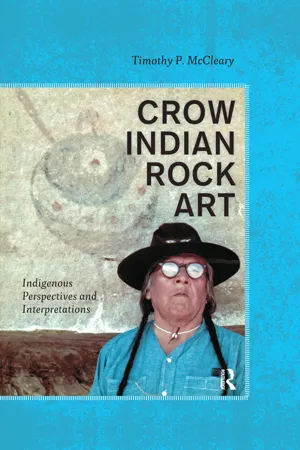
This absorbing volume examines the cultural role of rock art for the Apsáalooke, or Crow, people of the northern Great Plains. Their extensive rock art developed within the changing cultural life of the tribe. Individual knowledge and meaning of rock art panels, however, relies as much on collective concepts of landscape as it does on shared memories of historic Crow culture. Using this idea as a focus, this book:-introduces Plains Indian rock art of the 19th century as we know about it from its own stylistic conventions, ethnographic data, and historical accounts;-investigates the contemporary Crow discourse about rock art and its place within the cultural landscape and archaeological record;-argues that cultural concepts of space and place are fundamental to the way rock art is discussed, experienced and interpreted.
Information
Chapter 1
Introduction

Rock art is our heritage.
–George Reed Jr., Cultural Director, Apsáalooke Nation, 2002
This book examines the cultural role of rock art for the Apsáalooke, or Crow, people of the northern Great Plains. Like any sociocultural product, rock art has a history that developed within the changing cultural life of the tribe. Importantly, then, this presentation begins by introducing Plains Indian rock art of the 19th century from what we know about it through its own stylistic conventions and from ethnographic data and historical accounts. The discussion then proceeds to investigate the contemporary Crow discourse about rock art and its place within the cultural landscape and archaeological record.
People invest the physical landscape with significant meaning, both historical and spiritual, and rock art is the land literally inscribed with cultural texts. Although contemporary descendants of the people who made the rock art interpret historic rock art somewhat variably, this book argues that cultural concepts of space and place are fundamental to the way rock art is discussed, experienced, and interpreted. Rock art has been created in specific places—such as buttes with unobscured views of the surrounding area, or in secluded coulees—which ultimately informs interpretation. The meaning and interpretation of a rock art panel relies as much on collective concepts of landscape as it does on shared memories of historic Crow culture.
Before we delve into the specifics of Crow rock art interpretation, however, it is helpful to get a basic background on the ways archaeologists record, categorize, and analyze rock art.
ARCHAEOLOGICAL ANALYSIS OF ROCK ART
The historic Crow territory comprised most of present-day southeastern Montana and northeastern Wyoming. Archaeologists have categorized the rock art of this area into at least ten styles and traditions dating as far back as 12,000 B.P. (Conner and Conner 1971; Keyser and Klassen 2001). In a more general sense, rock art is classified by technique: pictographs were made with paint or another substance; and petroglyphs by pecking, scratching, or incising the rock surface (Francis and Loendorf 2002; Keyser and Klassen 2001; Sundstrum 2004).
A majority of archaeologists who work with rock art follow an approach known as the formal method, which relies on empirical evidence alone—that is, the study of the material evidence itself—for analysis. This method is restricted to that which can be discerned from the form and style of the images, and considers neither ethnographic nor emic knowledge (Ross 2001: 543; Whitley 2001: 35). In keeping with the formal method, Linea Sundstrom identified the three basic aspects of style as the “directly observable form and surface structure, underlying structure or organizing principles inferred from the observed form, and variation in a style introduced by both deliberate and unconscious choices made by the individual” (1990: 11–12).
Until recently, most rock art researchers have preferred the formal method, as it seems the most scientific or least subjective: the formal and structural aspects of style can be directly observed or inferred from the data, and the researcher need not take into account the expressive quality of art, which may be difficult to assess objectively (Murray 1998: S2; Ross 2001: 543; Whitley 2001: 24–26). Some, arguing under the strictest positivistic terms, assert that all interpretations of rock art are mere speculation, inasmuch as archaeologists can never return to the past and interview the rock art creators about their intentions. Studies based on the formal method have produced a large amount of valuable data but have separated the symbols from almost all contextual evidence (Murray 1998: S2; Taçon 1994: 118–119).
Within the last 20 years, rock art researchers have come to realize that, like all products of human activity, prehistoric artworks have significance beyond their directly observable traits. These archaeologists argue that the distribution, frequency, context, and meanings of rock art are not questions of statistical probability. They are determined by cultural intent and therefore can only be explained from within an anthropological framework (Murray 1998: S1–S2; Sundstrom 1990: 7; Whitley and Loendorf 1997: 4–6).
Nonetheless, and despite the problems and limitations of the formal method, it is still acknowledged that form and style analysis is a beginning point for rock art research. As David Whitley states,
Regardless if one is a traditional, processual, or post-processual archaeologist, cultural-historical classification is one of the starting places for research. For rock art this has commonly involved the concept of style. (2001: 24)
The primary character of style continues to underlie the construction of motif taxonomies and the creation of chronological sequences. Even with advancements in rock art dating techniques, the importance of style as an analytical and chronological tool endures (Francis and Loendorf 2002:43–46; Keyser and Klassen 2001: 30–31). Some even argue that these recent advancements have not diminished the importance of the concept of style but actually assist in refining it. Jean Clottes states,
It is obvious when reading even the most recent papers by leading rock art specialists that we are still very far from giving up stylistic criteria and that the concept of style can be and is still used in a number of ways, and probably will be for a long time. (1993: 19)
Research in neuropsychology has also allowed for new interpretations of rock art. This research suggests that humans are hard-wired to perceive certain consistent visual patterns while in various altered states of consciousness; these patterns are termed entoptic patterns or phosphenes (Lewis-Williams 2001: 336–339). This phenomenon is believed to be the source for the abstract and geometric figures found in prehistoric rock art, as evidenced by the creation of similar art by shamans in contemporary hunter-gatherer societies (Lewis-Williams and Dowson 1988: 201). (For further discussion, see Chapter 4’s section on “Pipe Owners and Their Dreams.”)
The idea that some rock art imagery is trance-induced shamanistic art was met with great skepticism when first proposed in the 1980s. Today, however, the concept is widely accepted and utilized to interpret rock art data (Francis and Loendorf 2002; Lewis-Williams 2001; Whitley 2000).
The oldest method, after style, used to interpret rock art is based on ethnographic data. This methodology generally adopts one of two forms: informed and analogy (Chippindale and Taçon 1998: 6–7; Layton 2001: 314–318). The informed method depends on insight passed on directly through the descendants of those who made or used the rock art. Most often this involves the examination of ethnographies written within the time that the art was created, as well as ethnohistorical and historical records. Some archaeologists engage in ethnographic research with the living descendants of those who created the art, to assist them in their interpretations (Chippindale and Taçon 1998: 6–7; Layton 2001: 314–318).
By contrast, ethnographic analogy extrapolates cultural universals from ethnographic data and applies them cross-culturally, rather than relying on data about the people who created the rock art (R. Bradley 1997; Lewis-Williams 2002; Lewis-Williams and Dowson 1988). As Christopher Chippindale and Paul Taçon stated, “when we cannot observe x but we can y, which is sufficiently like it, we can hope to infer things about x based on observations of y” (1998: 8). This method can easily be misapplied, however, and must be used cautiously and critically (see, e.g., Layton 2001: 318–319; Lewis-Williams and Dowson 1988: 201; Wylie 1985).
Another form of analogy, called the direct historical approach, is based on the idea that rock art about which we have little or no information can be interpreted by comparing it with similar prehistoric or historic art for which more information is available. This method most often entails applying data about historic portable art for which we have associated ethnographic data1 in order to interpret rock art with similar stylistic traits (Keyser and Klassen 2001: 257–279; Keyser, Poetschat, and Taylor 2006).
Though the informed method and the use of analogy are long-standing traditions in rock art interpretation, it took the development of post-processualism in anthropology to establish their credibility more broadly. In fact, it was post-processualism’s concern with art, symbolism, and general cognitive phenomena that led to a reevaluation of the contribution of the direct historical approach (Loendorf 2001: 58–59; Whitley 2001: 20).
With these various new interpretive methods at hand, rock art has gained new relevance. This advance is also due in part to the general trend in archaeology of recognizing the importance of Native people’s participation in archaeological interpretation. The concept of “indigenous archaeology,” or archaeology as Native history, provides a greater awareness of social and political claims to the aboriginal heritage of North America (Hodder 2001; Klassen 1995; Taçon 1994; Trigger 1989). The Native American Graves Protection and Repatriation Act (NAGPRA) can be seen as a legal correlate to this trend (Whitley 2001: 31–32).
Before the post-processual movement, it was assumed that modern Native people had little to offer regarding the interpretation of archaeological data generally, and of rock art specifically. More recent studies, however, have shown the importance of Native consultations in understanding the process of meaning-making.
These studies emphasize that while Native cultures are not stagnant, we can seek to comprehend rock art by utilizing active cultural memories of icons, symbols, and meaning (Francis and Loendorf 2002; Kantner 2007; Keyser and Klassen 2001; Keyser, Poetschat, and Taylor 2006; Whitley 2000; York, Daly, and Arnett 1993).
The earliest attempt to interpret North American rock art was undertaken by Garrick Mallery of the Bureau of American Ethnology in the 1880s. He believed that rock art was a form of writing that could be interpreted by utilizing documented portable ethnographic art as a “Rosetta Stone” (Mallery 1972). The first archaeological projects to document and analyze rock art of the Northern Plains occurred in the 1940s and 1950s (Gebhard and Cahn 1950; Mulloy 1958; Over 1941). In the late 1970s, interest in Northern Plains rock art increased significantly (Brink 1979, 1981; Conner and Conner 1971; Jones and Jones 1982; Keyser 1979; Loendorf 1988; Loendorf and Porsche 1985). The work of many of these scholars has recently resulted in a number of major texts (Francis and Loendorf 2002; Keyser and Klassen 2001; Sundstrom 2004), all of which have utilized the full panoply of analytical techniques developed over the course of rock art research, including the analysis of form, the neuropsychology model, ethnographic analogy, and the informed method, as well as some recent breakthroughs in dating techniques (Francis and Loendorf 2002; Keyser and Klassen 2001; Sundstrom 2004).
It is my intention in this book to build on this tradition of interpretation by examining the way in which one particular Northern Plains group, the Crow people, describe, understand, and relate to rock art—to accomplish, as David Gehbard requested, “the move from the analysis of style to the study of iconography” (1969: 22).
To place Crow rock art in its historical context, the next section presents an overview of the development of the Crow people, followed by a brief description of the Crow cultural categories relevant to the analysis of rock art.
CROW PEOPLE: AN ARCHAEOLOGICAL AND HISTORICAL OVERVIEW
The majority of Crow people presently reside on or near their 2.2 million acre reservation in southeastern Montana. This territory was carved by federal treaties and agreements from the Crow’s original homeland of approximately 30 million acres in present-day central Montana and northern Wyoming. Although the Crow have been on their present reservation for more than 100 years, the original territory and the history embedded in it remain vital to how they conceive of themselves as a nation (Figure 1.1).

FIGURE 1.1. Crow landholdings.
For the past 50 years, various researchers, both in and outside of the present Crow community, have examined how Crow people developed into a distinct cultural and historic entity. Recent archaeological work has dramatically enhanced understanding of the culture, history, and origins of modern Crow people.
Archaeologists, historians, and other ...
Table of contents
- Cover Page
- Half Title page
- Dedication
- Title Page
- Copyright Page
- Contents
- Figures
- Foreword
- Acknowledgments
- Crow Language Alphabet and Pronunciation Guide
- Introduction
- Crow Country
- Crow Rock Art Sites
- Historic Crow Culture and the Warrior Ethic
- Biographic and Historic Event Rock Art
- Ghost Writing
- Conclusion
- References
- Index
- List of Contributors
Trusted by 375,005 students
Access to over 1.5 million titles for a fair monthly price.
Study more efficiently using our study tools.
Frequently asked questions
Yes, you can cancel anytime from the Subscription tab in your account settings on the Perlego website. Your subscription will stay active until the end of your current billing period. Learn how to cancel your subscription
No, books cannot be downloaded as external files, such as PDFs, for use outside of Perlego. However, you can download books within the Perlego app for offline reading on mobile or tablet. Learn how to download books offline
Perlego offers two plans: Essential and Complete
- Essential is ideal for learners and professionals who enjoy exploring a wide range of subjects. Access the Essential Library with 800,000+ trusted titles and best-sellers across business, personal growth, and the humanities. Includes unlimited reading time and Standard Read Aloud voice.
- Complete: Perfect for advanced learners and researchers needing full, unrestricted access. Unlock 1.5M+ books across hundreds of subjects, including academic and specialized titles. The Complete Plan also includes advanced features like Premium Read Aloud and Research Assistant.
We are an online textbook subscription service, where you can get access to an entire online library for less than the price of a single book per month. With over 1.5 million books across 990+ topics, we’ve got you covered! Learn about our mission
Look out for the read-aloud symbol on your next book to see if you can listen to it. The read-aloud tool reads text aloud for you, highlighting the text as it is being read. You can pause it, speed it up and slow it down. Learn more about Read Aloud
Yes! You can use the Perlego app on both iOS and Android devices to read anytime, anywhere — even offline. Perfect for commutes or when you’re on the go.
Please note we cannot support devices running on iOS 13 and Android 7 or earlier. Learn more about using the app
Please note we cannot support devices running on iOS 13 and Android 7 or earlier. Learn more about using the app
Yes, you can access Crow Indian Rock Art by Timothy P McCleary in PDF and/or ePUB format, as well as other popular books in Social Sciences & Archaeology. We have over 1.5 million books available in our catalogue for you to explore.