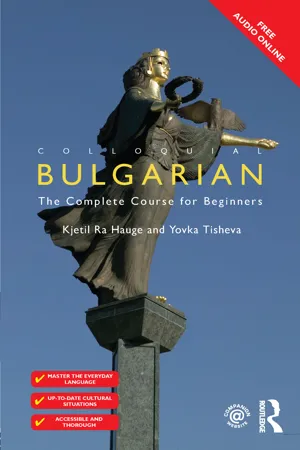
Colloquial Bulgarian
eBook - ePub

Colloquial Bulgarian

  1. 284 pages
  2. English
  3. ePUB (mobile friendly)
  4. Available on iOS & Android
eBook - ePub

Colloquial Bulgarian

About this book

Colloquial Bulgarian: The Complete Course for Beginners has been carefully developed by an experienced teacher to provide a step-by-step course to Bulgarian as it is written and spoken today.

Combining a clear, practical and accessible style with a methodical and thorough treatment of the language, it equips learners with the essential skills needed to communicate confidently and effectively in Bulgarian in a broad range of situations. No prior knowledge of the language is required. Colloquial Bulgarian is exceptional; each unit presents a wealth of grammatical points that are reinforced with a wide range of exercises for regular practice. A full answer key, a grammar summary, bilingual glossaries and English translations of dialogues can be found at the back as well as useful vocabulary lists throughout.

Key features include:

A clear, user-friendly format designed to help learners progressively build up their speaking, listening, reading and writing skills

Jargon-free, succinct and clearly structured explanations of grammar

An extensive range of focused and dynamic supportive exercises

Realistic and entertaining dialogues covering a broad variety of narrative situations

Helpful cultural points explaining the customs and features of life in Bulgaria

An overview of the sounds and alphabet of Bulgarian

Balanced, comprehensive and rewarding, Colloquial Bulgarian is an indispensable resource both for independent learners and students taking courses in Bulgarian.

Audio material to accompany the course is available to download freely in MP3 format from www.routledge.com/cw/colloquials. Recorded by native speakers, the audio material features the dialogues and texts from the book and will help develop your listening and pronunciation skills.

Frequently asked questions

Yes, you can cancel anytime from the Subscription tab in your account settings on the Perlego website. Your subscription will stay active until the end of your current billing period. Learn how to cancel your subscription.
At the moment all of our mobile-responsive ePub books are available to download via the app. Most of our PDFs are also available to download and we're working on making the final remaining ones downloadable now. Learn more here.
Perlego offers two plans: Essential and Complete
  • Essential is ideal for learners and professionals who enjoy exploring a wide range of subjects. Access the Essential Library with 800,000+ trusted titles and best-sellers across business, personal growth, and the humanities. Includes unlimited reading time and Standard Read Aloud voice.
  • Complete: Perfect for advanced learners and researchers needing full, unrestricted access. Unlock 1.4M+ books across hundreds of subjects, including academic and specialized titles. The Complete Plan also includes advanced features like Premium Read Aloud and Research Assistant.
Both plans are available with monthly, semester, or annual billing cycles.
We are an online textbook subscription service, where you can get access to an entire online library for less than the price of a single book per month. With over 1 million books across 1000+ topics, we’ve got you covered! Learn more here.
Look out for the read-aloud symbol on your next book to see if you can listen to it. The read-aloud tool reads text aloud for you, highlighting the text as it is being read. You can pause it, speed it up and slow it down. Learn more here.
Yes! You can use the Perlego app on both iOS or Android devices to read anytime, anywhere — even offline. Perfect for commutes or when you’re on the go.
Please note we cannot support devices running on iOS 13 and Android 7 or earlier. Learn more about using the app.
Yes, you can access Colloquial Bulgarian by Kjetil Ra Hauge,Yovka Tisheva in PDF and/or ePUB format, as well as other popular books in Languages & Linguistics & Languages. We have over one million books available in our catalogue for you to explore.

Information

1 Запознáнство

Getting acquainted

In this unit you will learn how to:
• Greet people
• Apologise
• Say goodbye
• Ask about nationalities and professions
• Use verbs of the а-class

Dialogue 1

Ana meets her good friend Georgi at the café.
Áна
Здравéй, Геóрги. Кáк си?
Геóрги
Благодаря́, добрé съм. Α ти́?
Áна
И áз съм добрé. И́мам мнóго рáбота днéс.
Геóрги
И́маш ли врéме за кафé?
Áна
Съжаля́вам, нó ня́мам врéме.
Геóрги
Бъ́рзаш ли?
Áна
Дá, мнóго. И́мам срéща с Мéри. Tя́ присти́га от Лóндон. Чáо, Геóрги!
Геóрги
Чáо, Áна!
Ana
Hello, Georgi. How are you?
Georgi
Thank you, I’m fine. And you?
Ana
I’m fine too. I have a lot of work today.
Georgi
Do you have time for coffee?
Ana
I’m sorry, but I don’t have time.
Georgi
Are you in a hurry?
Ana
Yes, very much [so]. I have a meeting with Mary. She is arriving from London. Bye, Georgi!
Georgi
Bye, Ana!

Vocabulary

здравéй
hi, hello
благодаря́
thank you
мнóго
much, a lot
днéс
today
бъ́рзам
to hurry
срéща
meeting; date
чáо
bye!
кáк си?
how are you?
добрé
fine, well
рáбота
work
врéме
time
съжаля́вам
to be sorry, regret
присти́гам
to arrive

Language points 1

Present tense, а-verbs

Bulgarian verbs are grouped in three patterns, а-verbs, и-verbs and е-verbs, according to how their present tense is formed. There is no infinitive (for more about this, see Unit 2, pp. 17–18), so the first person singular (the ‘I’ form) is used as the dictionary form. Here is И́мам ‘to have’:
áз И́мам
I have
ти́ И́маш
you (sing.) have
тóй и́ма/ти́ и́ма/тó и́ма
he has/she has/it has
ни́е И́маме
we have
ви́е и́мате
you (pl.) have
тé и́мат
they have
The verbs in Dialogue 1, съжаля́вам ‘to regret’, бъ́рзам ‘to hurry’, и́скам ‘to want’ and присти́гам ‘to arrive’, all follow this pattern:
Áз съжаля́вам.
I am sorry.
Áна бъ́рза.
Ana is in a hurry.
Ни́е и́скаме кафé.
We want coffee.
Тé присти́гат от Лóндон.
They arrive from London.
The plural form of ‘you’ ви́е is also used for addressing strangers and people you want to be polite to. Ana and Georgi, however, are good friends and use the ти́ form. The ви́е form is written with a capital в in letters, but not in literary works or newspapers.
As all the forms have distinct endings, there is not any need to use a personal pronoun with the verb unless you want to put special emphasis on the pronoun:
И́мам врéме за кафé.
I have time for coffee.
И́маме врéме за кафé.
We have time f...

Table of contents

  1. Cover
  2. Halftitle
  3. Title Page
  4. Copyright Page
  5. Table of Contents
  6. Introduction
  7. 1. Запознáнство
  8. 2. В хотéла и вкъ́щи
  9. 3. В ресторáнта
  10. 4. Телефóнен рáзговор
  11. 5. Kни́ги и вéстници
  12. 6. На покýпки
  13. 7. Оти́ваме на пазáр
  14. 8. Пътýване
  15. 9. Семéйство
  16. 10. Здра́ве
  17. 11. На ки́но
  18. 12. И́мен де́н
  19. 13. Вре́мето
  20. 14. Ма́дарският ко́нник
  21. 15. Президе́нт за eди́н дéн
  22. 16. Изгу́беният биле́т
  23. 17. Káк пpекáрах ля́тната вакáнция
  24. Grammar overview
  25. Key to exercises
  26. Bulgarian–English glossary
  27. Index