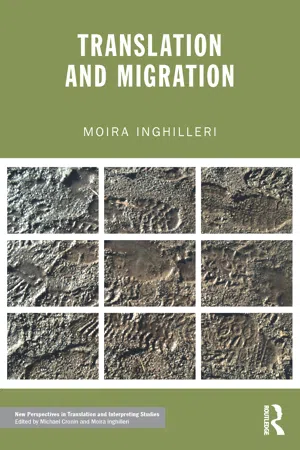
Translation and Migration examines the ways in which the presence or absence of translation in situations of migratory movement has currently and historically shaped social, cultural and economic relations between groups and individuals. Acts of cultural and linguistic translation are discussed through a rich variety of illustrative literary, ethnographic, visual and historical materials, also taking in issues of multiculturalism, assimilation, and hybridity analytically re-framed. This is key reading for students undertaking Translation Studies courses, and will also be of interest to researchers in sociology, cultural studies, anthropology and migration studies.
- 224 pages
- English
- ePUB (mobile friendly)
- Available on iOS & Android
eBook - ePub
Translation and Migration
About this book
Trusted by 375,005 students
Access to over 1.5 million titles for a fair monthly price.
Study more efficiently using our study tools.
Information
1 Migration, mobility, and culture
DOI: 10.4324/9781315399829-1
Migrants, like all human beings, are always simultaneously influencing and being influenced by others, perceiving the world and evolving within it even when they appear to be standing still.1 The immediate effects of migration on individuals are mostly experienced in synchronic moments – events lived at particular points in time as a cluster of culturally, socially, and linguistically managed encounters and entanglements with others. Migration is at the same time an unfolding diachronic process: a singularly marked instantiation of social life involving movement, transformation, and continuous becoming.
In debates over migration and its local or global impact, migrants from the same nations, regions, or continents are often referred to as homogeneous categorical entities, despite vast differences among them. After their arrival, these categories and their associated characteristics often persist. Once migrants establish a more permanent residence, legal or not, designations become more varied and finely tuned – contingent on factors such as who is doing the labeling and in what context. Names themselves can take on particular significance, representing a fixed otherness or morphing opportunely, whether to fit local cultural or phonological norms or create symbolic or strategic links between departure and arrival; or as the following extract about a New York sweatshop in the 1890s shows, to respond to the very specific circumstances of the local:
When Mrs Nelson [the boss’s wife] had worked a few minutes she asked father in very imperfect Yiddish “Well, Mr ---, have you given your daughter an American name?”“Not yet,” father answered. “What would you call her? Her Yiddish name is Rahel.”“Rahel, Rahel,” Mrs Nelson repeated to herself, thoughtfully, winding the thread around a button, “let me see.” The machines were going slowly and the men looked interested.The presser called out from the back of the room“What is there to think about? Rahel is Rachel.”[…]Mrs Nelson turned to me“Don’t let them call you Rachel. Every loafer who sees a Jewish girl shouts ‘Rachel’ after her. And on Cherry Street where you live there are many saloons and many loafers. How would you like Ruth for a name?”I said I should like to be called Ruth.(Dublin 1993: 162)
Though the experience of migration varies significantly between individuals and cultural groups and across history and geographical settings, there is also commonality. Migration can involve the maintenance of strong attachments with a particular culture or social group and/or an opportunity for reinvention – a means to create distance between a new and a prior self. Migrants often suffer social and cultural isolation due to processes of racialization, ethnicization, and/or ethnocentric attitudes from individuals, communities, or entire nations. The form of migration – whether individuals have left their homes voluntarily or under political, social, or economic duress; the socioeconomic status of migrants; whether an individual or family intends to return or not; how first-generation migrants situate themselves in relation to their identity/identities – always leaves an impress on how individuals and subsequent generations adapt to or are received in a new environment. Language has always been an active site where the contours of inclusion and exclusion become most visible. Utterances between co-ethnics can signify warmth or shame or warning, and access to new sources of knowledge in a new land can be found in translation as well as lost.
Much has been made of the fact that, unlike their predecessors, twenty-first-century migrants are able to maintain virtual if not physical contact with their past and present as a result of technological advances. The availability and greater affordability of air travel in the mid to late twentieth century and less expensive forms of telecommunication like smart phones, the internet, and satellite radio and television which link migrants culturally, linguistically, and psychologically to their countries or regions of origin, has transformed the experience of migration significantly. It has become less unidirectional, and communication between migrants and those they leave behind can be more frequent and not limited to letters delivered by surface mail with weeks or months in between. The internet provides webcasts, blogs, and access to information in national newspapers or news programs from countries of origin. For many communities, local radio and television programming, community newspapers, and supplements in local newspapers keep individuals informed about national and global events in their own languages. The significance of these particular media varies with personal profile. Email, instant messaging, webcam sessions, and social media sites allow many foreign overseas workers living thousands of miles away from their parents, children, wives, or husbands to sustain these relationships at a distance over years, and often decades. Music and video circuits and locally produced websites offer younger first and second-generation immigrants a way to cultivate and express their multilingual identities. Transnational media within migrant societies give greater fluidity to territorial and conceptual boundaries, fostering new sensibilities of geographic and temporal locality, intimacy and distance, community and society. Taken together, different media – and the new technologies that make them possible – play a central role in the formation of a particular migrant sensibility, a migratory ‘aesthetic’ created by a departure from one place and arrival in another.
Transnational media open up new ‘routes’ and provide different possibilities for or challenges to the concept of ‘roots’ in the twenty-first century. The effects of this wider range of media on issues historically associated with migration, such as acculturation and advancement within the new environments migrants inhabit and their relationships with the places and people they leave behind, remains a complex matter however. The compression of time and space that characterizes transnational communication is invariably shaped by social identities as well as geographical locations (Baldassar et al 2016).
This chapter presents aspects of the historical, social, philosophical, and geographical conditions that have shaped migration and the different forms of multi- or transcultural societies that result, framed within theoretical considerations that are, in my view, the most pertinent to an understanding of cultural translation in all its many voices. It provides the material and theoretical background for the themes explored in depth in subsequent chapters which bring substantive contexts of translation into view, seen through the diverse forms that migration has taken and continues to take across the globe.
Migration, mobility, and landscape
Migrants transform and are transformed by the communities and societies they become a part of, and translation is central to this process. With the aid of different types of translation, strangers to one another’s cultures and languages glimpse their differences but also their possible overlapping values and prior experiences. These precarious moments of attempted mutual recognition establish the initial conditions for further contact. The movement of people, historically and geographically, has played a vital role in the evolution of both the social and the physical world. This evolution is not only a product of encounters between humans; it also involves humans interacting with the physical environment. Migration necessitates movement through land, sea, and/or air.
Most of the physical evidence of this mobility, the traces that individuals leave behind, is erased over time. Footprints and vehicles only temporarily leave their marks on different surfaces and modern paved roads retain little evidence of the multitudes that traverse them daily (Figures 1.1 and 1.2). It is only when bodies are washed up on a beach, lost at sea, or when remains are discovered in the desert that we are reminded of the relationship between migration and the topographical spaces that are integral to the journey. In these cases, it is almost always humans, not the chosen terrain or the mode of transportation, who are responsible for these deaths.


In his book, Being Alive: Essays on Movement, Knowledge and Description (2011), the anthropologist Tim Ingold makes the important observation that locomotion and cognition are inseparable. He contends that knowledge is formed as humans move across the surface of the earth, not by collecting information from observations they make about this place or that place, but from human action and lived experiences. Wayfaring, he suggests, is the fundamental mode by which living beings inhabit the earth.
Like all other creatures, humans do not exist on the other side of materiality, but swim in the ocean of materials. Once we acknowledge our immersion, what this ocean reveals to us is not the bland homogeneity of different shades of matter, but a flux in which materials of the most diverse kinds, through processes of admixture and distillation, of coagulation and dispersal and of evaporation and precipitation undergo continual generation and transformation.(Ingold 2011: 24)
Though migration is frequently associated, mainly in a negative sense, with words like uprooted, unsettled, disruption, and displacement, all of which represent movement as a break with an immovable foundation, throughout history humans have shown themselves to be disposed to and capable of adaptation and change. Their relationship with landscape has been an intricate part of this process. The significance of the physical environment to migration endures, while the landscape remains alive too.
And as the environment unfolds, so the materials of which it is comprised do not exist – like the objects of the material – but occur. The properties of materials, regarded as constituents of the environment, cannot be regarded as fixed, essential attributes of things, but are rather processual and relational. They are neither objectively determined nor subjectively imagined but practically experienced. To describe the properties of materials is to tell the stories of what happens to them as they flow, mix and mutate.(ibid.: 30)
These ideas about mobility, materials, and their relation to the physical environment correspond with the view of migration and translation offered in this book. All human beings can be said to be ‘migrating’ to some degree. To be human entails moving through life in much the same way that being a fox entails “streaking like a flash of fire through the undergrowth” and being an owl entails “perching in the lower branches of spruce trees” (ibid.: 72). Like all sentient beings and other non-human entities such as stone and wood, human attributes are in a constant state of fluidity. The archaeologist Christopher Tilly has described the properties of “stoniness” as “endlessly variable in relation to light or shade, wetness or dryness, and the position, posture or movement of the observer” (Tilly qtd. in Ingold 2011: 30–31). But stones, like humans, also “have histories, forged in ongoing relations with surroundings that may or may not include human beings and much else besides” (ibid.: 31, my emphasis). The ability of humans to adapt to different environments – from geological and climatic to ecological and social – provides strong evidence of human malleability and connectivity.
In the era of globalization, however, despite an abundance of increasingly accessible technologies of connectivity, mobility has come to mean different things to different people. For a transnational elite it may offer the possibility of a cosmopolitan freedom, but for many migrant workers, refugees, and other persons politically, culturally, and economically displaced by the consequences of global capitalism it can signify isolation, desperation, and restricted opportunity. Indeed, the very notion of transnationalism can “obscur[e] and elid[e] different scales, networks and manifestations of connections, diminishing its clarity as a conceptual tool” (Harney and Baldassar 2007: 190).
Departures
Significant waves of global migration took place in the nineteenth and twentieth centuries. The first, from the mid-nineteenth to the first half of the twentieth century, involved millions of people leaving Europe largely for economic reasons in the direction of the Americas and Australia. In the mid-nineteenth century, Australia, a colonial outpost itself, was also a major recruiter of cheap indentured labor from India, Sri Lanka, China, and the Pacific Islands for its sugar plantations, despite otherwise exclusionary immigration policies regarding non-Whites and strong local resistance to Asian migrants (Rivett 1975). Around the same time, Chinese migrants, driven by the colonial expansion leading up to the Opium Wars and the weakening of Chinese sovereignty, departed in large numbers for Australia and the United States alongside the many others who were seeking their fortune in gold (Clarke 2006). The second wave of migration beginning in the latter half of the twentieth century was triggered by decolonization and the initial recruitment of individuals from prior colonies as laborers to fulfill the needs of the growing European economies. Western Europe also served as a destination during World War II and the Cold War for those escaping Nazi Germany and other autocratic regimes in Africa, Asia, and Latin America.2
A new twenty-first century wave is currently taking place as autocratic regimes in the Middle East long supported by the United States and Europe are being challenged, and in some cases, ousted by their own populations. In Iraq, Afghanistan, and Syria political and economic turmoil caused by invasion and civil war have driven millions to leave their homes to seek refuge in neighboring countries, Europe, and elsewhere. The UN Refugee Agency (UNHCR) has indicated that these and other conflicts have forced more people than at any other time since records began – surpassing World War II – to flee their homes and seek refuge elsewhere.
Departures are rarely the beginning for migrants and refugees. The final moments before their ‘flight’ come after many tough choices made, terrifying escapes, hopeful realizations, dangers encountered, loved-ones anguished over, and stark realities confronted. While migrations forced on people by war or sudden changes in regimes or economies are one kind of urgent pressure toward leaving their homeland, social ideals and a belief in the ability to make a new life can be quite a different impetus, sometimes prepared for by earlier gene...
Table of contents
- Cover Page
- Half-Title Page
- Title Page
- Copyright Page
- Dedication
- Table of Contents
- List of figures
- Acknowledgments
- 1 Migration, mobility, and culture
- 2 The multiple meanings of hospitality
- 3 Translation and labor migrants
- 4 Translating the landscape
- 5 Signs of transnationalism from above and below
- 6 Constructing and contesting young migrant identities
- Index
Frequently asked questions
Yes, you can cancel anytime from the Subscription tab in your account settings on the Perlego website. Your subscription will stay active until the end of your current billing period. Learn how to cancel your subscription
No, books cannot be downloaded as external files, such as PDFs, for use outside of Perlego. However, you can download books within the Perlego app for offline reading on mobile or tablet. Learn how to download books offline
Perlego offers two plans: Essential and Complete
- Essential is ideal for learners and professionals who enjoy exploring a wide range of subjects. Access the Essential Library with 800,000+ trusted titles and best-sellers across business, personal growth, and the humanities. Includes unlimited reading time and Standard Read Aloud voice.
- Complete: Perfect for advanced learners and researchers needing full, unrestricted access. Unlock 1.5M+ books across hundreds of subjects, including academic and specialized titles. The Complete Plan also includes advanced features like Premium Read Aloud and Research Assistant.
We are an online textbook subscription service, where you can get access to an entire online library for less than the price of a single book per month. With over 1.5 million books across 990+ topics, we’ve got you covered! Learn about our mission
Look out for the read-aloud symbol on your next book to see if you can listen to it. The read-aloud tool reads text aloud for you, highlighting the text as it is being read. You can pause it, speed it up and slow it down. Learn more about Read Aloud
Yes! You can use the Perlego app on both iOS and Android devices to read anytime, anywhere — even offline. Perfect for commutes or when you’re on the go.
Please note we cannot support devices running on iOS 13 and Android 7 or earlier. Learn more about using the app
Please note we cannot support devices running on iOS 13 and Android 7 or earlier. Learn more about using the app
Yes, you can access Translation and Migration by Moira Inghilleri in PDF and/or ePUB format, as well as other popular books in Languages & Linguistics & Linguistics. We have over 1.5 million books available in our catalogue for you to explore.